Viska (species)
The Viska (a single member is called a Visk) were sentient beings with wings, who originated from the planet Rordak.
Biological Traits and Physical Description
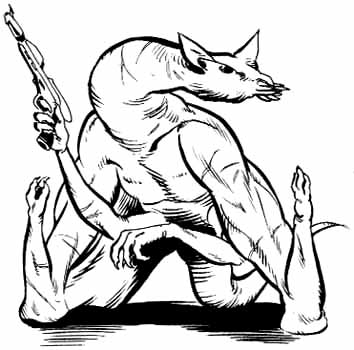
Viska possessed bodies that ranged from two to three meters in length, complemented by leathery wings that extended to a span of five meters. Positioned centrally on their bodies was a pair of arms which were used for manipulating objects. Their heads were long and slender, featuring widely spaced eyes and large ears. The positioning of their eyes allowed them to achieve a full 360-degree field of vision, enabling them to see even what was directly behind them. Furthermore, they had infrared sight, granting them perfect vision in complete darkness.
Most notably, they were equipped with a needle-sharp proboscis measuring forty centimeters in length. This proboscis, known as a blossug, was extended from their circular mouth during feeding. It consisted of multiple layers of robust muscles surrounding a hollow bone that terminated in a sharp, jagged point. The Visk would penetrate the flesh of their prey with this bone, then employ muscles located in their snout and skull to extract the creature's blood.
Their rudimentary digestive system rendered them entirely incapable of consuming meats or plants. Their nutritional needs required them to ingest two liters of blood each day. The most nutritious blood for a Visk came from creatures native to their homeworld, particularly grazing herd animals. They typically avoided feeding on alien creatures or sentients, as blood from off-world sources often caused them physical harm. While Viska did not prey on each other, they could utilize their blossug as a weapon during physical altercations.
Due to the high energy demands of their daily activities, Viska were required to rest for a minimum of eight hours each day.
Social Structure and Cultural Norms
A caleisk, a monarch chosen upon the death of their predecessor, governed their world. The children of the caleisk would engage in a battle to the death, with the last one standing inheriting the throne. The new ruler would then select between three and six clans to oversee all of the repulsorlift-supported cities across the planet. These designated clans were known as the lurinn, while the clans without power were called calsedra.
Each clan was under the leadership of a calsk. Upon the death of the calsk, their children would engage in a similar deadly competition for power, mirroring the succession of the caleisk. Power would only transfer to a different family if a calsk died without offspring. In such cases, each family would nominate a leader, who would then compete against the other nominees for the position of calsk.
Each lurinn clan held absolute authority over specific calsedra clans, and each calsk likewise exerted total control over every Visk within their clan. The tasks and occupations of individual Viska were predetermined, leaving them with no personal choice. While they often excelled in their assigned roles, Viska society was strongly meritocratic, encouraging them to strive for upward mobility through success. Viska were perpetually driven to accumulate more wealth, influence, and comfort, as well as to elevate their personal status and the standing of their clan. To deter clandestine attempts to disrupt the Viska power structure, such as assassination (as opposed to the open battles that determined their leaders), individuals found guilty of such plots would face execution if the victim was a member of their own family. If the victim belonged to another family, the entire family of the guilty party would be put to death.
The Viska resided in expansive repulsorlift cities. This was necessitated by the unstable nature of Rordak's surface, which was prone to groundquakes and volcanic activity. Even before the arrival of Republic scouts with repulsorlift technology, the Viska had developed a society that avoided ground-level habitation. The introduction of this technology enabled the Viska to establish a completely aerial society. These cities were massive structures, designed to be entirely open to the air to accommodate the Viska's large wingspans. Their buildings were anchored to colossal repulsor columns, measuring over 500 meters in length and 100 meters in diameter. The cities' levels often extended thousands of meters into the sky. The upper levels of these cities were reserved for the ruling families of the clans, while the lower levels housed the workers and less influential clans. The middle levels were dedicated to manufacturing, trade, and spaceports.
Due to their dependence on large quantities of blood, the Viska maintained vast herds of grazing animals, such as the kessarch and the drivveb. They imported significant amounts of grain and grasses to sustain these herds.
It was uncommon for a Visk to venture beyond Rordak. Those who did were relentlessly pursued by elite Viska warriors and bounty hunters dispatched by their clan.
Their blood-based diet and their notorious disregard for the sanctity of life led off-worlders to commonly refer to them as "the great bloodsucking fiends of Rordak." However, this was inaccurate, as they seldom preyed on other sentient beings. Nevertheless, they were highly intimidating to off-worlders, a characteristic that the Viska took great pride in.
Historical Context
The Viska had independently achieved an atomic level of technological advancement before encountering other sentient species. Upon the arrival of Republic scouts, the Viska enthusiastically embraced space-level technology. The "bloodsucking fiends" quickly gained notoriety throughout their home sector.
By the time of the Galactic Empire's rise, the Viska had been integrated into galactic society for over three centuries. Following the Empire's establishment, the Imperials promptly designated the planet as a penal colony.
Additional Information
In The New Jedi Order: Dark Tide II: Ruin, the term Viska is mistakenly used to refer to a single member of the species.