Multispectrum disguise suite
Multispectrum disguise suites, also referred to as holographic disguise matrixes, holomasks, shadow holograms, holoshrouds, holographic image disguisers, holoflage, camouflage suits, and Photo-Optic Replicators, represented a form of holoprojector technology engineered to conceal people, buildings, and items. These devices could be integrated into portable units, droids, and structures.
Description
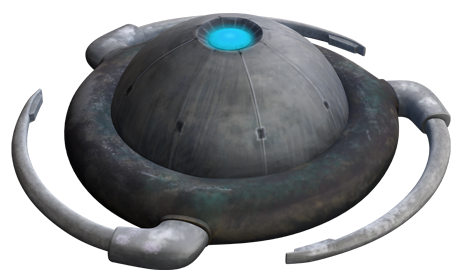
Across the galaxy, multispectrum disguise suites, which were essentially a collection of high-resolution holoprojectors, found application among governments, criminal syndicates, private enterprises, and individuals for reasons encompassing security, privacy, and covert operations. More sophisticated iterations featured speech scramblers, scanners, and bio-signature generators, further enhancing the effectiveness of the disguise.
By the time of the Galactic Civil War, numerous variants of the disguise suite were being manufactured, exhibiting a broad spectrum of capabilities. Basic models were limited by a small memory capacity, restricting them to storing only one image, and their power reserves were depleted after a mere two minutes unless connected to a larger power source. Portable versions were designed for handheld use, attachment to a belt, or projecting a mask over the user's face (known as a holomask). Camouflage suits, worn by individuals, analyzed the surrounding visual spectrum, with the holoprojector then displaying these readings onto the wearer. This process effectively made the user blend into their environment, creating an illusion of invisibility. However, rapid movement by the user would cause the projected image to blur and distort.
Other disguise systems were embedded within building facades to conceal entrances, projecting a predominantly pre-rendered image over the intended area. While pricier models generated incredibly realistic, high-definition images, certain models exhibited a subtle "flicker." This flicker, imperceptible to the naked eye, could be detected by specific droids, cameras, and other sensory devices, indicating that something was not quite right. A holoflage served as a hologram to obscure a doorway or other surface. A typical model, such as the Corellidyne CQ-3.9x holographic image disguiser, was compact enough to be worn on a belt, but its limited memory meant it could only store one image, and its power would run out in just two minutes unless connected to an external power source. The CQ-3.99 holographic image disguiser was another model available.
History
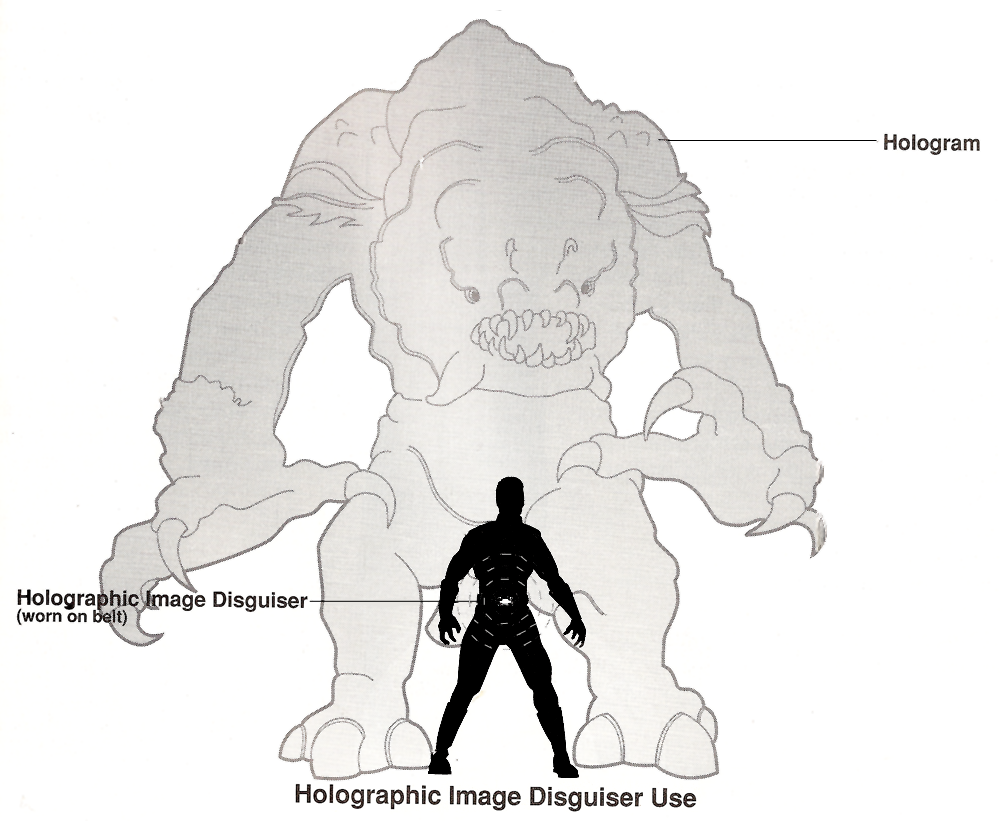
The bounty hunter named Sinrich is credited with developing this technology.
During the Clone Wars, a group of bounty hunters embarked on a mission to abduct Supreme Chancellor Palpatine on Naboo. Twazzi, Embo, Derrown, and Cad Bane utilized four of these devices to disguise themselves as three Senate Guards and a Neimoidian, respectively.
Cybot Galactica integrated a CQ-3.80 disguise suite into the TC-SC infiltration droids, which, in conjunction with the droid's comprehensive databases on culture and behavior, created a remarkably convincing disguise.
A bounty hunter named Daxtorn Lethos employed a holographic belt to generate disguises for himself.