Tulvaree
The Tulvarees were a species of semi-sentient avian hunter race originating from the planet called Pochi. Each wing ended in three extremely sharp talons, and their diminutive mouths contained rows of pointed teeth. Various Tulvaree tribes existed, constantly at war with one another. When the Human pirate known as Faarl the Conqueror seized control of their homeworld, the Tulvarees rapidly adapted to taking orders from the warlord. Faarl, seeing them as a potential source of soldiers, ensured a steady food supply for the Tulvarees in exchange for their loyalty.
Biology and appearance
These semi-sentient avian Tulvarees typically stood between 1.5 and 1.8 meters tall. Every member of this species possessed a small, somewhat flat body, a whip-like tail, and four slender, elongated limbs. The arms and legs both terminated in digits equipped with very sharp talons. Their hands had three fingers each, while their feet had four toes, with three facing forward and one pointing backward. A thin membrane of skin extended from the knee joints along the body's sides and the outer edges of each arm. A network of bony supports radiated from each elbow, creating a membranous wing structure that allowed the Tulvarees to take flight. Despite this, they could also move on the ground, though at a slower pace than in the air. The Tulvaree head featured a rounded skull and a short muzzle filled with sharp fangs. Their lower jaw was flat and tapered to a point. Tulvarees reproduced by eggs.
Society and culture
Tulvarees inhabited the mountainous areas of their homeworld, Pochi, where they would hunt grazing herbivores in coordinated groups. They were organized into large groups, each composed of members of a single extended family, also known as a tribe. These tribes lived together in caverns and other naturally formed shelters. They deposited their eggs in designated hatching caves, where the eggs were incubated until the young emerged.
Warfare was a communal activity. Tribes regarded all other Tulvaree groups as rivals, and enemies to be attacked whenever encountered. Because of the species' inherent talons and fangs, Tulvaree conflicts were often deadly. The only time Tulvarees from different tribes would set aside their hostility was when faced with a shared threat.
This species was only considered semi-sentient, lacking any clear signs of art, construction, music, or tools of their own design. Nevertheless, the Tulvarees were capable of learning foreign languages and obeying commands from a superior. Following the arrival of offworlders on Pochi, the Tulvarees quickly learned to utilize the weapons and tools introduced to them. With these external resources, the Tulvarees achieved a feudal level of technology during the Galactic Civil War.
History
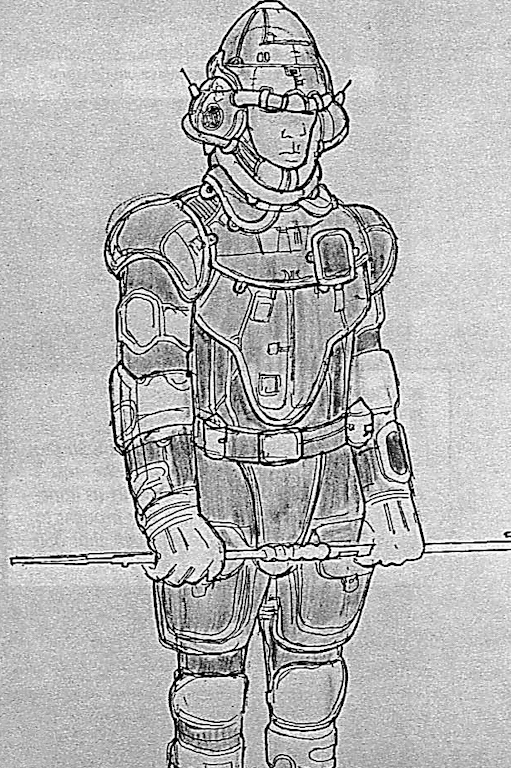
The Tulvarees evolved on Pochi, a dry world characterized by scrub-covered plains interspersed with sparse clusters of stunted trees and small mountain ranges. The species developed a tribal structure defined by near-constant warfare between tribes.
Eventually, explorers from distant lands mapped Pochi, incorporating it into the Parthovian Cluster within Wild Space. During the Galactic Civil War, a young Human calling himself Faarl the Conqueror arrived on the planet, which at the time was still beyond the reach of the Galactic Empire. Faarl was accompanied by a group of pirates assisting their captain in systematically conquering worlds in Wild Space to establish his personal domain.
From these newcomers, the Tulvarees acquired the ability to use tools and weapons in combat. The offworlders provided the avians with ample food, medicines, and other items from distant worlds. The Tulvarees also learned to comprehend the strangers' language and follow Faarl's instructions. They were eager to assist him as long as he continued to satisfy their hunger.
Initially, Faarl attempted to unite members of rival Tulvaree tribes into unified armies, but the avians proved unable to overcome their long-standing animosities. Subsequently, Faarl only formed regiments comprised of members from a single tribe. The Tulvarees became Faarl's primary fighting force, carrying out his orders as mercenaries in exchange for food and goods from other worlds.
Meanwhile, Faarl chose Pochi as his headquarters, establishing himself in an abandoned tower which he renamed Fortress Baarlos. There, he ordered the construction of large camps for military training, as well as camps to house slave laborers. The warlord also founded the city of Vindru, which included a spaceport. Consequently, Pochi experienced an influx of offworlders, both traders and slaves, all drawn to the planet by Faarl. He named the star system after himself: the Faarlsun system.
This new power dynamic on Pochi persisted throughout the Galactic Civil War and into the rise of the New Republic, when General Airen Cracken placed a bounty of 50,000 credits on Faarl's head. The Tulvarees' service to Faarl ended when the Human bounty hunter Boba Fett stormed Fortress Baarlos, defeated the Tulvaree guards, and captured Faarl to claim the New Republic bounty.
Behind the scenes
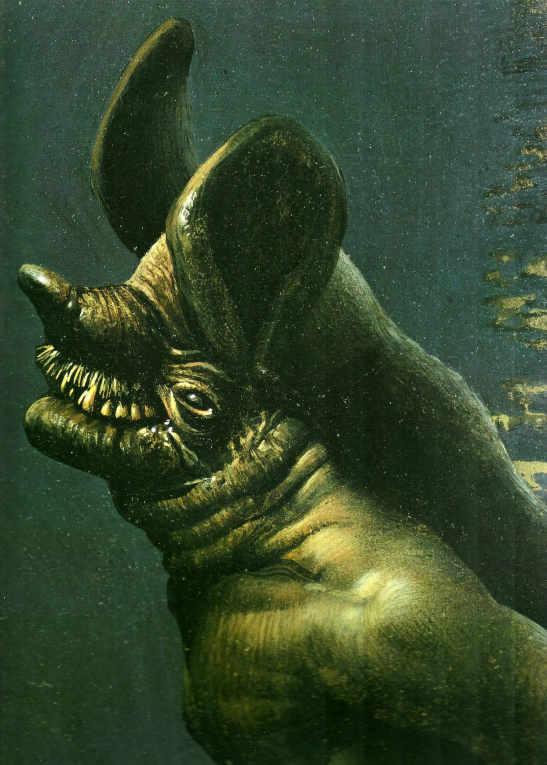
The Tulvarees are detailed in Wanted by Cracken, a sourcebook by Louis J. Prosperi for Star Wars: The Roleplaying Game, published by West End Games in 1993. The book provides statistics for playing a Tulvaree character, depicting them as significantly weaker than most species, as they start with a smaller pool of points to allocate to attributes. Prosperi portrays the Tulvarees as agile compared to Humans, but slightly inferior in perception, and significantly lacking in intelligence and mechanical aptitude. The species receives bonuses for combat using their talons and teeth. The image illustrating the Tulvarees in Wanted by Cracken is a concept sketch by Ralph McQuarrie for the mynocks from Star Wars: Episode V The Empire Strikes Back. A modified version of this sketch appears in both the second and third editions of A Guide to the Star Wars Universe as an illustration for the mynocks. The Complete Star Wars Encyclopedia, published in 2008, mentions the Tulvarees, but does not capitalize their name.
A mirrored version of the same concept art used for the Tulvarees is featured in Monsters and Aliens from George Lucas, an art book of aliens with accompanying poems, jokes, and short stories by Bob Carrau, also published in 1993. The book does not name the species. The Tulvaree image accompanies a poem about a member of the species stalking, killing, and devouring a victim before seeking another. Lucasfilm employee Leland Chee, who manages the Holocron continuity database, has stated that the information in this book is non-canonical.
In Monsters and Aliens from George Lucas, the species is depicted as nocturnal and capable of surviving the vacuum of space. Each Tulvaree hunter planned their attacks in advance, selecting prey isolated from the group and striking unexpectedly, accompanied by taunts to maximize fear. The Tulvaree would then fly away with the prey, sometimes impaling it on an asteroid. According to an original painting in Monsters and Aliens from George Lucas, at least some Tulvarees had large, upright ears, a prominent snout, small eyes on the sides of their heads, and short fur.
Sources
- The Art of Star Wars Episode V: The Empire Strikes Back (Picture only)
- Wanted by Cracken (First mentioned)
- Star Wars: Behind the Magic (Picture only)
- " The History of the Mandalorians " — Star Wars Insider 80
- The Complete Star Wars Encyclopedia
- Back from the Drawing Board: Recycled Star Wars Aliens on StarWars.com (backup link) (original link is obsolete)
Non-canon sources
- Monsters and Aliens from George Lucas