Shock collar
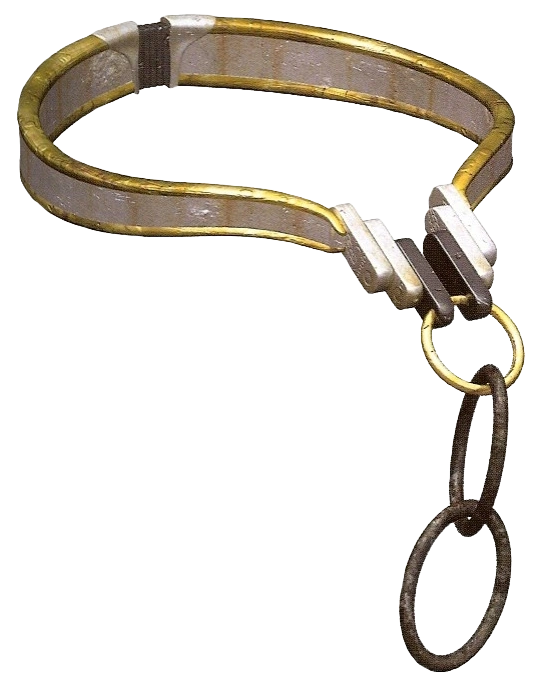 A typical slaving collar.
The purpose of a slaving collar was to control prisoners and those subjected to slavery. These collars typically involved a rigid band around the neck, often connected to chains or cables. Some included shock-inducing components to discipline disobedient captives, then being known as a shock collar. Certain variations were designed to explode if removal was attempted incorrectly, or could be detonated remotely if the slave tried to escape.
A typical slaving collar.
The purpose of a slaving collar was to control prisoners and those subjected to slavery. These collars typically involved a rigid band around the neck, often connected to chains or cables. Some included shock-inducing components to discipline disobedient captives, then being known as a shock collar. Certain variations were designed to explode if removal was attempted incorrectly, or could be detonated remotely if the slave tried to escape.


Description
Generally, slaving collars were made up of adjustable restraints that were secured around the neck, arms, or legs. Chains or conductive cables were used to link multiple collars. Durasteel, often reinforced, was the primary construction material for most slaving collars, and some models had integrated shock panels capable of delivering electrical shocks to the wearer. A shock controller could activate the collars remotely.
Because most star systems outlawed slaving collars, they could not be obtained through legal channels. They were either available on the black market or manufactured in clandestine workshops.
History

During the period of the Cold War, the Sith Empire employed shock collars as a means of controlling prisoners and slaves who were prone to defiance, including Vette. Shock collars were also used on prisoners in some Republic prisons, like the one on Belsavis.
During the time of the Clone Wars, the Secret Service of the New Mandalorian faction used this collar to torture prisoners.
The Zygerrians made use of them to maintain control over their slaves.
During the Galactic Civil War, Trandoshan slavers commonly forced captured Wookiees into chain gangs, with a slaving collar placed around their necks. The task of placing these collars on the Wookiees' necks was usually assigned to the lowest-ranking member of the slaver patrol, a task fraught with danger.
In the year 4 ABY, Princess Leia Organa suffered the indignity of wearing a slave collar while held captive by Jabba the Hutt. Jaina Solo, Leia's daughter, was also compelled to wear one briefly during the Yuuzhan Vong War.