Eclipse-class dreadnought
The Eclipse-class dreadnought, alternatively known as the Eclipse-class Super Star Destroyer, represented a class of Imperial Super Star Destroyer that Kuat Drive Yards produced, seeing primary deployment around six years following the Battle of Endor. Similar to the Sovereign-class, they were considered the next generation of Super Star Destroyer.
Characteristics
Size
These colossal Eclipse-class ships stretched 17.5 kilometers in length, making them one of the largest vessels ever created. While the Executor-class Star Dreadnought exceeded this length by 1.5 kilometers, the Eclipse-class possessed a significantly greater mass compared to any other Super Star Destroyer.
Offensive and defensive systems
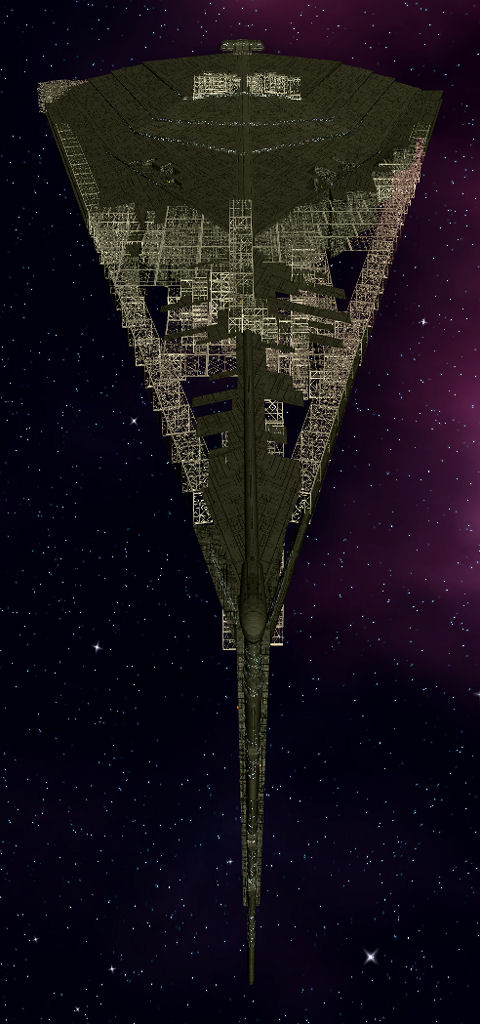
The most formidable weapon on board Eclipse-class ships was an axial superlaser, sharing similarities with, but being notably weaker than, one of the individual beams utilized in the Death Star's superlaser.
An Eclipse's superlaser could effortlessly obliterate other Super Star Destroyers, a fact the Annihilator discovered when Tyber Zann commandeered the Eclipse's immense power above Kuat.
These axial superlasers had the capability to breach any planetary shield, fracture a planet's crust, and incinerate entire continental landmasses. However, the massive superlaser was more frequently employed to eliminate enemy capital ships and space stations during combat. According to Admiral Conan Antonio Motti in the Imperial Handbook: A Commander's Guide, the superlaser was designed to penetrate planetary shields and vaporize cities with a single shot.
The class benefitted from the most advanced weaponry enhancements of recent decades. This included gravity well projectors and improved ion cannons, the former being identical to those found on the Interdictor-class Star Destroyers. Furthermore, these colossal ships were equipped with hundreds of heavy laser and turbolaser batteries.
Beyond its sheer firepower, the Eclipse-class possessed hull armor and shields of such resilience that it could confidently ram enemy vessels.
Propulsion systems
Unlike the Death Star, the Eclipse-class boasted enhanced mobility, featuring both an upgraded hyperdrive and rapid sublight engines.
Complement
Each Eclipse-class ship carried 600 TIE/IN interceptors and 96 TIE Bombers, organized into 58 squadrons. For ground operations, they transported 150,000 Imperial troops, 100 AT-ATs, and five prefabricated bases. The hangars were situated on the ship's flanks, with the forward and rear launch bays positioned closely together beneath this area, towards the vessel's center.
Each ship of this class required a crew of over 700,000 personnel, and the Eclipse II also included a complement of Shadow Droid starfighters. Troop accommodations were located in the lower front section of the ship, ahead of the hangar bays.
Bridge tower
The bridge tower housed the primary communications and sensor arrays, located on the left and right sides, respectively. In addition to the main command center for the ship on the lower part of the tower, it also contained the deflector shield control center on the upper level. The bridge tower was positioned closer to the hull compared to standard Star Destroyers of the Imperial-I and Imperial-II classes.
Variances
Notable differences existed between the two known ships of this class, the Eclipse I and the Eclipse II: The Eclipse I had six engines at the rear, while the Eclipse II had eight. Furthermore, the Eclipse I's engines were spaced apart and positioned on the sides, whereas the Eclipse II's engines were grouped together, resembling the configuration of other Star Destroyers. Finally, the Eclipse II featured a command bridge tower directly above the superlaser weapon, a feature absent on the Eclipse I.
History
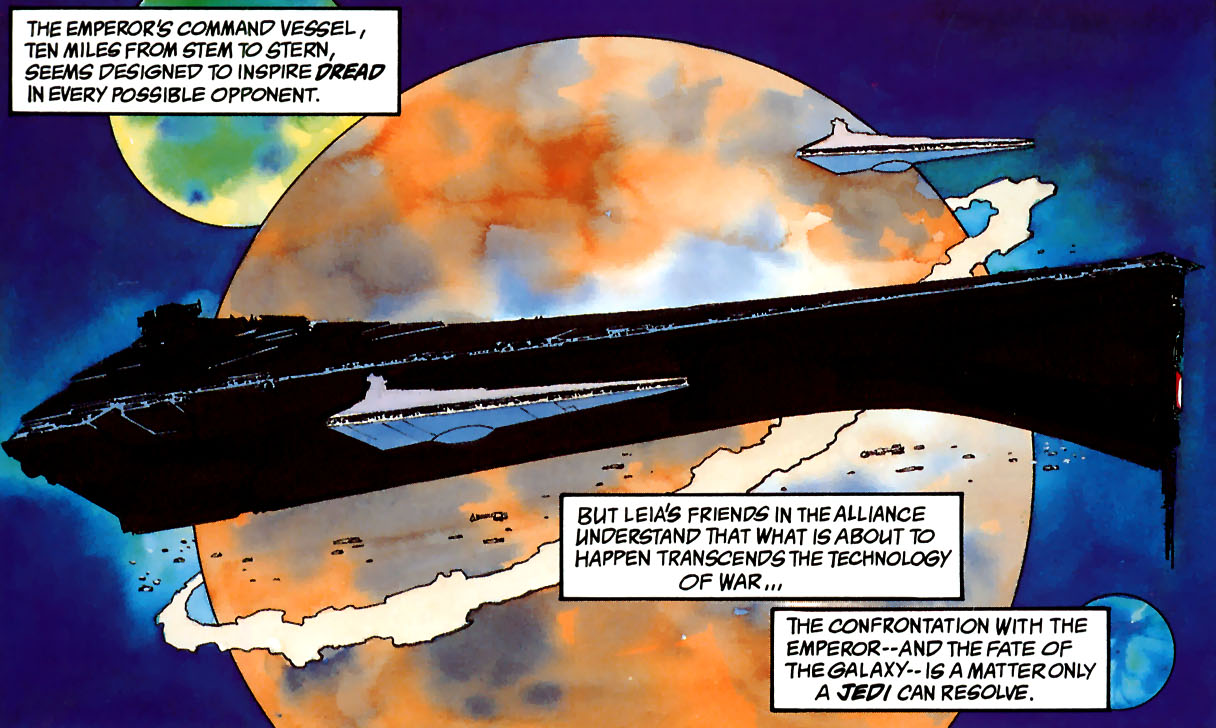
During the construction of the lead ship, the Eclipse, the Empire also built an Eclipse-class prototype for weapons testing. This prototype was later modified into the battle station Tarkin. The Tarkin was eventually destroyed by a Rebel sabotage team in 3 ABY.
Construction of the Eclipse and its sister ship, the Eclipse II, began early in the Galactic Civil War, around 0 ABY. This ship class, along with the similar Sovereign-class Star Dreadnoughts, was intended to revolutionize naval combat and ensure the dominance of the Imperial Navy for the next century. Details of the planned design were included in the Imperial Handbook, an official reference guide for Imperial commanders. The Eclipse was constructed above Kuat, while the Eclipse II was built over Byss. The design of both ships' hulls drew inspiration from ancient nautical warships.
By 4 ABY, both the Eclipse and the Eclipse II had their superlaser main weapons installed and operational. However, their completion was significantly delayed due to Palpatine's demise and the ensuing power vacuum. The nascent New Republic remained unaware of the Eclipse-class' construction. Although the New Republic Intelligence Service obtained a copy of the Imperial Handbook shortly after the Battle of Endor, this was their only information on the class, and General Carlist Rieekan believed that the Empire had made no progress on the design. Furthermore, the crime lord Tyber Zann sought access to records of the ship, and if possible, to steal it. Consequently, he attacked Kuat, seized control of the ship, and used it to inflict damage on both Imperial and Rebel fleets, manipulating the latter into granting him access. Afterward, Zann abandoned the vessel, deeming its size too unwieldy for maintaining a low profile, even compared to the Rebel Alliance, leaving it adrift until the New Republic attacked and destroyed the Eclipse.
Subsequently, the ship was completed and became the flagship of the resurrected Emperor Palpatine, with its sister ship, the Eclipse II, assuming the same role after the original's destruction.
Stretching approximately 17.5 kilometers, these jet-black battleships ranked among the largest Super Star Destroyers ever built and were among the most heavily armed warships ever conceived. In terms of scale, they succeeded dreadnoughts like the Eye of Palpatine and the Kuati Star Dreadnoughts that predated the New Republic era.
The construction of the Eclipse took nearly as long as either of the Empire's Death Star battlemoons, and for much of its service, it functioned as an orbital battlestation at Byss. At a later point, the Eclipse emerged from hyperspace, its black hull initially leading some New Republic forces to mistake it for a ghost ship. However, they quickly realized its true nature when it opened fire, leaving only the information officer, Nara Dun, alive to inform New Republic forces about the devastating surprise attack.
It was destroyed along with the reborn Emperor in 10 ABY during an Imperial assault on Pinnacle Moon in the Da Soocha system. Luke Skywalker and his sister, Princess Leia Organa Solo, managed to disrupt the Emperor's control of a titanic Force storm, a massive surge of dark side energy summoned by the Emperor to annihilate the assembled New Republic fleet.
Following this disaster, the Eclipse II replaced the original. It exhibited slight differences from its predecessor, notably in its thruster configuration. Above the planet Onderon, Lando Calrissian and Wedge Antilles led a small boarding party against the powerful battleship, and R2-D2 successfully overrode the Eclipse II's computer systems. The astromech droid then sent the Eclipse II hurtling through hyperspace on a collision course with the superweapon Galaxy Gun. The Eclipse II collided with the Galaxy Gun, destroying both. A final projectile was pulled by Byss' gravity and struck the planet, the resulting explosion annihilating Byss and the clones of Emperor Palpatine.
Behind the scenes
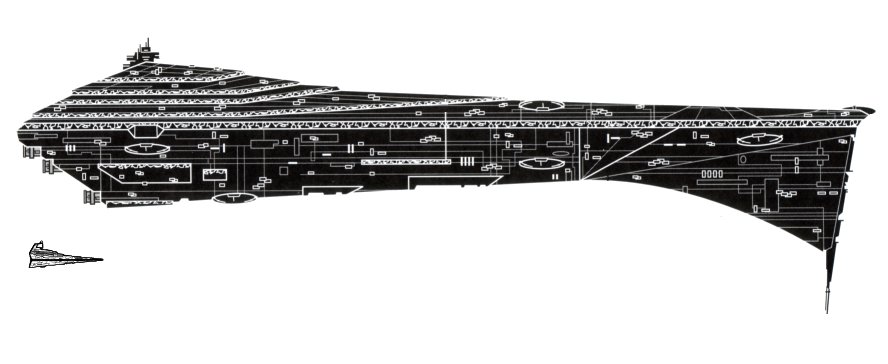
The Dark Empire Sourcebook specifies the Eclipse's length as 17.5 kilometers, contradicting the description in Star Wars: Dark Empire, which states the ship measures "ten miles from stem to stern," or 16 kilometers. The author of the Dark Empire Sourcebook has reportedly suggested that an additional 1.5 kilometers were added to the first ship of this class, indicating the ship's unique customization, with the standard design being only 16 kilometers. Alternatively, "ten miles from stem to stern" might be a vague, rhetorical expression, or the discrepancy could stem from the extended and irregular construction period, or it may represent a difference between the Eclipse and Eclipse II. Adding to the confusion, the Eclipse entry in The Complete Star Wars Encyclopedia lists a length of 17.5 kilometers, while the Star Destroyer entry lists 16 kilometers, potentially a typo given that the Star Destroyer is 1,600 meters long.
Regardless of the exact size, considering the initial statements regarding the size of Executor-class Star Dreadnoughts, it's evident that the Eclipse was intended to be significantly larger. Later statements about the size of Executor ships indicate that the Eclipse is actually shorter, though still likely more massive and destructive.
There is also an apparent contradiction concerning the Eclipse's construction timeline. According to the Dark Empire Sourcebook, design work on the Eclipse commenced after the Battle of Hoth, while Byss and the Deep Core asserts that it was under construction for as long as either Death Star, suggesting a timeframe of decades (although at the time of writing Byss and the Deep Core, the Death Star construction timeline was believed to be much shorter, on the order of years).
Byss and the Deep Core further implies that the Eclipse was stationed in orbit at Byss before the Battle of Endor, as this is the only timeframe in which it could have served as a rendezvous point for meetings of the Grand Admirals as claimed in the text (though the Grand Admirals mentioned may be a new group that postdates the original 12). However, The Essential Chronology states that it was built at Kuat and only moved to Byss four and a half years after the Battle of Endor, when it was stolen in a partially completed state by Lira Wessex and her design team shortly before the shipyards surrendered to the New Republic.
These perceived discrepancies can be explained in several ways. It's possible that, as with the Executor and its sister ship Lusankya (also originally named Executor), the Eclipse and Eclipse II were built concurrently in separate shipyards, with each project kept secret from the personnel working on the other. The potential timeline discrepancies may be attributed to in-universe errors, with the fictional authors serving as proxies for the real-world writers being unaware of the true construction duration.
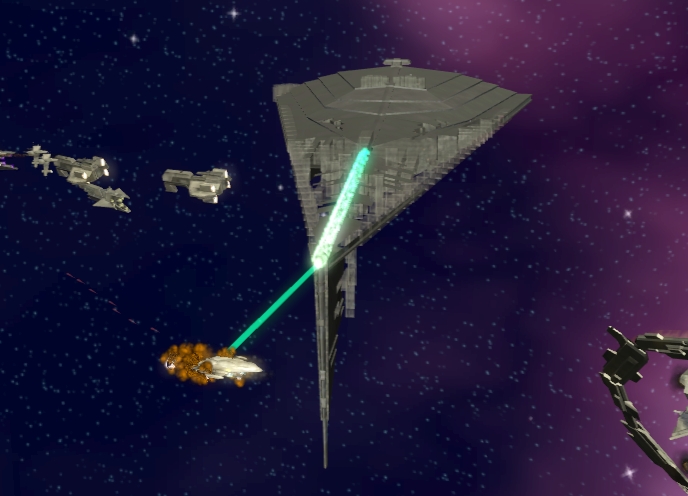
Some fans consider the stated power of the Eclipse's superlaser to be paradoxical. It's described as not powerful enough to destroy a planet, yet capable of breaching planetary shields and possessing 2/3rds the power of the Death Star's primary weapon. However, some fan calculations suggest that such a weapon would be more than sufficient to destroy a planet, and some believe that planetary shields are harder to destroy than planets. Those seeking to reconcile these beliefs with canon suggest that the "2/3rds" figure refers to the magnitude of the energy release rather than the total value, placing the main weapon below the threshold required to destroy a planet.
Another possibility is that the Eclipse-class' superlaser had 2/3rds the power of one of the Death Star superlaser's component beams, considering that the Death Star's superlaser consisted of eight individual beams that combined into a single larger beam after firing. Alternatively, the fan calculations may be flawed, as the exact destructive mechanism of a hypermatter-fueled superlaser is not fully understood beyond it being a direct energy transfer weapon. The New Essential Guide to Vehicles and Vessels mentions it as being designed to penetrate a planet's crust, which is significantly less than what either Death Star was capable of, namely pulverizing an entire planet.
Another suggestion is that the Eclipse could potentially destroy a planet, but not if the shot's power is diminished by passing through a planetary shield.