Emperor's throne room
Behold, the Emperor's grand throne room, a sight to behold on Coruscant. The throne rooms of the Emperor served as the secluded command hubs for the Emperor of both the Galactic Empire and the Fel Empire. Palpatine, the Emperor himself, maintained a throne room within the Imperial Palace, aboard the formidable Death Stars, on the serene Naboo, the enigmatic Byss, the remote Wayland, and essentially any location he was anticipated to grace with his presence. His most cherished and frequently used throne room resided on Coruscant, positioned a single meter above the neighboring chambers, affording him a panoramic vista of the entire planet. These Imperial command centers typically featured an expansive, circular viewport window directly in front of the throne, granting a view of the surrounding area, often framed by an intricate web-like pattern. A permanent company of the Emperor's Royal Guards was always stationed at each throne room.


A Variety of Throne Rooms
Imperial Palace
Within the Imperial Palace on Coruscant, the Emperor possessed not one, but two throne rooms. One was crafted for public engagements, resembling a vast, sunken auditorium, akin to a colossal crater carved into the bedrock. The auditorium featured flat stone benches arranged in sweeping arcs, providing seating for visitors who came to hear the Emperor's decrees. The Emperor's pronouncements were audible to all in attendance, and conversely, he could hear anything spoken to him from the audience decks. Crowning the throne room was an angled, prismatic skylight, which cast beams of light upon the Emperor as he sat upon his throne. At the base, encircling the tower of the throne, stood six vigilant Emperor's Royal Guards, ever at attention. The second throne room served as Palpatine's private sanctuary, nestled within the palace's highest tower. This was his preferred and most significant throne room. It was slightly elevated on a platform with a small staircase above the floor. The circular window in front of the throne, lined with the usual web-like framework, gave the Emperor a view of all of Coruscant. When staying in this primary chamber, Palpatine was usually flanked by at least two to four Royal Guards. It was here where Palpatine promoted his most trusted military commander, Thrawn, to Grand Admiral.
Emperor Palpatine Surgical Reconstruction Center
The initial throne room of Palpatine was situated on an upper level of the EmPal SuRecon, purposefully designed to mirror the Chancellor's holding office. A broad yet short, polished staircase divided the room into two tiers, with the upper tier adorned with lengthy permaplas windows. A pair of the Emperor's Royal Guards were positioned at attention at the staircase's base. Behind the Guard stations was a table for Palpatine to meet with his Imperial Advisors, and behind that table stood his large mechanized throne, integrated with the building's communications and computer systems.
Palpatine relocated the majority of his artwork and statuary (including the Massassi frieze) from his office in the Republic Executive Building to this new throne room. Palpatine also maintained a smaller, private throne room at the center, adjacent to the operating room.
Death Star I
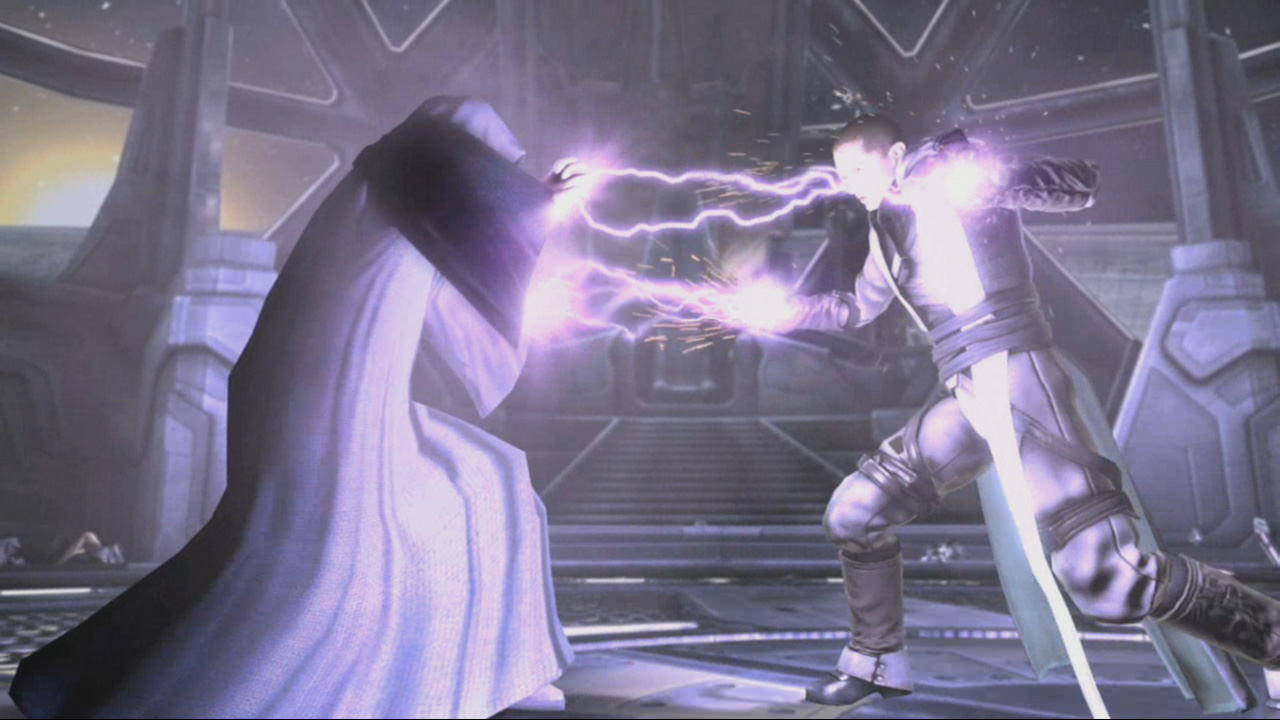
The Emperor's throne room, aboard the first Death Star, was strategically located within an observation dome atop a tower, positioned directly adjacent to the station's formidable superlaser. This platform served as Palpatine's vantage point for observing the laser's firing demonstrations. Access to the Emperor's chamber was granted through a massive circular doorway, secured by a rotating metal beam. Within the main chamber, the Emperor's throne was elevated slightly above the floor by a short staircase and flanked by his Royal Guards and Imperial Senate Guards. The room was equipped with numerous control consoles and adorned with imposing statues crafted from black stone.
Palpatine established this chamber during the initial phases of the first Death Star's construction, ensuring his ability to closely monitor the workers and expedite its completion. During the Battle on Death Star I, Galen Marek journeyed to the Death Star to liberate the leaders of the nascent Rebel Alliance, including Rahm Kota, Bail Organa, Garm Bel Iblis, and Mon Mothma. Palpatine had brought the Alliance leaders here in order to execute them personally; he would interrogate and torture them to the point of death, retaliating for their "betrayal" and learning the names of their allies. He also intended to show their painful deaths to the rest of the galaxy as demonstration and to crush the resolve of further dissent.
After fighting his way through the station, defeating one of the Emperor's Shadow Guard and his group of Royal Guards protecting the doorway, and severely injuring Darth Vader in a duel in the tower's carbon-freezing chamber, Galen Marek made it into the chamber and fought Darth Sidious. Sidious and Marek battled with their lightsabers and the Force. Marek won the battle, rescuing the Senators. Just as Juno Eclipse arrived in the Rogue Shadow, Palpatine sprung back to life and attacked Kota with Force lightning. Galen deflected the blast and allowed the rebels to escape by releasing his spirit to the Force. The resulting explosion all but destroyed the tower, leaving Vader and Palpatine as the only ones left standing.
Following the skirmish, Palpatine abandoned the throne room, leaving the responsibility of monitoring the Death Star solely to Darth Vader. The Emperor never visited the station again before its destruction.
Death Star II
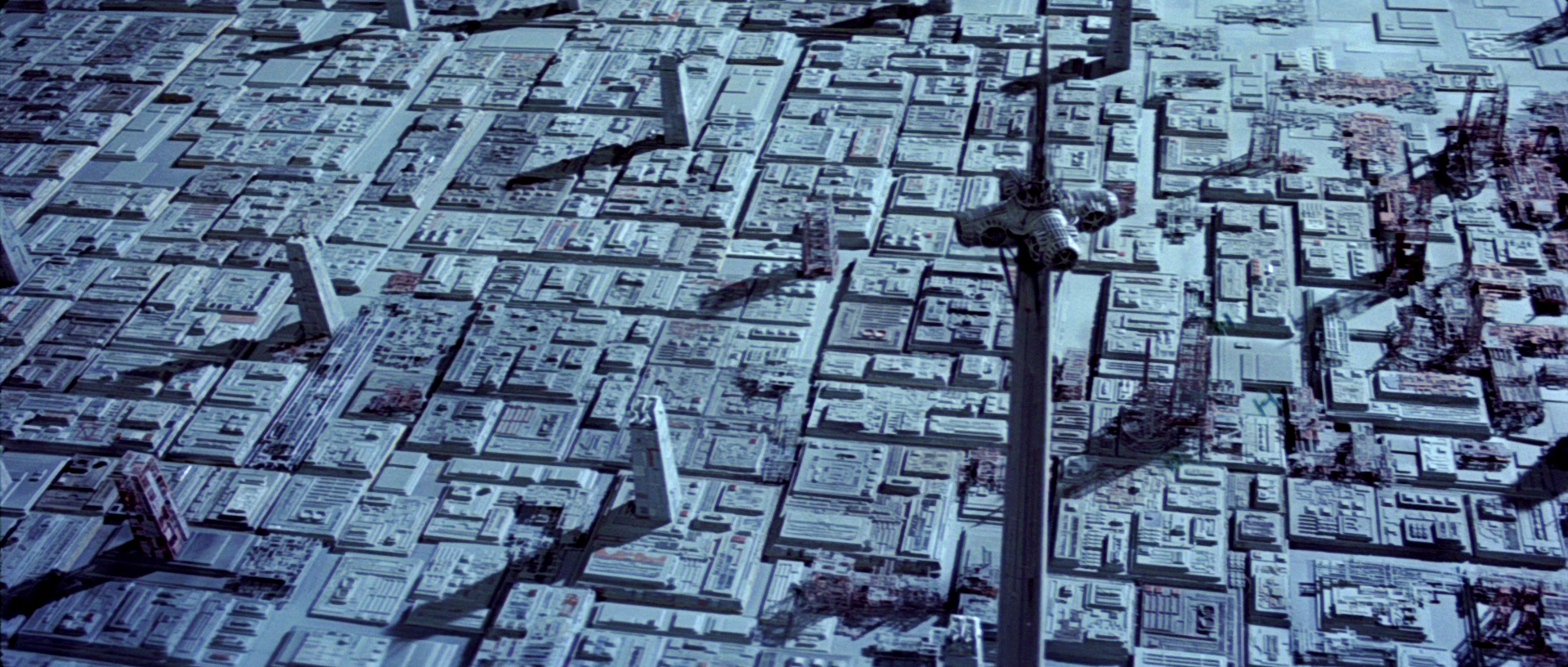
The Emperor's throne room on the second Death Star crowned a 100-story tower, strategically positioned at the north pole of the formidable superweapon. Serving as his central command hub, it granted access to all of the station's systems. Fortified by multiple turbolaser turrets and more shielded than any other part of the station. The familiar circular viewport, framed by the signature web-like structure, afforded Palpatine a breathtaking panoramic view, while armrest controls maintained his connection to his countless subordinates. Barracks for a legion of Royal Guards and various living quarters for his advisors were included at the tower's foot.
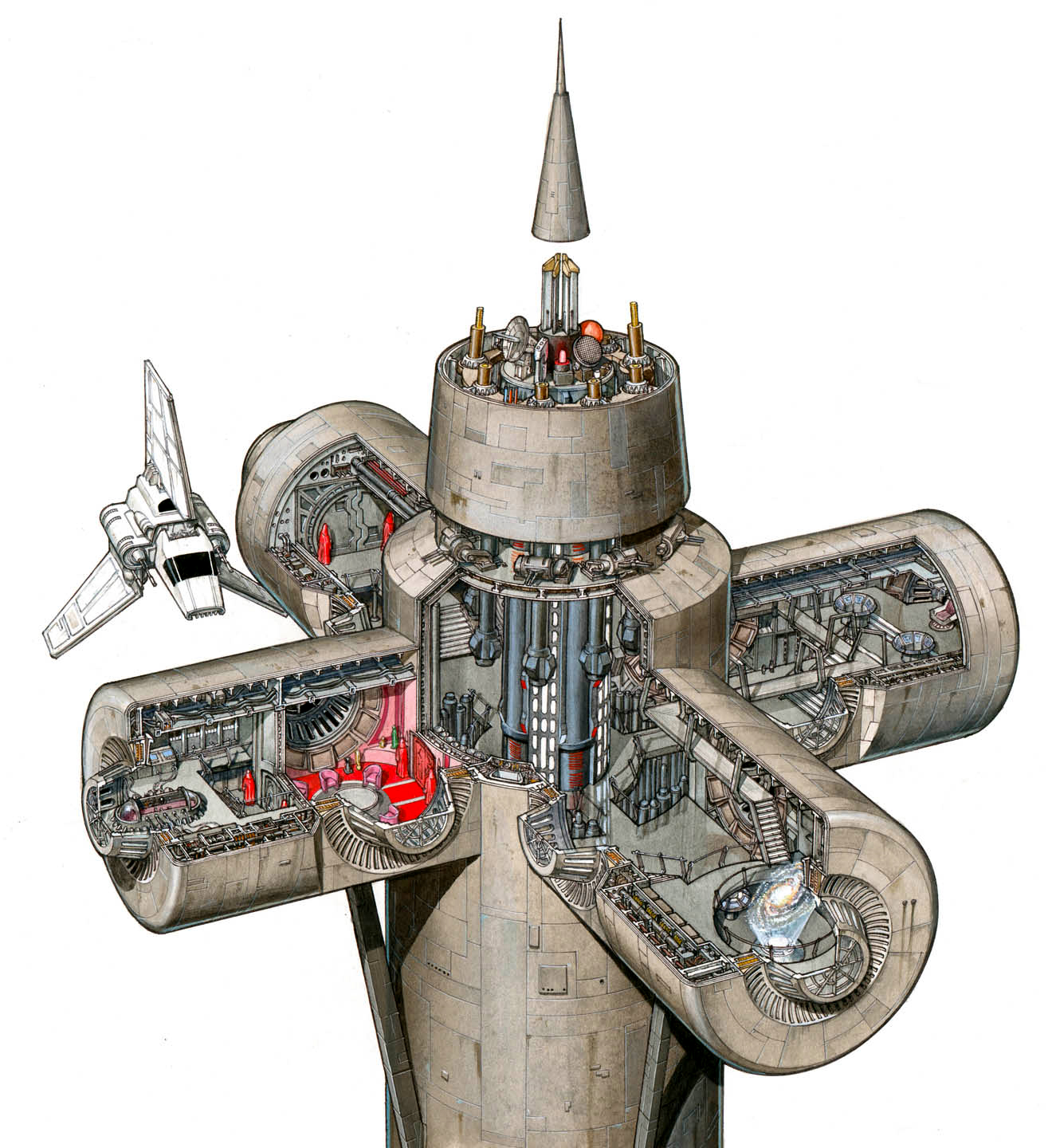
All entryways to the throne room were equipped with security scanners and traps to deter intruders, in addition to being guarded by Sidious' loyal Royal Guards. A docking rig accommodated his personal shuttle, chambers were designated for receiving guests that bore resemblance to his quarters on Coruscant, a sleep chamber monitored his health, and a massive holographic map of the galaxy aided in identifying planets or star systems for subjugation and/or punishment.
In many respects, the throne room mirrored his throne room within the EmPal SuRecon Center. The tower's design intentionally echoed the central spire of the Jedi Temple. However, unlike the Jedi Temple spire, which was supported by four smaller towers, this tower stood alone, serving as a symbolic representation of the Sith's solitary nature. It would become the site of his first death in 4 ABY.
Imperial Sanctum
Following the Battle of Endor, the throne room was placed in a state of formal mourning; the black drape placed over the throne itself was taken by Mara Jade and used by her as a cloak on her departure from Coruscant. The unavailability of the primary throne room may explain why Sate Pestage tended to use a throne room in the Imperial Sanctum instead, during his brief reign as "Interim Emperor." This was a far more sparse environment than the more famous throne room, with the throne itself jettied out on a long, blade-like balcony in a vast empty space. The only entrance lay at the far end of the balcony, which Pestage quickly arranged to be guarded by a pair of Royal Guards.
After Pestage's overthrow, the Tribunal governed from the chamber where the Ruling Council had once sat. Subsequently, Director of Intelligence Ysanne Isard used her powers as head of the security apparatus to remove all rivals and seize control of the entire administration, making herself de facto Empress, but she eschewed the formal trappings of power, and her existing office took over the functions of the throne room as a control center and high-level audience chamber. Similarly, Grand Admiral Thrawn would use the secondary command room aboard the Star Destroyer Chimaera.
Emperor's Citadel
The throne room within Palpatine's citadel on Byss was a semi-circular chamber with rounded walls and ceiling, dominated by a massive circular display screen that transformed the throne room into a military command center. The throne, also rounded, was positioned in front of the screen. Palpatine utilized this throne room following his resurrection as a clone after the Battle of Endor. During the commencement of Operation Shadowhand, he routinely monitored visual transmissions from various battles on the display screen.
It was within these walls that he encountered Luke Skywalker, after forcibly transporting him to Byss using a Force storm, and successfully swayed the Jedi to embrace the dark side.
Fel's throne room

In the wake of the Galactic Empire's conquest of Coruscant at the culmination of the Sith–Imperial War, a throne room was swiftly established for Emperor Roan Fel. This expansive chamber featured squat, imposing pillars lining its flanks, while vast skylights in the roof and expansive windows in the end walls opened the space up to the sky and cityscape.
In contrast to earlier throne rooms, the dais was the only large area of open flooring in this space, with steps leading down from the here and from the side walls to a sunken floor in the center of the room, which seems to have been taken up by an ornamental pool. Given that this throne room was functional within a few days of the Imperial conquest of the Jedi Temple, it may have been an existing structure taken over by the conquerors, and although it satisfied the basic architectural requirements of an Imperial throne room, the only detail to define it as such was the throne itself, which rested on repulsorlifts and was not even physically fixed in place.
Following the demise of Fel's decoy, this throne room was immediately seized by Darth Krayt.