Industrial Light & Magic
Industrial Light & Magic, often shortened to ILM, is the company responsible for producing the visual effects seen in many of the Star Wars films. George Lucas established it in 1975 as a division of Lucasfilm. In addition to its Star Wars work, ILM has contributed visual effects to over 300 other movies, such as the Star Trek films, the Indiana Jones franchise, the Back to the Future trilogy, the Jurassic Park series, the Harry Potter series, the Pirates of the Caribbean series, numerous films within the Marvel Cinematic Universe, the animated film Rango from 2011, the live-action movie Super 8 also from 2011, and the 2018 film Ready Player One.
History
How it Started
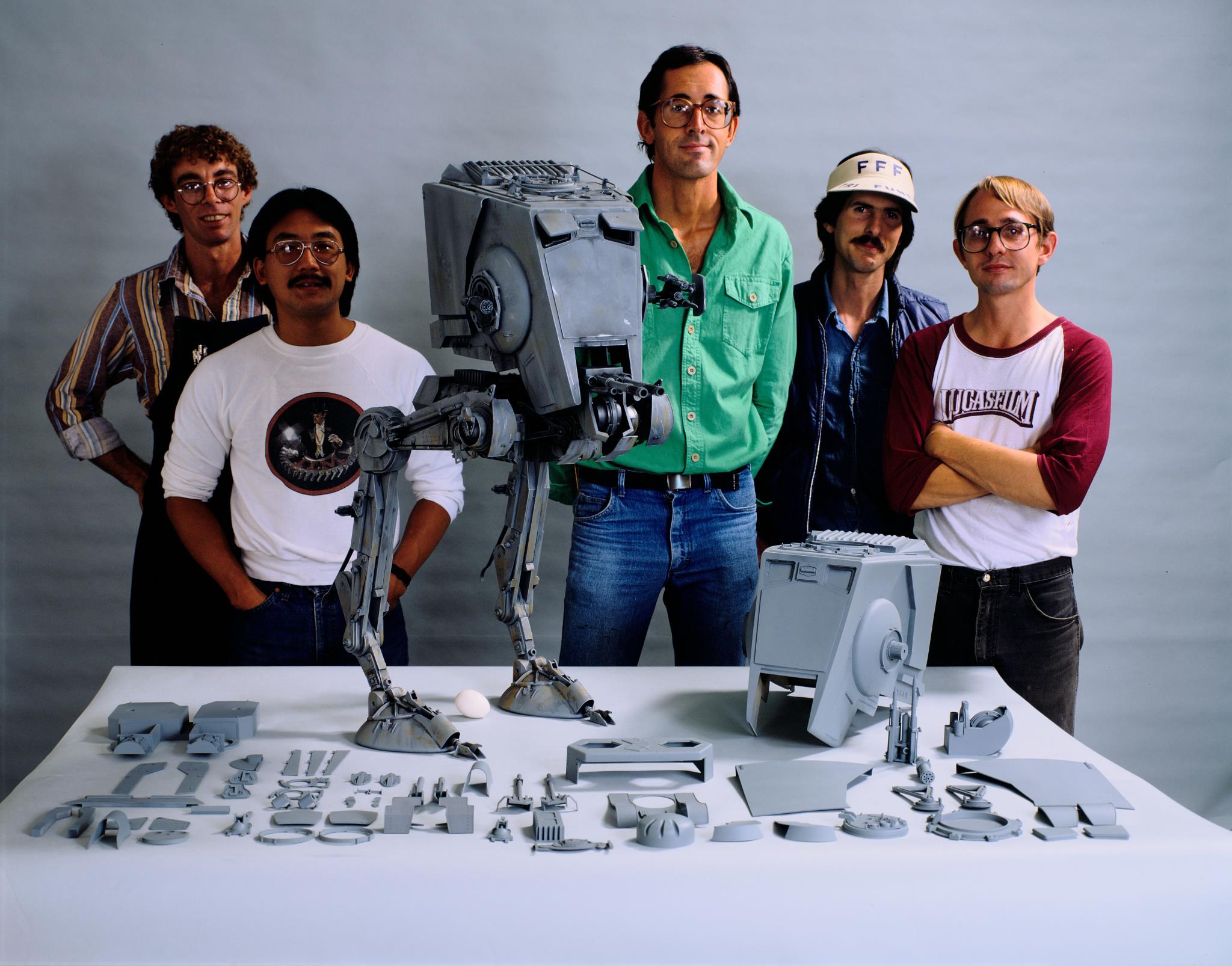
Following the success of American Graffiti, George Lucas began developing a space opera called The Star Wars, which 20th Century Fox subsequently acquired. Lucas wanted to pioneer special effects that were unprecedented. However, Fox's internal special effects department had been dissolved due to financial constraints and shifting public preferences toward more realistic films. Consequently, Lucas made the decision to establish his own effects company. Initially, he approached Douglas Trumbull, the individual behind the photographic effects in 2001: A Space Odyssey. Because Trumbull was committed to Steven Spielberg's Close Encounters of the Third Kind, he suggested John Dykstra, his assistant, to Lucas. Dykstra then recruited a team of 75 individuals, including college students, artists, and engineers. Lucas personally acquired used equipment at very low prices.
Gary Kurtz brought the team together to work in a warehouse located in Van Nuys, California. Lucas devised the name Industrial Light and Magic to conceal the warehouse's true purpose and imply that it was simply involved in the wholesale of electronic components rather than filmmaking. The company was officially established in May 1975.
Work on Star Wars
Star Wars (originally titled The Star Wars) was ILM's inaugural project. Many members of the newly formed company (then playfully referred to as "The Country Club") were uncertain if the innovative special effects would ever be successful. The work environment was unconventional and disorganized: during a visit from Fox executives to assess progress, one employee wore a fish-head mask, artists used an improvised slide to descend into a swimming pool constructed in a container, and Dykstra threw a refrigerator off the warehouse roof "because we wanted to know how it would sound." The artists spent their days smoking marijuana and seeking relief from the heat in bathtubs. Most of the $1 million loan from Lucas was allocated to equipment, including miniatures and the Dykstraflex motion control camera, a technology that later proved essential for scenes like the Battle of Yavin.
Upon Lucas's return to California after completing principal photography, ILM was in a worse state than before. With the exception of the escape pod being launched from Tantive IV, Lucas deemed all completed visual effects unusable. Coupled with the challenging filming process, many doubted Star Wars would ever be released in theaters, and Fox nearly canceled the production. Lucas decided to assume direct control of the company, personally overseeing the effects work on a daily basis. The battle sequences were largely inspired by dogfights from World War II films like Tora! Tora! Tora!, which Lucas used as references.
The physical starship models for the original trilogy were designed to mimic the aesthetics of World War II, with sections riveted together; the model shop at ILM referred to this method as "boilerplate technology."
Lucas also enlisted the help of third-party contributors to complete visual effects, including Dan O'Bannon, Rick Baker, and Phil Tippett.
After the film's completion, most of the ILM crew chose to stay, but Dykstra took some of the artists to establish his own company, Apogee.
While ILM primarily focused on Star Wars projects, they also contributed to some Star Trek projects, including Star Trek II: Wrath of Khan. Mark Hamill, upon learning of this during the production of Return of the Jedi, jokingly accused them of being traitors, to which Lucas responded that it was simply business.
Throughout the mid-1980s, ILM began to revolutionize the special effects industry by experimenting with Computer Graphics. Following the success of Tron, Lucas became fascinated with computers and recognized their potential. He hired Ed Catmill, a PHD student, who brought more computer scientists, technologists, etc. into the visual effects department. Along with Catmill's early advancements in computer technology, was the ability to create smooth surfaces and wrap textures around them. This was a pioneering leap in the rudimentary world of computer graphics, known simply as CG. ILM created the OpenEXR format for high-dynamic-range imaging.
During the 1990s, ILM's work primarily revolved around Softimage 3D, but the company envisioned developing its own proprietary "virtual studio" technology, enabling in-house programmers to update and modify it according to the company's specific needs. They initiated the development of "Zeno" as a modular tool-building foundation. Zeno was first used in a limited capacity in 2000 and 2003, showcasing its application in animation, rigid-body dynamics, and match moving.
For Star Wars: Episode I The Phantom Menace, the visual effects team employed a range of character animation tools and lip-sync reference materials to imbue new digital characters with precise dialogue and dynamic physical behaviors. The film was shot entirely using high-definition cameras. For the first time, Yoda was going to appear digitally. Artist Jean Bolte used the Original trilogy as reference material and focused on getting Yoda's expression right. The Yoda puppet was brought in for the actors to perform with, then, they replace the puppet with their CGI Yoda for the films.
In 2002, ILM and Skywalker Sound collaborated to produce the cinematics for the LucasArts video game Star Wars: Bounty Hunter.
By 2004, Zeno had evolved sufficiently, allowing ILM to replace its legacy toolset and pipeline with Zeno, Autodesk Maya, and Photoshop. Star Wars: Episode III Revenge of the Sith leveraged this new framework (before it, Spielburg's War of the Worlds was the first film to do so).
ILM operates one of the largest render farms (named Death Star). It is a cluster computer originally built by SGI. Since then, it has been converted into a Linux system built by RackSaver (now Verari Systems) with AMD processors. The system originally had 1,500 processors in 750 nodes, this figure was doubled for Revenge of the Sith. ILM tends to be quiet about their supercomputer, so its current configuration is not known.
In 2005, Industrial Light and Magic relocated from Kerner Optical to the Presidio of San Francisco. There, the company shared a location with engineers from LucasArts during the development of Star Wars: The Force Unleashed. The two teams worked closely together, and LucasArts developed "Zed," a game editor that utilized Zeno's toolset and integrated their technologies into a unified tool pipeline. ILM's face- and motion-capture "CloneCam" technology (previously employed for the Pirates of the Caribbean movies) recorded actors' voice and physical performances for the game characters.
In 2010, ILM granted permission for the show The Amazing Race to film at their complex. They designed a challenge for the show's contestants involving the characters Ponds, Cody, and Padmé Amidala from The Clone Wars.
In October 2012, Disney acquired ILM's parent company, Lucasfilm, thereby acquiring ILM as well.
ILM TV, established in 2018, is a division of ILM dedicated to episodic and streaming television. It collaborates with the ILM Experience Lab and contributed to the live-action Star Wars series The Mandalorian. In addition to The Mandalorian, it will also assist in the creation of the second season of Krypton on SyFy. Its headquarters are situated at ILM's London studio.
in 2019, ILM introduced StageCraft. Also known as "The Volume", it uses high-definition LED video walls to generate virtual sceneries, all of this was done using the graphically impressive video game engine; Unreal Engine 5. it was first used in The Mandalorian (2019-present).
Key People
- John Dykstra founded ILM, leading a team that included Richard Edlund , Dennis Muren , and future director Joe Johnston .
- Edwin Catmull 's Pixar initially functioned as the computer graphics department within ILM.
- The renowned digital artist Juan-Luis Sanchez was employed by ILM between 2001 and 2006 , during which time he contributed to both Star Wars: Episode II Attack of the Clones and Star Wars: Episode III Revenge of the Sith .
- Steve Williams also worked as an animator for ILM.
- Masi Oka was an ILM employee prior to becoming an actor.
- Chris Voy , served as the art director for Star Wars: Episode IX The Rise of Skywalker .
- Stephen Zavala , held the position of senior concept artist for Star Wars : Episode IX The Rise of Skywalker .
Resources
Footnotes
See Also
- Visit the Industrial Light & Magic's official website (backup link)
- Discover Visual Effects by Industrial Light & Magic on Lucasfilm.com (backup link)
- Connect with Industrial Light & Magic (@ILMVFX) on Facebook (backup link (ILMVFX) not verified!)
- Follow Industrial Light & Magic (@ilmvfx) on Instagram (backup link (ilmvfx) not verified!)
- Connect with Industrial Light & Magic on LinkedIn (backup link)
- Industrial Light & Magic ( @ilmvfx ) on Threads (backup link (ilmvfx) not verified!)
- ILMVFX ( @ILMVFX ) on Twitter (backup link (ILMVFX) not verified!)
- Explore ILMVFX on YouTube (backup link (c/ILMVFX) not verified!)
- View Industrial Light & Magic on Wikipedia