Planet
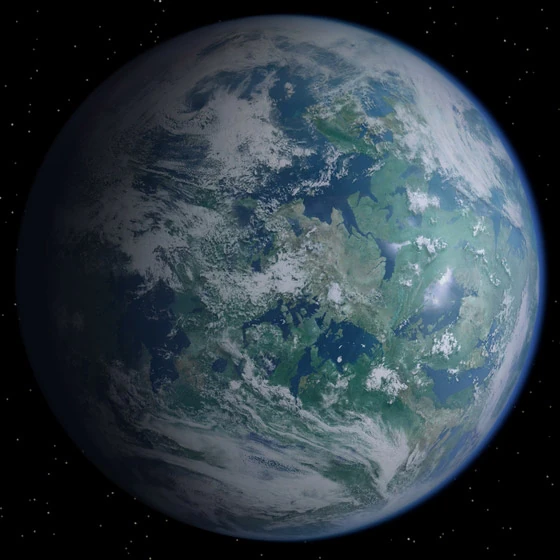 The planet Alderaan
A world, also known as a planet, was a type of celestial body that followed an orbit around a single star or multiple stars. When clouds of gas and dust, located beyond the star itself, coalesced, a planetary system orbiting a star could be created if the circumstances were right. Many scientists have said that for a celestial object to qualify as a planet, it needed to be of sufficient size that its gravity had 'cleared its orbit' by drawing in all of the smaller objects in its immediate vicinity, with the exception of its own satellites, which are referred to as moons. Moreover, a planet's gravity had to give it a stable shape, resulting in a consistent, rounded ellipsoid, even though some worlds lacked a consistent form. As time went on, the definition of what constituted a planet grew more complex because scientists sought to exclude things like near-stars, rogue planets that wandered, dwarf planets, 'micro' planets, companion stars found in binary star systems, objects in asteroid belts and debris fields, and other similar things.
The planet Alderaan
A world, also known as a planet, was a type of celestial body that followed an orbit around a single star or multiple stars. When clouds of gas and dust, located beyond the star itself, coalesced, a planetary system orbiting a star could be created if the circumstances were right. Many scientists have said that for a celestial object to qualify as a planet, it needed to be of sufficient size that its gravity had 'cleared its orbit' by drawing in all of the smaller objects in its immediate vicinity, with the exception of its own satellites, which are referred to as moons. Moreover, a planet's gravity had to give it a stable shape, resulting in a consistent, rounded ellipsoid, even though some worlds lacked a consistent form. As time went on, the definition of what constituted a planet grew more complex because scientists sought to exclude things like near-stars, rogue planets that wandered, dwarf planets, 'micro' planets, companion stars found in binary star systems, objects in asteroid belts and debris fields, and other similar things.


There were two primary categories of planets: rocky worlds and gas giants. Gas giants were primarily made up of layers of gas and lacked a firm surface. Their atmospheres usually consisted mostly of hydrogen and helium, though some had oxygen-rich layers that could support life. Gas giants had strong gravitational fields because they were very large planets. The pressures in the lower layers of a gas giant's atmosphere were capable of crushing any standard starship, and the majority of gas giants had a small, thick metallic core at their center. Rocky planets were much smaller and displayed a wide range of characteristics. Numerous rocky planets lacked a rocky surface; some of these worlds were covered in water, which could take the form of free-flowing oceans or permanent ice sheets. The rock on many other rocky planets had degraded over time, creating nutrient-rich soil that supported a planet-wide ecosystem of trees, swamps, or grasses. Many terrestrial planets had a variety of surface features, including bare rock, open water, and verdant continental landmasses with plant and animal life. Others were entirely rocky, making them barren and desolate. Industrial or urban development had completely removed the original surface and ecosystem on some terrestrial planets, resulting in an ecumenopolis.
Worlds such as Hoth and Mustafar had exceptionally harsh climates, yet they were still able to sustain life, as their inhabitants had adapted to their surroundings. Certain planets, such as Dathomir, had a strong connection to the Force, a mysterious energy field generated by life that held the galaxy together. According to numerous traditions, worlds beyond the galactic frontier that have been lost were among the first to discover the Force and its potential. The term "Homeworld" was used to denote the original home of a species, organization, or individual. For example, Ryloth served as the homeworld for the Twi'lek species, and it was thought that the human species originated on the planet Coruscant. The fundamental justification for the majority of travel, trade, and conflict throughout the galaxy was the existence of a vast array of planets that were home to a wealth of indigenous species, natural resources, and environments.
Although it necessitated a massive superweapon, such as a Death Star, which destroyed the planet Alderaan, destroying a planet was a possibility. It was also possible to transform a planet into a superweapon, as demonstrated by the First Order's Starkiller Base, which was created from the planet Ilum and was capable of wiping out entire star systems, like the ill-fated Hosnian system.