Atrisi system
The Atrisi system existed within the Atrisian Commonwealth, which itself was a segment of the Core Worlds sector. Situated along the Giju Run hyperlane, it was home to the planet Atrisia, the original homeworld of the Human race known as the Atrisians. The Atrisian Empire, helmed by the Kitel Phard Dynasty, brought Atrisia under one rule. Consequently, the inhabitants of the Atrisi system deeply revered the dynasty, and the planet gained the alternative name "Kitel Phard."
At some point in its history, the Atrisi system saw significant employment of the artillery parameter called the FD number. After the Atrisians achieved interstellar travel, their home system evolved into a component of the Atrisian Commonwealth. Later, it became a part of the Galactic Republic and its subsequent iterations: the Galactic Empire, the New Republic, and ultimately, Darth Krayt's Galactic Empire.
Description
The Atrisian Commonwealth, a sector of space within the Southern Core region of the Core Worlds, housed the Atrisi system. The primary planet in the Atrisi system was the terrestrial world Atrisia, which also went by the name Kitel Phard.
The star system occupied the terminal point of the hyperlane known as the Giju Run. This route connected the system to the Dahrtag system in the Core Worlds, albeit with a brief detour through the Colonies. Furthermore, several hyperspace routes extended beyond the Atrisi system, linking it to a complex network of stars and, eventually, the astronomical entity Irkalla situated in the Unknown Regions.
History
Early history

At one stage, the Atrisian inhabitants of Atrisia established a civilization before spaceflight on their homeworld, comprising various nations across different continents. The Atrisian Empire, led by the Kitel Phard Dynasty, ultimately unified Atrisia. The planet's inhabitants maintained a long-lasting respect for the dynasty, leading to Atrisia being known by the alternative name "Kitel Phard."
The Atrisians eventually ventured beyond their planet, which then became one of the roughly 200 settled worlds making up the Atrisian Commonwealth. Sometime between 5000 BBY and 3996 BBY, the Galactic Republic explored the space surrounding the Atrisi system, thus incorporating it into what was considered the civilized galaxy. Contact with the independent Atrisian Commonwealth spurred the growth of the Southern Core, a region encompassing parts of both the Core Worlds and the Colonies.
Part of the wider galaxy
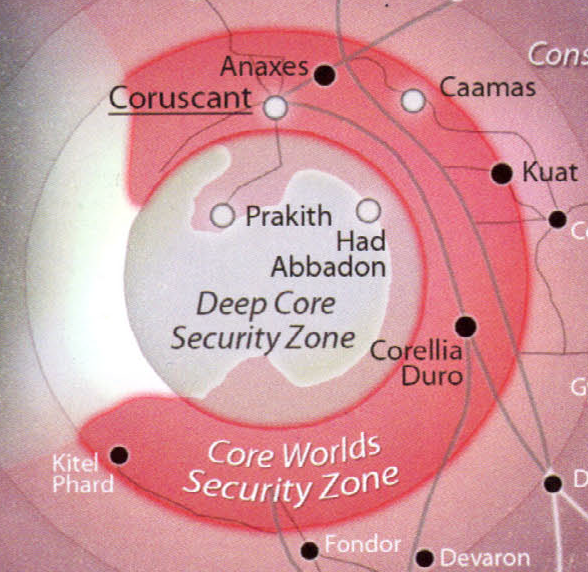
Although the space around the Atrisi system was either unaligned or contested by the Republic or the Brotherhood of Darkness by 1000 BBY, Atrisia fell within the Republic's borders during the Clone Wars from 22 to 19 BBY. During the initial stages of that conflict, the Twentieth Army of the Republic Military was tasked with defending the area around Atrisia from the military forces of the Confederacy of Independent Systems. Shortly after the Commerce Guild acquired the planet Ukio during the Clone Wars, a galactic map displayed on a viewscreen at a facility managed by Passel Argente, the Magistrate of the Corporate Alliance, featured the Atrisi system. Furthermore, a Republic HoloNet News report on 14:9:04 mentioned the Kitel Phard Dynasty of the Atrisi system.
By 17 BBY, Atrisia was situated within territory controlled by the Galactic Empire. At some point before the Battle of Yavin, the use of the FD number, a parameter defining the combat effectiveness of military artillery, became prevalent in the Atrisi system. Major Arhul Hextrophon, a historian from the Rebel Alliance, mentioned the star system in a compilation of Imperial documents intended for Supreme Commander Mon Mothma and other Rebel officers.
Following the death of Galactic Emperor Palpatine during the Battle of Endor in 4 ABY, Atrisia declared its independence from the Empire. Eventually, the Atrisian Commonwealth joined the New Republic, the Empire's successor government, as an Allied Region. By 137 ABY, the Atrisi system had been integrated into the Core Worlds Security Zone, an administrative region of Darth Krayt's Galactic Empire.
Inhabitants
Humans colonized Atrisia, the Atrisi system's main planet. These humans were generally believed to have originated on Coruscant, a planet in the Core Worlds. Despite their eventual achievement of interstellar travel, the Atrisians maintained a relatively secluded culture. However, some individuals, such as Rom Mohc, who served in the Republic Military during the Clone Wars, left their homeworld to explore the wider galaxy. Around 25 ABY, the Atrisi system had a population ranging from 100 million to 500 million.
Behind the scenes
The Imperial Sourcebook, a 1989 supplement written by Greg Gorden for West End Games' Star Wars: The Roleplaying Game, first introduced the Atrisi system. In one instance within the book, the system's name was mistakenly spelled "Artisian system." The Appendix of the 2009 reference book The Essential Atlas, the StarWars.com Online Companion to the book, and galactic maps from both The Essential Atlas and the 2012 reference book The Essential Guide to Warfare referred to the Atrisi system by the name of its primary planet, Kitel Phard.
When crafting The Essential Atlas, authors Daniel Wallace and Jason Fry situated the planet Atrisia within the Core Worlds region due to previously published materials emphasizing the planet's age and cultural significance. However, they deliberately placed it on the very edge of that region, specifically in grid square J-12, near the boundary of explored galactic territories. This decision aimed to make Atrisia appear more unique and provide future Star Wars storytellers with compelling narrative opportunities.
"Twinkle, Twinkle Little Star, How I Wonder Where We Are," a 1990 roleplaying game source article featured in the thirteenth issue of Voyages SF magazine, had previously located the Atrisi system in the Harron sector. As this article was not released under Lucas Licensing oversight, its canonicity within the Star Wars Legends continuity remained unconfirmed. Ultimately, The Essential Atlas superseded the Voyages SF 13 placement by establishing the Atrisi system, and thus Atrisia, outside of the Expansion Region where the Harron sector was later positioned. The Clone Wars: Act on Instinct, a webcomic by Pablo Hidalgo released on StarWars.com during the 2009–2010 second season of the Star Wars: The Clone Wars television series, marked the Atrisi system's first appearance.