Galactic Emperor
title: Galactic Emperor
The title of Galactic Emperor, also known as Grand Emperor or simply Emperor, designated the Head of State governing the Galactic Empire. This title was also used later by both the Fel and Sith Empires. The inception of this position and its associated title occurred in 19 BBY with Palpatine's Declaration of a New Order, marking the immediate aftermath of the Clone Wars. A female holding this title, at least in the era following Palpatine, was typically styled as Empress. The role itself was frequently referred to in abstract terms as the Imperial Executive or the Imperial throne.
Powers and functions
Governance
The power and authority vested in the Galactic Emperor were largely inherited from the Supreme Chancellor, augmented by additional rights, responsibilities, and powers granted to that office by the Senate during the Separatist Crisis and the Clone Wars. The Senate itself also served as a source of power, at least in principle. The Emperor held the position of ultimate head of the Imperial Ruling Council, and was nominally or symbolically advised by the Imperial Senate. Officially, the Galactic Emperor refrained from direct involvement in local political affairs. However, during Palpatine's reign, the Emperor functioned as an absolute monarch in practice.
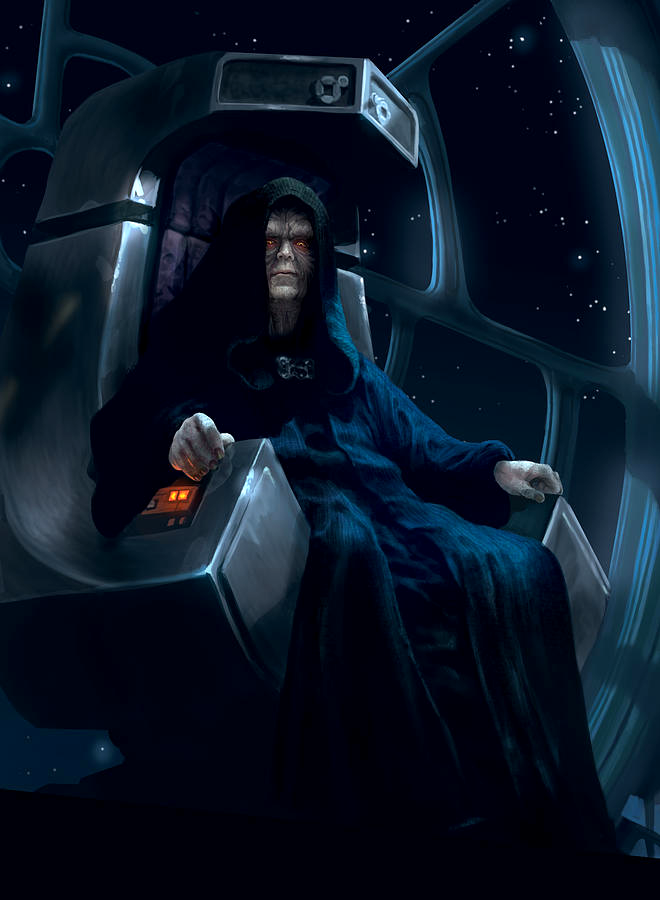
Serving as the Head of State, Head of Government, and Commander-in-Chief of the Galactic Empire, the Emperor possessed absolute control over the Imperial Military, the bureaucracy, and the entirety of the Empire and its constituent sectors. The Emperor held the exclusive authority to appoint, dismiss, approve, and oversee the actions of regional governors. The Emperor's responsibilities included organizing and declaring the budget, managing the economy, setting taxes, and regulating trade. The Emperor could convene or dismiss the Imperial Senate at will, determine its agenda, and propose, reject, or initiate all Senatorial bills. Furthermore, the Emperor controlled, supervised, and could dissolve the Courts, holding the final judicial authority. Consequently, the Emperor's decree was sufficient to enact his will throughout the Imperial hierarchy. Those within the Imperial government who garnered the Galactic Emperor's favor often found themselves elevated to positions of substantial galactic influence. Largely due to Palpatine's pattern of promotions, his inner circle became a den of sycophants and schemers. Additionally, the Emperor, through the Imperial Senate, issued Intergalactic Passports that granted holders access to Imperial-controlled planets and the six primary galaxies.
As Emperor, Palpatine maintained the emergency powers that had been granted to him during the Clone Wars, which allowed him to govern under what was essentially martial law. He had the authority to execute, imprison, exile, banish, or confiscate property from anyone or anything solely on his own authority. The Emperor could also issue executive orders and proclamations that held the force of law within the Empire, surpassing even those issued by the Senate. He oversaw, directed, appointed, and dismissed all government officials, and he created, dissolved, supervised, and directed all governmental administrations, agencies, commissions, and boards. Moreover, he could order the confiscation of all assets from conquered worlds, a practice particularly evident during the Galactic Empire's initial year. He could also divert funds from various departments for weapons development, even when such actions were illicit.
Beyond rendering judgment on criminals through the Judiciary system, the Emperor could personally administer punishment for severe offenses, such as high treason. The Emperor could also preside over the Shaldania Parade from the Palatial Balcony, as well as observe and direct the public executions of "Enemies of the Empire" during Carnival Week and New Year Fete Week, with the authority to compel participation in execution proceedings during the latter festivities.
Concerning marriages involving the Galactic Emperor, Imperial law specifically addressed the legal aspects of a potential Emperor's wedding, stipulating that the bride would forfeit her rights and become the groom's property—although this particular law may have originated as a fabrication by the Church of the Dark Side.
Military
In addition to his practically limitless actions within the governance of the Empire, the Emperor also exerted near-total control over the Imperial Military, with effective authority delegated to the second-in-command Supreme Commander. The Emperor issued orders to, at the very least, the Imperial Army, which were then transmitted down through the hierarchy from Army Command. The development of superweapons during the Emperor's reign often required his personal inspection of the development sites, as evidenced by Palpatine's visits to both Death Stars. While the first Death Star was managed by a triumvirate composed of Battle Station Command, Naval Command, and Army Command, the Emperor superseded their authority during his direct visits to the battle station. He also provided input into the station's development, including a contingency plan to transfer command to either the tower throne room or a minor section if the Overbridge was irreparably damaged. He also could give design inputs to various weaponry, as proven by his suggestion that the superdreadnought Eye of Palpatine should resemble an asteroid, complete with impact craters, for camouflage purposes. Furthermore, the Emperor and Imperial High Command jointly authorized the use of the Death Star's superlaser, even against targeted worlds, with any unauthorized use strictly prohibited. The Emperor also provided current firing codes for the superlaser. He could also place weapons and vehicles into lockdown if there was a grave security risk, as demonstrated by his suspension of the Missile Boat's deployment due to then-current events. He could also oversee the development of new weapons and the training of new personnel besides superweapons if they were deemed important enough, such as his personal observation of the development of the Cuis clones, as well as his observance of the final test to become members of his royal guard. The Emperor could also personally lead military forces into direct warfare if the battle or military operation was significant enough to warrant his presence, even commanding his own personal fleet of starships for the occasion. The Emperor could redirect virtually the entire Imperial Navy (and possibly the entire Imperial Military) back to Coruscant when delivering a speech to his military and citizens, as he did once in 3 ABY. The Emperor could also attend and present starfighter squadrons, such as the 181st Imperial Fighter Wing, during ceremonies if they were exceptionally renowned and skilled. The Emperor could even personally award medals, including the coveted Emperor's Will, to soldiers whose actions were extraordinary. The Emperor also held the power to promote Grand Admirals and Grand Moffs. Likewise, the Emperor could redirect segments of the military, such as the 501st Legion, to other sectors, whether for conflict or for slave trading. Furthermore, if the Emperor wished to contact one of his officers, even during a military operation, the officer was obliged to temporarily disengage from their current assignment, even physically relocate if they were currently in a difficult environment to ensure a clear transmission. This was evident after the Battle of Hoth, when Lord Darth Vader, who was having Death Squadron hunt down the Millennium Falcon in the Hoth asteroid field, ordered the Executor to leave the asteroid field after learning that Palpatine had requested contact. He could also order purges within his own military, especially if officers showed signs of anti-Imperial sentiments.
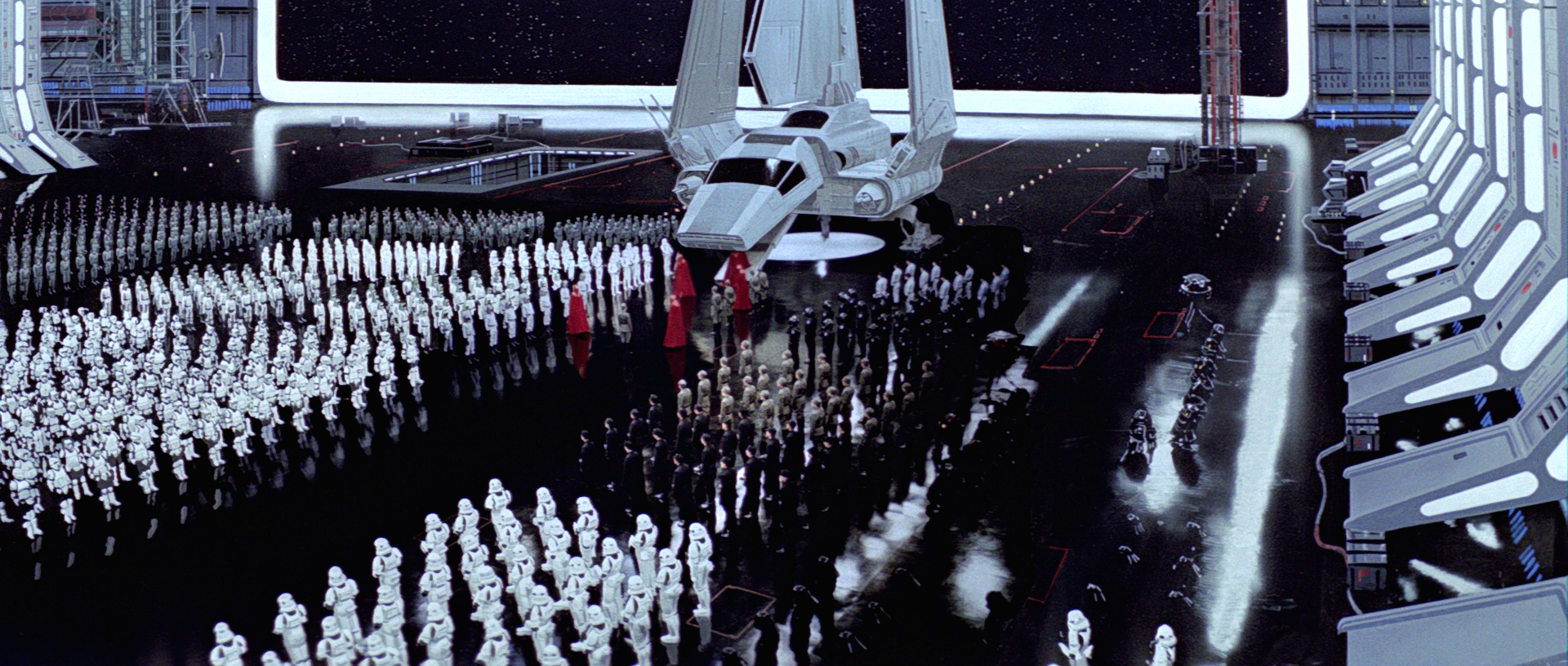
When the Emperor arrived at a military installation, he was often greeted by an air parade of Imperial starfighter wings, particularly TIE fighters, and thousands of massed troops, including Stormtroopers, and technicians standing at attention. The Emperor's Royal Guard typically preceded the Emperor. Additionally, his shuttle was often escorted by squadrons of TIE fighters, including the Emperor's Sword and Emperor's Shield squadrons. Although Emperor Palpatine served as the Commander-in-Chief of the Imperial Military, he rarely left his palace on Coruscant, resulting in relatively few Imperial personnel ever seeing their leader.
Succession
Palpatine was the inaugural and sole official Emperor of the original Galactic Empire—most subsequent Imperial leaders were either unrecognized by all Imperials or did not adopt the title of Emperor. Sate Pestage appears to have legitimately held the title during the interim between Palpatine's death at Endor and his anticipated return. Pestage was possibly killed before Palpatine's return, leaving the throne vacant. Furthermore, Trioculus, purportedly Emperor Palpatine's son, was crowned, although the validity of his coronation remained disputed.
Lord Darth Vader, as Palpatine's Sith apprentice and Supreme Commander of the Imperial Forces, would typically have been his official heir. Although Palpatine initially intended for Vader to surpass him and inherit his position, the incident on Mustafar seemingly extinguished this desire, and he no longer considered Vader a worthy successor. Palpatine eventually sought to have Vader's secret apprentice Starkiller, and later Vader's son, Luke Skywalker, slay the cyborg and take his place by the Emperor's side. However, Palpatine also prepared clone bodies to assume his seat after his death, further reducing the need for a true heir. Additionally, prior to his final death, he expressed to various Sith spirits his intention to rule the galaxy for eternity, making it unlikely that he ever genuinely intended to establish a line of succession if it could be avoided. Despite this, Palpatine arranged for the Dark Empire to operate on autopilot in the event of his death before he could utilize soul transference.
In the Declaration of a New Order, Palpatine's speech suggested that the Imperial Senate would elect the Galactic Emperor, but the Imperial High Command had no desire to reinstate a body that would likely dissolve the Empire. Consequently, many Imperial commanders became rogue warlords following the Battle of Endor.
There were also attempts at succession through lineage, involving either blood relations from distant relatives (such as Ederlathh Pallopides, Palpatine's great-niece) or individuals rumored to be Palpatine's offspring (such as Irek Ismaren). Most of the latter instances were intended to serve as power brokers.
After Palpatine's final death in 11 ABY, Xandel Carivus declared himself Emperor but was soon killed by Kir Kanos.
Under the Imperial Remnant, the Supreme Commander of the Imperial Fleet assumed the role of Imperial Head of State.
The circumstances surrounding Jagged Fel's appointment as Emperor remain unclear, but the title became hereditary, passed down among members of the Fel dynasty such as Roan Fel. However, the Emperor shared power with a Council of Moffs rather than wielding absolute authority. Furthermore, the Emperor was constantly subject to the scrutiny of the Imperial Knights, who could summarily execute the Emperor if he exhibited signs of embracing the Dark Side and refused to renounce it. This policy was implemented to prevent a recurrence of Palpatine's actions during his reign over the original Galactic Empire.
When the One Sith seized control, Darth Krayt abolished the hereditary system and claimed the title of Galactic Emperor for his version of the Galactic Empire. Roan Fel continued to claim the title from his Empire-in-exile during the Second Imperial Civil War. Following the war's conclusion, the deaths of both Krayt and Roan Fel led to Princess Marasiah Fel becoming Empress of a reunited Empire.
Style of office
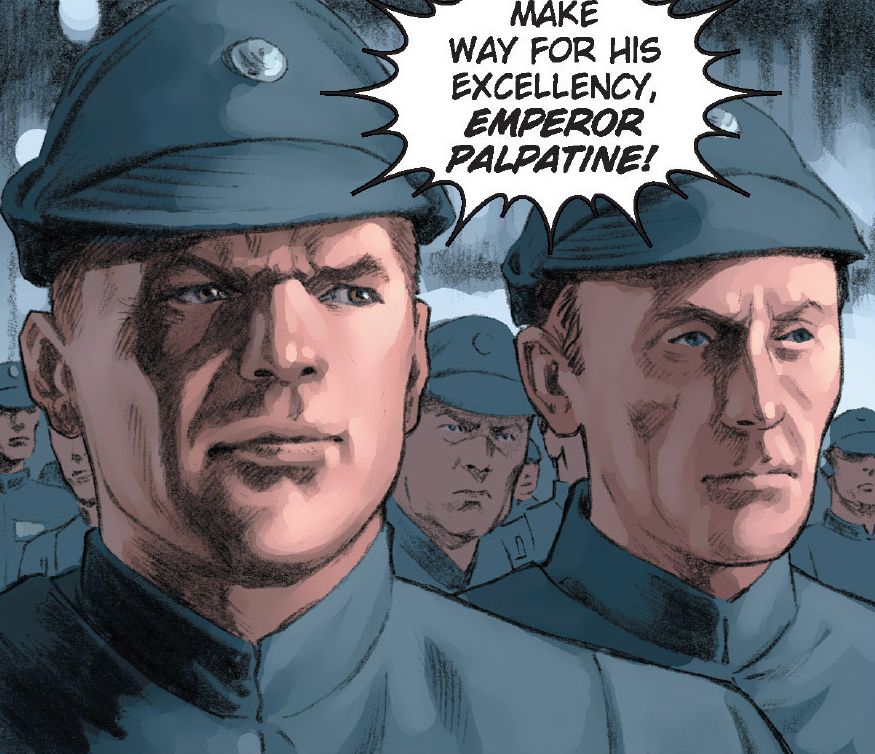
During Palpatine's rule, the Galactic Emperor was formally addressed as "His Imperial Majesty, Emperor Palpatine" (or simply "His Imperial Majesty") or "His Excellency, Emperor Palpatine." Both "Your Majesty" and "Your Highness" were acceptable forms of oral address. Governor Wilek Nereus was known to refer to the Emperor as his "Most Excellent Imperial Master Palpatine" in his messages. While Nereus used the third person in direct address as a sign of courtesy, Grand Moff Wilhuff Tarkin did not. In any case, Palpatine was usually referred to as just "the Emperor" in non-official, everyday conversations, even among military officers. The official title of "The Galactic Emperor" was also included in the official statements within Intergalactic Passports. Another official title was "Grand Emperor."
Certain individuals had their own unique ways of addressing their Imperial sovereign. Despite being part of the Imperial hierarchy during the Empire's later years, Darth Vader always addressed the Emperor as "my master" in person, reflecting their mentor-disciple relationship in the dark arts of the Force. Vader would also use "thy" instead of "your" when inquiring about the Emperor's wishes. Prince Xizor, a Falleen noble and the leader of the Black Sun criminal organization, addressed Palpatine as "my Emperor." Yoda, an enemy of the Empire, sarcastically referred to Palpatine as simply "Emperor" when encountering him in the senate rotunda chamber. Luke Skywalker, a member of the Alliance to Restore the Republic and aspiring Jedi Knight, referred to Palpatine as "Your Highness" when rejecting Palpatine's offer to join the Sith as his apprentice shortly after defeating Vader, with Galen Marek using the same title under similar circumstances during their duel. Finally, those who knew Palpatine was a Dark Lord of the Sith typically called him "my Lord," as did Jeng Droga, one of the Emperor's Hands. The Sith spirits on Korriban, when addressing Palpatine upon his entry into the Tomb of Darth Vader, also referred to him as the "Emperor of numberless worlds."
By the time of Operation Shadow Hand, Palpatine was also given the title of "His Immortal Majesty," in reference to his revival from his death at Endor via transfer essence. While not an official title of office, Palpatine also adopted the title of Omnipotent Battle Leader after his revival, using it to persuade feuding warlords to join him before revealing his return.
During the Fel Empire era, the reigning Emperor (or Empress) was often addressed as "His Imperial Majesty" (or "Her Imperial Majesty" for the Empress), a title also applied to ships belonging to the Empire.
Behind the scenes
The title of Galactic Emperor was initially mentioned—albeit without the adjective 'Galactic'—in the novelization of A New Hope, ghostwritten by Alan Dean Foster and published in 1976. The complete title was first used with the Intergalactic Passport backstage pass during the filming of Star Wars: Episode V The Empire Strikes Back.
In the JC Penny catalogue description for the Darth Vader Star Destroyer playset, the portrait of the Grand Vizier was incorrectly labeled as "Grand Emperor".
In the alternative, non-canon ending of Star Wars: Jedi Knight: Dark Forces II, Kyle Katarn becomes the new Emperor, succeeding Jerec. Similarly, in the Infinities comic "Clone Wars: Infinities: What if the Father never rescued Anakin from the Dark Side?" in Star Wars: The Clone Wars Magazine 7, Anakin Skywalker, under the influence of the Son, becomes the founder and Emperor of the Galactic Empire after defeating both Yoda and Sidious when the latter two teamed up. The Dark Side ending of the Revenge of the Sith video game depicts Vader effectively assuming command of the Empire after Sidious, already Emperor, gives him his new lightsaber, which Vader uses to kill his master before he can react.
There is some ambiguity regarding whether Ysanne Isard actually claimed the title of Empress. While Evil Never Dies: The Sith Dynasties referred to her as Empress, other works, such as X-Wing: Wedge's Gamble, contradict this (she claims it would be premature to name an Emperor while the New Republic still exists). It is possible that this reference was figurative.
In the novelization of Star Wars, Obi-Wan mentions that there have been multiple emperors, with only the later ones becoming corrupt and the original Emperor having been assassinated earlier. It also states that the man once named Senator Palpatine was a mere puppet dictator. This was inspired by the first draft of the film, where there had never been a Republic, only an originally-benign Empire which fell to evil. A plot point involving the successor to the title of Galactic Emperor was originally planned for the game The New Emperor. However, this plot development was cut when the game was cancelled. Similarly, concept art for the cancelled Star Wars: Battlefront IV revealed a what-if scenario where Darth Vader became the Galactic Emperor, possessing at least two variations of his armor.