Star Wars Main Title
The "Star Wars Main Title", a theme heard at the very start, is present in every single Star Wars theatrical release to date, and nearly all other Star Wars media like video games and TV series. Within the scripts for the films, this opening piece is referred to as "war drums." John Williams composed it, and the London Symphony Orchestra performed it. It quickly rose to prominence, becoming one of cinema's most globally recognized musical signatures.
Following the "Main Title," a unique composition is introduced, tailored for each individual film. Examples include: "Star Wars: Episode I The Phantom Menace" features "The Arrival at Naboo" or "Boarding the Federation Battleship" (Star Wars: Episode I The Phantom Menace); "Star Wars: Episode II Attack of the Clones" showcases "Ambush on Coruscant" (Star Wars: Episode II Attack of the Clones); "Star Wars: Episode III Revenge of the Sith" presents "The Revenge of the Sith" (Star Wars: Episode III Revenge of the Sith); "Star Wars: Episode IV A New Hope" includes "Rebel Blockade Runner" (Star Wars: Episode IV A New Hope), which then incorporates elements from the conclusion of "Mars" by Gustav Holst from "The Planets"; "Star Wars: Episode V The Empire Strikes Back" highlights "The Ice Planet Hoth" (Star Wars: Episode V The Empire Strikes Back); "Star Wars: Episode VI Return of the Jedi" features "Approaching the Death Star" (Star Wars: Episode VI Return of the Jedi); "Star Wars: Episode VII The Force Awakens" uses "The Attack on the Jakku Village" (Star Wars: Episode VII The Force Awakens). "Star Wars: Episode VIII The Last Jedi" has "Main Title and Escape" (Star Wars: Episode VIII The Last Jedi). "Star Wars: Episode IX The Rise of Skywalker" contains "Fanfare and Prologue" (Star Wars: Episode IX The Rise of Skywalker).
John Williams has stated that the theme embodies heroism and adventure, concepts that are central to the Star Wars universe. He incorporated various musical motifs to emphasize key moments in the hero's journey, particularly in the story of Luke Skywalker, the main character in the original trilogy. He primarily utilized brass instruments to impart a sense of grandeur to the theme.
Interestingly, a variation of the theme appears within the Star Wars universe during a Life Day celebration, where Princess Leia performs a song with a melody reminiscent of it.
Conception and development
Steven Spielberg recommended John Williams to George Lucas for the purpose of composing the musical score for what was then simply known as Star Wars, which later became Star Wars: Episode IV A New Hope. When creating the primary theme, Williams aimed for a composition that possessed an "idealistic, uplifting but military flare [sic]." He specifically wanted to showcase the powerful brass section of the London Symphony Orchestra, as he himself had experience playing brass instruments in his youth. He chose to use the "brilliant register of the trumpets, horns and trombones" to achieve a "blazingly brilliant fanfare" at the beginning, which would define the score. This decision also served to create a contrast with the second theme, which had a more lyrical, adventurous, and romantic style.
Symbolism
The "Main Title" carries symbolic weight, representing several core aspects of the Star Wars saga. The most prominent of these is the idea of adventure and heroism. The musical phrases within the theme each represent a particular step toward heroism:
The theme also represents the character of Luke Skywalker in the original trilogy. However, since Luke did not exist at the time, the theme is not used for this purpose in the prequel trilogy, the sequel trilogy, or the Anthology films.
The scripts also refer to the title as "war drums".
Summary
The "Main Title" commences with a rapid and intricate sequence for the brass instruments. Following this brief introduction, the theme transitions into its most recognizable melody, played by the trumpets. After the trumpet melody is repeated twice, the strings enter, offering a calmer and more serene melody before the brass instruments return with the main melody. This melody is played twice before the strings conclude the theme with a quick, diminuendoing phrase.
Similarities with other compositions
Many have noted that John Williams' scores for the Star Wars saga, particularly the Original Trilogy, bear striking resemblances to works by other composers, even suggesting plagiarism. One such connection is drawn between the "Star Wars Main Title" and the main theme from the Golden Age film "King's Row" by Erich Korngold. These themes share melodic and orchestrational similarities, with the first eight notes being identical, although the final three notes in "King's Row" are played at a slower tempo than in the "Main Title." The melodies then diverge. The "Star Wars Main Theme" echoes numerous "heroic" melodies, such as the "Siegfried Horn Call" from Wagner's Ring Cycle. Sections of the motif are also audible in Carl Nielsen's Fifth Symphony. It is interesting to note that the London Symphony Orchestra, which recorded the Star Wars soundtrack, had recorded the first complete Nielsen Symphony cycle under Danish conductor Ole Schmidt just the year before Star Wars. Also of interest is the Paramount Pictures 'logo theme' which shares the first (and only) six notes of this theme in a faster, sped up version.
Use
In the Star Wars movies
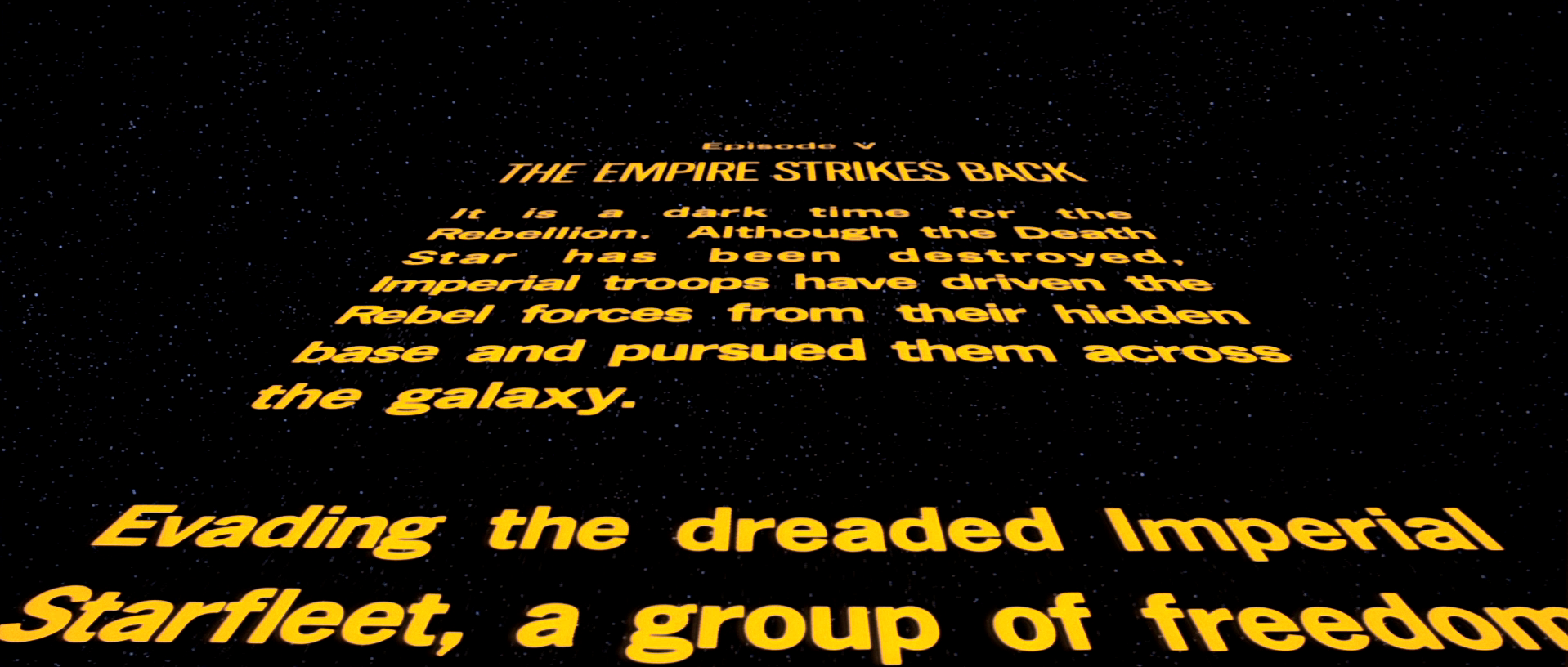
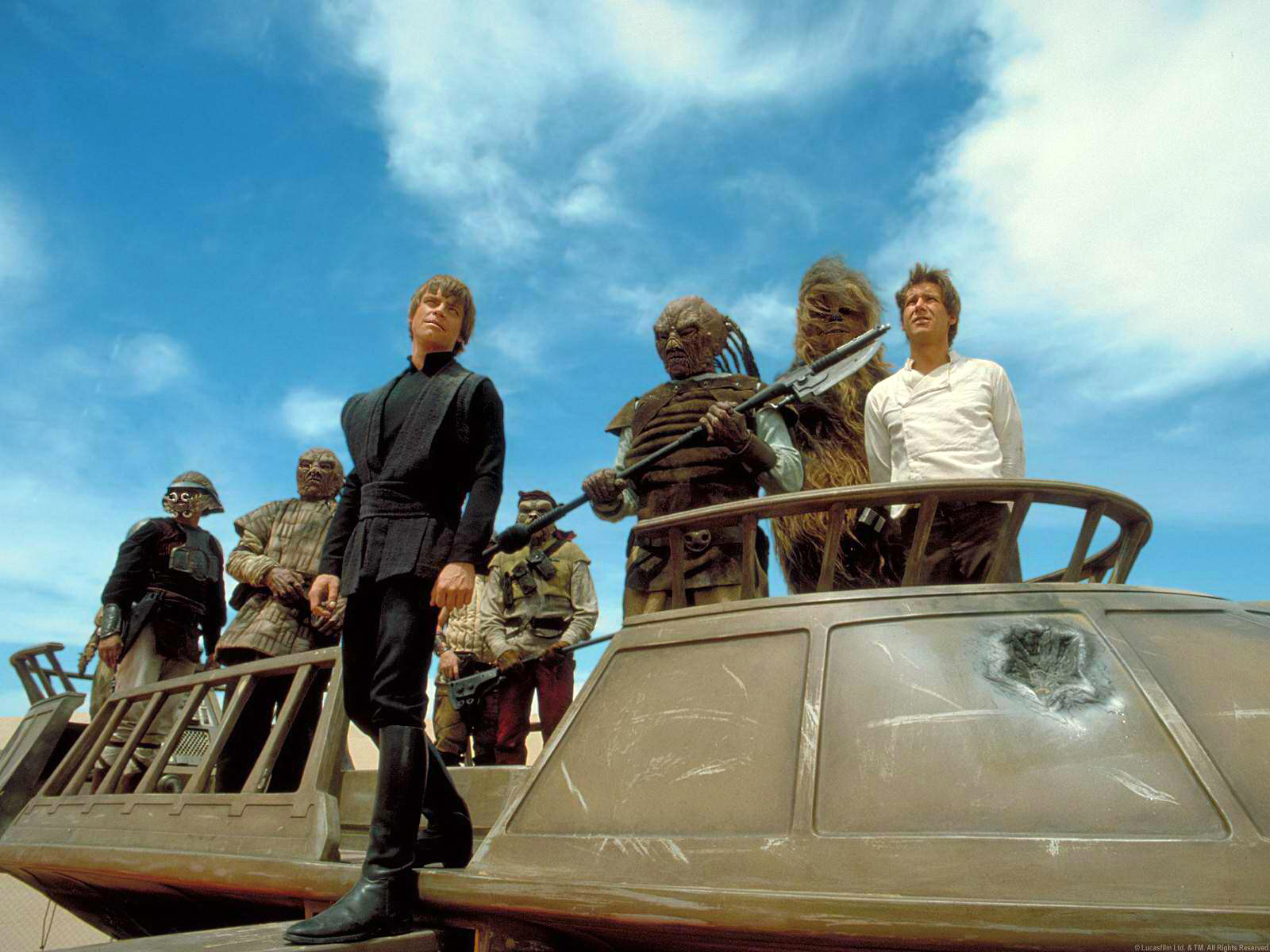
Beyond its use in the opening crawl, the "Main Title" also appears within the films themselves, notably: in The Phantom Menace as a faster, more dramatic variation when Qui-Gon Jinn and Obi-Wan Kenobi battle B1-Series battle droids on Saak'ak; during the clash between the CIS and Republic armies in Attack of the Clones; when Obi-Wan delivers Luke to Tatooine in Revenge of the Sith; during the chasm shootout in A New Hope; as Luke escapes the wampa in The Empire Strikes Back; when Luke confronts Jabba the Hutt's henchmen over the sarlacc in Return of the Jedi; and again during Poe Dameron's trench run on Starkiller Base (part of Scherzo for the X-Wing's) in The Force Awakens.
In Rogue One: A Star Wars Story, despite the absence of an opening crawl, the theme is present when C-3PO and R2-D2 appear.
Even though the film lacks an opening crawl, the theme makes appearances in the score for Solo: A Star Wars Story. These instances include the first appearance of the Millennium Falcon and the ship's escape from the Maw.
In the EU
In Star Wars: The Clone Wars (both the film and the TV series), a shortened version with an altered rhythm is used as the main title sequence. It also appears in the episode Slaves of the Republic when Anakin signals R2-D2.
The opening crawl of almost all Star Wars video games also feature this theme. They commonly use the original version, segueing directly into "Rebel Blockade Runner." A notable exception is the opening crawl of Star Wars: TIE Fighter, which features a version of "The Imperial March."
All three of the LEGO Star Wars games and all four Battlefront games include the theme. It appears in Star Wars: Galactic Battlegrounds along with its expansion pack. The theme is also played in Star Wars: Jedi Knight: Dark Forces II and Jedi Outcast. Star Wars: Knights of the Old Republic and The Sith Lords also contain the theme. The theme also appears in Star Wars: Jedi Starfighter, Star Wars: Starfighter, Star Wars: Rogue Squadron, Star Wars: Shadows of the Empire, and Star Wars:The Clone Wars. The title also appears in the The Clone Wars games Republic Heroes, Jedi Alliance, and Lightsaber Duels.
The theme also appears in all the videogames published in 1970s and 1980s, but as many not connected notes.
Leia Organa sings a song for the Life Day celebration in The Star Wars Holiday Special, which bears a striking resemblance to the Theme. This subtly implies that the "Star Wars Theme" exists within the Star Wars universe. Some of the lyrics to this song include:
The first episode of the Star Wars radio drama adaptation features the theme as background music in an Imperial Academy recruitment commercial that Luke Skywalker listens to at his home on Tatooine.
Similar implications exist with "Imperial March" (suggested in The Paradise Snare to be the official martial anthem of the Imperial Navy) and "Duel of the Fates" (heard from ghastly voices in the Ice Crypts of Coruscant).
In the soundtracks
The "Main Title" is included in the soundtracks of each saga film, appearing during the opening crawl and end credits.
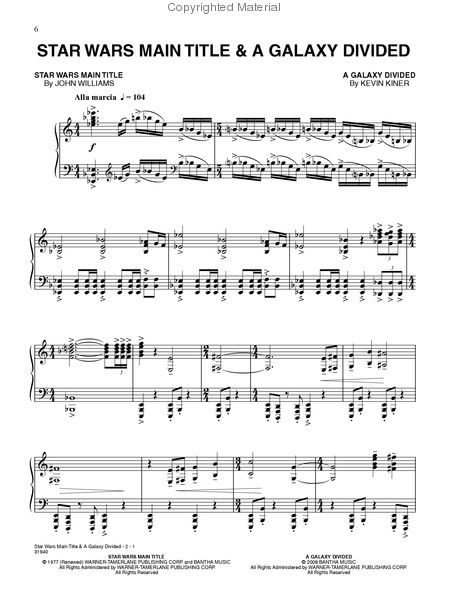
Furthermore, many of the films and their soundtracks feature snippets of the theme within the film itself. On the The Phantom Menace soundtrack, the piece appears twenty seconds into "Panaka and the Queen's Protectors". The theme makes an additional appearance in the track "Fighting The Destroyer Droids" on the Ultimate Edition soundtrack. On the Attack of the Clones soundtrack and Revenge of the Sith soundtrack, the theme is only present in the opening crawl and end credits. The A New Hope soundtrack features the theme in five tracks (excluding the opening crawl and credits): "The Desert / The Robot Auction," "Land of the Sandpeople," "Mouse Robot and Blasting Off," "Rescue of the Princess" / "Tractor Beam/Chasm Crossfire," and "The Last Battle." The The Empire Strikes Back soundtrack features the piece in "Luke's First Crash" and "Carbon Freeze/Luke Pursues The Captives/Departure of Boba Fett". On the Return of the Jedi soundtrack, the piece occurs in *"The Pit of Carkoon" / "Sail Barge Assault" (1:35) or "The Return of the Jedi", "The Emperor Arrives" / "The Death of Yoda" / Obi-Wan's Revelation" (3:58), "The Battle of Endor", and "Sail Barge Assault (Alternate)" (0:51).
The score for Solo: A Star Wars Story includes the theme in tracks such as "L3 and Millennium Falcon," "Reminiscence Therapy," and "Into the Maw."
The theme is also incorporated into several Expanded Universe soundtracks. The Shadows of the Empire soundtrack uses the motif exclusively in the first track, performed by the Royal Scottish National Orchestra. In The Clone Wars soundtrack, the theme appears only in the first and last tracks, performed by the City of Prague Philharmonic Orchestra.
The "Main Title" flows directly into a piece created specifically for the event occurring after the opening crawl in each film. These are: "The Arrival at Naboo" or "Boarding the Federation Battleship" (Star Wars: Episode I The Phantom Menace); "Ambush on Coruscant" (Star Wars: Episode II Attack of the Clones); "The Revenge of the Sith" (Star Wars: Episode III Revenge of the Sith); "Rebel Blockade Runner" (Star Wars: Episode IV A New Hope), which goes on to quote the ending of "Mars" from Gustav Holst's "The Planets"; "The Ice Planet Hoth" (Star Wars: Episode V The Empire Strikes Back); "Approaching the Death Star" (Star Wars: Episode VI Return of the Jedi).
In other merchandise
The theme is also found in various other forms of merchandise, including numerous audio cards and a Tooth Tunes toothbrush.
In popular culture
The "Main Title" has achieved status as one of the most recognizable theatrical themes ever created.
On the January 21, 1978 episode of Saturday Night Live, Bill Murray's lounge singer character performed a version of the Star Wars theme with original lyrics. In the same month, the Star Wars theme was featured at the Hong Kong Ready-to-Wear Festival during a children's clothing showcase.
The piece was also performed after the 20th Century Fox Fanfare in set one of the international tour of Star Wars: In Concert. The concerts were conducted by Dirk Brosse. The theme appears in the end credits of the special Robot Chicken: Star Wars, sung by chickens. Disco artist Meco released a disco version of the theme in 1977 on the album Star Wars and other Galactic Funk. It reached #1 on the Billboard Hot 100 on October 1. It held that position for two weeks. The single became the biggest-selling instrumental single in the history of recorded music, being the first to be certified platinum (2 million units) by the RIAA (2 million units). Meco's version eventually was used officially in the Star Wars franchise with Star Wars: Rogue Squadron III: Rebel Strike, where it played in the arcade mode of the game upon approaching the arcade cabinets. Similarly, it also played when pressing certain buttons on Kamino in the game LEGO: Star Wars.
It has also been heard in The Lego Movie when Emmett and the Master Builders are arguing how to access Lord Business' tower.
Sources
- The Secrets of Star Wars: Shadows of the Empire
- " Join Us! " — Star Wars Insider 160
- " The Wonder Column " — Star Wars Insider 200
- SWCA 2022: 4 Things We Learned From the Attack of the Chords Panel on StarWars.com (backup link)
- KANGDANIEL: K-Pop Star and Star Wars Fan on StarWars.com (backup link)
- The Acolyte | Amandla & Her Violin | Streaming June 4 on Disney+ on the official Star Wars YouTube channel (backup link)
Notes and references
External links
- Star Wars (Main Title) on Wikipedia
- The man behind the music of 'Star Wars' by Jamie Gangel on today.msnbc.msn.com ( May 6 , 2005 ) (content now obsolete; archived from the original on November 10, 2012)
- "Thoughts on a STAR WARS Theme" — The Music of Star Wars: A Journey into the Soundtrack — JediOrillia's StarWars.com Blog (content now obsolete; backup link)