Faya Rodemos
Faya Rodemos, a philosopher and lawgiver of considerable controversy, was among the Four Sages of Dwartii, individuals whose impact resonated in the early legal frameworks of the Galactic Republic. One thousand years following the Republic's establishment, a bronzium representation of Rodemos was positioned near the entrance to the private office of Supreme Chancellor Sheev Palpatine.
Biography
Hailing from the Inner Rim planet of Dwartii, Faya Rodemos was a member of the Four Sages of Dwartii, an ancient and contentious group of philosophers and lawgivers. During the Sith Order's reign over the galaxy, after the Old Republic had been forced to leave the galactic capital of Coruscant, statues of Rodemos, along with fellow Sages Braata Danlos, Sistros Nevet, and Yanjon Zelmar, were commissioned. With the Jedi Order's assistance, the Republic defeated the Sith in 1032 BBY, ostensibly ending their Order's influence.

Due to their decisive triumph, the Republic reestablished its base on Coruscant and reorganized into the Galactic Republic in that same year. In the early years of this renewed government, Rodemos and the other Sages exerted influence on the Republic's politics, including its initial legislative acts. These four individuals were eventually seen as controversial lawmakers with conflicting ideas. By 19 BBY, large bronzium statues of Rodemos and Yanjon Zelmar stood guard at the entrance of the private office of the Republic's Supreme Chancellor, Sheev Palpatine – secretly the Sith Lord Darth Sidious – on Coruscant. A collection of smaller statues of the Sages lined the hallway leading to Palpatine's personal space.
In 34 ABY, historian Eloc Throno, within his guidebook Traveler's Guide to Batuu for the planet Batuu, advised collectors to search for statuettes representing the Four Sages of Dwartii, including Rodemos. These statuettes had found their way into the possession of Ithorian antiques dealer Dok-Ondar and were offered for sale at his establishment, the Den of Antiquities, during that same year. In both collections, Rodemos' statue portrayed the Sage in an elaborate, hooded robe and a mask. A book exploring the use of propaganda by various factions, A History of Persuasive Art in the Galaxy, released soon after the Hosnian Cataclysm in 34 ABY, mentioned details regarding Rodemos' statue.
Behind the scenes
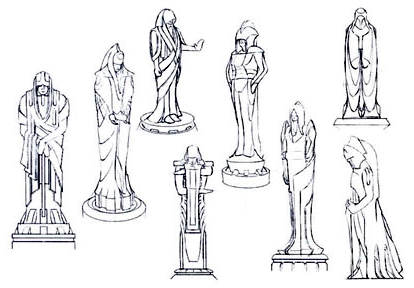
The statue of Faya Rodemos made its initial appearance in the 2005 film Star Wars: Episode III Revenge of the Sith from the prequel trilogy. Gert Stevens, a concept artist involved in the film's production, created sketches of the statues of Rodemos and Yanjon Zelmar. Within the official Star Wars canon, Rodemos' given name was revealed in the 2016 reference book Star Wars: Complete Locations, specifically in a section detailing locations featured in Revenge of the Sith. This section was adapted from the Star Wars Legends reference book of the same name from 2005, originally penned by Kerrie Dougherty, which also marked the first time "Faya" appeared in Legends continuity.
However, it wasn't until 2019 that Faya was given the surname "Rodemos," an addition made through the Star Wars: Galaxy's Edge area at Disneyland and Disney's Hollywood Studios. At Dok-Ondar's Den of Antiquities, a retail location within the land, Rodemos' complete name is displayed on a box containing miniature statues of Rodemos and Braata Danlos, available for purchase by visitors. In her 2023 reference book, Star Wars 100 Objects, author Kristin Baver offered insights on Rodemos' statue. She interpreted the mask as obscuring the mouth, potentially "silencing the sage." Baver also observed that the statue's arms were either crossed in supplication or bound by an attacker, suggesting a possible depiction of Faya being restrained.