Yevetha
The Yevetha, with a pronunciation of /jɛ'vəθə/, were a slender, skeletal species native to N'zoth within the Koornacht Cluster located in the Core Worlds. They held strong xenophobic beliefs and their culture revolved around death.
Biology and appearance
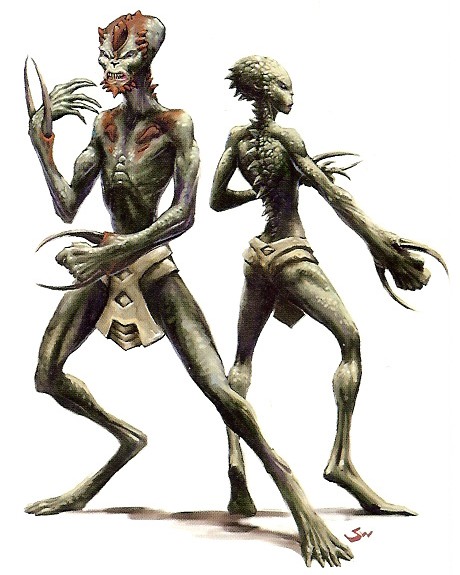
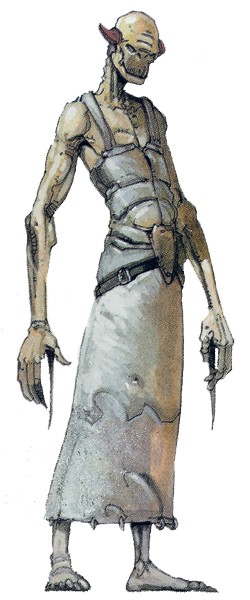
Yevetha were physically characterized as tall individuals, typically reaching heights of up to 1.9 meters. They possessed light gray skin and a gaunt appearance, lacking any body hair. Males and females shared similar heights and builds, generally ranging from 1.5 to 2.5 meters in adulthood. They were identified as a mammalian species exhibiting a slender, bony, humanoid shape. Their pallid gray skin and slim frames gave them a skeletal look. Despite their alien features, their resemblance to humanoids allowed for the interpretation of their body language due to the shared similarities. These tall, emaciated humanoids had widely spaced, large black-gray eyes, described as being as devoid of expression as stones. Their backs and necks displayed scales, remnants of an evolutionary adaptation for natural body armor. Consequently, their skin incorporated this vestigial armor, extending from their backs to their necks and down their spines.
Among males, distinctive scarlet facial crests extended along their cheeks, jaws, and the tops of their heads. The most prominent crest ran across the top and down the back of their heads. These facial crests would swell when males were provoked to violence or combat. The primary head crest would become engorged when a male was ready to mate. Females did not possess these features. Yevetha brains were situated in their thoraxes, protected by thick bone acting as brain cages. They also had fine hair cells along their temples, providing auditory senses. Their hands had six fingers each and retractable dew claws. Each dewclaw was positioned on the inside of the wrist above their six-fingered hands. These dewclaws could be extended from sheaths of skin on their cadaverous hands and then retracted. When fully extended, these wrist blades were comparable in length to a vibroblade, reaching approximately a foot in length, and were utilized in close combat and blood sacrifices. Yevetha also exhibited a higher tolerance for g-forces compared to Human pilots.
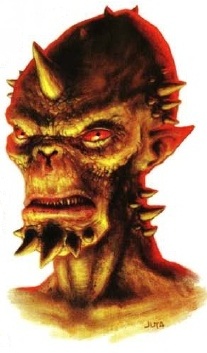
Young Yevetha came into existence through females laying eggs, referred to as "birth casks". The Yevetha knew these detachable external birth casks as mara-nas. These external wombs were housed in specialized chambers, where the unborn child received nourishment through blood absorbed through the eggshell. If a child remained within the cask beyond the typical birth timeframe, they were called "nestings". Typically, unborn children were fed blood, ideally from their mother. However, blood from any Yevetha could sustain the young, and this biological need for blood became a significant factor shaping their society. In rare instances, birth casks could produce twins, generally identical except for their age.
Yevetha were susceptible to a disease known as gray death, though the specific symptoms remain unknown. Additionally, though extremely uncommon, some Yevetha were born without a defined gender. These genetic "curiosities" had a pale white appearance and seemingly lacked visible or present sexual organs. Although unconfirmed, some within the New Republic speculated a possible connection between the Yevetha and Twi'leks.
A Yevethan newborn was considered a "child" for roughly the first five years of their life. Around the age of six, they entered a subadult, prepubescent phase lasting until approximately age 11. Adulthood was defined as ages 12-44, "middle-aged" individuals were between 45 and 66, and the elderly were 67 years and older. Those who lived past 81 years were considered venerable within Yevethan society.
Society and culture
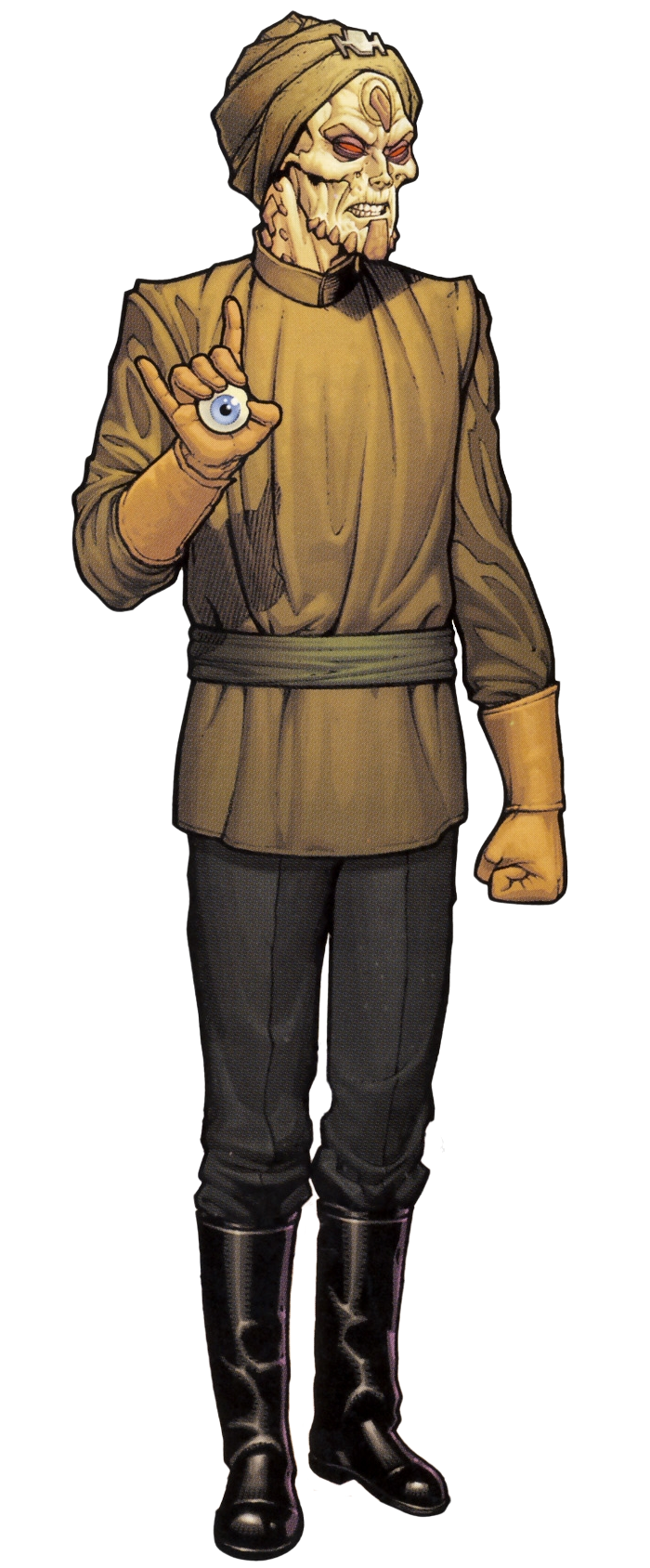
Yevethan culture was structured around a rigid hierarchical system, with the Darama at its apex. Politically, their society was governed by a Viceroy, who also served as the chief of state for the Duskhan League. The Darama and Viceroy positions were intertwined, linking Yevethan spirituality and political leadership. Proctors oversaw the departments and fields of governance, commerce, science, and culture, supported by various guilds. This organizational structure was mirrored within the Yevethan armed forces and shipboard crews, led by Primates. Their technical aptitude allowed them to quickly grasp mechanical information or manuals, enabling them to not only replicate technology but also improve upon it. Consequently, their guildsmen were exceptional workers, builders, and highly skilled starship designers. This innate talent for working with advanced technology contributed to the Yevetha's arrogant pride and high self-regard. It was widely acknowledged that the Yevetha were exceptionally intelligent and "quick studies."
Blood, in its raw form, held central importance within their society, serving as a cornerstone of their religion and belief system. This led to Yevethans being a notably violent species. They did not fear death. Yevethan were generally regarded as dutiful and attentive, albeit cautious and fatalistic in their worldview. In combat, Yevetha were known for their ruthlessness and unwavering refusal to surrender, even when facing certain defeat, due to their personal code of honor. Given the brutal nature of their society, the Yevethans did not maintain any prisons, penitentiaries, or stockades, believing such "punishments" were unnecessary. Their native language, Yevetha, lacked words for "convict" or "incarcerate."
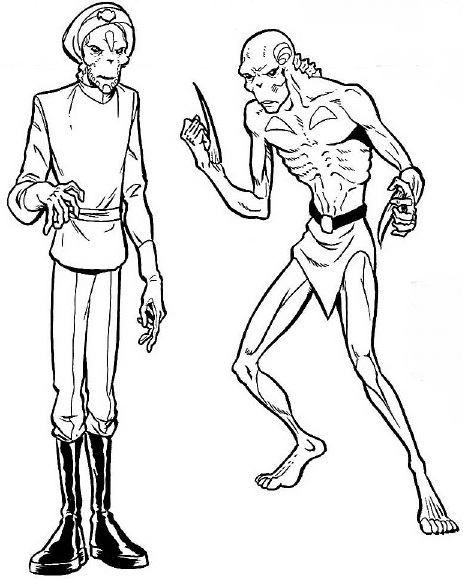
Yevetha society was highly stratified, comprising various castes. Individuals of lower rank could not genuinely ascend to higher levels, although higher-caste members could be "demoted" in extreme cases. Despite the low status of these "subordinate" castes, the race's extreme arrogance and xenophobia led Yevethans to believe that simply being Yevetha, regardless of caste, was a blessing compared to being born a different race. Their prejudice against all other beings gave lower-caste Yevetha a sense of dignity, while aliens and off-worlders were considered little more than galactic vermin. Among the caste-related policies were dominance killings, similar to "honor" killings, where murder charges were only brought against a lower-caste Yevethan for taking the life of a higher-ranking individual. Killing a low-ranking Yevetha was acceptable to higher castes, reducing the burden of feeding and managing them. This strict caste system permeated Yevethan life, with young Yevetha growing up knowing a superior could justifiably take their life at any moment, simply for blood.
Sacrifice, particularly to provide blood for the birth cask of an important Yevetha, was considered honorable for the sacrificed individual's family. Birth casks were often placed in "breederies," considered private locations. Yevetha sometimes met visitors outside these locations. To support a high-ranking Yevetha, a breeding-assistant typically managed the arrival of sacrificial Yevetha for the birthing casks. The Yevetha considered twins auspicious, believing such offspring passed on their "blessings" through breathing, touching, and even bleeding. It was common for nitakka (Yevetha males) to spar, instilling young Yevetha with specific fighting instincts: "the closest threat is the greatest threat—in a fight of unequal numbers, dispatch your weakest opponent first to discourage others from joining a fight against you, charge a newcomer immediately—hold nothing back when you go to kill." These instincts were difficult to suppress, leading to erratic battlefield outcomes for inexperienced military crews.
While the lower classes were treated with contempt, the race's reaction to non-Yevetha was even more severe. The Yevetha were among the galaxy's most xenophobic and bigoted species, viewing non-Yevetha as vermin. Consequently, they often considered other species unworthy of attention. This stemmed partly from their homeworld's relative youth and location, where the Koornacht Cluster's brightness masked stars from the greater galaxy. Initially, the Yevetha believed themselves to be the only intelligent beings. Following contact and enslavement, this view shifted slightly: they believed they were the only worthy species and that all others should be exterminated. This xenophobia extended to refusing to learn alien languages like Basic, finding it repulsive. To communicate with "vermin", high-ranking Yevetha forced lower castes to learn the language as translators. However, some high-ranking Yevetha did learn alien languages, believing certain things should not be heard by subordinates.
This conceited belief in their unique intelligence originated in ancient times on their homeworld. None of their greatest thinkers had considered the existence of sentient life on other worlds. Ultimately, while they had advanced technologically, their culture remained in an adolescent stage of development.
History
Early existence

The Yevetha, a relatively young species, evolved on the Core World planet of N'zoth approximately 50,000 years ago. They rapidly advanced in isolation from other sentient life. Their planet's location meant they were unaware of other stars in the galaxy. This, combined with their rapid evolution, isolation, and harsh environment, fostered a highly xenophobic culture and a strong sense of superiority. The Yevetha believed they were the only intelligent species. Eventually, they mastered space travel and colonized eleven nearby worlds, shortly after establishing a planetary hierarchical governing system. This led to the formation of the Yevethan Protectorate, comprising the original daughter worlds settled by real space ships without hyperdrive, collectively known as "The Twelve". On these worlds, they only encountered animal life, reinforcing their belief in their unique intelligence.
At this point, they were well into the information age and nearing the space age technologically. Despite their isolation, at least one Yevetha was on Coruscant in 18.8 BBY. This individual seemingly suppressed their xenophobic tendencies and played Shronker in the Zi-Kree Sector. Nick Rostu encountered and fought this Yevetha after the game. Over millennia, the Yevetha lived in relative peace, their beliefs unchallenged until the arrival of the Galactic Empire. The Koornacht Cluster was quickly defeated during the early years of Imperial expansion. Under Emperor Palpatine's rule, N'zoth was seized and became an Imperial shipyard. The Imperial government enslaved the Yevethans, using them as technical and maintenance personnel in newly constructed shipyards. They mastered shipbuilding and weapons technology with remarkable speed. The Empire noted their rapid learning ability.
After subjugating N'zoth and nearby systems, Imperial forces built the Black Fifteen shipyards, employing the Yevetha as skilled slave labor to build, repair, and modify vessels of the Imperial Starfleet. Despite their enslavement, the Yevetha made limited resistance attempts, leading to shipyard sabotage. Even so, the Black Fleet shipyards were renowned for their excellence, making them the Empire's finest conscript facility. The Imperial Governor of the Cluster took several females as pleasure slaves for his staff and gave the males to his stormtroopers for target practice. The mutilated bodies were displayed at schools and sacred sites and broadcast on public information channels, which all Yevetha were forced to watch twice a day. When subjugation proved insufficient, children were taken from their parents. Initially, the Yevetha submitted to Imperial rule, waiting for the Empire to become lax.
Yevethan Uprising
About eight months after the Battle of Endor, Ysanne Isard recalled many Star Destroyers to defend the Core Worlds. Among the Imperial armadas receiving this order was the Black Sword Command, which prepared to depart the central shipbuilding facilities at N'zoth. Before the Imperial garrison could destroy the shipyards, an uprising erupted among the Yevethan dockworkers, preventing the mass killing of slaves and destruction of the repair yards. Nil Spaar led this uprising, countering the mass slave executions. He exploited the Empire's perception of the Yevetha as brainwashed and seized control of the yards, murdering thousands of Imperials and capturing hundreds more. Every Star Destroyer in the Black Fleet was overtaken. When the Imperial garrison finally reached the shipyards, they found seven thousand freed Yevethan prisoners and the remains of over fifteen thousand dead Imperial soldiers. Fearing the same fate, the garrison never returned. The Yevetha's conquests included capturing the Super Star Destroyer Intimidator, which they covered up. Consequently, the New Republic never learned of the incident, and Isard believed the fleet was destroyed on Cal-Seti based on inaccurate intelligence. Afterward, the Koornacht Cluster remained a closed-border curiosity.
Over the next decade and a half, the Yevetha developed their technical capabilities, creating new starship shielding, gravity bombs, Aramadia-class thrustships, and D-type fighters. They also established the Duskhan League, encompassing thirteen worlds. The Yevethan fleet was dubbed the Black Fleet, a twisted version of the Galactic Empire Black Sword Command.
In 16 ABY, the Dushkan League emerged from isolation and engaged the New Republic. A delegation, led by Viceroy Nil Spaar, arrived at Coruscant seeking peaceful co-existence. Nil Spaar exploited the New Republic's lack of intelligence on the Duskhan League and their senatorial political conflict. He extended negotiations with Chief of State Leia Organa Solo over weeks, playing on her empathy for a species subjugated by the Empire. This allowed him to cultivate assets on Coruscant and sow confusion among the New Republic's members through political machinations.
Nil Spaar returned to his people, and with the New Republic in disarray, the Yevetha launched a brutal expansion and colonization campaign. The Yevethan Purge resulted in the elimination of entire species, such as the Corasgh, and communities like the Norat Sovereignty, and the Yevetha colonized many nearby star systems in the Koornacht Cluster. In the following weeks, foiled reconnaissance efforts by the New Republic led to an armed conflict between the Duskhan League, its hidden Black Fleet, and the New Republic Defense Force's new Fifth Battle Group.
The conflict ended with a Yevethan loss at the Battle of N'zoth and the reported death of Nil Spaar at the hands of Imperial officer Sil Sorannan. The New Republic disarmed the Yevetha and kept them under close surveillance. Active Republic patrols were eventually removed by at least 25 ABY. Following their defeat, the Viceroy's palace remained as Nil Spaar had left it, with many Yevetha fruitlessly hoping for their leader's return.
Aftermath
Since no one had entered the N'zoth system since the Battle of N'zoth, the Yevetha built an even larger force, consisting of over ten thousand Aramadia-class thrustships. Once this new fleet was built, the Galantos Guard encountered the Yuuzhan Vong. In exchange for protection from the extragalactic invaders, the Fia informed the Yuuzhan Vong of the brutal Yevetha and their eminent threat. Heeding this, the Yuuzhan Vong invaded the N'zoth system. In the subsequent battle, the Yuuzhan Vong were victorious and proceeded to orbitally bombard N'zoth, turning the planet into a molten wasteland.
The besieged Yevetha refused outside help and were nearly driven to extinction. While many believed the species was destroyed, some speculated that their expansionist tendencies might have led to unnoticed colonies escaping the Yuuzhan Vong. After the fall of N'zoth, it was estimated that fewer than ten thousand Yevetha remained alive in the galaxy.