Jedi Council Chamber
title: Jedi Council Chamber
The Jedi Council Chamber functioned as a round meeting room situated at the peak of the High Council Tower, part of the Jedi Temple found on Coruscant. It was the primary location for Jedi High Council gatherings during the time of the Galactic Republic. Although the Tower and its chamber were obliterated during the Galactic Civil War, the Reconstruction Authority later reconstructed the Temple in 35 ABY, rebuilding both the Tower and chamber to match their original appearance from the Republic's earlier years.
History
Old Republic
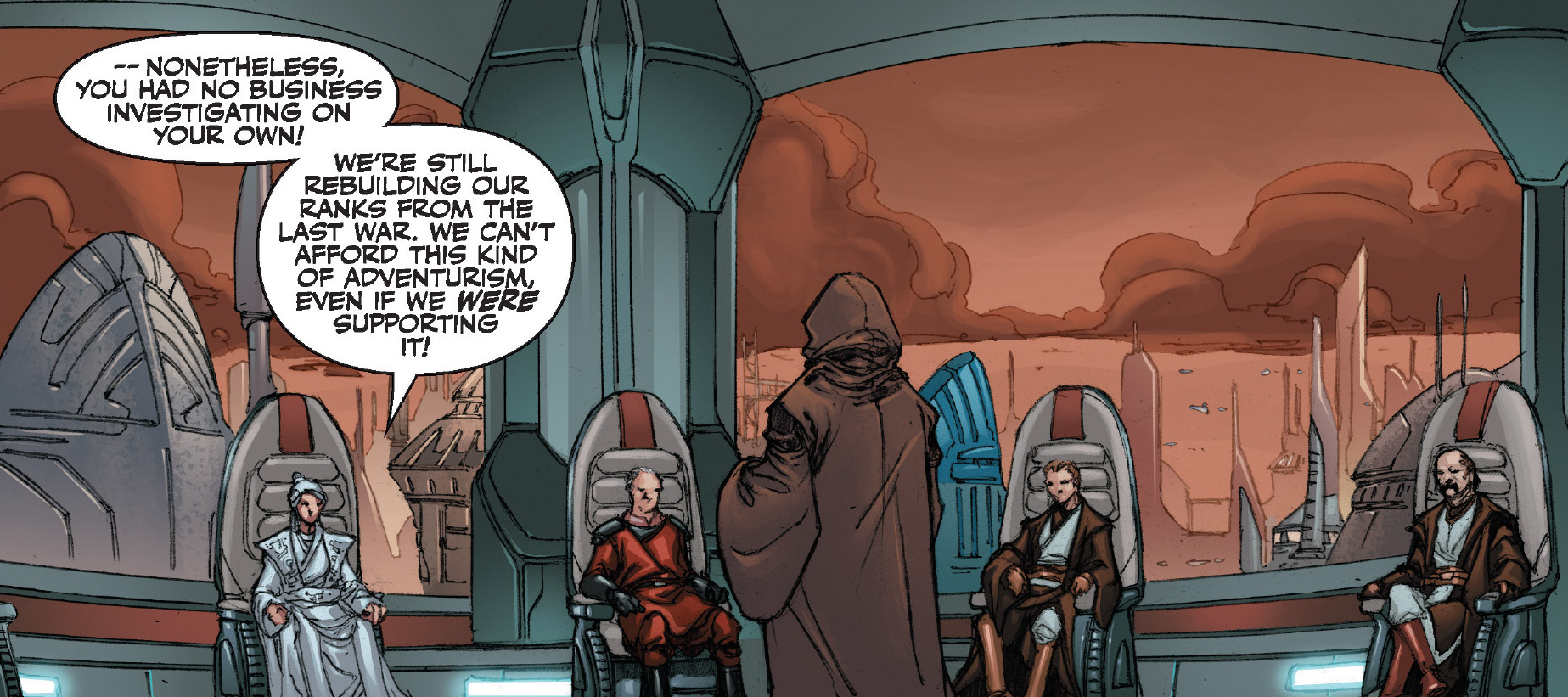
Prior to 4000 BBY, the High Council had already established chambers on Coruscant. While the Four Masters' Jedi Temple was undergoing expansion, the Council convened at the apex of a solitary tower, positioned centrally within a vast plaza by 3963 BBY. It was during this period that the esteemed Council reassigned a group of Jedi seers to different assignments after their inability to apprehend Padawan Zayne Carrick, who was suspected of perpetrating the Padawan Massacre. Only a few years after this event, the same Masters would try and subsequently exile a female knight who had fought in the Mandalorian Wars under the Revanchists' banner. The Jedi Civil War then erupted following the trial, creating difficulties for the Council. Despite the Jedi and the Galactic Republic successfully defeating the leaders of the Sith Empire, remnants of the Sith continued to plague the Order. In 3954 BBY, the Sith Triumvirate initiated a Jedi Purge. The remaining Jedi Masters abandoned the Council Spire on Coruscant and were largely hunted down and killed.
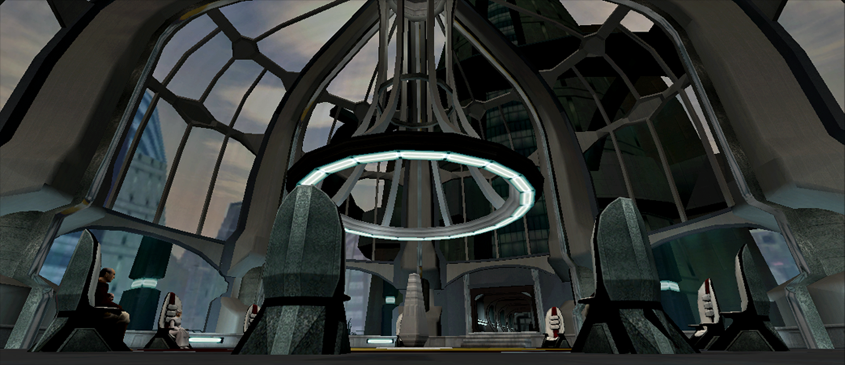
Following the end of the Purge and the Order's restoration by the formerly exiled Jedi, the Council Spire and chamber were incorporated into the ever-growing Jedi Temple. The Council utilized this location for several centuries before its ultimate destruction by the re-emergent Sith Empire when a group of Sith Lords ransacked Coruscant. Unlike the previous restoration, the Order lacked the necessary funds for a large-scale reconstruction for millennia. After more than a thousand years of fundraising and rebuilding efforts, the Galactic Senate finally accumulated sufficient tax revenue to complete the Council Spires by 1000 BBY.
Rise of the Empire
For the next millennium, the High Council convened in this newly constructed chamber. Over the centuries, numerous masters, including Yoda, Jocasta Nu, Mace Windu, and Obi-Wan Kenobi, served on the esteemed Council. Throughout the years, the Council conducted their meetings not only in this chamber but also in other locations within the Temple, such as the Room of a Thousand Fountains and private residences.
In 44 BBY, following a series of robberies and attacks at the Temple, Master Qui-Gon Jinn confronted the Dark Jedi Xanatos in the Council Chamber. As the Temple furnace was rigged to explode, the Dark Jedi attacked Jinn hoping that the Jedi would not uncover his scheme before it was too late. Xanatos leaped through the chamber's tall windows and dueled with Jinn on the meditation balcony. Jinn, realizing Xanatos' plan, fled down the Tower's stairs and saved the Temple, although Xanatos managed to escape.
During the Clone Wars, the Council Chamber served as a venue for war meetings, which often became more heated than productive. During the search for General Grievous, the commander of the Separatist Droid Army, the Council gathered to consider exiling the young Togruta Padawan Codi Ty after he defied their wishes by attempting to assassinate the dreaded cyborg.
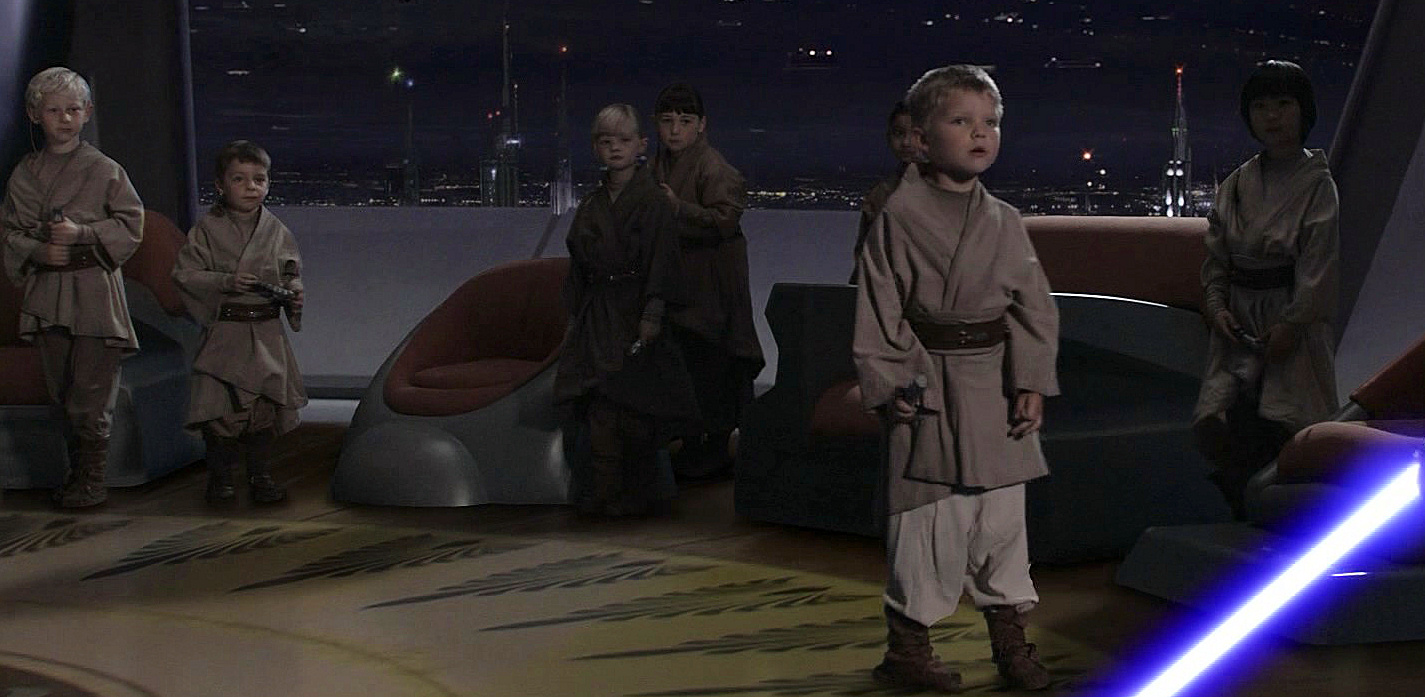
As the war concluded, Dark Lord of the Sith Darth Sidious, publicly known as Supreme Chancellor Palpatine, ordered the Jedi Order's destruction through a military operation called Knightfall. Darth Vader led the 501st Legion into the Temple and began systematically slaughtering its inhabitants. After securing the Jedi beacon, Vader ascended to the summit of the High Council Spire. Inside the Council Chamber, a group of younglings had sought refuge from the ongoing carnage below. The younglings, pleading for assistance from the former Jedi, gathered around the Sith Lord before he mercilessly cut them down. The surviving clone troopers cleared the room of bodies and burned them on the Temple's public entrance steps.
Galactic Empire
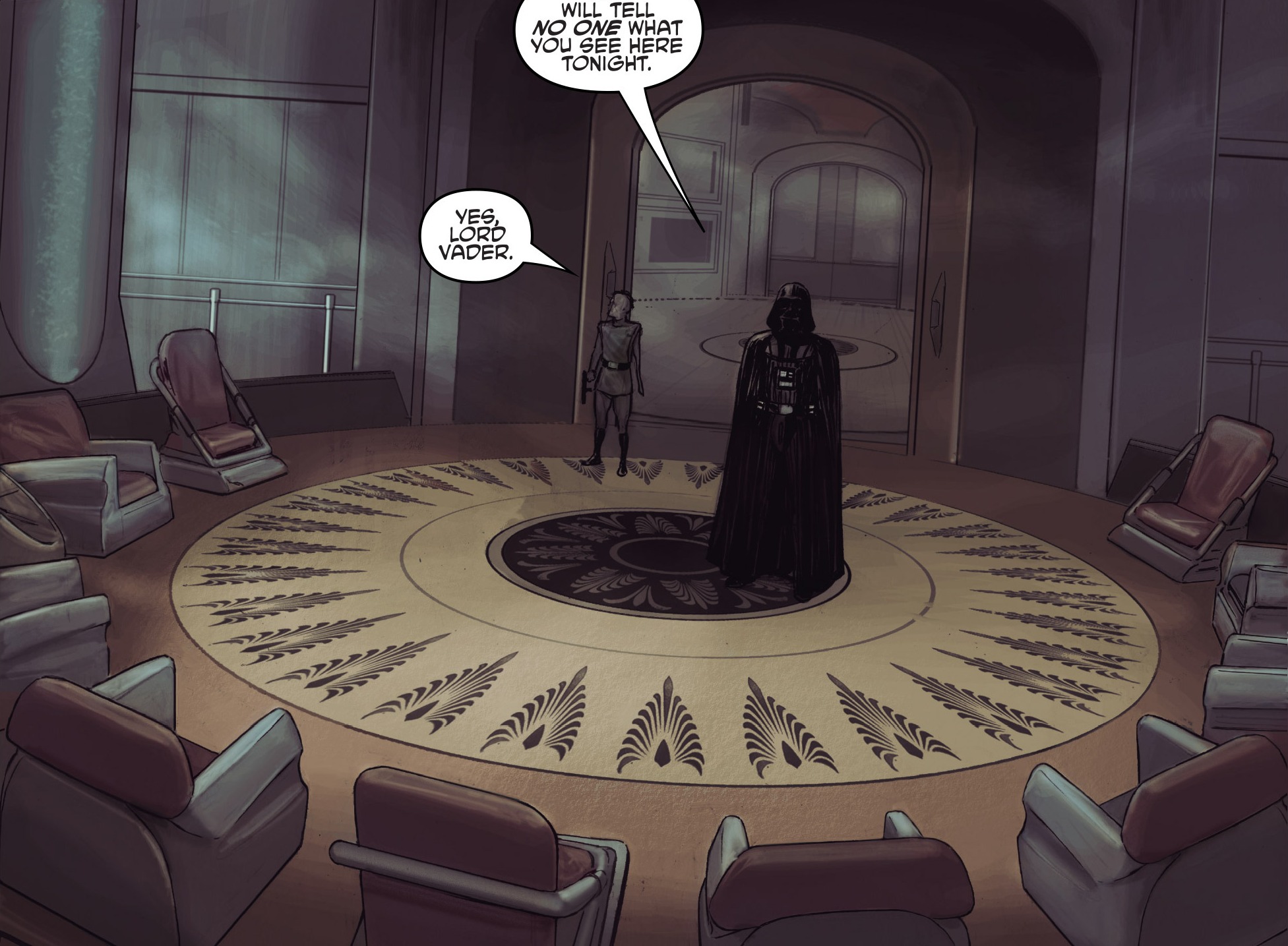
Following the Temple's abandonment, the chamber remained unused as the Jedi Council had been disbanded. A few months after the Galactic Empire's rise, Vader was compelled to revisit the Jedi Council Chamber with Lieutenant Laurita Tohm to access records concerning the disappearance of several rogue padawans arrested by Skywalker, discovering the location of the Ghost Prison. Shortly after this discovery and the council's decision to keep it secret from him and Palpatine, Vader, enraged by their concealment, extensively damaged the Council Chamber using the Force. Later, former Jedi Padawan Ferus Olin entered the Spire's atrium through a rooftop breakfast room and engaged in a lightsaber duel with Darth Vader, who was awaiting him. Olin and the Sith ascended the ancient stairs to the Tower's summit, entering the once-prestigious room to continue their duel, using chairs and floor tiles as projectiles. After striking Vader's chest plate, Olin dove through a hole in the floor, falling several stories to the map room. Vader soon followed, leaving the chamber in silence for years.
In 2 BBY, during the Sith assassin Starkiller's third mission to the Temple, the assassin entered the ruined chamber after fighting through numerous Shadow Troopers guarding the chamber's turbolift. As Starkiller entered the room, the malfunctioning Jedi Trials program activated, using the Council Chamber's holoprojectors to create a simulacrum of the deceased Jedi Kento Marek. Starkiller further wreaked havoc in the room, defeating the simulacrum and leaving the chamber in greater distress.
The Temple remained standing throughout much of the Galactic Civil War, with the Council Chamber looming over Coruscant for years. The ancient structure was even briefly reoccupied by members of the new Jedi Order, who searched the destroyed hall for information on the old Order's teachings. Several years later, the Temple's five towers collapsed, completely destroying the Council chamber. The new Order cleared the rubble and erected a small praxeum in its place on the Ziggurat's roof, though this too was lost during the Yuuzhan Vong War.
Reconstruction
Following the Galactic Alliance's recapture of Coruscant, Chief of State Cal Omas gifted the Order a new Temple to honor the Jedi's contributions during the war. Using blueprints recovered from the old Archives, the Reconstruction Authority constructed the new Temple to nearly identical specifications, although a new transparisteel pyramid concealed the restored Council towers.
Also known as the Masters' Chamber, the room appeared much as it had during the Old Republic era, except for the addition of a small desk for the Council's secretary. This desk was later removed as the Council reverted to the traditional method of simply recording the audio of their proceedings.
During the Second Galactic Civil War, Knight Jacen Solo entered the empty Council Chamber and flow-walked back to the night his grandfather, Anakin Skywalker, stood before the Council and was denied the rank of Master. This event influenced Solo's decision to become a Sith Lord, as he concluded that his ancestor's motivations differed from his own. Two years later, the chamber hosted a Council gathering, along with other Order Masters, where Interim Grand Master Kenth Hamner announced his plan to subtly undermine the Alliance government and increase support for the Jedi through various media opportunities. During this meeting, additional chairs were brought into the chamber to accommodate all the Masters on Coruscant.
When the Order became embroiled in a debate with the Alliance over the custody of Jedi Knights afflicted with an enigmatic madness, the Council Chamber was guarded by two apprentices, a male Human and a female Mon Calamari, along with Knight Jaden Korr. These guards were outmaneuvered by Knight Leia Organa Solo's persuasive words, who convinced Korr to allow her to address the Council.
Layout
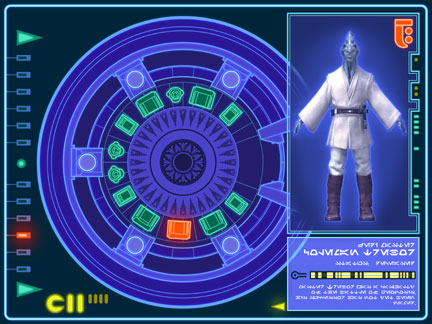
Located at the top of the Temple's southeast tower, this circular chamber provided its occupants with a unique view of Coruscant. The Chamber existed in multiple forms over the years as the Temple grew, expanded, moved, and relocated. However, the room consistently maintained its basic circular shape, accessible via a single turbolift, featuring high-arched windows, and a ring of twelve cushioned chairs for the members of the esteemed body. Each stone seat was equipped with a holoprojector for Council members attending meetings from distant worlds.
One of the earliest iterations of the Council Chamber, constructed around 3976 BBY, stood atop a solitary tower in the center of a wide plaza. The simple chamber was equipped with a holoprojector capable of displaying images in the room's center, as the Council did during the examination of the Padawan Massacre. This room was soon abandoned in favor of another domed room near a different tower. Similar to the previous meeting room, the chamber was made of dark stone with a large, polished rock at the circle's center. It was here that the Council banished the Revanchist Meetra Surik, who had returned to Coruscant after the Mandalorian Wars. At the trial's conclusion, Surik drove her lightsaber into the central stone and left the Chamber permanently. This Chamber was lost several years later when the Sith Triumvirate initiated the First Jedi Purge.
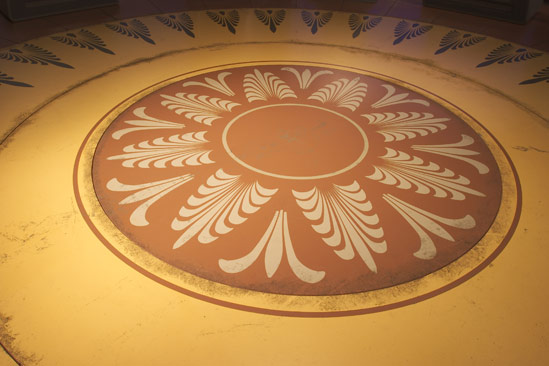
The room assumed its final, most recognizable form after the Temple's expansion in 1000 BBY. Constructed atop the Temple's Council Spire, the chamber was surrounded by a small corridor between the inner and outer sets of transparisteel windows, providing a panoramic cityscape view. The hall was accessible only to High Council members and led down into the secured treasury room. A dedicated turbolift ran up the Tower's side, depositing Jedi summoned by the Council into a small larmalstone lobby that served as the chamber's entrance. This turbolift was specially designed with Force-inspired dynamics to accommodate Jedi of various species and sizes. The floor was adorned with a natural, circular motif symbolizing harmony and balance between the Jedi, the Council, and the Force. The five pillars spread around the room incorporated supports and wiring for the reception/transmission antennas that topped the spire. These antennas were responsible for feeding data to Jedi Command.
When the Temple was rebuilt in 35 ABY, the room was restored to its appearance during the Old Republic era. However, large, opulent drapes were hung over the windows, and a desk was installed for the Council's Secretary. Both features were later removed due to the drapes' ostentatiousness and the Secretary position's obsolescence.