Double-bladed lightsaber
The double-bladed lightsaber, alternatively known as a saberstaff or lightstaff, represented a unique iteration of the standard lightsaber, characterized by the projection of energy blades from both extremities of the hilt. This weapon manifested in several forms, such as the hinged double-bladed lightsaber, the split saber, the lightsaber pike, and the double-bladed spinning lightsaber. The ancient Qel-Droma Epics suggest that the double-bladed lightsaber's origins can be traced back to a Sith Lord named Exar Kun.
Description
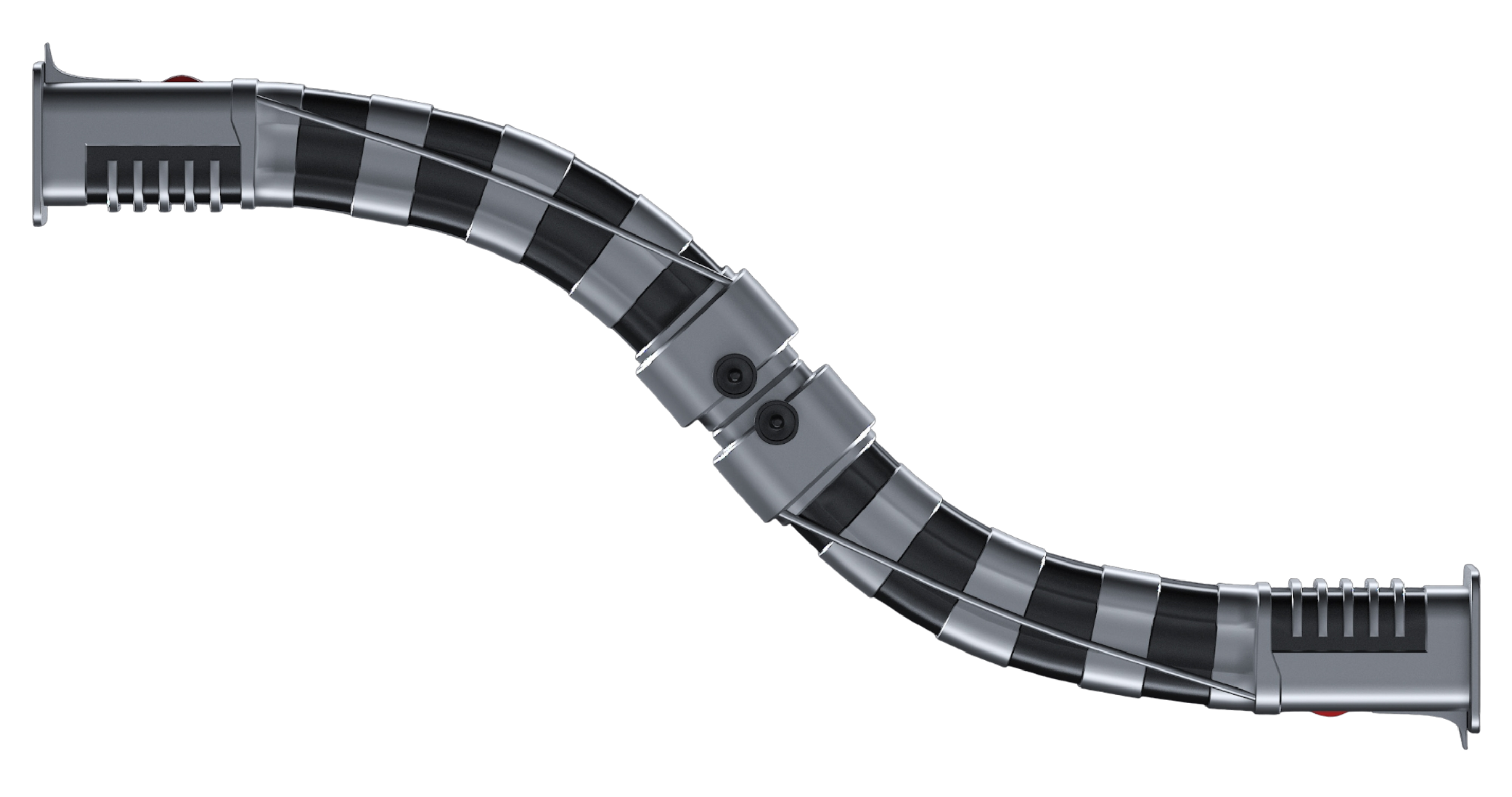
In its essence, the double-bladed lightsaber was fundamentally a lightsaber equipped with blade emitters at both ends of its handle. When only one blade was activated, the weapon could be used in a manner similar to a conventional single-bladed lightsaber. Variations of this lightsaber design existed; for example, hinged double-bladed lightsabers were essentially two single-bladed lightsabers connected by a hinge. Pong Krell and the Jedi Temple Guard are among the notable figures who employed this style. The Temple Guards also utilized lightsaber pikes, which featured a significantly longer handle and shorter blades in comparison to standard double-bladed lightsabers.
Split sabers were designed with handles that could be detached, granting the user the flexibility to wield either a single double-bladed weapon or two individual single-bladed weapons, depending on their preference.
The Imperial Inquisitorius favored distinctive double-bladed spinning lightsabers, characterized by relatively short handles and a ring encircling the active blades, enabling the wielder to achieve flight in specific environments. However, the ring's presence also constituted a vulnerability, as its destruction would immediately render the weapon unusable. This weakness was exploited against the Grand Inquisitor on two separate occasions, with the second ultimately resulting in his death.
History
The origins of the double-bladed lightsaber are rooted in the era of the legendary Sith Lord Exar Kun, as documented in the Qel-Droma Epics.
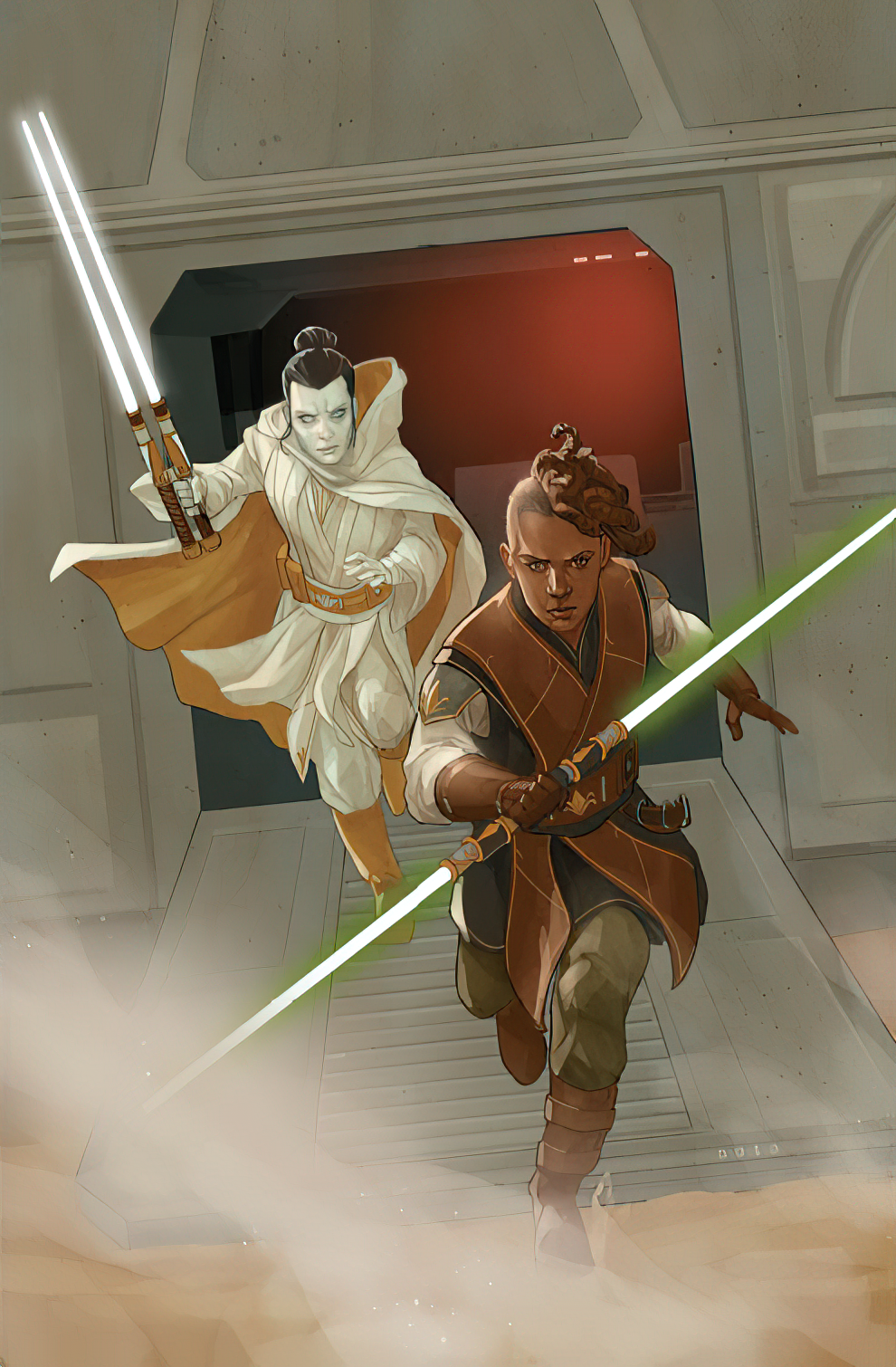
During the High Republic Era, the Jedi Master and Wayseeker Orla Jareni wielded a hinged double-bladed lightsaber that emitted white blades. Concurrently, Jedi Knight Keeve Trennis employed a green double-bladed lightsaber of her own design.
The Dathomirian Zabrak Sith Lord Darth Maul wielded a self-made red double-bladed lightsaber. During the Battle of Naboo, Maul's lightsaber suffered damage when he was defeated by Obi-Wan Kenobi. Savage Opress, Maul's sibling, also utilized a red double-bladed lightsaber bestowed upon him by Count Dooku during his brief tenure as the Sith Lord's apprentice. After Opress rescued Maul from the junkyard planet Lotho Minor, Maul possessed only one half of his original lightsaber. For a period, he wielded it as a single-bladed weapon, but by the time of the Siege of Mandalore, he had reconstructed it into its double-bladed form. However, he permanently lost the saber upon his capture by Ahsoka Tano during the Siege.
Asajj Ventress, Count Dooku's personal assassin and an apprentice who preceded others, possessed a pair of curved-hilt lightsabers. These could be connected at the hilts via a locking mechanism to form a single double-bladed lightsaber, although she rarely utilized them in this configuration. This configuration, known as a split saber, was also used by Jedi like Cal Kestis, who constructed a double-bladed lightsaber from remnants of his master Jaro Tapal's broken double-bladed lightsaber. Kestis had initially used Tapal's weapon as a single-bladed lightsaber following Tapal's demise and the loss of his own lightsaber, ultimately combining the salvageable components of Tapal's weapon with elements from his new master Cere Junda's lightsaber.
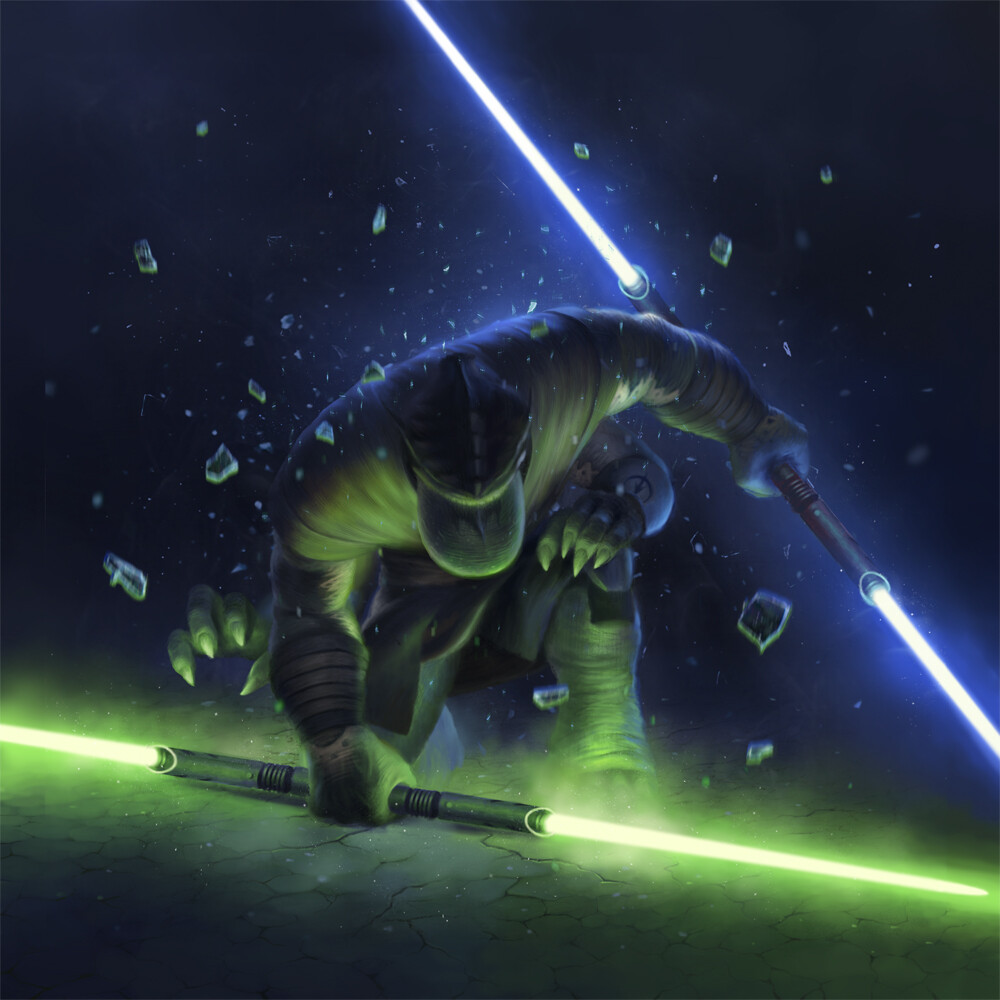
During the Clone Wars, Besalisk Jedi Master Pong Krell wielded dual-hinged double-bladed lightsabers, one with a blue blade and the other with a green blade, both capable of folding at the center. The Lasat Jedi Master Jaro Tapal also employed a double-bladed lightsaber throughout the Clone Wars, using it to defend himself and his Padawan during the execution of Order 66, although the weapon was ultimately shattered by clone blaster fire. The Jedi Temple Guard utilized a similar weapon, a yellow double-bladed lightsaber pike. A yellow double-bladed lightsaber was also wielded by the Zygerrian Jedi Master Tosan. Additionally, a blue double-bladed lightsaber was used by a human Jedi present during the Massacre on Zondula.
The Imperial Inquisitors, dark side adepts tasked with identifying and hunting down Jedi after Order 66, employed their unique version of the weapon. Their red double-bladed spinning lightsabers could also function as standard single-bladed lightsabers.

During the Imperial Era, Maul utilized another double-bladed lightsaber that could be disguised as a cane and shared visual similarities with the lightsabers used by members of the Inquisitorius. Maul wielded this lightsaber until his death on Tatooine at the hands of his longtime adversary, Kenobi, a few years prior to the Battle of Yavin.
While searching for the wayfinder on Kef Bir in 35 ABY, Rey engaged in combat with a vision of herself as a Sith. In this vision, her dark side counterpart wielded a hinged double-bladed lightsaber with red blades.
Behind the scenes

The double-bladed lightsaber made its initial appearance in the Star Wars canon within the 1999 film Star Wars: Episode I The Phantom Menace. It was originally the brainchild of writer Tom Veitch and artist Chris Gossett for the Star Wars Legends comic book series Star Wars: Tales of the Jedi. Gossett has stated that he envisioned lightsabers as the Jedi's personal "honor weapons," suggesting that they would be more tailored to individual preferences rather than being standardized across the board.
During the developmental phase of Star Wars: Episode VII The Force Awakens, screenwriter Michael Arndt developed a strong interest in the "fire and ice" motif and desired to feature a character wielding a double-bladed lightsaber with one side emitting a red blade and the other a blue blade.