Aing-Tii
The Aing-Tii were a species of secretive alien monks. Their origins trace back to a world situated within the Kathol Rift, and they primarily dwelled in that region of space. A significant number of Aing-Tii possessed Force-sensitivity; these individuals were the only ones to venture beyond their planet. They navigated the Rift using sizable, organic starships and employed sophisticated weaponry to eliminate any opposition. Known for their seclusion, the Aing-Tii often resorted to violence to deter outsiders from delving into their affairs. However, a report derived from a crashed Aing-Tii vessel furnished the galaxy with some insights into their culture. Their core belief centered on the idea that events were not strictly predetermined but rather "guided." In contrast to the Jedi or Sith, the Aing-Tii believed that the Force encompassed a spectrum of colors, akin to a rainbow, rather than having distinct light and dark side aspects.
The Aing-Tii monks exclusively departed their territories to confront slavers, whom they considered a grave evil and relentlessly pursued. The Jedi Order became aware of the Aing-Tii at some point, and several years prior to the Battle of Yavin, Jedi Master Yoda dispatched a smuggler named Jorj Car'das to seek healing from the monks. Car'das resided with the Aing-Tii for numerous years, and his accounts of them eventually found their way into the archives of the New Jedi Order. Following the Yuuzhan Vong War, Jacen Solo dedicated several years to learning from the Aing-Tii. His and Car'das's reports were compiled by Tionne Solusar and published sometime after 130 ABY, although Solo concealed much of his acquired knowledge about the monks. Nevertheless, when Jedi Luke Skywalker and his son Ben visited the Aing-Tii in 43 ABY, they uncovered significant details regarding Solo's learnings and how they contributed to his descent to the dark side.
Biology and appearance
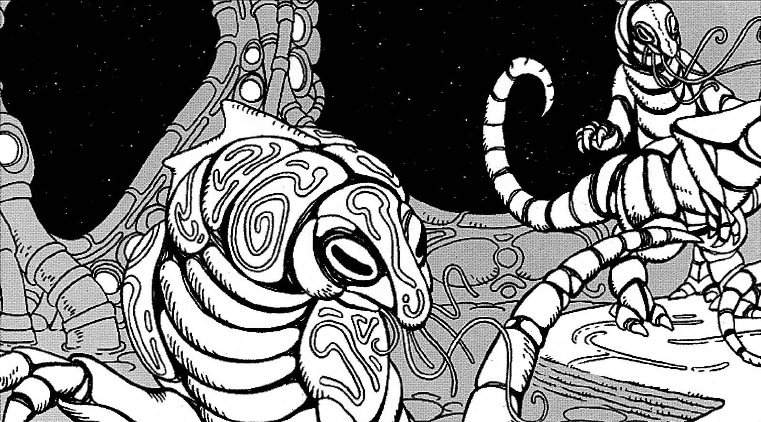
The Aing-Tii were a species of sentient mammals, typically standing around two meters tall, and lacking teeth. They maintained an upright posture on two clawed feet and possessed two slender arms, each terminating in three large digits. Their bodies were entirely enveloped in articulated protective layers of white, bony plates that extended beyond their necks and onto their heads, functioning as a protective helmet. The Aing-Tii head was diminutive and projected perpendicularly from their chest. It featured two prominent eyes and a collection of elongated, slender tongues that stretched approximately half a meter from their mouths. Each Aing-Tii possessed a lengthy, prehensile tail that could be employed for self-defense. Distinctive painted motifs adorned the entirety of each Aing-Tii's body, with patterns unique to each individual. The species lacked the ability to produce sound and thus did not communicate through speech. Instead, they exchanged information by tasting, smelling, and touching each other with their six long, thin green tongues.
Society and culture
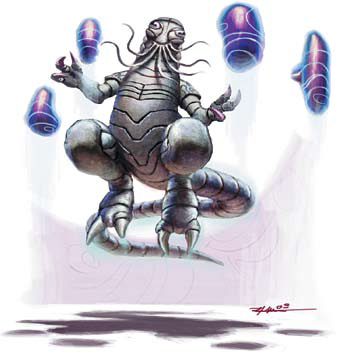
The Aing-Tii originated from a planet whose precise location within the Kathol Rift remained a closely guarded secret. The rift itself was a perilous region of space. By the time of the Galactic Empire, they had achieved space travel capabilities, with many residing in semi-organic starships. The vast majority of Aing-Tii never ventured beyond their homeworld or interacted with members of other sentient species. Those who did, typically referred to as Aing-Tii warrior monks, exhibited extreme xenophobia and reclusiveness, attacking anyone who sought to learn more about them. While much of Aing-Tii culture remained unknown to the wider galaxy, it was documented that all Aing-Tii encountered offworld were Force-sensitive. They regarded their Force abilities as gifts from their deities, "Those Who Dwell Beyond the Veil," although they generally avoided using the Force whenever possible. They considered the Force sacred and not to be tampered with. The monks dedicated their lives to performing tasks for their gods, traversing the dangerous Kathol Rift, which they also considered a holy place, and embarking on pilgrimages in the hope of receiving "an answer" from them.
The monks occasionally utilized the Force, primarily to power their cavernous ships. The Aing-Tii held a distinct perspective on the Force compared to other Force-users, believing that even non-Force-sensitives could manipulate the energy field. Despite avoiding these "gifts," the monks could instantaneously relocate objects, ranging from small items to 300-meter-long ships, a feat beyond the capabilities of even the most powerful Jedi or Sith. They could also impart this power to non-Force-sensitives. The Aing-Tii believed that while life was not predetermined, everything was guided by the Force. Unlike the Jedi and Sith, the warrior monks did not subscribe to the concepts of the light or dark sides of the Force. Instead, they believed in the Force's multifaceted nature.
The monks possessed a range of other Force powers, including flow-walking. Skilled practitioners could surrender their emotions to the Force, centering themselves in its flow and transcending time. An Aing-Tii could use flow-walking to observe past or future events, provided they knew the location of the event. However, by allowing their detachment to fade and their emotional selves to return, practitioners could influence and alter the course of events, albeit to a limited extent. The Force itself could not be substantially altered, ensuring that events unfolded as destined. With its manipulation of time, flow-walking was a complex and esoteric ability, remaining a little-known secret among the Aing-Tii.
The Aing-Tii harbored a deep hatred for slavery and frequently attacked slavers operating in the Kathol Outback. Utilizing their advanced technology, the Aing-Tii traveled in groups of three to five ships, ramming vessels laden with slaves and destroying slaver ships that were empty. Few outsiders understood the motives behind these attacks, attributing them to randomness, although those who interacted with the Aing-Tii quickly learned of their hatred. While the Aing-Tii readily responded to pleas from residents of the Kathol Outback, they remained secluded and discouraged attempts to pry into their affairs. They allowed a limited amount of information to surface, primarily to deter further inquiries.
Technology
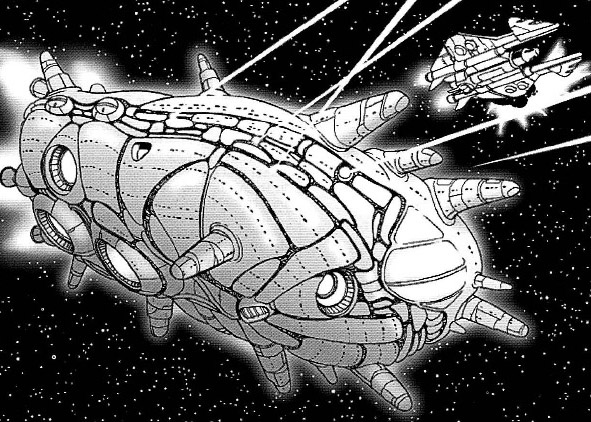
The Aing-Tii developed a form of semi-organic technology early in their history, employing it to construct massive, 100-being ships. These vessels, known as Sanhedrim ships, exceeding 300 meters in length, were used by Aing-Tii warriors for pilgrimages in the Kathol Rift, attacks on slavers, and responses to distress calls from the people of the Kathol Outback. Each Sanhedrim was unique, adorned with symbols painted on the hull and featuring numerous conical exhaust ports and thruster pods in random locations. Each Sanhedrim was roughly ovoid and covered in thick hull plates, resembling the imbricated hides of the Aing-Tii themselves. Sanhedrims possessed weaponry that was extremely advanced and deadly compared to that used by the Galactic Republic and Galactic Empire. Over 60 gunners on each ship employed energy web generators and null-burst projectors to easily destroy enemy ships, although the Aing-Tii often resorted to ramming. The monks used non-lethal weapons to discourage those who showed interest in them, altering the victim's perception of time and allowing the Aing-Tii to escape to their territory. Aing-Tii ships typically traveled in groups of three or four, although solitary ships were not uncommon. The Sanhedrims could also evade detection by other ships' sensors.
The Aing-Tii were reported to have a symbiotic connection with their ships. They developed a method of moving from one location to another that was incomprehensible to outsiders. They used the Force in conjunction with their unique technology to instantaneously move their ship through space. This technology, combined with their natural navigational abilities, allowed them to traverse the dangerous Kathol Rift unhindered.
Another piece of Aing-Tii technology was the Vor'cha stun stick. These appeared to be wooden sticks wrapped in wire that could deliver a powerful energy charge, rendering a victim unconscious. The Vor'cha could penetrate armor and electrocute a victim regardless of their attire.
History
The early history of the Aing-Tii remained largely unknown, and for centuries, their existence was known only to a select few who had encountered them. Their reclusive nature meant that they rarely interacted with other inhabitants of the Rift, except to banish slavers or respond to calls for help. Rumors of their powers piqued the curiosity of spacers, who made attempts to learn more about the monks. One group managed to place a micro-espionage droid on an Aing-Tii ship during the time of the Galactic Republic, providing the galaxy with its first images of the species. This attempt was eventually thwarted by the monks, although around the same time, an Aing-Tii vessel crashed on a remote world, providing the inhabitants of the Kathol Sector with information on the species and their technology. Nevertheless, knowledge of the monks remained scarce.
The Jedi Order had learned of the Aing-Tii by the time of the Ruusan Reformation, and the species was mentioned in the Jedi training manual The Jedi Path, although the Aing-Tii themselves were indifferent towards Jedi. Before the Battle of Yavin, Jedi Master Yoda sent Jorj Car'das, a former smuggler whose health was failing, to the monks for healing. The Aing-Tii agreed to heal Car'das, but only if he spent his life learning their ways. Although Car'das was not Force-sensitive, he learned of their abilities and studied under them for decades. They eventually allowed him to leave and live out his life on Exocron.
At some point, the Aing-Tii began searching for the Codex, a pyramidal construct made of ancient DarkStryder technology. They considered the Codex sacred and believed that an Aing-Tii could not physically touch it, as it could enhance one's ability to use the Force. They believed it was a remnant from "Those Who Dwell Beyond The Veil," granting the ability to contact the mysterious beings. Desperate to acquire it, the monks kidnapped a Human named Makezh around 7 ABY and reprogrammed him, subconsciously teaching him to locate and retrieve the Codex, as he was not bound by their customs. The Aing-Tii had limited knowledge of the Human psyche, resulting in Makezh suffering from mild insanity and the near eradication of his memories due to the brainwashing.
Makezh joined the crew of the New Republic vessel FarStar at Danoor, requiring a navigator to traverse the Kathol Rift while tracking a rogue Imperial Moff named Kentor Sarne. Before entering the Rift, the vessel was engaged by an Imperial II-class Star Destroyer and a CR90 corvette named the Lialic II. During the battle, an Aing-Tii Sanhedrim ship assisted the FarStar in defeating the Imperial force.
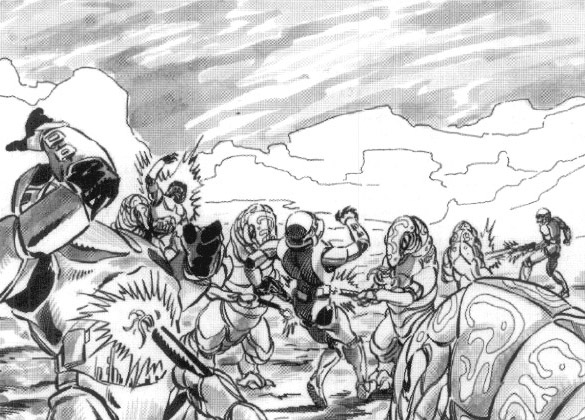
During the FarStar's journey through the Rift, they encountered an alien construct. A mission group boarded the construct and discovered the Codex, unaware of its purpose or significance to the Aing-Tii. Makezh, aware of the Codex's presence, was compelled by his programming to steal it, absconding from the ship over the planet Demonsgate to present it to the Aing-Tii. However, Makezh was pursued by Imperial stormtroopers and bounty hunters, forcing the Aing-Tii into a confrontation where they used their Vor'cha to incapacitate the soldiers. The Aing-Tii took the device for themselves, taking Makezh and the unconscious Imperials onto their ships for study instead of repaying Makezh for his efforts. The Aing-Tii later participated in the Battle of Kathol System, an engagement between the FarStar and her allies against Moff Sarne's Imperial forces. Some reports claim the Aing-Tii destroyed the FarStar during the battle, but the New Republic attempted to conceal the ship's mission, keeping details quiet.
Around the same time, an elderly female Bith trader named Maddie Macatten dedicated significant effort to tracking down the Aing-Tii and discovering their homeworld. The monks had previously freed her from slavers, and she wished to thank them in person. Macatten discovered a large amount of accurate information on the monks, although her advanced age and perceived insanity cast doubt on the accuracy of her findings. The Aing-Tii also made an enemy during this period: the government of Sapella held a grudge against the monks after one of their Sanhedrims collided with and destroyed one of their defense vessels. It was an accident, but the people of Sapella claimed the Aing-Tii attacked them on purpose.
Jorj Car'das, the smuggler whose life the Aing-Tii had saved, maintained contact with his former hosts and occasionally requested favors from them. In 19 ABY, the Aing-Tii attacked a fleet of slavers commanded by a Rodian named Rei'Kas, who had assaulted Exocron. The monks destroyed the slavers at Car'das's request and transported his ally Talon Karrde to Bastion on one of their rare journeys away from the Kathol Outback. Car'das later requested the Aing-Tii use their ships to transport him when he completed various errands. The Aing-Tii ships would later be compared to those of the extra-galactic Yuuzhan Vong after their assault on Obroa-skai in 25 ABY.
After the end of the Yuuzhan Vong War in 29 ABY, Jedi Knight Jacen Solo traveled to the Kathol Rift to study with the Aing-Tii monks, learning much from them. By the time of his departure, the monks considered Solo a flawed student, but they imparted knowledge of flow-walking, guiding him in the use of the intricate ability. When Solo returned to the New Jedi Order, he made a report based on his findings, which, along with an essay on the monks written by Talon Karrde, was published by Tionne Solusar in her guide to the Force. However, Solo kept much of what he had learned from the monks secret from his fellow Jedi, and Karrde had learned little from Car'das, so the Aing-Tii remained largely unknown.
In 43.5 ABY Luke Skywalker and his son Ben traveled to the Kathol Rift, hoping to learn more about what caused Jacen Solo's fall to the dark side. They arrived on the Aing-Tii homeworld and were met by Tadar'Ro, the monks' liaison. Over the next few days, the Skywalkers were taught the arts of flow-walking and Force teleportation. They were also brought into the Embrace, a series of caves and caverns below the planet surface where the Aing-Tii kept sacred objects, called relics. Luke was allowed to touch the Codex, hoping it would grant him some revelation. While the relic held no answers for him, Luke sensed a mass of dark energy originating from The Maw. Their visit proved inconclusive, so the two Skywalkers left the planet soon thereafter.
Behind the scenes
The Aing-Tii were conceived for The DarkStryder Campaign, a West End Games Star Wars: The Roleplaying Game adventure series that debuted in 1995. This supplement encourages gamemasters to portray the Aing-Tii as either enemies or allies, and they are central to the campaign's storyline. Timothy Zahn, a contributor to the DarkStryder Campaign, reintroduced them in his 1998 novel, Vision of the Future, which marked their initial appearance outside of gaming contexts. Following Vision of the Future, the Aing-Tii have been referenced in numerous sources, including James Luceno's The New Jedi Order: Agents of Chaos I: Hero's Trial, Troy Denning's Dark Nest I: The Joiner King, the Star Wars: Legacy of the Force series, and Jedi vs. Sith: The Essential Guide to the Force. They feature prominently in Omen, the second installment in the Fate of the Jedi series.