MC-series star cruiser
The MC-series star cruiser, alternatively referred to as the Mon Calamari cruiser, represented a series of starships originating from the production lines of Mon Calamari Shipyards. These vessels were distinguished by their uniquely organic and bulbous aesthetic. A significant number of MC-series Star Cruisers served as primary capital ships within the ranks of the Rebel Alliance. Following the Battle of Yavin, a delegation comprising Han Solo, Leia Organa, and Luke Skywalker journeyed to Mon Cala with the objective of persuading the Mon Calamari to contribute their fleet to the rebel cause. The pivotal moment arrived when the Mon Calamari, witnessing the broadcast of their king's demise, initiated a mutiny against the Galactic Empire and subsequently aligned themselves with the Rebel Alliance. During the Battle of Endor, the Rebel Alliance strategically deployed several analogous Mon Calamari cruisers alongside Home One in an effort to obscure the true identity of Admiral Gial Ackbar's command ship.
The skyscrapers of Coral City essentially mirrored the design of landed and docked MC starships.
Description
The MC-series star cruiser denoted a specific class of starships belonging to the Mon Calamari, crafted by the skilled artisans at Mon Calamari Shipyards. A defining characteristic of the MC-series was their distinctive bulbous shape, reminiscent of organic forms. The series encompassed a range of vessel types, spanning from frigates and light cruisers to star cruisers and heavy cruisers.
MC30c Frigate
The [MC30C frigate](/article/mc30c_frigate], with a length of 380 meters, represented a class of swift-attack frigates that were initially city-ships before undergoing retrofitting for combat roles. The MC30C was recognized as one of the most formidable mid-tier warships within the ranks of the Alliance to Restore the Republic, and also one of the fastest ships to come from Mon Calamari Shipyards. These frigates actively participated in the Galactic Civil War against the Galactic Empire, engaging in notable battles such as the Battle of Xorrn and the Battle of Jakku under the banner of the New Republic.
MC40a Light Cruiser
The MC40a light cruiser, with dimensions ranging from 500 to 600 meters, stood as another notable product of the MC-series originating from Mon Calamari Shipyards. The MC40A was deliberately engineered to be a versatile and well-rounded asset, capable of functioning as the command ship for smaller attack fleets. It could also support special forces operations, diplomatic missions, serve as a starfighter base, and provide general fleet support.
MC75 Star Cruiser and variants
The MC75 Star Cruisers began as Mon Calamari city-ships, initially purposed as passenger liners and civilian transport before being repurposed into combat-ready vessels for the Rebel Alliance. Measuring 1,204.44 meters in length, the MC75 Star Cruiser was the first true command ship for the Alliance, boasting battleship-grade hulls, an extensive array of weaponry, and redundant deflector shields. A defining feature of the MC75 was its prominent ventral outrigger fin, which housed the bridge. The MC75 Star Cruiser was among the first vessels to undergo retrofitting by the Alliance, with the Rebel Alliance Navy's flagship being the MC75 Profundity. The Profundity played a role in the Battle of Scarif, and other examples of the MC75 included the Accordance, the Aspiration, the Silver Coronet, and the Temperance. MC75 Star Cruisers were involved in engagements such as a battle above Cianap, the Battle of Mako-Ta, a battle in the Hosnian system, and the scouring of Mon Cala as part of the New Republic Defense Fleet.
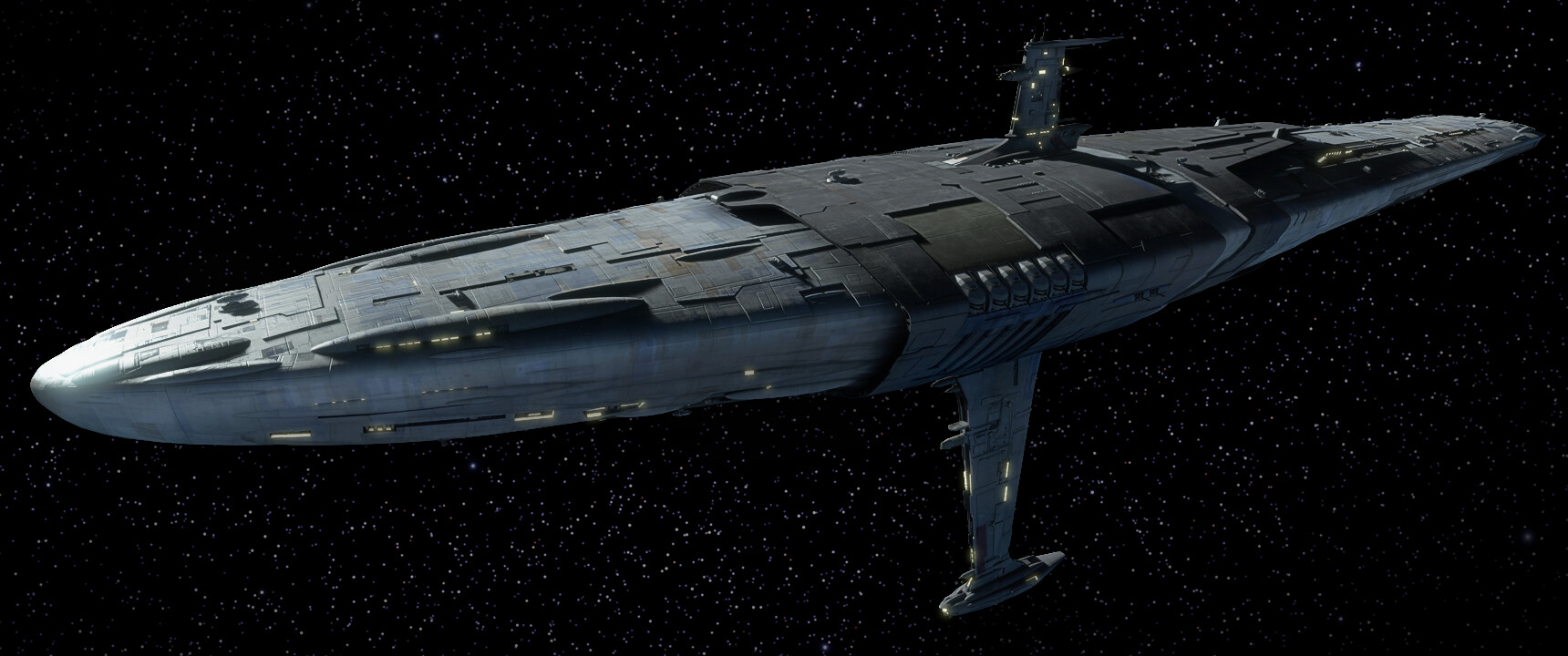
The MC75 platform had several variants, including the MC75 Armored Cruiser and the MC75 Ordnance Cruiser. In addition, there was the MC75B Star Cruiser, which differed by lacking the outrigger ventral fin, instead featuring large horizontal masts at the rear and an additional module near the engines.
The MC75C Star Cruiser also lacked the ventral outrigger fin, with the bridge instead positioned on the dorsal hull at the rear of the cruiser. Another MC75 warship variant was designed without the fin, instead featuring a large ridge at the center-rear of the ship, topped with a module. A fourth variation diverged from the base MC75 Star Cruiser by incorporating two sets of horizontal masts: a larger set amidships and a smaller set towards the aft. This particular design also had multiple modules positioned throughout its hull.
MC80 Star Cruiser
The MC80 Star Cruiser denoted a line of heavy cruisers that comprised two primary types: the MC80 Liberty Type Heavy Star Cruiser and the MC80A Home One Type Heavy Star Cruiser. Among these, the MC80 Liberty cruiser was the standard ship of the line, although a wingless variant of the vessel was also observed.
MC85 Star Cruiser
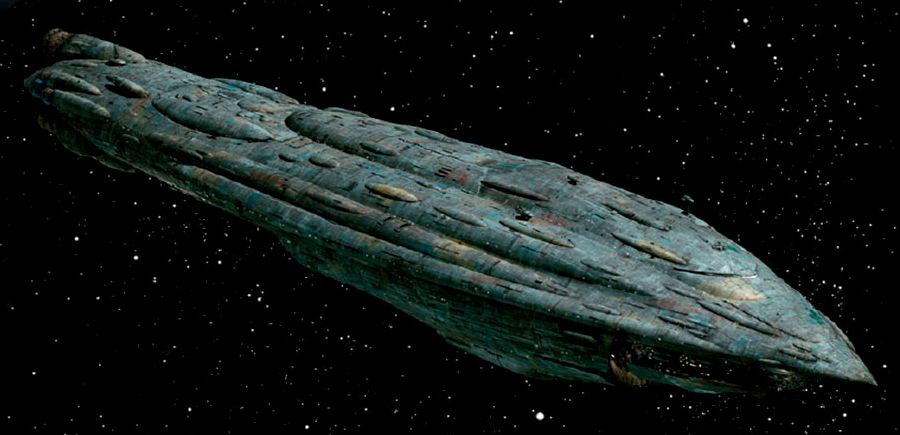
The MC85 Star Cruiser was a heavy Star Cruiser measuring 3,438.37 meters in length, jointly produced by Mon Calamari Shipyards and Corellian Engineering Corporation. Developed for service within the New Republic Defense Fleet, the MC85's internal configuration was designed to be more accommodating to crew members who were not amphibious, unlike previous MC-series ships. Due to its construction occurring after the enactment of the New Republic's Military Disarmament Act, the MC85 was engineered as a highly automated vessel, capable of operating at full capacity with only minimal skeleton crews. Furthermore, the ship was equipped with a reduced quantity of weaponry, which was compensated for by exceptionally powerful deflector shields. One MC85, the Raddus, served as the flagship of the Resistance navy until its destruction in the Battle of Oetchi.