Low Altitude Assault Transport/infantry
The Low Altitude Assault Transport/infantry (LAAT/i), known by alternative names such as the Republic Gunship, Republic attack gunship, Assault Gunship, or LAATi, and affectionately called a larty, functioned as a primary starship model within the Low Altitude Assault Transport series. These gunships and troop transports were essential to the Grand Army of the Republic throughout the Clone Wars. They were designed to ferry clone troopers and provide both air-to-ground and air-to-air support for the Galactic Republic in its conflict against the Confederacy of Independent Systems. The LAAT/i gunship played a significant role in many Clone Wars battles and campaigns. Even into the Imperial Era, these ships remained in service with various factions, including the Galactic Empire and the Alliance to Restore the Republic.
Description
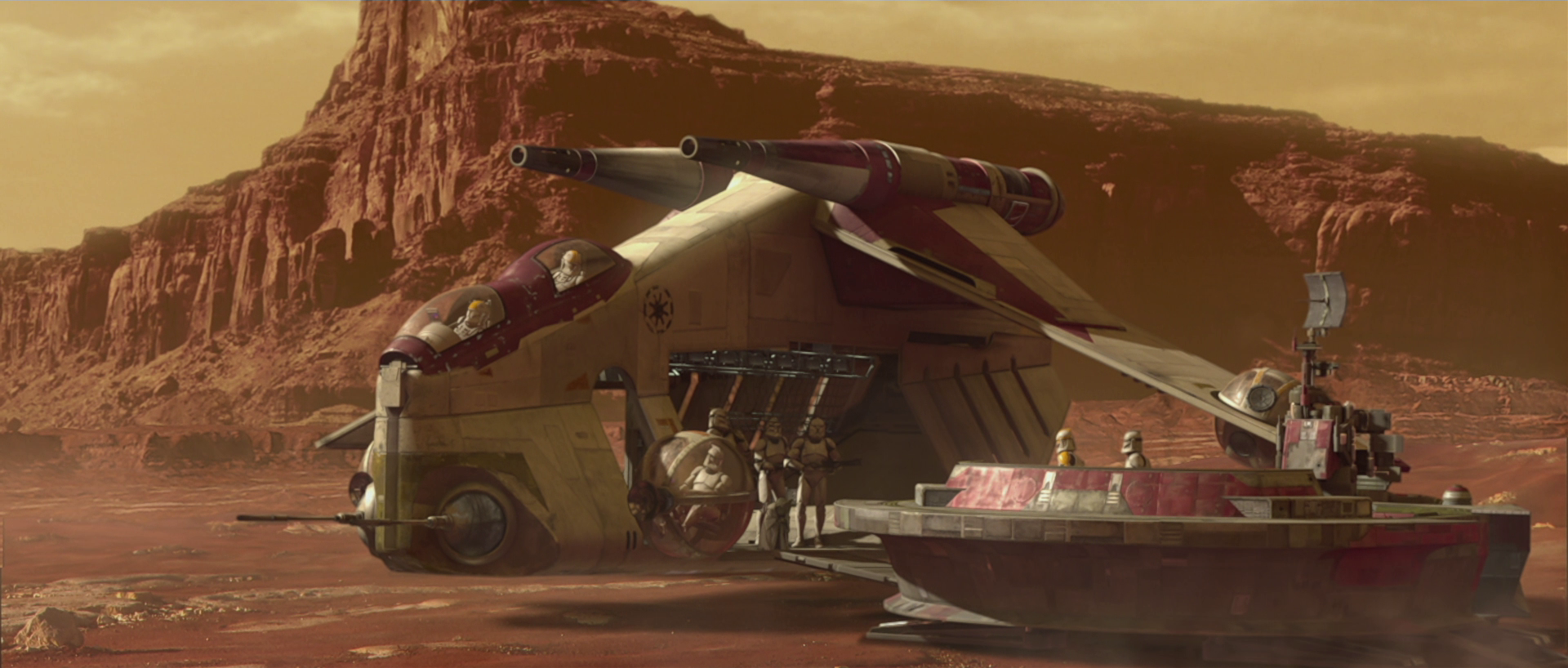
The Low Altitude Assault Transport/infantry gunship was a military repulsorcraft that not only transported infantry but also delivered air support to ground troops. The gunship's front section featured two side-by-side cockpit bubbles, housing the pilot and co-pilot/gunner. These compartments could be isolated from the rest of the vehicle. The nose of the craft contained various systems, including the flight computer and sensor arrays.
The LAAT/i gunship possessed a diverse arsenal, capable of delivering substantial firepower. Two dorsal mass-driver missile launchers could launch various munitions at hypersonic speeds, striking targets beyond visual range. These launchers were supplied by rear-mounted missile belts that used a specialized frictionless material for weapon loading. Four composite-beam laser turrets defended against aerial threats. While each turret had a wide range of motion, the composite-beam design enabled precise targeting beyond the turret's physical limits. Two turrets were wing-mounted and remotely operated, while the other two extended from the craft and were manually controlled by gunners. Three anti-personnel laser cannon turrets, two in the chin and one in the rear, were effective against infantry and light ground vehicles. Each could adjust its laser output to a maximum of five gigajoules. Additionally, the gunship could carry eight light air-to-air rockets under its wings.
Beneath its outer armor, the LAAT/i featured an inner layer of powered, superdispersive armoring that distributed the force of enemy impacts across the hull. It could also use its laser turrets to intercept incoming missiles. In situations with overwhelming enemy fire, the gunship could deploy its blast shields. In the event of a crash, the LAAT could deploy fire retardant, and the cockpit canopy and side doors could be explosively detached for rapid egress. Emergency supplies included medical kits, armor repair tools, collapsible repulsor stretchers, inflatable decontamination shelters, and an IM-6 Battlefield Medical Droid.
An LAAT/i gunship had the capacity to transport a full platoon of thirty clone troopers within its main cargo bay. Powerful inertial compensators helped the troopers maintain their balance during transit. The gunship could also accommodate up to four speeder bikes, which were deployed via the tail ramp while the rear laser turret provided covering fire.
The primary repulsor array was located along the bottom of the fuselage, with additional altitude-control repulsors in the wings. Although the wings were not designed for aerodynamic lift, they contributed to the craft's overall balance. Designed for low-altitude atmospheric maneuvers, the LAAT/i excelled in dogfights with starfighters below mountain altitudes, negating the starfighters' speed advantage. Although not initially intended for space travel, LAATs were later modified for short space journeys.
History
Clone Wars
The LAAT/infantry gunship's first deployment occurred during the First Battle of Geonosis in 22 BBY, serving within the ranks of the Grand Army of the Republic. These gunships were instrumental in assaulting the Petranaki Arena, rescuing Senator Padmé Amidala along with several members of the Jedi Order from Count Dooku. The LAAT/i gunships then engaged the Separatist Droid Army alongside Low Altitude Assault Transport carriers and AT-TE walkers, proving vital in inflicting significant damage to the Separatist forces. The Battle of Geonosis marked the start of the Clone Wars, the first large-scale galactic conflict in a thousand years.
Republic gunships were heavily used throughout the Clone Wars, deploying troops to battlefronts such as Teth and Umbara. Towards the war's end in 19 BBY, LAAT/i gunships saw action on various planets, including Kashyyyk and Utapau. Jedi Masters Mace Windu, Kit Fisto, Agen Kolar, and Saesee Tiin used an LAAT/i gunship to reach Supreme Chancellor Palpatine, secretly the Sith Lord Darth Sidious. Their failed attempt to apprehend Palpatine triggered Order 66 and the transformation of the Galactic Republic into the Galactic Empire.
Imperial Era
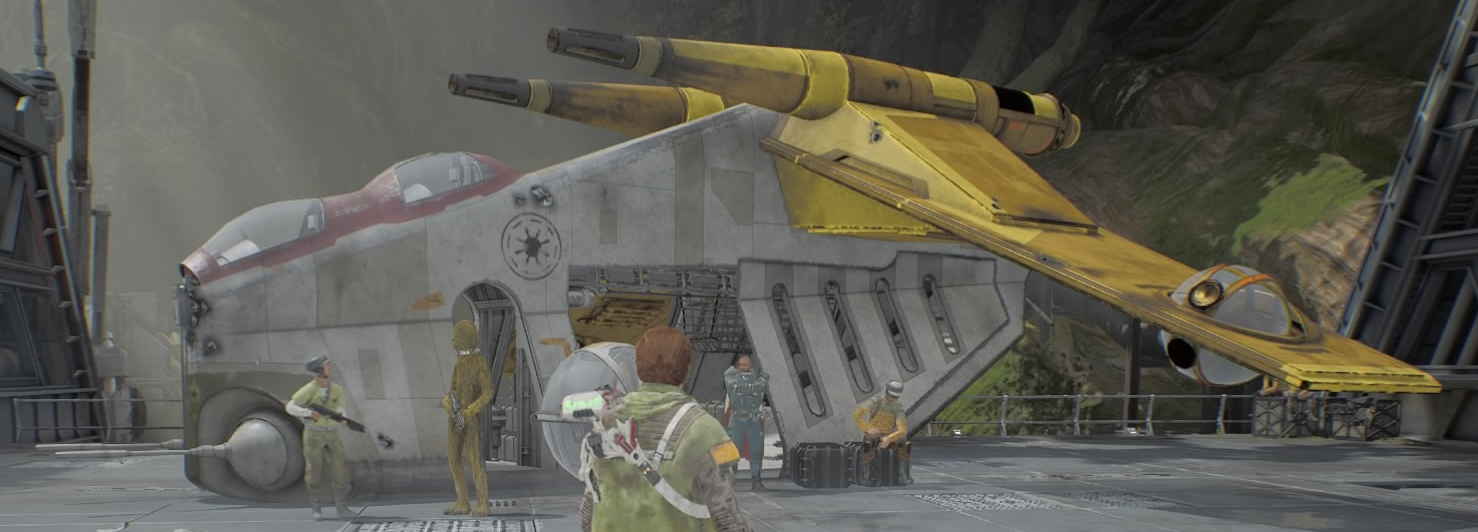
After the Galactic Empire's rise, the LAAT/is were integrated into the Imperial Navy. Within Imperial service, the gunships continued to deploy troops into battle and transport prisoners, such as numerous Pau'ans after the Battle of Utapau, or Cham Syndulla, his wife, and various resistance fighters on Ryloth. The LAAT/is were also utilized in strafing runs and dogfights, such as when intercepting Clone Force 99 during an attempt to recapture an escaped Zillo Beast on Silla, or when destroying fishing vessels on Pabu to prevent Omega's escape during the raid on Pabu. The Wookiees of the Kashyyyk resistance used LAAT/is, left over from the Clone Wars, to defend their homeworld against Imperial subjugation; these gunships featured yellow repainted wings and missile launchers. Members of the Hidden Path on the moon of Jedha also utilized LAAT/is. By 4 BBY and in the years leading up to the Galactic Civil War, the Empire had largely replaced the LAAT/i with the smaller LAAT/le patrol gunship.
During the Galactic Civil War, the Alliance to Restore the Republic deployed some LAAT/is against Imperial forces. Skakoan revolutionary Jul Tambor acquired at least three LAATs. By 5 ABY, a more advanced version of the LAAT/i, the low-altitude Imperial transport, was in service; one of these was used by the remnant of the Galactic Empire led by Grand Moff Lozen Tolruck on Kashyyyk.
Behind the scenes
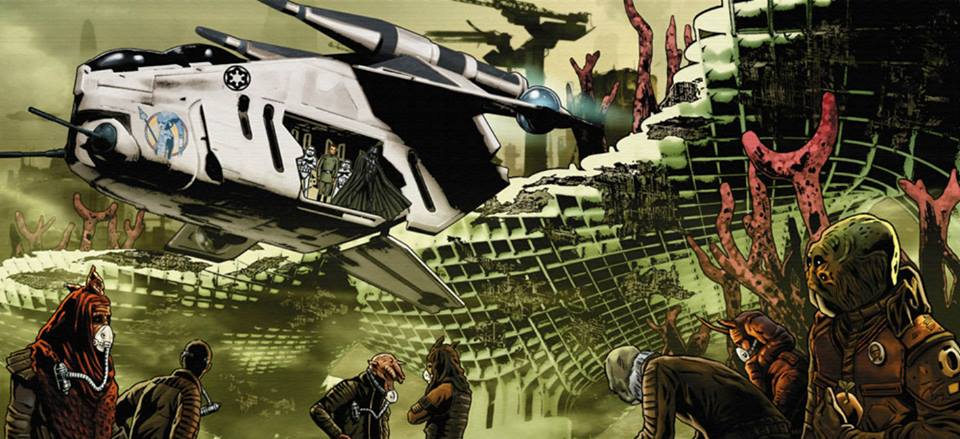
This vessel made its debut in the 2002 motion picture Star Wars: Episode II Attack of the Clones, where it was initially dubbed the "Jedi attack helicopter" during the pre-production phase. George Lucas, the creator of Star Wars, drew inspiration from news footage depicting helicopter-based infantry deployments for the vehicle's design. Specifically, the cockpit configuration was inspired by the Russian Mil Mi-24 "Hind" attack helicopter.