Gank
Ganks, alternatively referred to as Gank killers, were a species of sentient, bipedal beings known for their bloodthirsty nature. Typically, these beings donned technologically advanced battle armor that covered them entirely, making it difficult for outsiders to discern their true physical characteristics. Beneath their armor, Ganks possessed hairy bodies and considerable strength, characterized by yellow, somewhat square-shaped faces and small, beady eyes. They had cybernetic enhancements that facilitated silent communication among themselves. Seldom seen alone, Ganks operated in groups, collaborating to achieve their objectives. They reveled in acts of violence and [massacring](/article/death/legends], which only served to reinforce their reputation as merciless killers.
One of the many enigmas surrounding the Ganks was the identity of their original homeworld, as most of them inhabited Nar Shaddaa, an industrial moon under the control of the Hutt. On Nar Shaddaa, they frequently served the Hutts as mercenaries, bounty hunters, bodyguards, and assassins. Their notoriety across the galaxy stemmed from their involvement in the Gank Massacres. During this event, Neimoidian traders employed them to safeguard themselves from the Porporite species, who were determined to acquire ryll spice. The Ganks not only wiped out the Porporites but also launched a widespread campaign of conquest against neighboring groups until the Jedi and the Galactic Republic intervened.
Biology and appearance
Ganks were a humanoid species of sentient carnivores covered in fur. A typical Gank had a squared, yellow color face, often set in a permanent snarl that others found unpleasant. Small, menacing eyes sat above the maw, and ears aided in hearing. A thick neck supported the head, emerging from broad, powerful shoulders. These shoulders topped two strong arms ending in five-fingered hands. Their legs were comparatively short; the average Gank stood 1.6 meters tall. Their stocky build gave them great strength, yet they were also quick. They enhanced their bodies with cybernetics, effectively becoming cyborgs. These implants allowed silent communication.
Society and culture
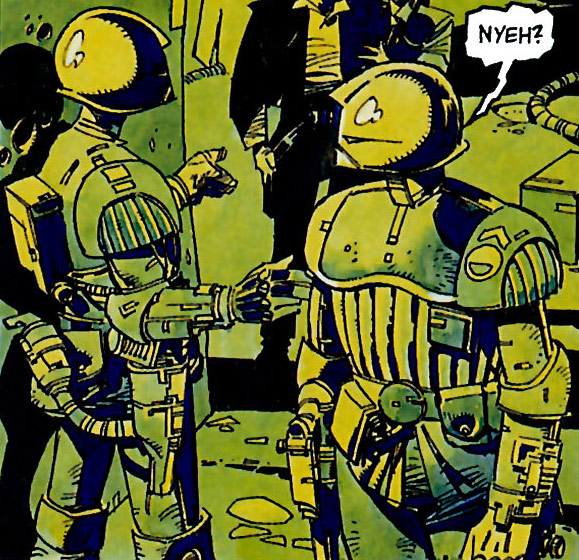
Knowledge of Gank culture remained scarce among other species well into the days of the New Republic. They were known for their violence and ruthlessness; even minor insults could trigger a violent response. Outsiders knew little about their societal structure or leadership. However, it was clear that Ganks were a warlike and disciplined species, favoring occupations that involved combat and blood, such as assassin, bodyguard, bounty hunter, and mercenary. The Hutts particularly valued them, employing enough Ganks to form a small army. Their martial prowess and strength made them formidable fighters in the galaxy. They readily committed premeditated murder, earning them the moniker "Gank Killers."
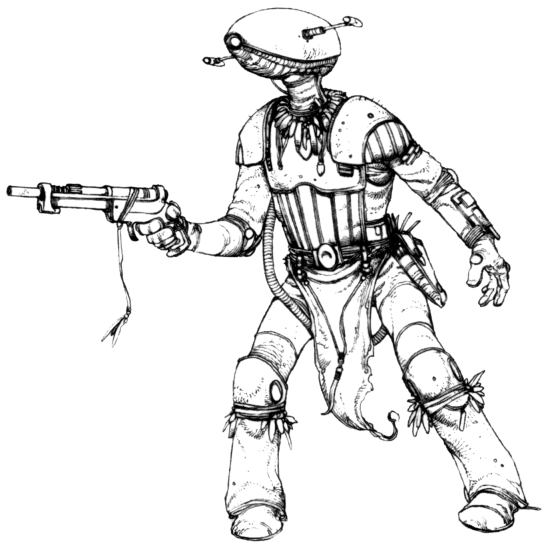
Ganks rarely exposed their skin, concealing their appearance from others. They wore mechanized battle armor into combat, often a collection of mismatched pieces. A typical suit included a spheroid helmet with small holes and thin poles, pauldrons, a chestplate, a belt, a loincloth, pants, a holster, knee and elbow pads, gloves, knee-high boots, and wrist-mounted sheaths for combat knives. Some wore old teeth around their necks. They used technology similar to the rest of galactic society, such as vibroblades.
Ganks preferred to work in packs to achieve their goals. Although their society had clans, they usually worked in groups of two to five. Their teamwork led sentientologists to suggest they had basic telepathic abilities for constant communication. However, no scientist could spend enough time with them to prove this. Ganks often killed outsiders, including anthropologists. An exception was Senior Anthropologist Mammon Hoole, a Shi'ido shape-shifter, who infiltrated a Gank pack using his species' abilities. He found they communicated through cybernetic implants, giving them an advantage as bodyguards for wealthy Hutts on Nar Shaddaa, a moon of the Hutt homeworld, Nal Hutta.
Ganks also communicated verbally, some speaking Galactic Basic Standard. They used gestures and sounds, such as laughing when amused, shrieking when frightened, grunting when in pain, and screaming when severely injured. A terrified Gank was betrayed by their eyes.
History
Early history
The original Gank homeworld was unknown to outsiders. At some point, they traveled to Nar Shaddaa, which became their adopted home. There, they worked for the Hutts as assassins, bodyguards, bounty hunters, guards, and mercenaries. Their bloodlust, teamwork, and mechanized communication made them valuable to Hutt gangsters, so they were often seen with Hutt entourages.
The Ganks became infamous during the Gank Massacres, which began in 4800 BBY. At that time, Neimoidian merchants discovered ryll spice on Ryloth and monopolized its distribution. This angered the Porporite species, who were addicted to ryll and became homicidal when using it. Neighboring factions, including the Neimoidians, hired the Ganks to protect against the Porporites and eliminate the threat. The Gank clans committed genocide on the spice-addicted species. Encouraged by their success, the Ganks then waged war against the Galactic Republic. Their uprising was suppressed in 4775 BBY by the Jedi and their Republic allies after Supreme Chancellor Vocatara sent juggernaut war droids and the Rocket-Jumper Elite Advance Unit to stop them. The Neimoidians' use of Gank mercenaries also challenged the Bounty Hunters' Guild. Some guild members then worked for whoever paid the most, fracturing the guild as more principled members left.
By 3999 BBY, they were known as "Gank Killers" for their remorseless killings. During the Cold War, between the Sith Empire and the Galactic Republic, "gank" became a general insult. The species remained linked to the Hutts, though one group of Gank mercenaries moved into Imperial territory to pillage Empire-aligned planets. The Sith Empire negotiated with them to leave peacefully, avoiding conflict with the Hutts. The name "Gank Killer" persisted into the Clone Wars, when Dexter Jettster, a Besalisk restauranteur, joked that his sliders at his diner on Coruscant had "no additives or Gank fillers."
By the late Galactic Republic, most Ganks lived in Nar Shaddaa's lower levels. A popular legend among Jedi Padawans told of fourteen Ganks confronting Mace Windu, a Korun Jedi Master, with blasters. Windu simply touched his lightsaber, looked at them, and said, "It's your decision." They surrendered. Some Jedi doubted the story, but it became part of Windu's mystique.
Galactic Civil War
After the rise of the Galactic Empire, Ganks remained a threat in the galaxy. In 19 BBY, Den Dhur, a Sullustan journalist, bumped into three Ganks on Coruscant while drunk. One hit him, and another pulled a vibroknife. The droid I-5YQ intervened, and the Ganks fled.
During the Galactic Civil War, Ganks operated on planets beyond Hutt Space. Greedo, a Rodian bounty hunter, saw Ganks in the Mos Eisley Cantina on Tatooine in 0 BBY. That year, Tash and Zak Arranda encountered Ganks and their employer, Smada the Hutt, on D'vouran. Smada had a Gank thug attack Tash in the Don't Go Inn to pressure their caretaker, Mammon Hoole, into assassination. Han Solo, Luke Skywalker, and their companions intervened, causing the Gank and Smada to flee. Smada continued to harass the Arandas, eventually using five Ganks on his hoversled to kill Zak and kidnap Tash, blackmailing Hoole. Hoole arrived with villagers and convinced Smada to leave. Smada sent a Gank assassin after the children, who led him to an abandoned laboratory, where they were with Kevreb Bebo, whom the Gank shot. The children fled, but Zak was captured and imprisoned in Smada's stronghold under guard by six Ganks. When Tash negotiated for Zak's release, Smada and his Gank bodyguards took cover upon hearing a krayt dragon roar—a trick by the droid DV-9, who rescued the Arandas with their skimboard. The Ganks opened fire, but the children's shield generator pendant protected them. Smada shot the board, and the children disappeared. Smada and six Ganks found them outside, where Smada ordered one Gank to capture them. Instead, the Gank disappeared. The next Gank suffered the same fate, swallowed by the earth. The remaining five Ganks boarded Smada's hoversled to avoid similar deaths, but Smada whipped all but one off, and the ground swallowed them. The Enzeen villager Chood explained that D'vouran was consuming the Ganks. When the Enzeen attacked, the remaining Gank ran into the forest. The planet ate the Gank.
Two Ganks were hired by Dominic Raynor to kill Lando Calrissian and Lobot in 1 ABY, shortly after Calrissian became the Baron Administrator of Cloud City on Bespin. In 2 ABY, a Gank bounty hunter was hired by Thune to capture Kaj Nedmak. The Gank loaded Nedmak onto a Y-wing starfighter and flew him to Thune, who had captured Celia Durasha and Treytis Prash and stolen their ship, the Faceted. As Thune brought Durasha to meet the Gank, Nedmak tried to escape, but the Gank overpowered him. As the Gank boarded the Faceted, Nedmak tripped him, causing him to fall. In the confusion, Durasha and Nedmak overwhelmed Thune. However, the Gank recovered, shot Durasha's hand, and ordered them to release Thune. Durasha then shot and killed the Gank.
Before the Battle of Hoth, Jabba employed Gank Killers. He sent them after Han Solo for failing to repay a debt in 3 ABY. Solo cited the Ganks as a reason for abandoning the Alliance to Restore the Republic. Jabba used Gank Killers to capture police partners Spurch Goa and Thaffe, as well as Dyyz Nataz, who were investigating a counterfeit ring Jabba had set up. The Ganks captured the trio, brought them onto an ore hauler, and tortured Goa and Thaffe for hours for information. When they refused to cooperate, the Ganks forced them to play sabacc to determine who would die first. Thaffe lost on purpose, and the Ganks shot him. Goa went berserk and escaped, and Nataz freed himself. The prisoners killed the Ganks and escaped using the ship.
New Republic period and beyond
The elusive nature of the Ganks persisted well into the era of the New Republic, largely because of their tendency to eliminate any researcher audacious enough to try and study them at close range. A notable exception was the Shi'ido Senior Anthropologist Mammon Hoole, a shape-shifter, who successfully infiltrated a Gank Killers group by mimicking their appearance. Hoole had previously angered a Hutt, who then dispatched a group of Ganks to pursue the scientist. Rounding a corner, Hoole shifted his form to resemble those hunting him. The group, upon realizing their quarry had vanished, paused to strategize. Hoole detected no audible communication, leading him to deduce that the Ganks maintained contact via cybernetic implants. Upon discovering Hoole's deception, he transformed into a Rishii avian and escaped by flight. Hoole later documented his findings, including this encounter, in his book titled The Essential Guide to Alien Species. Another researcher, Doctor Hira Deboota from the Coruscant State Coroner's office, also contributed a significant discovery regarding Gank biology to Hoole's book. During the New Republic's reign, Deboota, while performing an autopsy on a cybernetic Yaka, observed similarities between the Yaka's implants and those of the Ganks, though the Yaka's were slightly more advanced. Deboota proposed that Gank circuitry served as a rudimentary prototype for the more sophisticated devices used in the Yakas, a species whose cybernetic augmentation stemmed from experiments conducted by the Arkanian species.
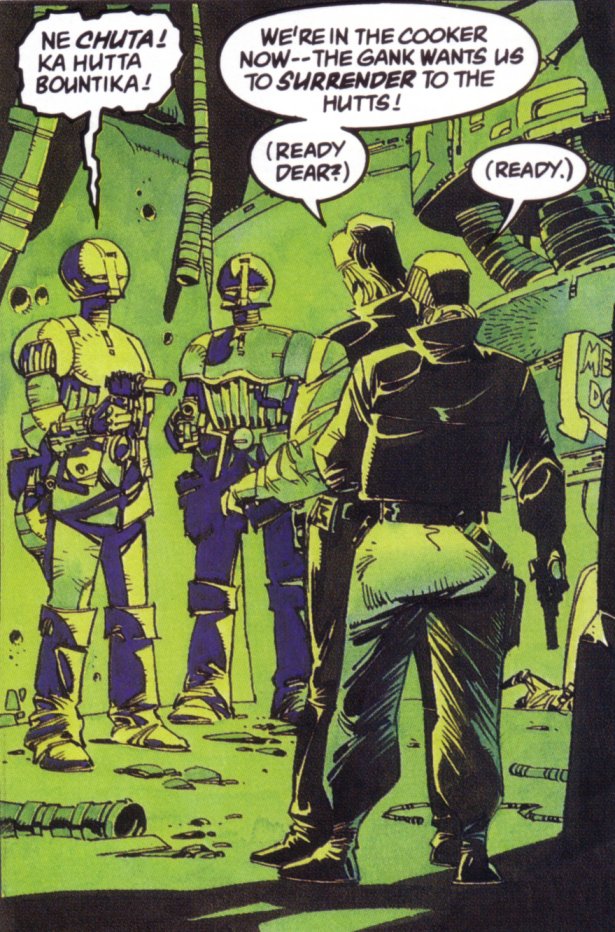
In 10 ABY, on Nar Shaddaa, a band of Ganks joined forces with the Mandalorian bounty hunter Boba Fett with the aim of capturing Han Solo and his family. Later that same year, a group of Ganks employed by the Hutts confronted Solo, his wife Leia Organa Solo, and his former associate Salla Zend in Nar Shaddaa's Corellian Sector as the trio of Humans were attempting to secure a starship to reach the Emperor's throneworld of Byss and locate the ancient Jedi Vima-Da-Boda. Upon locating the Solos, the Ganks demanded their surrender to the Hutts. Organa Solo responded by drawing her blaster and shooting two of the Ganks. When three more Ganks appeared, the Solos called for assistance from their Wookiee companion, Chewbacca. Simultaneously, a rival group of bounty hunters also seeking the Solos arrived and engaged the Gank Killers. The ensuing conflict resulted in the mutual destruction of the Ganks and bounty hunters, allowing their intended targets to escape.
During the Yuuzhan Vong War, specifically in 28 ABY, at least a pair of Ganks aligned themselves with the Yuuzhan Vong sympathizers known as the Peace Brigade. When a contingent of Jedi Knights arrived on the planet Ylesia and a battle commenced, the Ganks barricaded themselves within a bunker utilized by the Ylesian Senate. The Jedi Jaina Solo and Lowbacca infiltrated the bunker, whereupon the Ganks initiated gunfire. Lowbacca responded by striking their heads together, effectively neutralizing the threat they posed.
Behind the scenes
The Ganks' origins can be traced back to the second script revision of Star Wars: Episode V The Empire Strikes Back, which George Lucas revised from Leigh Brackett's initial draft on April 1, 1978. In this version, Han Solo informs Leia Organa of his need to depart the Rebel Alliance's base on the ice planet Hoth to settle his debt with Jabba the Hutt. Despite Organa's objections, Solo insists that failure to repay Jabba would result in an overwhelming number of bounty hunters pursuing him, including "Remotes, Gank killers, even Bell Cambos." This line was modified before the 1979 filming, removing the reference to Gank killers. However, Donald F. Glut preserved a variation of the line in his 1980 novelization of the film, as did Archie Goodwin in his 1980 comic book adaptation, thus maintaining the reference. Solo's quote was also repeated in The Empire Strikes Back Official Poster Monthly 5, published in the same year.
The precise nature of a "Gank killer" remained undefined until the release of issues 3 and 4 of the comic book series Star Wars: Dark Empire, published by Dark Horse Comics in 1991 and 1992, respectively. These comics, penned by Tom Veitch and illustrated by Cam Kennedy, depicted Hutt characters attended by armored retainers. While the comics never explicitly identified these figures as Ganks, Bill Slavicsek's 1994 second edition and 2000 third edition of A Guide to the Star Wars Universe made this connection. The species' background was further elaborated upon by Michael Allen Horne in 1993's Dark Empire Sourcebook and by Ann Margaret Lewis in 2001's The Essential Guide to Alien Species. The latter work included an illustration of the species by R. K. Post. Since then, Ganks have appeared in minor roles in various Star Wars novels and stories, including John Whitman's Galaxy of Fear: Eaten Alive (1997), Walter Jon Williams' "The New Jedi Order: Ylesia" (2002), and Michael Reaves' Coruscant Nights I: Jedi Twilight (2008).
Some sources, such as the 1994 second edition of A Guide to the Star Wars Universe, were ambiguous regarding whether the terms Gank and Gank Killer were synonymous or whether Gank Killers constituted a specific subset of the Gank species. However, the 2000 third edition update of the same book, also by Slavicsek, clarified that both terms referred to the species as a whole. The species is also referenced in sourcebooks such as the Star Wars Encyclopedia, The Complete Star Wars Encyclopedia, and the codex of the 2011 video game Star Wars: The Old Republic.
Twinkle, Twinkle Little Star, How I Wonder Where We Are credits Donald F. Glut's Star Wars: The Empire Strikes Back novelization with the first mention of Gank killers and the Gank system, placing the system within the Spinward sector.