Star Wars: Episode IV A New Hope
Star Wars: Episode IV A New Hope, initially known as Star Wars, is a 1977 science fiction film, both written and directed by George Lucas. It serves as the initial installment of the Star Wars original trilogy and holds the distinction of being the first Star Wars movie to be shown in theaters.
The narrative unfolds 19 years following the establishment of the Galactic Empire and the events depicted in Revenge of the Sith. The Death Star, a weapon with the capability to obliterate an entire planet, is now fully constructed. Princess Leia Organa, a key figure in the Rebel Alliance, obtains the schematics of this weapon, hoping to exploit a weakness. However, she is subsequently captured and brought to the Death Star. Simultaneously, a youthful farmer named Luke Skywalker encounters Obi-Wan Kenobi, who has been living in solitude for many years on the desert world of Tatooine. After Luke's home is destroyed by fire, and his aunt and uncle are murdered, Obi-Wan commences Luke's Jedi training. Together with Han Solo, Chewbacca, C-3PO, and R2-D2, they embark on a mission to save the princess from the clutches of the Empire.
Lucas drew inspiration from sources like the Flash Gordon serials, the samurai films directed by Akira Kurosawa, and seminal works such as Joseph Campbell's The Hero with a Thousand Faces and Frank Herbert's Dune book series, commencing work on Star Wars in 1974. This film, notable for its pioneering special effects, is widely regarded as one of the most successful and influential movies ever made. With a production budget of US$11,000,000, it was initially released on May 25, 1977, and achieved immense success, grossing $215 million in the United States and $337 million internationally during its original theatrical run. The film also garnered numerous awards, including 10 Academy Award nominations. It saw multiple re-releases, some incorporating notable alterations. Prominent among these were the 1997 Special Edition and the 2004 DVD release, which featured enhanced CGI effects and re-created scenes. In September of 2011, the film was re-released on Blu-ray. The Library of Congress selected the film for preservation in its National Film Registry in 1989, the registry's inaugural year.
Opening crawl ‡
Plot summary
Assault on Tantive IV
Set nineteen years after the establishment of the Galactic Empire, the galaxy is embroiled in civil war. The Rebel Alliance has achieved a significant victory by stealing the plans for the Galactic Empire's superweapon, the Death Star. Princess Leia Organa, in possession of these stolen plans, hopes they will save her people and restore freedom. She attempts to return home aboard the Tantive IV, but her ship is intercepted by the Imperial I-class Star Destroyer Devastator above the desert planet of Tatooine.
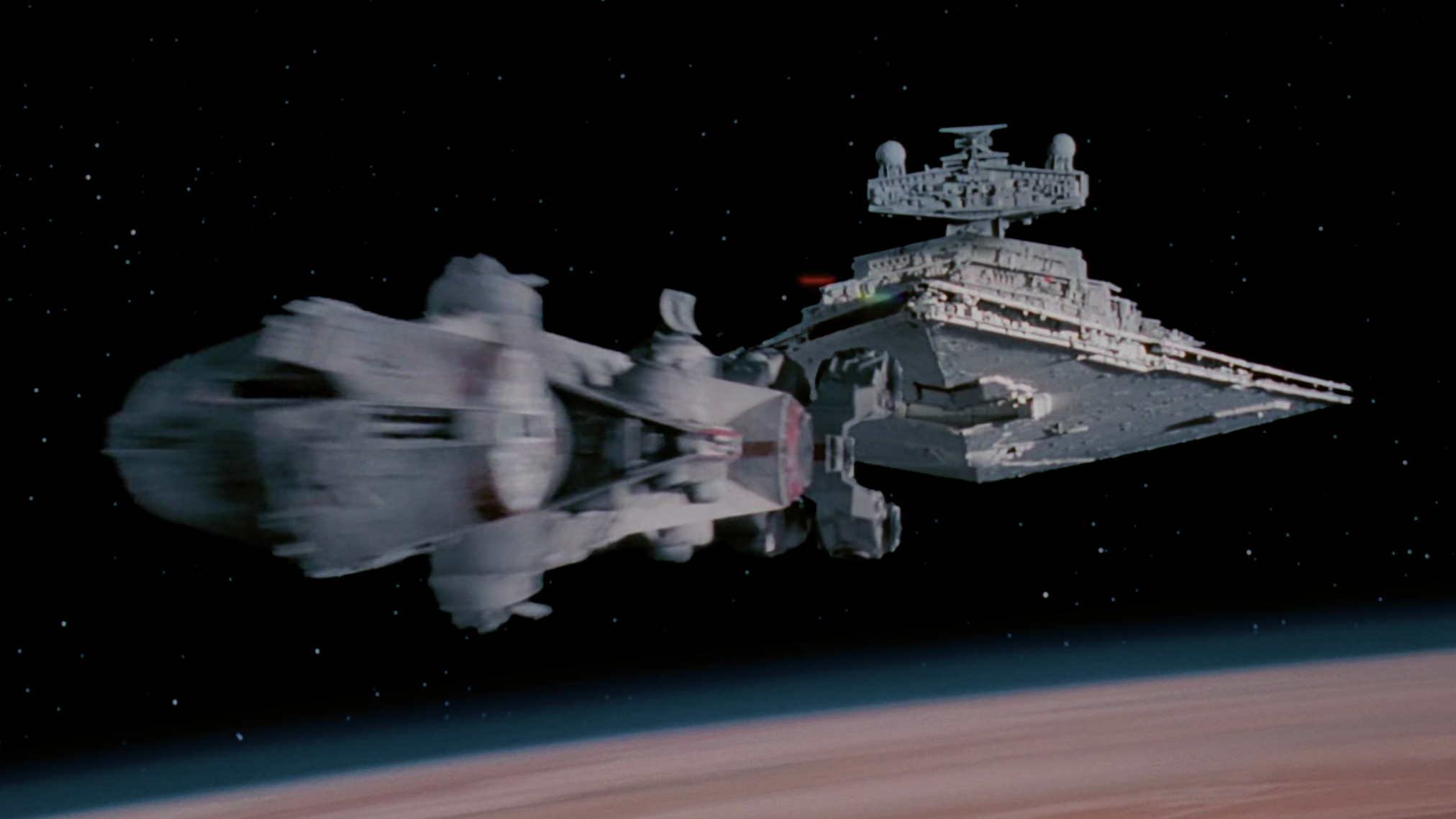
The ship is boarded, and Imperial stormtroopers take control. After defeating the few guards defending the vessel, the Sith Lord Darth Vader arrives to assess the situation. Enraged, Vader interrogates Captain Antilles, ultimately killing him by strangulation. Princess Leia, concealed on the ship, manages to record a holographic message with the aid of R2-D2. She entrusts the droid with the Death Star plans and the mission of delivering the message to Obi-Wan Kenobi, a Jedi hiding on Tatooine. Stormtroopers discover Leia, stun her, and bring her before Vader. Leia claims she and the crew were on a diplomatic mission to Alderaan, but Vader dismisses this, branding her a traitor and ordering her imprisonment. Vader instructs that a message be sent to the Imperial Senate, stating that the ship was destroyed with all aboard killed. R2-D2 and C-3PO escape in a pod, reaching Tatooine and narrowly avoiding destruction by an Imperial cannon due to the operators' failure to detect them.
Luke's destiny
After a disagreement that leads to their temporary separation, the droids are captured separately by Jawa traders and taken aboard a sandcrawler. Later, they are purchased by Owen Lars, a moisture farmer, and his nephew, Luke Skywalker. Luke, a young farmer who lost his parents when he was a baby, dreams of becoming a starfighter pilot like his friends. While cleaning R2, Luke finds a small part of the hologram. He wonders if the "Obi Wan" mentioned is his neighbor, Ben Kenobi.
During dinner with Owen and his Aunt Beru Whitesun Lars, Owen asks Luke to take R2 to Anchorhead the next day to have his memory erased. He hopes Luke will stay for one more harvest season before joining the Academy. R2 runs away from the Lars' home to find Obi-Wan, claiming to be his property. Luke and C-3PO search the desert and find R2 the next day, but are attacked by sand people. Ben Kenobi rescues them, confirming he is Obi-Wan.
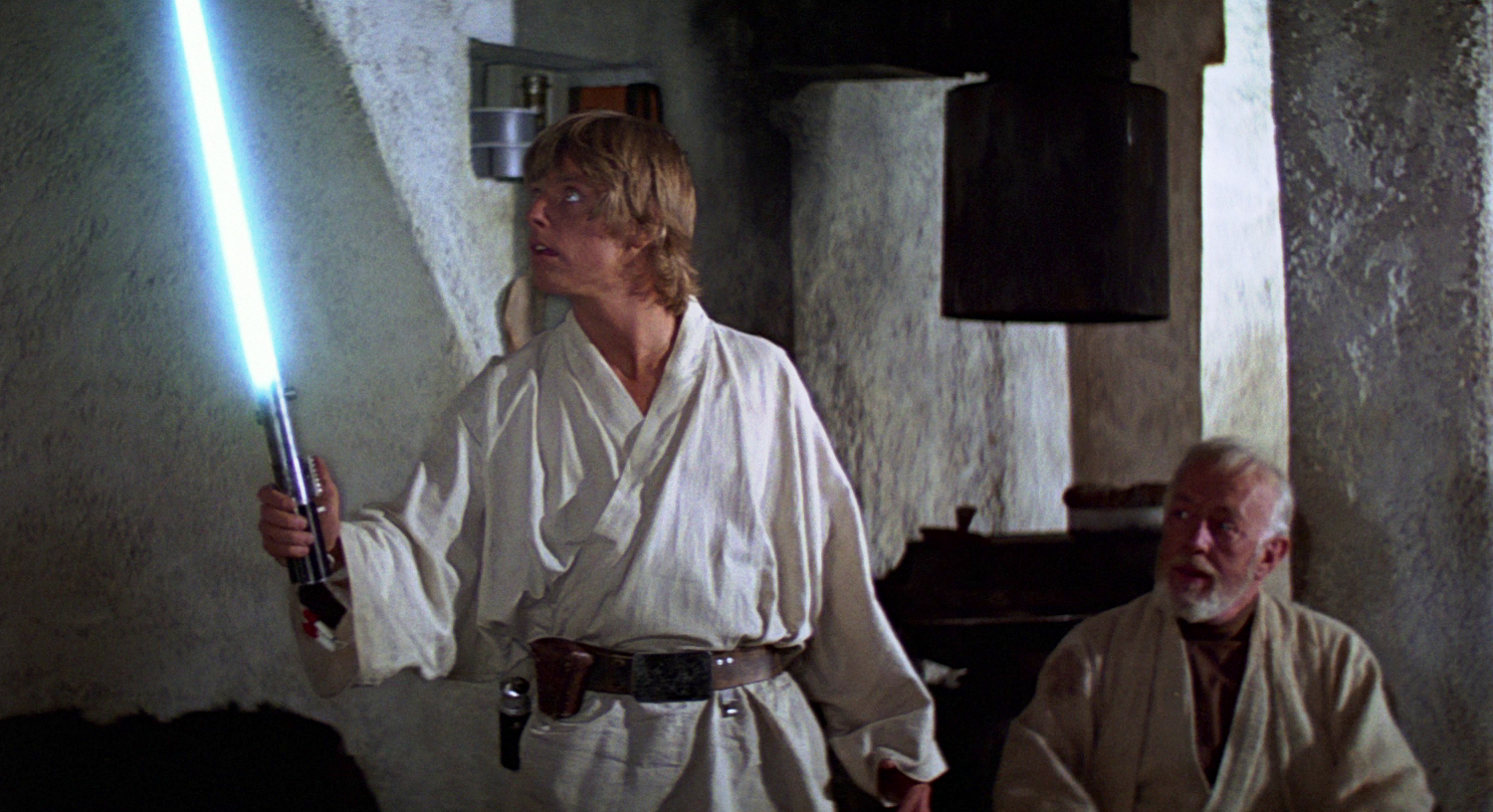
At his home, Obi-Wan gives Luke his father's lightsaber, recalling his friendship with Luke's father. He tells Luke that they were both part of the Jedi Order, which protected the galaxy before the Empire took over. He explains that Darth Vader was once his apprentice before turning to the dark side of the Force and killing Luke's father. After seeing Princess Leia's full message, Obi-Wan tries to convince Luke to come with him to Alderaan. Luke initially refuses but agrees to take Obi-Wan to Anchorhead. On the way, they find the remains of the sandcrawler, the Jawas killed by stormtroopers searching for the droids. Horrified, Luke rushes home to find it burning and his aunt and uncle murdered by the same stormtroopers.
Luke is devastated, but Obi-Wan tells him there was nothing he could do, and that he would have been killed too, and the plans would be in the Empire's hands. With nothing left on Tatooine, Luke, Obi-Wan, and the two droids go to Mos Eisley to find a way to Alderaan, Princess Leia's home planet.
Aboard the Death Star, Cassio Tagge and Conan Antonio Motti argue about the station's vulnerability to the rebels, noting the rebellion's growing support in the Imperial Senate. Wilhuff Tarkin and Darth Vader enter, announcing that the Emperor has dissolved the Senate, eliminating the last vestige of the Old Republic. Motti boasts the Death Star's power, believing fear will keep the galaxy in line, but Vader says its power is insignificant compared to the Force. When Motti mocks Vader's belief in the Force, Vader Force chokes him until Tarkin orders him to stop, expressing his desire to crush the Rebellion.
Back in Mos Eisley, Luke, Obi-Wan, and the droids encounter stormtroopers who demand identification. Obi-Wan uses a Jedi mind trick on the lead trooper, allowing them to pass. At Chalmun's Spaceport Cantina, they hire smuggler Han Solo and his First Mate, the Wookiee Chewbacca, for 17,000 credits, with 2,000 paid upfront and 15,000 upon arrival, to take them to Alderaan on the Millennium Falcon. Han has a brief encounter with Greedo over debts to crime lord Jabba the Hutt, which ends with Han shooting Greedo. Jabba confronts Han in the Falcon's docking bay, scolding him for killing Greedo. Han defends his actions (dumping cargo when confronted by an Imperial patrol) and promises to repay Jabba. Luke, Ben, and the droids arrive at the Falcon's hangar. A brief fight with stormtroopers occurs, and the Falcon escapes Imperial Star Destroyers over Tatooine, setting course for Alderaan, unaware that the Death Star has arrived there.
Rescue of the princess
Leia, having resisted torture with a mind probe to reveal the location of the Rebel Alliance's headquarters, is brought before Grand Moff Tarkin. Tarkin threatens to use the Death Star's superlaser on Leia's homeworld of Alderaan if she refuses to disclose the Rebel base's location. She reluctantly tells them the base is on Dantooine, but Tarkin orders Alderaan's destruction anyway for supporting the rebels.
Aboard the Millennium Falcon, Obi-Wan feels a great disturbance in the Force while Luke trains with a training remote. Upon exiting hyperspace, they find what appears to be an asteroid field in Alderaan's place. The Millennium Falcon is then pulled into the Death Star by its powerful tractor beam.
Tarkin and Vader discover that Leia lied about the Rebel base's location when their forces find only the ruins of a base on Dantooine. Tarkin orders her execution.
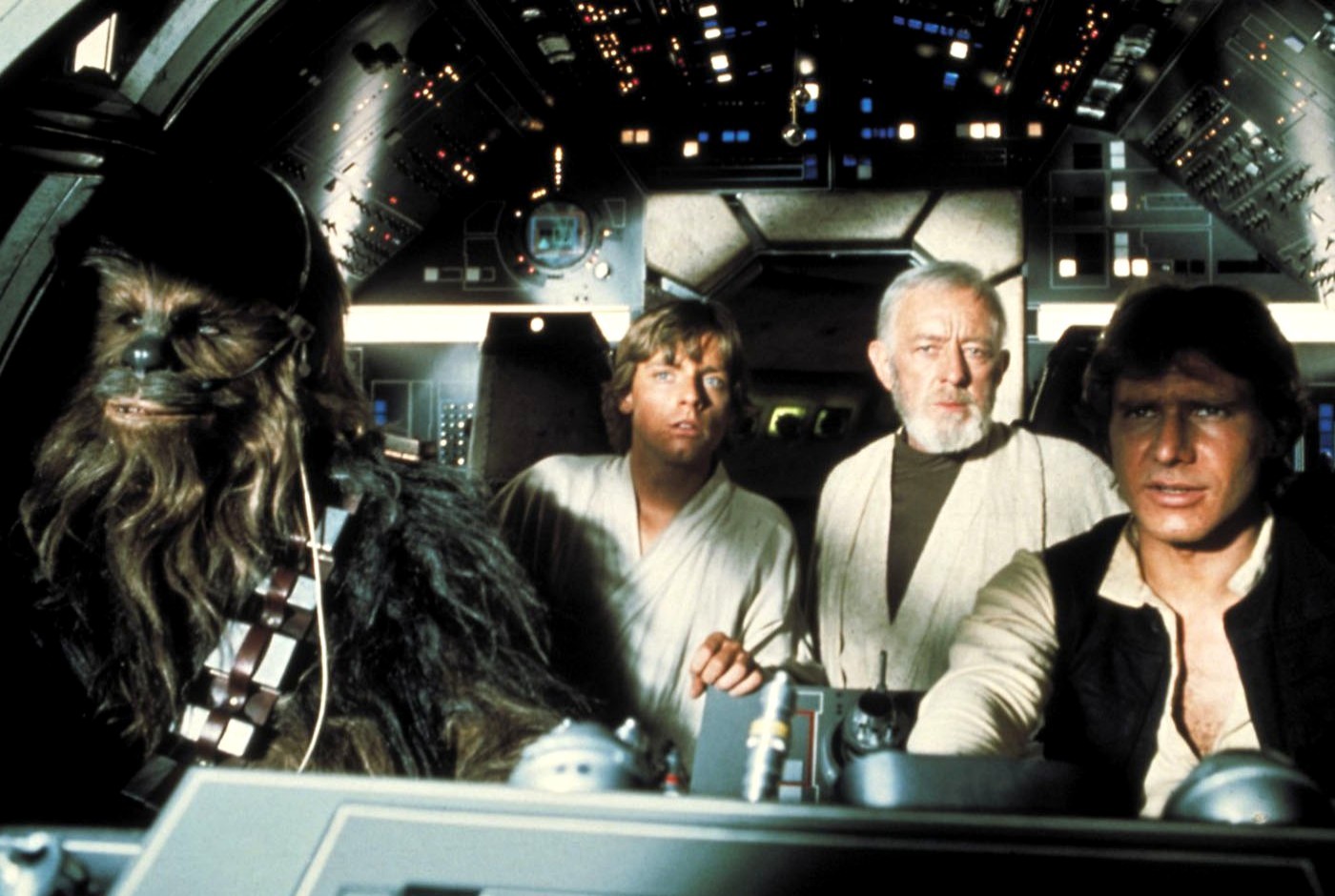
Having docked with the Death Star, Solo and the others ambush two stormtroopers and the Imperial scanning crew sent to investigate the Falcon by hiding in hidden smuggling compartments. With Han and Luke disguised as the two stormtroopers, the group storms a control room to figure out how to escape. Obi-Wan separates from the group to disable the tractor beam, leaving the others alone. While connected to the Imperial Network, R2-D2 discovers Princess Leia is aboard the station and is set for termination. Luke convinces Han and Chewbacca to rescue her with the vague promise of a grand reward. Han and Chewbacca reluctantly agree. Luke plans to march into Detention Block AA-23, claiming that Chewbacca is part of a prisoner transfer. C-3PO and R2-D2 are instructed to remain behind, and the trio sets off on their rescue attempt. Upon being met with suspicion, they are quick to subdue the officers and guards in the princess's cell block. Luke frees Leia from her cell, but the group are pinned down by a squad of stormtroopers. Leia takes charge, blasting a hole in a nearby grate and jumping through while Chewbacca, Luke, and Han all dive after the princess.
The chute leads to a garbage compactor that houses a resident dianoga. Soon after landing, the creature pulls Luke under the surface, but releases him and is scared away when the Imperials realize where the heroes escaped to and activate the compactor. As the walls close in, Luke desperately calls C-3PO over his comlink, asking for the compactor to be shut down. Leia struggles to reach the top, and Chewbacca tries to unlock the door. R2-D2 manages to shut down the compactor in the nick of time, although, amidst the muffled cries of joy over the comlink, C-3PO is briefly convinced that his master and friends have been crushed.
After escaping the trash compactor, the group hurries back to the Millennium Falcon, hoping Obi-Wan has disabled the tractor beam. Leia and Han argue about who is in charge, while Han muses that no reward is worth Leia's criticism. Luke and Leia briefly separate from Han and Chewie when Han chases after a group of stormtroopers, only to run into a whole battalion and be chased by them instead. Luke and Leia nearly fall into a large chasm and swing across with a grappling hook amidst blaster fire, with Leia giving Luke a brief kiss "for luck". The group soon reunites and heads back to the Falcon.
Sacrifice and victory
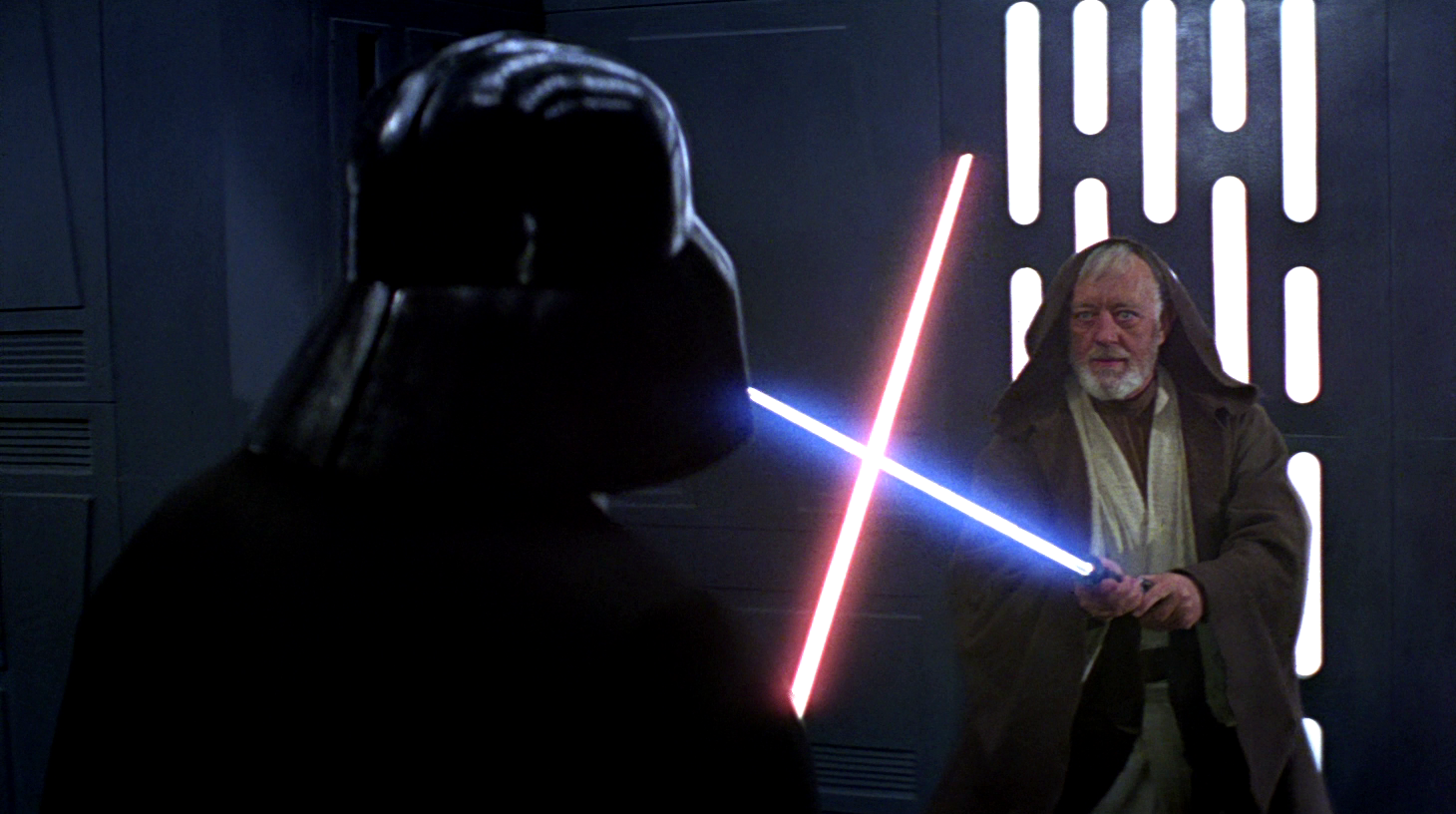
Meanwhile, Obi-Wan, remaining undetected, shuts down the tractor beam. Vader, however, senses his presence through the Force and confronts his old master, engaging him in a lightsaber duel. Luke and the others return to the Falcon, where Luke and several stormtroopers witness the battle. Obi-Wan glances at Luke one last time and allows Vader to strike him down, thus becoming one with the Force and allowing Luke and the others to escape. Horrified and angered by Obi-Wan's death at Vader's hands, Luke and the others flee on the Millennium Falcon under blaster fire from the stormtroopers.
Still mourning Obi-Wan's death, Luke helps Solo fight off a squadron of TIE fighters. Despite their victory, Leia believes the Empire let them escape to track them to the rebel base. The Falcon crew meets the Rebel Alliance on Yavin 4, and the information in R2-D2 is given to them. General Dodonna plans the attack on the Death Star, as the plans reveal a weakness: a thermal exhaust port leading to the station's reactor. Believing a direct hit with proton torpedos will cause a chain reaction, Dodanna orders the pilots to their ships. To Luke's dismay, Han leaves after receiving his reward to settle his debts.
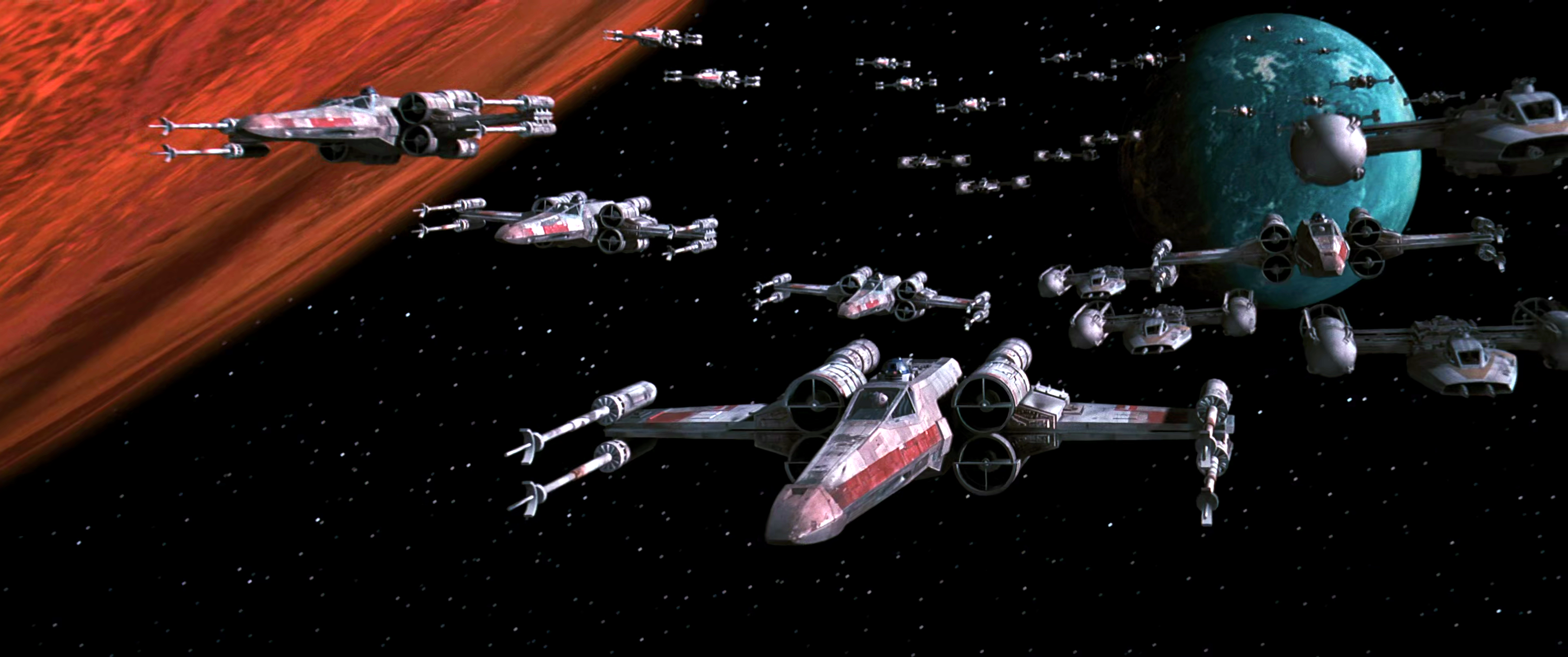
The Rebel strike force attacks the Death Star as it approaches Yavin 4. A group of X-wing and Y-wing starfighters, including Luke, assault a trench on the Death Star's surface to hit the vulnerable spot before it destroys the Alliance's base. Most of the Rebel craft, including Luke's friend Biggs Darklighter, are shot down by Imperial fighters led by Darth Vader. Tarkin is told that the Rebels are a threat, but he refuses to evacuate. With the Death Star minutes from destroying Yavin 4, Luke makes a final run down the trench. Just as Vader fires on Luke from his TIE Advanced x1, Han returns in the Millennium Falcon and attacks the Imperials, knocking Vader's TIE out of the trench. Luke, guided by the voice of Kenobi and the Force, accurately fires two proton torpedoes into the exhaust port and retreats. Moments later, the battle station explodes, killing Tarkin and everyone on board, while Vader escapes into space.
The remaining ships (those of Wedge Antilles, Luke, Han, and a Y-wing Pilot) return to Yavin 4, and a victory ceremony is held. Medals are presented to Han Solo and Luke Skywalker by Princess Leia, as the rebels give them a standing ovation.
Development
Conception
During the post-production phase of his previous project, American Graffiti, Lucas frequently engaged in discussions with producer Gary Kurtz regarding the concept of a "space opera." By January 1973, Lucas had initiated work on this idea, and by May, he had developed a 14-page story outline intended for distribution among various film studios. Initially, Lucas had envisioned the film as a continuation of both American Graffiti and Apocalypse Now (the latter of which he contributed to before Warner Bros. Studios dissolved his American Zoetrope studio, compelling him to transfer development to his associate, Francis Ford Coppola). His fundamental plot idea for the film, conceived as a response to the Vietnam War era, centered on "a technological empire pursuing a small group of freedom fighters."[6][7] According to Walter Murch, a former colleague of Lucas during the filming of Apocalypse Now, the space opera setting was largely chosen because the ongoing Vietnam War would have made audiences unreceptive to a direct critique of American involvement in Vietnam.[8][9] Given its setting in outer space, the story was categorized as science fiction, a genre with limited box office appeal. Lucas later suggested that terms like "space fantasy" or "science fantasy" were more appropriate for the narrative.[5] He presented the outline to Universal Studios and United Artists, both of which rejected the project (the former with a direct refusal, while the latter delayed their response beyond the stipulated 10-day period).[6][10][7] He also approached Walt Disney Studios Motion Pictures, but they also declined.[6][7] Lucas expressed dissatisfaction with the studio system due to the unauthorized re-editing of his previous two films, American Graffiti and THX 1138.[11] Nonetheless, recognizing the necessity of studio involvement, he approached Alan Ladd, Jr., the head of 20th Century Fox. Although Ladd did not fully comprehend the project's technical aspects, he recognized Lucas's talent. Lucas later stated that Ladd "invested in me, [but] he did not invest in the movie."[5]_
Production
Lucas authored several script drafts: a rough draft in May, a first draft in July 1974, a second draft titled Adventures of the Starkiller as taken from the Journal of the Whills, Saga I: The Star Wars in January, and a third draft titled The Star Wars: From The Adventures of Luke Starkiller in August 1975.
As the script evolved, the characters underwent significant transformations. Early in the development phase, Luke Skywalker's character transitioned from a 60-year-old general to a member of a family of dwarfs. The Corellian smuggler, Han Solo, was initially conceived as a large, green-skinned monster with gills. Chewbacca was inspired by Lucas's Alaskan malamute dog, Indiana, who often served as the director's "co-pilot" by occupying the passenger seat of his car. The Force, a mysterious energy field, was originally conceptualized as the Kyber crystal, a "galactic holy grail." The completed script exceeded the length suitable for a single movie; however, Lucas declined to condense it. Instead, he expanded the initial third into one film and reserved the remainder for two subsequent movies, effectively establishing the original Star Wars trilogy.
Lucas enlisted conceptual artist Ralph McQuarrie to produce paintings of specific scenes during the screenwriting process. Upon delivering his screenplay to the studio, Lucas included several of McQuarrie's paintings. 20th Century Fox approved a budget of $8,250,000. The positive reception of American Graffiti enabled Lucas to renegotiate his agreement with Alan Ladd, Jr., and request the sequel rights to the film. This arrangement safeguarded the unwritten portions of Star Wars and a significant portion of the merchandising profits for Lucas.
After realizing that 20th Century Fox had shut down its visual effects department, Lucas established Industrial Light & Magic (ILM), a company specializing in visual effects, in 1975. ILM commenced work on Star Wars within a warehouse located in Van Nuys, California. Lucas personally acquired used equipment at very low prices. In contrast to the conventional method of filming models by moving them before a still camera, most of the visual effects employed motion control photography, a technique that gives the impression of scale through the use of small models and slowly moving cameras called the Dykstraflex. All models were filmed against a blue screen, which facilitated the insertion of other elements into the scene, a process known as optical compositing. The special effects team modified an optical printer, enabling the photography and combination of separate film strips onto a single film layer. Artists crafted matte paintings to enhance the scope and production quality of scenes, extending environments by painting on glass, which was then photographed and merged with live-action footage. Model spaceships were built based on drawings by Joe Johnston, Lucas's input, and McQuarrie's paintings. Lucas chose to move away from the typical sleekness of science fiction, instead creating a "used universe" where all devices, ships, and buildings appeared worn and dirty. Principal photography began on March 22, 1976 in Tunisia. Lucas encountered delays during the initial week of filming due to an unusual rainstorm in Tunisia, malfunctioning props, and electronic failures. When Anthony Daniels first put on the C-3PO costume, the left leg piece broke through the plastic covering his left foot, causing an injury. Following the completion of filming in Tunisia, production relocated to the more controlled setting of Elstree Studios, situated near London. Nevertheless, significant challenges persisted, including a crew that showed little enthusiasm for the project. The majority of the crew viewed the film as a "children's film," rarely taking their work seriously and often finding it unintentionally comical. Kenny Baker later admitted his belief that the film would fail. Harrison Ford struggled with the dialogue, remarking, "You can type this shit, George, but you sure can't say it." Lucas conflicted with director of photography Gilbert Taylor, whom producer Gary Kurtz described as "old-school" and "crotchety." Furthermore, Lucas, with his background in independent filmmaking, was accustomed to creating most of the film's elements himself. Taylor, offended by Lucas's camera suggestions, felt that Lucas was overstepping his boundaries by providing specific instructions, and rejected them. Eventually, Lucas grew frustrated that the costumes, sets, and other elements were not meeting his original vision for Star Wars. He seldom interacted with the actors, who felt he expected too much from them while offering minimal direction. His instructions to the actors typically consisted of the words "faster" and "more intense." Ladd provided Lucas with some of the only support from the studio, addressing concerns from board members regarding the escalating budget and intricate screenplay drafts. After production fell two weeks behind schedule, Ladd informed Lucas that he had one week to complete production or face a shutdown. The crew divided into three units, led by Lucas, Kurtz, and production supervisor Robert Watts, respectively. Under this revised structure, the project adhered to the studio's deadline. ILM wrapped up filming on April 22, 1977, with shot 110P, depicting a Star Destroyer. Star Wars was initially scheduled for release in Christmas 1976; however, delays pushed the film's release to the summer of 1977. Already concerned about meeting his deadline, Lucas was dismayed when the initial cut of the film by his editor was deemed a "complete disaster." After attempting to persuade the original editor to cut the film according to his vision, Lucas replaced the editor with Paul Hirsch and Richard Chew. He also enlisted the help of his then-wife Marcia Lucas in the editing process while she was working on the film New York, New York with Lucas's friend Martin Scorsese. Richard Chew observed that the film lacked energy, having been edited in a conventional manner: scenes unfolded in master shots that transitioned into close-up coverage. He noted that the pace was dictated by the actors rather than the cuts. Hirsch and Chew worked on two reels concurrently, with the first to finish moving on to the next. During production, the cast members attempted to elicit laughter or a smile from Lucas, who often appeared despondent. At one point, the project became so demanding that Lucas was diagnosed with hypertension and exhaustion, and was advised to reduce his stress levels. Post-production was equally stressful due to mounting pressure from 20th Century Fox. Additionally, Mark Hamill's face was injured in a car accident, precluding reshoots. Meanwhile, ILM struggled to create groundbreaking special effects. The company had spent half of its budget on four shots that Lucas found unacceptable. Furthermore, rumors circulated that ILM employees lacked discipline, necessitating frequent intervention from Lucas to ensure they stayed on schedule. With hundreds of shots still incomplete, ILM was compelled to accomplish a year's worth of work in six months. Lucas motivated ILM by compiling aerial dogfights from vintage war films, which improved the pacing of the scenes. Amidst the chaos of production and post-production, the team made decisions regarding character voicing and sound effects. Sound designer Ben Burtt had amassed a collection of sounds that Lucas referred to as an "organic soundtrack." For Chewbacca's growls, Burtt recorded and combined sounds from dogs, bears, lions, tigers, and walruses to create phrases and sentences. Burtt created R2-D2's robotic voice by filtering his own voice through an electronic synthesizer. Darth Vader's breathing was achieved by Burtt breathing through the mask of a scuba tank equipped with a microphone. Lucas never intended to use the voice of David Prowse, who played Darth Vader in costume, due to Prowse's strong English West Country accent. He initially wanted Orson Welles to voice Darth Vader. However, he felt that Welles's voice would be too recognizable, so he cast the lesser-known James Earl Jones. Lucas also did not plan to use Anthony Daniels's voice for C-3PO. Thirty established voice actors, including Stan Freberg, auditioned for the droid's voice. According to Daniels, one of the major voice actors suggested Daniels's voice for the role. The "Lost Cut" of Star Wars was edited by John Jympson. When Lucas screened an early cut of the film for his friends, including directors Brian De Palma, John Milius, and Steven Spielberg, their reactions were underwhelming. Spielberg, who claimed to be the only person in the audience who enjoyed the film, attributed the lack of enthusiasm to the absence of finished special effects. Lucas later stated that the group was honest and seemed perplexed by the film. Conversely, Alan Ladd, Jr. and the rest of 20th Century Fox loved the film; one of the executives, Gareth Wigan, told Lucas, "This is the greatest film I've ever seen," and cried during the screening. Lucas found the experience shocking and rewarding, as he had never received approval from studio executives before. Despite the delays increasing the budget from $8 million to $11 million, the film remained the least expensive in the Star Wars saga. ### Music From the very beginning, Lucas' intention for "Star Wars" was that it would have very familiar sounding music, that despite the extraordinary visuals and events occurring onscreen, the music would be reminiscent of Earth and of the past. To that end, he originally wanted to fill the film with tracked classical music from various composers, in a similar fashion to 2001: A Space Odyssey. Lucas' friend, Steven Spielberg, recommended composer John Williams to Lucas after their recent collaboration on Jaws (1975). Spielberg convinced Lucas that he should meet with the composer, who in turn convinced him of the need for original music. They also decided in this early meeting that the score should have a romantic musical sound, with leitmotifs for different characters and events, similar to the operas of Richard Wagner. Rough cuts of "Star Wars" used something called a "temp score", referring to musical material that was there to find a rhythm while editing but would not be kept in the final cut as it would be replaced by the final score. These temp tracks would help to inspire the direction John Williams was to take with his score as he began writing it. Most of the temp tracks are not public knowledge, but some information has been revealed over the years. In one interview, editor Paul Hirsch confirmed that a cue from Bernard Herrmann's Psycho score containing the famous "3-note motif" was used to temp the scene where the heroes exit the smuggling chambers of the Millennium Falcon. In another interview, Hirsch revealed that the opening to "The Sacrifice" from Igor Stravinsky's "The Rite of Spring" was used to temp the scene in the desert, the Jawa scenes were temped from other parts of the same piece, and the Main Title crawl was temped with the overture of Ivanhoe by Miklós Rózsa. Later, in his own book, Hirsch would claim that the Main Title crawl was temped with Erich Korngold's theme to 1938's The Adventures of Robin Hood. It is unknown which of these claims is correct. Also in his book, Hirsch mentions that the Cantina scene was tracked by Benny Goodman's "Avalon" from his Carnegie Hall performance, some of the early battle footage was tracked with "Dance of the Adolescents" from "The Rite of Spring", and the approach to the Death Star was temped with the music from the approach to Kong Island from Max Steiner's King Kong score. In an interview, sound editor Ben Burtt said that Antonín Dvořák's New World Symphony was temped into the medal ceremony (Hirsch mentioned this in his book too), and parts of Anton Bruckner's Ninth Symphony were temped as Luke's theme. Homages to many of these known temp tracks appear in the final score. For example, the cue [1m5-2m1] Desert Song from Star Wars is extremely similar to the opening of the Stravinsky piece it was temped with. Further, the music in [1m2] Main Title that plays when the underbelly of the Star Destroyer flies over the camera is very similar to the ending of "Mars - The Bringer of War" from Holst's "The Planets". Even the 3-note motif from Psycho appears in the very opening of the Star Wars cue [7m1-7m2 New] The Hatch Opens, exactly where the temp track would have been. On January 10, 1977, Williams was invited to the spotting sessions, where he watched a rough cut of the film with Lucas, music supervisor Lionel Newman, music editor Ken Wannberg, producer Gary Kurtz, and film editor Paul Hirsch. Over the next several weeks, he would get to work writing the score. The way Williams wrote his score, he began by creating all the various leitmotifs and character themes (such as "Luke's Theme," "Leia's theme," and "Ben's theme," the "Jawa theme," the "Rebel Fanfare," and the "Imperial motif"). He then went on to create the actual score by stringing all the themes he created together in a way that would match up with what was happening on screen. It was unknown exactly how long John Williams spent writing the score, but it is certain that he would have had at the absolute most no more than 8 weeks, given that they started recording on March 5th. This is unrealistic because there needed to have been time for the orchestrators to write out all the various parts for the players, so it is more likely that the score was completed in 7 weeks or less. As with any creative process, parts of the score went through multiple revisions. One well-known example is the cue "Lost R2", which scores the famous "binary sunset" scene. This scene was originally scored with a very different sounding piece that contained "Luke's theme". When Lucas heard the cue, he asked if it could be rescored with "Ben's theme" because he felt it fit the scene better. It can be argued that this opened the door for "Ben's theme" to be recontextualized into what we think of today as the "Force theme". Another interesting example of the score changing was the cue "A Home Destroyed". When this cue was written, it was designed to score the end of Ben's house, Leia's torture, the discovery of the attacked sandcrawler, and Luke returning home to find his guardians dead and his home burned. While Williams was writing the score, the film was re-edited so that the board room scene would occur where the torture scene used to be. This caused the cue to be split in half. The first 14 bars were recorded by themselves with a newly written ending featuring the "Death Star theme" for the transition to the boardroom scene. Then a second cue was recorded, being made up of bars 31-71 (attacked sandcrawler and burned homestead scenes) and bars 17-30 (Leia torture scene), with some new transition material written to join them. This isn't the only time editing of the film would require changes to the score, but it is one of the only examples where a re-edit resulted in the score being changed before it was recorded. The rest of the edits were done too late, and the remaining score changes were left to be made artificially by Ken Wannberg. After the writing of the score was completed, the orchestrations were performed by lead orchestrator Herbert Spencer, who was assisted by Arthur Morton, Angela Morley, Al Woodbury, Alexander Courage and Williams himself. #### Complete cue list (as written) When it came time to record the score, Williams was given no choice but to record in London, presumably due to budget constraints and the fact that most of the film was shot in England. He did have the choice of which orchestra he wanted to work with, and he ended up choosing the London Symphony Orchestra (LSO) due to its primary conductor being his friend André Previn. This was historically significant, as it was the first time Williams ever got to work with an organized symphony orchestra for a film. Previous films of his usually recorded with freelance players. The score was recorded over the course of eight days between March 5th and March 16th of 1977 at Anvil Recording Studios in Denham, England. People present at the sessions included John Williams himself, who was conducting, George Lucas, recording engineer Eric Tomlinson, his assistant Alan Snelling, and music editor Ken Wannberg. The orchestra itself was made up of 26 violins, 10 violas, 10 cellos, 6 basses, 11 woodwinds, 8 horns, 4 trumpets, 3 trombones, 2 tubas, 2 harps, 3 percussion, 1 timpani, 1 piano, and 1 celeste. The score was recorded with approximately 23 microphones, placed at strategic positions around the orchestra. The mixing console, a Rupert Neve, had 24 inputs and 16 outputs. Recording engineer Eric Tomlinson used the console to create a live LCR (Left, Center, Right) mix while the orchestra was playing. The live mixes were recorded straight to two 35mm magnetic film recorders (with healthy Dolby A noise reduction applied). The live mix was also routed to tracks 1-3 of a Struder A80 16-track 2 inch recorder, with sections of the orchestra isolated on tracks 4-15 and a 50 hz pilot tone on track 16. The pilot tone could later be used for synchronization with the film during editing. After the recording was completed, the best takes were combined into performance edits by music editor Ken Wannberg. He created performance edits using one of the 35mm mag recordings, as well as with the 16 track tapes. (note: a performance edit is where sections of different takes are combined together to create the best possible recording of a given cue) The 16 track tapes were intended both for backup purposes, and to be sent off to be remixed by John Neal for the eventual soundtrack release on LP. The 35mm edits would of course be further edited by Wannberg into the final stems for use in the film. #### Complete cue list (as recorded) and recording session log Total length of score (not including alternates or concert suites): 83:48 Total length of score (including alternates and concert suites): 90:34 #### Score as it appears in the final film (all releases from 1977-1996) Total length of music in movie: 80:37 #### Soundtrack releases The score to Star Wars has had several releases over the years. While many of these releases have been straight reissues of previous releases, there are currently four releases with unique programs that were independently mastered from the original session tapes: - 1977 OST (20th Century Fox Records) - 1993 Anthology (Arista Records) - 1997 Special Edition (RCA Victor) - 2016 Sony Classical Ultimate Vinyl Collection - 2016 Sony Classical Ultimate Soundtrack Edition - 2016 Sony Classical Ultimate Digital Collection - 2018 OST Remaster (Walt Disney Records) ### Sound A New Hope was originally presented in monaural sound in many theaters, though the first-run 70mm prints were some of the earliest wide-release examples of surround sound—something not seen in the commercial cinema since the Cinerama and Cinemascope experiments of the early 1950s. ### Sources and inspirations The film drew inspiration from a number of sources. This was conscious and has been acknowledged by George Lucas in interviews. It is characteristic of much myth-building. Lucas has stated that Akira Kurosawa's 1958 film The Hidden Fortress (USA release 1962) was a strong influence. The resemblance between the two buffoon farmers in The Hidden Fortress and the two talkative droids in A New Hope is apparent. Indeed, when the droids find themselves alone on Tatooine, even the music and the style of "wipe" cuts are a clear homage to Hidden Fortress. When Motti is criticizing Darth Vader, he is about to mention the Rebels' "hidden fortress" before Vader cuts him off in the middle of the last word. The climactic scene in which the Death Star is assaulted was modeled after (including some of the same dialogue) the 1950s film The Dam Busters, in which RAF Lancaster bombers fly along heavily defended reservoirs and aim "bouncing bombs" at German man-made dams in a bid to cripple the heavy industry of the Ruhr. (A New Hope cinematographer Gilbert Taylor had previously worked on the special-effects sequences for that film.) Lucas has made mention of the film 633 Squadron directed by Walter Grauman when citing movies that inspired themes or elements in A New Hope. The "trench run" in A New Hope wherein Luke flies his X-wing through a "trench" on the Death Star and destroys the ship was inspired, at least in small part, by the finale of 633 Squadron, which involves several Royal Air Force planes flying at low level up a fjord against heavy, ground-based anti-aircraft fire, to attack a factory located at the base of a cliff at the canyon's end. ## Release and reception Wary that Star Wars would be beaten out by other summer films, such as Smokey and the Bandit, 20th Century Fox moved the release date to Wednesday before Memorial Day: May 25, 1977. However, few theaters ordered the film to be shown. In response, 20th Century Fox demanded that theaters order Star Wars if they wanted an eagerly anticipated film based on a best-selling novel titled The Other Side of Midnight. The New York Times published the first advertisements for the film on May 15, only ten days before its premiere. Star Wars became an instant success upon release; within three weeks, 20th Century Fox's stock price doubled to a record high. Before 1977, 20th Century Fox's greatest annual profits were $37,000,000; in 1977, the company earned $79,000,000. Although the film's cultural neutrality helped it to gain international success, Ladd became anxious during the premiere in Japan. After the screening, the audience was silent, leading Ladd, Jr. to fear that the film would be unsuccessful. He was later told that, in Japan, silence was the greatest honor to a film. Meanwhile, thousands attended a ceremony at Grauman's Chinese Theater, where C-3PO, R2-D2 and Darth Vader placed their footprints in the theater's forecourt. During the film's original theatrical run, there were a number of television promotions: - Darth Vader on The Wacko Saturday Morning Preview and Other Good Stuff Special (September 8, 1977) - Darth Vader on The ABC All-Star Saturday preview show (September 9, 1977) [51] - A re-creation of the cantina set for The Richard Pryor Show (September 13, 1977) - The Making of Star Wars TV special (September 16, 1977) - A Star Wars –themed Donnie and Marie episode (September 23, 1977) - Mark Hamill on The Bob Hope All Star Christmas Comedy Special (December 19, 1977) - Bill Murray 's " Nick The Lounge Singer " singing the Star Wars Main Theme on Saturday Night Live (January 28, 1978) - The Star Wars Holiday Special (November 17, 1978) [52] - Carrie Fisher on Saturday Night Live (November 18, 1978) - American Graffitti ' s Wolfman Jack interviews Darth Vader on The Midnight Special . (unknown date) [53] ## Adaptations and tie-in media Charles Lippincott was hired by Lucas' production company, Lucasfilm, as marketing director for Star Wars. Because 20th Century Fox gave little support for marketing beyond licensing T-shirts and posters, Lippincott was forced to look elsewhere. He secured deals with Stan Lee, Roy Thomas and Marvel Comics for a comic book adaptation and with Del Rey Books for a novelization. Although Star Wars merchandise was available to enthusiastic children upon release, only Kenner Toys—who believed that the film would be unsuccessful—had accepted Lippincott's licensing offers. Kenner responded to the sudden demand for toys by selling boxed vouchers in its "empty box" Christmas campaign; these vouchers could be redeemed for the toys in March 1978. The novelization of the film was published in December 1976, six months before the film was released. The credited author was George Lucas, but the book was revealed to have been ghostwritten by Alan Dean Foster, who later wrote the first Expanded Universe novel, Splinter of the Mind's Eye. The book was first published as Star Wars: From the Adventures of Luke Skywalker; later editions were titled simply Star Wars and, later, Star Wars Episode IV: A New Hope, to reflect the retitling of the film. Certain scenes deleted from the film (and later restored or archived in DVD bonus features) were present in the novel, such as Luke at Tosche Station with Biggs and the encounter between Han and Jabba in Docking Bay 94. Other deleted scenes from the movie, such as a close-up of a stormtrooper riding on a Dewback, were included in a photo insert added to later printings of the book. Smaller details were also changed; for example, in the Death Star assault, Luke's callsign is Blue Five instead of Red Five as in the film. Lippincott secured the deal with Del Rey Books to publish the novelization in November 1976. By February 1977, a half million copies had been sold. A radio drama adaptation of the film was written by Brian Daley, directed by John Madden, and produced for and broadcast on the American National Public Radio network in 1981. The adaptation received cooperation from George Lucas, who donated the rights to NPR. John Williams' music and Ben Burtt's sound design were retained for the show; Mark Hamill (Luke Skywalker) and Anthony Daniels (C-3PO) reprised their roles as well. The radio drama featured scenes not seen in the final cut of the film, such as Luke Skywalker's observation of the space battle above Tatooine through binoculars, a skyhopper race, and Darth Vader's interrogation of Princess
In the year 1975, upon learning of the disbandment of 20th Century Fox's department dedicated to visual effects, George Lucas established [Industrial Light & Magic](/article/industrial_light_%26_magic) (ILM), a company focused on this area. The initial work of ILM on _Star Wars_ took place within a warehouse located in [Van Nuys, California](https://en.wikipedia.org/wiki/van_nuys,_california). Lucas himself obtained used equipment at very economical prices. Departing from the traditional approach of filming models by moving them in front of a fixed camera, the majority of visual effects leveraged [motion control photography](https://en.wikipedia.org/wiki/motion_control_photography), a technique that generates the impression of scale through the use of small models and slowly moving cameras referred to as the [Dykstraflex](https://en.wikipedia.org/wiki/dykstraflex). A blue screen served as the backdrop for filming all models, which facilitated the integration of other elements into the scene, a process known as optical compositing. The special effects team re-engineered an optical printer, enabling the capture and combination of individual film strips onto a unified film layer. To elevate the scope and production value of scenes, artists produced matte paintings, extending environments via paintings on glass, which were subsequently photographed and integrated with live-action segments. The designs of [Joe Johnston](/article/joe_johnston), along with Lucas's contributions and McQuarrie's paintings, served as the basis for constructing model spaceships. Lucas made the decision to diverge from the conventional sleek aesthetic of science fiction, opting instead for a "used universe" where all devices, vessels, and structures exhibited a worn and aged appearance. The commencement of filming occurred on [March 22](/article/march_22), [1976](/article/1976) in the country of [Tunisia](/article/tunisia). During the first week of shooting, Lucas experienced setbacks due to an uncommon rainstorm in Tunisia, malfunctioning props, and electronic failures. An incident occurred when [Anthony Daniels](/article/anthony_daniels) donned the C-3PO costume for the first time, resulting in the left leg piece shattering and piercing the plastic covering his left foot, causing injury. Following the completion of filming in Tunisia, the production was relocated to the more regulated environment of [Elstree Studios](/article/elstree_studios), situated near London. Despite the change in location, significant issues persisted, notably a [crew](https://en.wikipedia.org/wiki/film_crew) that displayed minimal interest in the film. The majority of the crew regarded the project as a "children's film," seldom approaching their work with seriousness and frequently finding it unintentionally humorous. [Kenny Baker](/article/kenny_baker) later confessed his belief that the film would be unsuccessful. [Harrison Ford](/article/harrison_ford) expressed difficulty with the dialogue, stating, "You can type this shit, George, but you sure can't say it." Lucas had disagreements with [director of photography](https://en.wikipedia.org/wiki/director_of_photography) [Gilbert Taylor](/article/gilbert_taylor), whom producer Gary Kurtz characterized as "old-school" and "crotchety." Furthermore, Lucas, drawing from his experience in independent filmmaking, was accustomed to personally creating the majority of the film's components. Taylor, taking offense at Lucas's suggestions regarding camera work, felt that Lucas was overstepping his authority by offering specific instructions, and therefore rejected them. As time went on, Lucas became increasingly frustrated that the costumes, sets, and other elements were not aligning with his initial vision for _Star Wars_. He rarely engaged in conversation with the actors, who perceived that he had excessively high expectations of them while providing inadequate direction. His directions to the actors typically consisted of the words "faster" and "more intense." Ladd was a source of support for Lucas, dealing with concerns from [board](https://en.wikipedia.org/wiki/board_of_directors) members regarding the increasing budget and complex screenplay drafts. With production falling two weeks behind schedule, Ladd informed Lucas that he was required to complete production within a week, or face the possibility of a production shutdown. The crew was divided into three units, each led by Lucas, Kurtz, and production supervisor [Robert Watts](/article/robert_watts), respectively. This new organizational structure enabled the project to meet the studio's deadline. ILM concluded shooting on [April 22](/article/april_22), 1977, with shot 110P, which depicted a Star Destroyer. The original plan was for _Star Wars_ to be released in [Christmas](https://en.wikipedia.org/wiki/christmas) of 1976; however, due to delays, the film's release was postponed to the summer of 1977. Already concerned about meeting his deadline, Lucas was taken aback when his editor's first cut of the film was a "complete disaster." After attempting to convince the original editor to cut the film in accordance with his vision, Lucas replaced the editor with [Paul Hirsch](/article/paul_hirsch) and [Richard Chew](/article/richard_chew). He also sought the assistance of his then-wife [Marcia Lucas](/article/marcia_lucas) in the editing process, while she was simultaneously editing the film _New York, New York_ with Lucas's friend [Martin Scorsese](https://en.wikipedia.org/wiki/martin_scorsese). Richard Chew observed that the film lacked energy, having been edited in a conventional manner: scenes unfolded in [master shots](https://en.wikipedia.org/wiki/master_shot) that transitioned into [close-up](https://en.wikipedia.org/wiki/close-up) coverage. He noted that the pacing was dictated by the actors rather than the cuts. Hirsch and Chew worked on two reels concurrently, with the individual who completed their reel first proceeding to the next. Throughout production, the cast members attempted to make Lucas laugh or smile, as he frequently appeared depressed. At one juncture, the project became so demanding that Lucas received a diagnosis of hypertension and exhaustion, and was advised to reduce his stress levels. The [post-production](https://en.wikipedia.org/wiki/post-production) phase was equally stressful, owing to escalating pressure from 20th Century Fox. In addition

Leia. Regarding [Star Wars canon](/article/canon), the radio drama is recognized as G-canon, the highest level. Over the years, numerous comic book versions of the movie have been created: - [Marvel Comics](/article/star_wars_(1977)) began their Star Wars comic book series with a six-part adaptation of the film, penned by [Roy Thomas](/article/roy_thomas) and with illustrations by [Howard Chaykin](/article/howard_chaykin). - In 1978, [Al Williamson](/article/al_williamson) created a comic strip adaptation, but it was never distributed. - [Dark Horse Comics](/article/dark_horse_comics), coinciding with the 1997 Special Edition release, put out a new [four-part adaptation](/article/star_wars:_a_new_hope_-_the_special_edition) authored by [Bruce Jones](/article/bruce_jones) and featuring art by [Eduardo Barreto](/article/eduardo_barreto). - A [manga adaptation](/article/star_wars_manga:_a_new_hope) drawn by [Hisao Tamaki](/article/hisao_tamaki) was first published in Japan in 1997, then in the United States in 1998. ### Re-releases The film was originally released and frequently referred to as _Star Wars_, omitting _Episode IV_ and the subtitle _A New Hope_. The 1980 sequel, [Star Wars: Episode V The Empire Strikes Back](/article/star_wars:_episode_v_the_empire_strikes_back), included the episode number and subtitle in its opening crawl. When the original film was re-released on [April 10](/article/april_10), 1981, _Episode IV: A New Hope_ was inserted above the original opening crawl. Despite Lucas's assertion that only six films were intended, Lucasfilm representatives mentioned the possibility of nine or twelve films in early interviews. The film was re-released in theaters in 1978, 1979, 1981, 1982, and 1997.<InsImage
    src="https://static.wikia.nocookie.net/starwars/images/9/9d/Star_Wars_1997_re-release_poster.jpg"
    alt="Official poster for A New Hope Special Edition release"
    alignment="left"
    height="265px"
    width="180px"
>
Official poster for A New Hope Special Edition release
</InsImage>

After ILM utilized [computer generated effects](https://en.wikipedia.org/article/computer_generated_imagery) for Steven Spielberg's _Jurassic Park_, Lucas determined that digital technology had advanced enough to realize his original vision for _Star Wars_. As part of _Star Wars_'s 20th anniversary celebration in 1997, _A New Hope_ underwent digital remastering and was re-released in cinemas, alongside _The Empire Strikes Back_ and _Return of the Jedi_, under the banner _The Star Wars Trilogy: Special Edition_. The Special Edition versions incorporated visual shots and scenes that were previously impossible due to financial limitations, technological constraints, and time pressures; one such scene depicted a meeting between Han Solo and [Jabba the Hutt](/article/jabba_desilijic_tiure). While most alterations were subtle or aesthetic, some fans felt that Lucas diminished the film with these additions. For example, a contentious alteration where Greedo shoots first during his confrontation with Han Solo has inspired T-shirts bearing the slogan "[Han shot first](/article/han_shot_first)."

### Home video

_A New Hope_ was made available on [DVD](https://en.wikipedia.org/article/dvd) on [September 21](/article/september_21), [2004](/article/2004) as part of a box set that included _The Empire Strikes Back_, _Return of the Jedi_, and a supplementary disc of bonus content. The movies were digitally restored and remastered, and [further changes were implemented](/article/list_of_changes_in_star_wars_re-releases#a_new_hope_3) by George Lucas.

The DVD includes a commentary track featuring George Lucas, Ben Burtt, Dennis Muren, and Carrie Fisher. The bonus disc contains the documentary _Empire of Dreams: The Story of the Star Wars Trilogy_, three featurettes, teaser and theatrical trailers, TV spots, still galleries, an exclusive preview of _Star Wars_: Episode III _Revenge of the Sith_, a playable [Xbox](https://en.wikipedia.org/article/xbox) demo of the [LucasArts](/article/lucasarts) game _Star Wars: Battlefront_, and a "Making Of" documentary on the [Episode III video game](/article/star_wars:_episode_iii_revenge_of_the_sith_(video_game)). The set was re-released in December 2005 as a three-disc "limited edition" boxed set without the bonus disc.

The trilogy was re-released on separate two-disc Limited Edition DVD sets from [September 12](/article/september_12), 2006, until [December 31](/article/december_31), [2006](/article/2006); the original versions of the films were included as bonus material. The release was met with controversy (often called "George's [original unaltered trilogy](/article/original_unaltered_trilogy)," or "GOUT" for short) because the so-called "unaltered" versions were sourced from the 1993 non-[anamorphic](https://en.wikipedia.org/article/anamorphic) [laserdisc](https://en.wikipedia.org/article/laserdisc) masters and were not re-transferred to contemporary DVD standards.

It was re-released in the Blu-ray format on [September 16](/article/september_16), [2011](/article/2011).

On [April 7](/article/april_7), [2015](/article/2015), the Walt Disney Studios, 20th Century Fox, and Lucasfilm jointly announced the digital availability of the six released _Star Wars_ films. Fox released _A New Hope_ for digital download on April 10, 2015 (while Disney released the other five films).

Even with The Walt Disney Company's [2012](/article/2012) acquisition of Lucasfilm and the distribution rights to all future _Star Wars_ films, Fox was to permanently retain original distribution rights to _A New Hope_, which they co-produced and co-financed, across all media worldwide. Fox was also to hold theatrical, nontheatrical, and home video rights globally for the franchise's five subsequent films, independently produced and financed by Lucasfilm, through [May](/article/may) [2020](/article/2020), after which ownership would transfer to Disney. This intricate relationship between Fox and Disney, especially regarding Fox's perpetual rights to Episode IV, presented a hurdle for any future box set encompassing all nine films. On [December 14](/article/december_14), [2017](/article/2017), The Walt Disney Company revealed its acquisition of most of Fox's parent company, [21st Century Fox](https://en.wikipedia.org/article/21st_century_fox), including the film studio and all distribution rights to _A New Hope_. On [March 20](/article/march_20), 2019, the [deal](https://en.wikipedia.org/article/acquisition_of_21st_century_fox_by_disney) was officially finalized. On [April 12](/article/april_12), 2019, a [Blu-ray](https://en.wikipedia.org/article/blu-ray) box set, featuring the nine main installments of the _Star Wars_ [saga](/article/star_wars_saga) remastered in 4K, was reportedly announced for a 2020 release.

## Reception ‡

_Star Wars_ premiered on May 25, 1977, in 32 theaters, quickly setting house records and establishing itself as one of the first [blockbuster](https://en.wikipedia.org/article/blockbuster_(entertainment)) films. It remains one of the most commercially successful films ever made. Cast and crew members recalled seeing lines of people wrapped around theaters as they drove past. Even technical personnel, like model makers, were asked for autographs, and cast members became instant celebrities. The film's original total U.S. gross reached $307,263,857, earning $6,806,951 during its initial wide release weekend. Lucas stated that he spent most of the release day in a sound studio in Los Angeles. During a lunch outing with his then-wife Marcia, they encountered an extensive queue of people stretching along the sidewalks leading to Mann's Chinese Theater, all waiting to see _Star Wars_. The film became the highest-grossing film of 1977 and the highest-grossing film of all time until _E.T. The Extra-Terrestrial_ surpassed it in 1982. (With subsequent re-releases, _Star Wars_ regained the title, only to lose it again to [James Cameron's](https://en.wikipedia.org/article/james_cameron) 1997 blockbuster _Titanic_.) The film grossed $797,900,000 worldwide, becoming the first film to reach the $300 million milestone. When adjusted for inflation, it stands as the second highest-grossing movie of all time in the United States, only behind _Gone with the Wind_.

In 1989, the U.S. [National Film Registry](https://en.wikipedia.org/article/national_film_registry) of the [Library of Congress](https://en.wikipedia.org/article/library_of_congress) designated the film as "culturally, historically, or aesthetically significant." In 2006, the [Writers Guild of America](https://en.wikipedia.org/article/writers_guild_of_america,_east) ranked Lucas's original screenplay as the 68th greatest of all time. The [American Film Institute](https://en.wikipedia.org/article/american_film_institute) (AFI) positioned it 15th on a list of the top 100 films of the 20th century. The American Film Institute has recognized _Star Wars_ and its specific elements in several of its "top 100 lists" of American cinema, compiled as part of the Institute's 100th-anniversary celebration. These include its ranking as the 27th most thrilling American film, the thirty-ninth most inspirational American film, Han Solo as the fourteenth greatest American film hero, and Obi-Wan Kenobi thirty-seventh on the same list. The frequently quoted line "May the Force be with you" was ranked as the eighth greatest quote in American film history. [John Williams](/article/john_williams)'s score was recognized as the greatest American film score of all time.

_Star Wars_ garnered numerous awards at the [1978 Academy Awards](https://en.wikipedia.org/article/50th_academy_awards), including [Best Art Direction-Set Decoration](https://en.wikipedia.org/article/academy_award_for_best_art_direction), awarded to [John Barry](/article/john_barry), [Norman Reynolds](/article/norman_reynolds), [Leslie Dilley](/article/leslie_dilley), and [Roger Christian](/article/roger_christian). [Best Costume Design](https://en.wikipedia.org/article/academy_award_for_best_costume_design) was given to [John Mollo](/article/john_mollo); [Best Film Editing](https://en.wikipedia.org/article/academy_award_for_film_editing) was awarded to Paul Hirsch, Marcia Lucas, and Richard Chew; [John Stears](/article/john_stears), [John Dykstra](/article/john_dykstra), [Richard Edlund](/article/richard_edlund), [Grant McCune](/article/grant_mccune), and [Robert Blalack](/article/robert_blalack) received awards for [Best Effects, Visual Effects](https://en.wikipedia.org/article/academy_award_for_visual_effects). John Williams won his third Oscar for [Best Music, Original Score](https://en.wikipedia.org/article/academy_award_for_original_music_score); [Best Sound](https://en.wikipedia.org/article/academy_award_for_sound) went to [Don MacDougall](/article/don_macdougall), [Ray West](/article/ray_west_(sound_editor)), [Bob Minkler](/article/bob_minkler), and [Derek Ball](/article/derek_ball); and Ben Burtt received a [Special Achievement for sound effects](https://en.wikipedia.org/article/academy_honorary_award). Additional nominations included [Alec Guinness](/article/alec_guinness) for [Best Actor in a Supporting Role](https://en.wikipedia.org/article/academy_award_for_best_supporting_actor), George Lucas for [Best Screenplay](https://en.wikipedia.org/article/academy_award_for_writing_original_screenplay) and [Best Director](https://en.wikipedia.org/article/academy_award_for_directing), and Gary Kurtz for his producing role in [Best Picture](https://en.wikipedia.org/article/academy_award_for_best_picture). At the [Golden Globe](https://en.wikipedia.org/article/golden_globe_awards) awards, the film was nominated for [Best Motion Picture – Drama](https://en.wikipedia.org/article/golden_globe_award_for_best_motion_picture_%e2%80%93_drama), [Best Director](https://en.wikipedia.org/article/golden_globe_award_for_best_director), [Best Supporting Actor](https://en.wikipedia.org/article/golden_globe_award_for_best_supporting_actor) (Alec Guinness), and [Best Original Score](https://en.wikipedia.org/article/golden_globe_award_for_best_original_score); it only secured the award for Best Original Score. It garnered six [BAFTA](https://en.wikipedia.org/article/british_academy_of_film_and_television_arts) nominations: [Best Film](https://en.wikipedia.org/article/bafta_award_for_best_film), [Best Editing](https://en.wikipedia.org/article/bafta_award_for_best_editing), [Best Costume Design](https://en.wikipedia.org/article/bafta_award_for_best_costume_design), [Best Production Design](https://en.wikipedia.org/article/bafta_award_for_best_production_design), [Best Sound](https://en.wikipedia.org/article/bafta_award_for_best_sound), and [Best Original Music](https://en.wikipedia.org/article/bafta_award_for_best_original_music); the film won in the latter two categories. John Williams received three [Grammy](https://en.wikipedia.org/article/grammy_awards) awards for [Best Original Score Written for a Motion Picture or a Television Special](https://en.wikipedia.org/article/grammy_award_for_best_score_soundtrack_for_visual_media), [Best Pop Instrumental Performance](https://en.wikipedia.org/article/grammy_award_for_best_pop_instrumental_performance), and [Best Instrumental Composition](https://en.wikipedia.org/article/grammy_award_for_best_instrumental_composition). The film was honored with the [Hugo Award](https://en.wikipedia.org/article/hugo_award) for Best Dramatic Presentation. In 1997, the [MTV Movie Awards](https://en.wikipedia.org/article/mtv_movie_awards) presented Chewbacca with the lifetime achievement award for his contributions to the _Star Wars_ trilogy.

In the event of the film's box office failure, Lucas intended to adapt the novel _Splinter of the Mind's Eye_ into a low-budget sequel. According to an interview with Alan Dean Foster in _Empire_ magazine, the book was designed to be filmed as a low-budget sequel if _Star Wars_ did not achieve significant success. Harrison Ford was not contracted for the sequel at the time of the book's writing, explaining Han Solo's absence from the novel. However, the success of _A New Hope_ enabled Lucas to proceed with _The Empire Strikes Back_.

## Deleted scenes ‡

Throughout _Star Wars_, numerous brief alternate takes show Luke wearing his poncho: in the desert, in the Tusken Raiders' canyon, when discovering the destroyed homestead, and in the hangar on [Yavin 4](/article/yavin_4). The only poncho scenes that made it into the final version were in [Docking Bay 94](/article/docking_bay_94), during the _Millennium Falcon_'s flight from the Death Star, and upon arrival on Yavin 4.

### Aunt Beru's Blue Milk

[Beru](/article/beru_whitesun_lars) is shown inside the homestead, pouring a [blue liquid](/article/blue_milk) into a jug.

### Luke in the Desert

<InsImage
    src="https://static.wikia.nocookie.net/starwars/images/a/ad/EP4_luke_watching_battle.jpg"
    alt="Luke with his macrobinoculars"
    alignment="left"
    height="135px"
    width="180px"
>
Luke with his macrobinoculars
</InsImage>

[Luke Skywalker](/article/luke_skywalker) is depicted in the Tatooine desert, repairing a [moisture vaporator](/article/moisture_vaporator) with the help of a [Treadwell](/article/wed_treadwell_repair_droid) droid, when he spots shining objects in the sky. Using his macrobinoculars, Luke observes two ships engaged in combat beyond the atmosphere. He then enters his [landspeeder](/article/landspeeder). The malfunctioning Treadwell blows a fuse and is unable to follow. Luke speeds off into the desert in search of his friends. This scene was originally placed after the _Tantive IV_ is boarded, just before Darth Vader's initial appearance in the film. It is believed that no clear footage of this scene remains. Existing footage has been degraded due to poor film storage conditions over the years. Before the film was edited, this was the audience's introduction to Luke Skywalker, occurring much earlier than in the final cut. It was removed along with subsequent scenes featuring Luke and his friends in [Anchorhead](/article/anchorhead). George Lucas initially wrote and filmed these scenes at the suggestion of his industry colleagues, who felt that audiences might not grasp the story if it were solely presented from a droid's perspective. However, after realizing that the story revolved around the droids' adventures and their role in leading events to Luke and Obi-Wan, Lucas decided to remove the footage.

### Tosche Station

Luke's landspeeder speeds into the town of Anchorhead, nearly hitting an elderly woman. Luke excitedly enters [Tosche Station](/article/tosche_station), sharing news of the battle above their planet with his friends. He is thrilled to reunite with his friend [Biggs Darklighter](/article/biggs_darklighter), who is on leave from the Academy. [Deak](/article/deacon), [Windy](/article/windy_starkiller), [Camie](/article/camie_loneozner), [Fixer](/article/laze_loneozner), and Biggs follow Luke outside to observe the battle through Luke's macrobinoculars. The battle seems to have ended, and Luke's friends mock him for fabricating the story. This scene was intended to follow R2-D2 and C-3PO's ejection from the _Tantive IV_ in an escape pod, and precede the scene where [Princess](/article/princess) [Leia](/article/leia_skywalker_organa_solo) is brought before Darth Vader as a captive. This scene establishes Luke's complex relationships with his peers and provides insight into life on Tatooine. Storyline pacing may have been a crucial factor, but it's also worth noting that after Lucas's initial screening of the rough cut of _Star Wars_ in 1977, a fellow filmmaker jokingly accused him of creating "_American Graffiti_ in space." This remark likely influenced Lucas to cut the scenes set in Anchorhead. The sequence where Luke nearly runs down an old woman was an effects shot that was never finalized.

### Luke and Biggs

<InsImage
    src="https://static.wikia.nocookie.net/starwars/images/f/f0/LukeBiggs2-MOSW.png"
    alt="Luke says farewell to Biggs"
    alignment="left"
    height="120px"
    width="180px"
>
Luke says farewell to Biggs
</InsImage>

This scene depicts a conversation between Luke and his closest friend, Biggs Darklighter. Biggs has left Tatooine and is on leave from the [Imperial Academy](/article/imperial_academy), where he is training to become a space pilot. Luke's envy of Biggs's achievements clashes with his obligations to his uncle and his reasons for staying on Tatooine. Biggs confides in Luke that he has decided to join the Rebellion against the Empire. In a tense and emotional exchange, the two young men bid each other farewell. This scene was intended to be placed between the scene where C-3PO spots a distant Jawa sandcrawler in the desert and the capture of R2-D2 by the Jawas in the canyon. The Luke and Biggs sequence was part of the larger Anchorhead backstory on Tatooine and was cut along with the other early scenes on Tatooine, likely to improve the story's pacing.

### Vader and Chief Bast

In this brief scene, Darth Vader and Chief [Bast](/article/moradmin_bast) are shown walking along a corridor on the Death Star. Bast reports that the search for the missing droids has expanded to Mos Eisley spaceport. Vader notes that Princess Leia is resisting interrogation, and Bast boldly criticizes [Tarkin](/article/wilhuff_tarkin)'s plan to break her as "foolish." The scene would have been positioned between the scene where Han Solo encounters Jabba the Hutt in [Docking Bay 94](/article/docking_bay_94) (also cut) and the scene where Luke and Ben discover the _Millennium Falcon_ in Docking Bay 94.

### The Search for R2

<InsImage
    src="https://static.wikia.nocookie.net/starwars/images/0/04/SearchForArtoo-MOSW.png"
    alt="C-3PO pilots the landspeeder"
    alignment="left"
    height="75px"
    width="180px"
>
C-3PO pilots the landspeeder
</InsImage>

R2-D2 has run away from his new owner, Luke Skywalker. Early in the morning, Luke and Threepio hurry off in the landspeeder to find R2, with Threepio at the controls. They discuss Artoo, Ben Kenobi, and the anticipated anger of Uncle Owen. The scene is meant to be at the beginning of the sequence where Luke and 3PO search for R2, preceding the attack by the [Tusken Raiders](/article/tusken_raider). The moment was scored with a lighter version of Luke's theme; the music can be heard at the start of the cue "Land of the Sand People" on the original LP and CD versions, or "Landspeeder Search" on the Special Edition album. Before the advent of CGI, scenes like this landspeeder cockpit sequence had to be filmed using a rear-projection screen. The scene was removed due to its poor quality.

### Stormtrooper Search

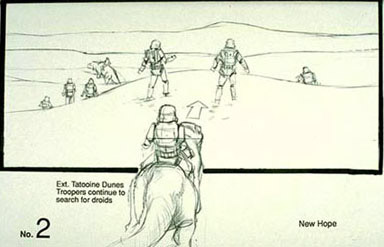
Various alien creatures are seen walking along a narrow street in Mos Eisley, and some Stormtroopers pass by.

### Darth Vader widens the Search

This scene features Darth Vader and another Imperial officer on the [Death Star](/article/death_star).

## Media

### Cover gallery

### Poster gallery

## Credits

<AppearanceSection>
<AppearancePanel
    content_type="Unkown"
    content="Star Wars: Episode IV – A New Hope on Industrial Light & Magics official website (backup link)"
    content_location="Unknown"
>
    -
</AppearancePanel>

<AppearancePanel
    content_type="Unkown"
    content="Star Wars: A New Hope on Lucasfilms official website (backup link)"
    content_location="Unknown"
>
    -
</AppearancePanel>

<AppearancePanel
    content_type="Unkown"
    content="Star Wars (film) on Wikipedia"
    content_location="Unknown"
>
    -
</AppearancePanel>

<AppearancePanel
    content_type="Unkown"
    content="Star Wars: Episode IV A New Hope on the Aurebesh Wiki"
    content_location="Unknown"
>
    -
</AppearancePanel>

<AppearancePanel
    content_type="Unkown"
    content=""
    content_location="Unknown"
>
    -
</AppearancePanel>
</AppearanceSection>