Neimoidian
Neimoidians originated as a humanoid species from the planet Neimoidia. They also established affluent colonies known as Purse Worlds, including Cato Neimoidia. These beings possessed smooth, noseless faces, skin with a mottled green-gray hue, and prominent red-gold eyes. In the later years of the Galactic Republic, they controlled the Trade Federation, a large collection of commercial enterprises. Consequently, they became part of the Confederacy of Independent Systems and played a role in initiating the Clone Wars. The Duros species are related to Neimoidians.
Biology and appearance
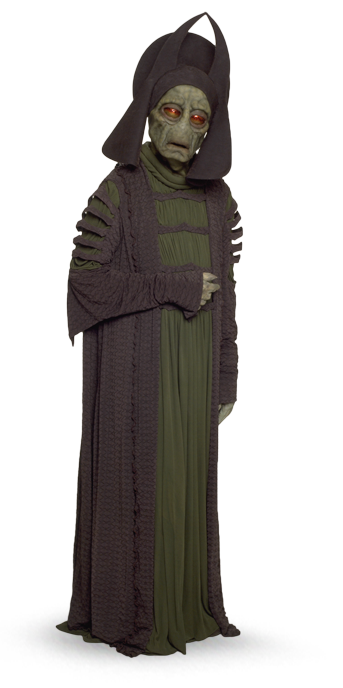
Neimoidians were sentient humanoids, a species characterized by a body plan featuring two arms, two legs, a torso, and a single head. Their skin was smooth and mottled green-gray, and they had large eyes of a red-gold color, distinguished by a horizontally split pupil. Some Neimoidians exhibited beige skin tones, and the color could change over time. For instance, Nute Gunray's skin was gray at the Clone Wars' start, later becoming green by the conflict's conclusion. Adults were typically tall, with heights ranging from 1.9 to 2.11 meters. They possessed brown blood and long, bony hands, each with five pointed fingers, including an opposable thumb. While many Neimoidians were slender, obesity was not uncommon.
Their resemblance to the Duros stemmed from their genetic connection. The Duros were the original discoverers and colonizers of the Neimoidian homeworld, Neimoidia. The Duros inhabitants of Neimoidia underwent evolutionary changes over thousands of years due to the planet's more humid atmosphere and stronger gravity. Neimoidians spent their first seven years as "grubs," larval creatures resembling maggots, forced to compete for limited food. Some never progressed beyond this larval stage due to insufficient food, becoming drones.
Society and culture
Education and way of life
The early life of a Neimoidian was exceptionally harsh. For the first seven years, Neimoidian larvae were confined within huge hives where resources were scarce. They were compelled to compete for sustenance, with the most avaricious individuals typically surviving. This formative experience shaped their inclination towards trade and organization, but also fostered dishonesty, greed, and cowardice. A common prejudiced view depicted Neimoidians as cunning, obese plutocrats, enriched by their avarice.
Neimoidians possessed a natural aptitude for calculation, a trait that significantly influenced their culture. They evolved to base decisions on meticulous risk assessment, which became a core cultural value and a counterweight to their numerical skills. Outsiders often perceived this as stereotypical Neimoidian cowardice, but Neimoidians considered it a source of pride, a survival skill distinguishing them from other species. Many Neimoidians were also known for being paranoid. Those serving on starships rarely left the command bridge, fearing that colleagues might usurp their power.
Status was an obsession for Neimoidians. High-ranking individuals were expected to flaunt their wealth. Even simple doors could signify prestige, often being elaborately crafted. Their status and affluence were further demonstrated through distinctive clothing and headgear. Owning a mechno-chair or a Sheathipede-class transport shuttle was also a mark of prestige for the wealthiest Neimoidians. Corruption was widespread among this species.
Neimoidians relied extensively on droids for manual labor, especially tasks that were potentially dangerous. High-ranking Neimoidians were almost always accompanied by battle droids or bodyguards. However, not all Neimoidians were cowardly. For example, the Neimoidian Royal Guards were military units composed of Neimoidians who were fiercely loyal to their people and committed to protecting them at all costs.
Society and ethics
Neimoidian society was structured hierarchically, with the wealthiest residing in luxurious palaces on elevated ground, while the poorest were relegated to the often-inhospitable soil of Neimoidian planets. Living on Neimoidia itself was generally undesirable for Neimoidians, with most preferring to relocate to one of the Purse Worlds. The Trade Monarch, based on Neimoidia, governed the Neimoidian people and government.
Neimoidians readily engaged in slavery, as exemplified by their treatment of the Narquois. They even practiced enslavement within their own species. Those who failed to develop beyond the larval stage, the Neimoidian drones, were used for administrative tasks. Overseers closely monitored these drones, maintaining them on a restricted diet to prevent them from maturing. To enhance their efficiency, they were placed in competition, with the winners consuming the losers.
History
The origins of the Neimoidians
The Neimoidian story began twenty-five millennia prior to the Imperial Era, when Duros explorers discovered the planet Neimoidia. They rapidly colonized the world, making it a Duro ally before it joined the Galactic Republic three millennia later. The Duros of Neimoidia diverged from their counterparts by prioritizing wealth accumulation over galactic exploration. Thriving trade guilds emerged among Neimoidia's settlers, and their influence expanded throughout the galaxy. The planet's wetter atmosphere and stronger gravity also caused the people of Neimoidia to evolve physically. Ten millennia after Neimoidia's colonization, its inhabitants, now known as Neimoidians, were recognized as a distinct species from the Duros.
The galactic expansion of the Neimoidians
The Government of Neimoidia soon sought to expand its influence by colonizing neighboring planets. Cato Neimoidia was the first such colony, followed by others like Deko Neimoidia and Koru Neimoidia. These colonies became collectively known as the Purse Worlds. Some colonized planets, such as Narq, the homeworld of the Narquois, were already inhabited. The colonists disregarded this, enslaving the natives and forcing them to work as miners, farmers, or technicians.
Shortly after its colonization, Cato Neimoidia joined the young Galactic Republic. This new galactic order brought protection and benefits to Cato Neimoidia, making it the most important of the Neimoidian Purse Worlds. The planet's strategic location near numerous Hyperspace routes and prosperous Republic worlds was a key factor. For instance, Cato Neimoidia was a stop on the Quellor Run, a vital trade route connecting the Core Worlds to the Inner Rim Territories and the Expansion Region, both of which were undergoing exploration when Cato Neimoidia joined the Republic. The Purse Worlds were also close to Kuat and Rendili, planets known for their starship production. Furthermore, the planet had access to the Corellian Run, the Hydian Way, and the Corellian Trade Spine, linking it to The Slice region and the southwestern part of the galaxy. The Neimoidians secured numerous commercial and industrial contracts for ship manufacturing. The species' influence and reputation grew rapidly due to Cato Neimoidia, as well as Neimoidia's proximity to the Trellen Trade Route and the existence of the other Purse Worlds. However, an imbalance emerged between Neimoidia and its colonies, with the latter being more dynamic and prosperous. Neimoidia attempted to maintain control over its Purse Worlds by demanding that they export their profits to Neimoidia. Nevertheless, some Neimoidians chose to leave their homeworld.
During this expansion, the Neimoidians discovered a planet in the Albarrio sector of the Outer Rim Territories rich in rare crystals. Determined to claim it, they engaged in a power struggle with the Hutt Clan, which had already established a presence there. The planet changed hands several times over centuries until the arrival of the Muun. The Muun, who colonized the nearby world of Muunilinst, were determined to seize the planet and used the resources of their organization, the Intergalactic Banking Clan, to achieve their goal. Ultimately, the Neimoidians, like the Hutts, abandoned the world to the Muun, who colonized it and renamed it Mygeeto.
The Neimoidians and the Trade Federation
Over the centuries, many Neimoidians attained positions of power and influence. Their golden age arrived when Neimoidia became a founding member of the Trade Federation in 350 BBY. This organization was a union of businesspeople, merchants, and the Neimoidians' own defense force. Initially, the Federation aimed to regulate trade in the Outer Rim. It maintained good relations with the Republic, as the Neimoidians were known for avoiding conflict with the galactic regime. The Trade Federation's success stemmed from the Neimoidians' acquisition of hyperspace mapping data. Instead of sharing this information, they monopolized it and taxed the use of trade routes. Their ultimate goal was to control all interstellar trade.
Over time, the Neimoidians gradually lost control of the Trade Federation to Kuati from Kuat Drive Yards. This changed during the Eriadu Conference, a summit intended to resolve differences between the Federation and the Republic. The Neimoidians seized the opportunity to assassinate the Federation's leaders through the Nebula Front, a radical political group. The deaths of these leaders allowed the Neimoidian faction, led by Nute Gunray, to gain control. Gunray promptly appointed his allies to key positions. However, the summit's failure led the Supreme Chancellor Finis Valorum to directly oppose the Federation by imposing taxes on the use of Free Trade Zones. Simultaneously, the Neimoidians allied themselves with the Sith Lord Darth Sidious. These events culminated in the blockade of Naboo. Although the blockade and subsequent invasion failed, they destabilized the Republic and facilitated Darth Sidious's election as Chancellor. Despite numerous trials, the Federation and Nute Gunray avoided conviction. Nonetheless, this crisis created unease within Neimoidian society, and some Federation members advocated for demilitarization. Instead, the Trade Federation withdrew to the Purse Worlds and abandoned Neimoidia.
The Clone Wars disaster
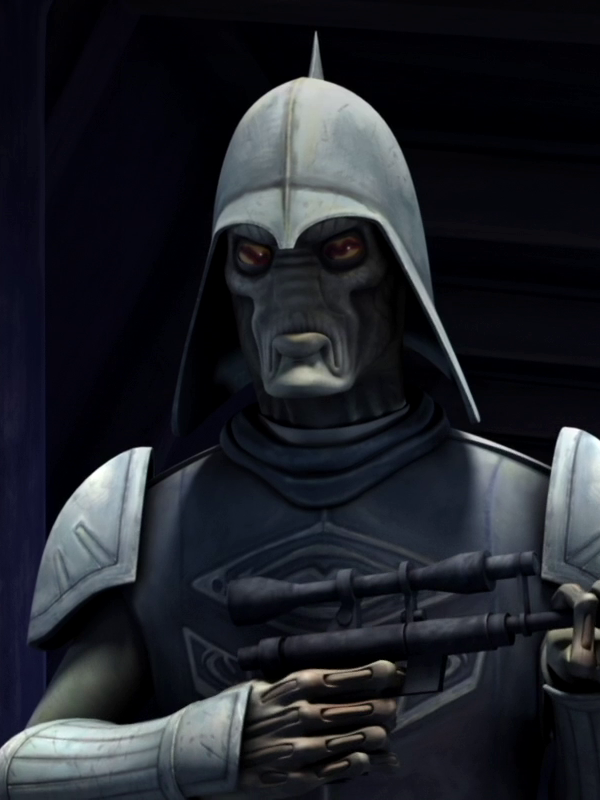
The Clone Wars proved disastrous for the Neimoidians. The Trade Federation collaborated with the Confederacy of Independent Systems during the Separatist Crisis and the war itself, and Nute Gunray became a member of the Executive Separatist Council. Many Neimoidians fought in the Confederacy military during the conflict. However, the Cato Neimoidian government and the Neimoidian people generally adopted a neutral stance. The Trade Federation also declared its neutrality and maintained representation in the Galactic Senate. Seeking to maximize profits, the Federation commercially supported both sides, but secretly favored the CIS as part of its organizational strategy. In practice, the Federation also prioritized business with the CIS despite its officially "neutral" position.
Early in the war, a pro-Republic Neimoidian faction led by businessman Oje N'deeb attempted to seize control of the Trade Federation with Republic support. Around the same time, a bombing destroyed Cadesura, a district in Zarra, the capital of Cato Neimoidia. Hundreds of civilians were killed, and the Republic and Separatists blamed each other for the attack. Despite the Federation's neutrality, Cato Neimoidia became a battleground between Separatist and Republican forces during the war's final months. Similarly, Neimoidia was devastated by a Republican attack. Ultimately, the war resulted in the defeat of the Separatists and the Trade Federation, with the death of Nute Gunray and the other Separatist Council members on Mustafar. The Neimoidians emerged from the conflict weakened, especially as many Neimoidian larval incubators had been destroyed by the Republic during the assault on Neimoidia.
The Imperial Era and the fall of the Neimoidians
With the rise of the Galactic Empire, the Neimoidians, like other species that had fought for the Confederacy of Independent Systems, were marginalized by the new regime and frequently mocked by Imperial representatives. Many Neimoidians chose to flee Imperial territory and establish colonies, hoping to eventually exact revenge on the Empire. One such colony was discovered by the Chiss Mitth'raw'nuruodo, and the Neimoidians attempted to persuade him to involve his government, the Chiss Ascendancy, in a war against the Empire.
Shortly after the battle of Yavin, Imperial Captain Canonhaus was assigned to write a report on the attempted destruction of a convoy carrying Alderaanian refugees. To test whether his superiors were actually reading his reports, Canonhaus included false information, describing the refugees as accountants from a Neimoidian Purse World. This allowed him to confirm that his reports were being ignored.
A new era
During the New Republic era, Narquois lawyers filed lawsuits against the Neimoidians, seeking compensation for the enslavement of their species by Neimoidian colonists. Some Narquians, like the pirate Pru Sweevant, retaliated against the Neimoidians by attacking their ships. During this time, the Neimoidians shifted their focus from commerce to security. The vaults of former Trade Federation leaders were opened to wealthy individuals throughout the galaxy, and Cato Neimoidia became a prominent banking center. A Neimoidian named Hallion Nark worked for the pirate Kragan Gorr's Warbird gang.
Neimoidians in the galaxy
Stereotyping
Neimoidians' education made them effective merchants, but their selfishness led to widespread disdain from other species. Stereotyping against Neimoidians was prevalent throughout the galaxy, particularly within the Galactic Republic. The belief that they were solely motivated by greed and cowardice was so pervasive that many felt they were treated as second-class citizens. Propaganda negatively portrayed Neimoidian culture, often downplaying their contributions to art and music. Other examples reinforced prejudices, such as the poster Taxation Without Federation, a HoloNet News piece accused of perpetuating the "fat Neimoidian" stereotype.
Other Neimoidians
During the High Republic Era, Idrax Snat served as a captain in the second division of the Valo Security Force. Eventually becoming the head of the entire security force, Snat was a humorless figure whom Jedi Master Elzar Mann considered unworthy of his leadership position. Snat later betrayed the Republic and joined the ranks of the Nihil, meeting his end during his service to the raider organization.
Luk Hutsok worked as an arms dealer during the Imperial Era, amassing considerable wealth. Around 1 ABY, two Neimoidians traveled to the Sorca Retreat for the auction of Rur, an attempt by Doctor Chelli Lona Aphra to sell the artificial intelligence Eternal Rur. In the end, Rur was released upon those gathered when he took control of a Cyban Front droid, using it to slaughter those who sought to buy him. Both Neimoidians, one of whom tried to raise a blaster pistol against Rur, were killed by the rogue unit.
Behind the scenes
Neimoidians debuted in the 1999 film Star Wars: Episode I The Phantom Menace, the first film released in the Star Wars prequel trilogy.
Concept art suggested that the Neimoidians were originally conceived as organic versions of their B1-series battle droids, with a head design similar to that of the later Geonosians. There was debate over whether the Neimoidians in the film would be animated CGI characters or actors wearing masks. Ultimately, due to budget constraints, it was decided that Jar Jar Binks would be the only animated main character, and the Neimoidians would be portrayed by actors in animatronic masks. This led to the simplification of the initial complex design, which was later used for the Geonosians.
The masks posed a challenge for lip-syncing with the voice actors, who also had to speak clearly, as the Neimoidian dialogues were intended to provide the political background of the story to the audience. Subtitling the alien language was considered but deemed too demanding for viewers. After hearing a voice audition for the eventual Thai dubbing, sound engineer Ben Burtt was impressed by the accent and suggested a casting call for Thai actors, but no professional talents were found. Ultimately, professional actors who mimicked Thai accents voiced Nute and Rune.
A Neimoidian pirate named Billow appeared in the non-canon LEGO comic "Trouble on Takodana."