A/SF-01 B-wing starfighter
The A/SF-01 B-wing assault starfighter, also known as the A/SF-01 B-wing starfighter, but more widely recognized as the B-wing, represented a significant advancement in Rebel Alliance single-pilot starfighter and bomber technology. This formidable starship was conceived by the skilled engineer Quarrie and brought to life through the manufacturing prowess of Slayn & Korpil. The B-wing played a crucial role throughout the Galactic Civil War, eventually being succeeded by the enhanced B-wing Mark II.
Characteristics

While not particularly adept at dogfighting, the Slayn & Korpil-manufactured A/SF-01 B-wing starfighter was primarily engineered as a "blockade buster," designed to engage and obliterate large capital ships. To this end, it was outfitted with weapons and systems generally found only on much larger vessels. The B-wing, in fact, possessed greater offensive capabilities than the majority of patrol ships and corvettes. However, it suffered from being slower and less maneuverable than a Y-wing, produced a substantial infrared signature, and demanded more maintenance than any other starfighter in the Rebel fleet.
The main airfoil extended the entire length of the hull, featuring a cylindrical command pod at one end, a weapons pod at the opposite end, and an engine cluster in the middle. Located just below the engine on either side of the main airfoil, two S-foils offered similar functionality to those found on the X-wing starfighter, but incorporated more sophisticated actuator technology and locking mechanisms. Anti-gravity generators and repulsorlift projectors were integrated into the S-foils.
Within the command pod was a cockpit for the pilot, along with life support systems, a flight computer, a comlink transceiver, and diverse sensor systems, including a long-range forward scanner, a short-range tactical sensor, and weather radar. Although the B-wing included an ejector seat, the pod could also detach from the rest of the starfighter, powered by its own sublight engine at the pod's rear. The avionics packages were comparable to those used by smaller capital ships. Sophisticated targeting systems enabled pilots to coordinate attacks across multiple B-wing fighters.

Unlike other starfighters, the B-wing's command pod employed a unique gyroscopic control system, maintaining its stationary position while the rest of the starfighter rotated around it. By keeping the cockpit module level with a horizon regardless of the craft's orientation, the B-wing pilot could focus more effectively on flying and targeting enemy vessels, enabling them to evade enemy fire while remaining on target. This gyroscopic stabilization also lessened the g-forces experienced by the pilot during evasive maneuvers. However, if the gyroscopic system malfunctioned, it would lock the wing in place, subjecting the pilot to increased physical strain when attempting sharp turns.
The engine cluster at the B-wing's center comprised a single Kyromaster ion engine with four thrust nozzles, along with the ship's fusion reactor and Class-2 hyperdrive. At the cluster's front was the B-wing's cooling system, featuring four cooling vent "intakes" on each side of the splitter plate, along with the main heat radiators. Retro-thrust nozzles were also positioned adjacent to the cooling system. The primary wing beneath the engine housed the B-wing's ANv-9q sensor array within a protective window, along with other systems such as a navigation sensor array, wing status sensors, velocity sensors, and a sensor jammer system.
Upon its introduction, the A/SF-01's impressive array of weapons made it the most heavily armed starfighter in the galaxy. Its standard weapons pod contained an SW-7a ion cannon, an R-9X heavy laser cannon, and an emission-type MG9 proton torpedo launcher. Two additional SW-7a cannons were mounted at the ends of the S-foils, with a secondary MG9 in an armored emplacement situated between the command pod and engine cluster. The command pod featured a weapon mount capable of accommodating various options; typically, it held a pair of twin auto-blasters with space for a second pair. Alternative weaponry included quad lasers or laser-guided bombs.
The B-wing starfighter could divert power from all other systems into its energy weapons, releasing sufficient firepower to obliterate a small mountain in a single blast. However, sustaining this level of firepower would gradually lead to system failure.
Besides the four low-powered targeting lasers, one at each of the starfighter's four extremities, the B-wing possessed another unique targeting feature. By continuously firing the R-9X heavy laser cannon at a very low power setting at an enemy, the targeting computer could gather enough data to ensure a 97% probability of hitting the target with the ion cannons and/or torpedoes. Unfortunately, this method also revealed the B-wing's approach vector to the enemy, so it was used sparingly and even removed by some pilots.
The prototype starfighter, B6, which was constructed by the Mon Calamari Quarrie, featured a Composite-beam laser weapon that could inflict significant damage on cruiser-class targets, but its range was limited, and its use interfered with the hyperdrive. The B6 also had a second gunner's cockpit at the opposite end of the main airfoil. Neither of these features were incorporated into later production models, which shifted the primary weaponry focus to missiles.
History
Imperial Era
Quarrie, a Mon Calamari engineer residing on the planet Shantipole, developed the initial B-wing prototype, known as the Prototype B6 Blade Wing, as part of Project Shantipole. Several of the B-wing's defining characteristics, such as the gyro-stabilized cockpit and S-foils, were inspired by Clone Wars-era starships, including the T-6 shuttle, the H-60 Tempest bomber, and the V-19 Torrent starfighter. After being impressed by the spirit and piloting skills of Hera Syndulla, Quarrie gifted the prototype—and his expertise in improving it—to the rebellion. Sabine Wren volunteered to redesign the starfighter's weapons package, including its targeting system.
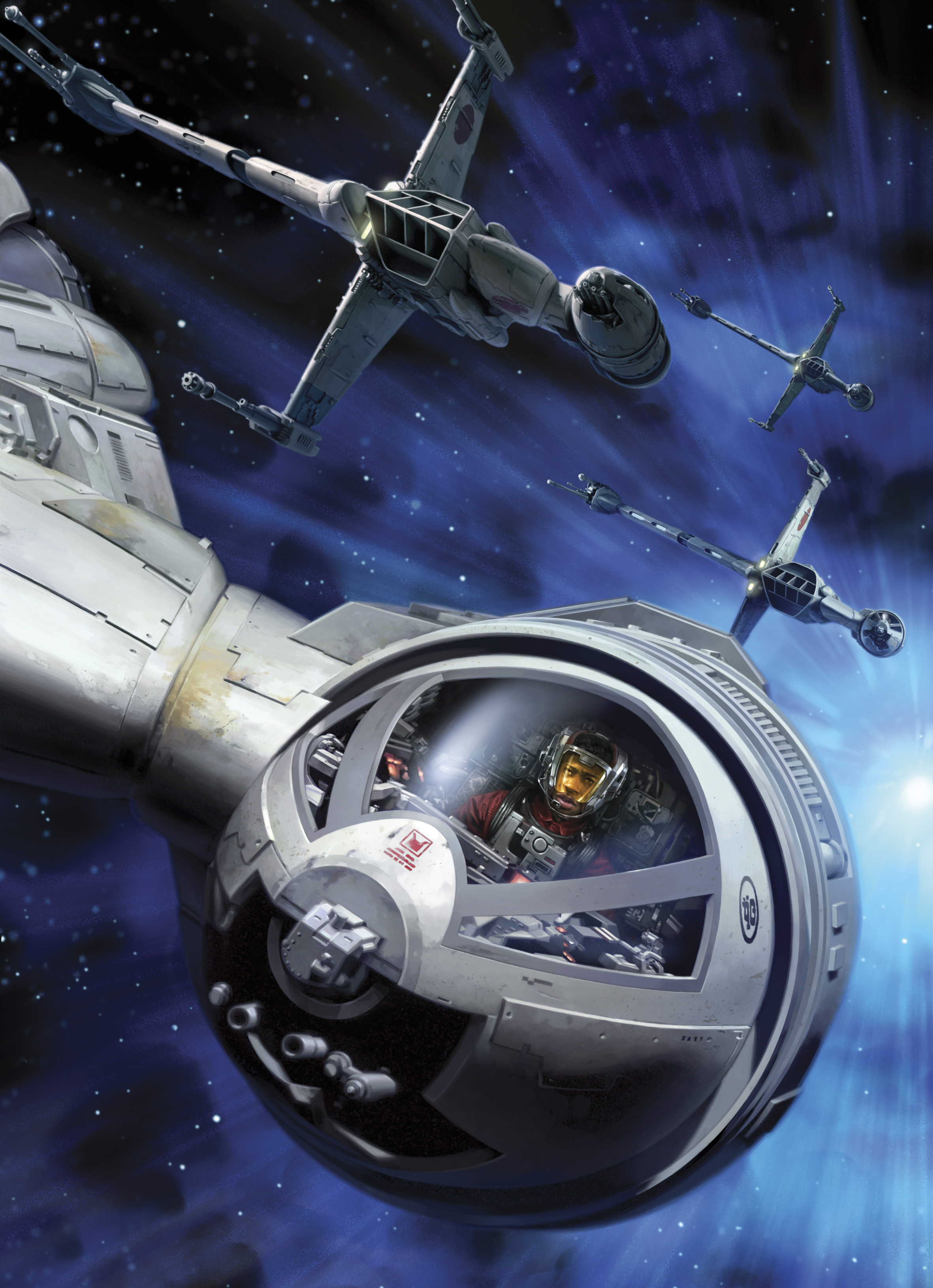
Following a successful test strike against the Galactic Empire, Bail Organa, a senator sympathetic to the rebellion, identified a manufacturer willing to secretly continue the B-wing's development. Slayn & Korpil, in collaboration with Quarrie, produced the production-line A/SF-01 B-wing starfighter, respectfully naming their collaborative workspace Allied/Shantipole Facility.
Despite Quarrie's description of the B6 prototype as "fast" and "agile," the production versions fell short of these qualities. Even with the removal of the heavy gunner position, associated life support systems, and composite-beam laser, the production B-wing was significantly slower and more cumbersome than other fighters in both the Alliance Fleet and the Imperial Navy. It also proved challenging to fly, as the gyro-stabilized cockpit design was difficult to master for all but the most skilled pilots. The B-wing was envisioned as a potential successor to the Y-wing fighter in its role as an assault fighter. The B-wing was primarily intended to carry a heavy weapons package with the purpose of destroying capital ships, though they proved difficult to maintain and fared poorly in dogfights. Despite its weaknesses, it could gain ship-to-ship combat victories in desperate situations, and one Blade Squadron pilot earned three kills in quick succession before being shot down himself in the Battle of Endor.
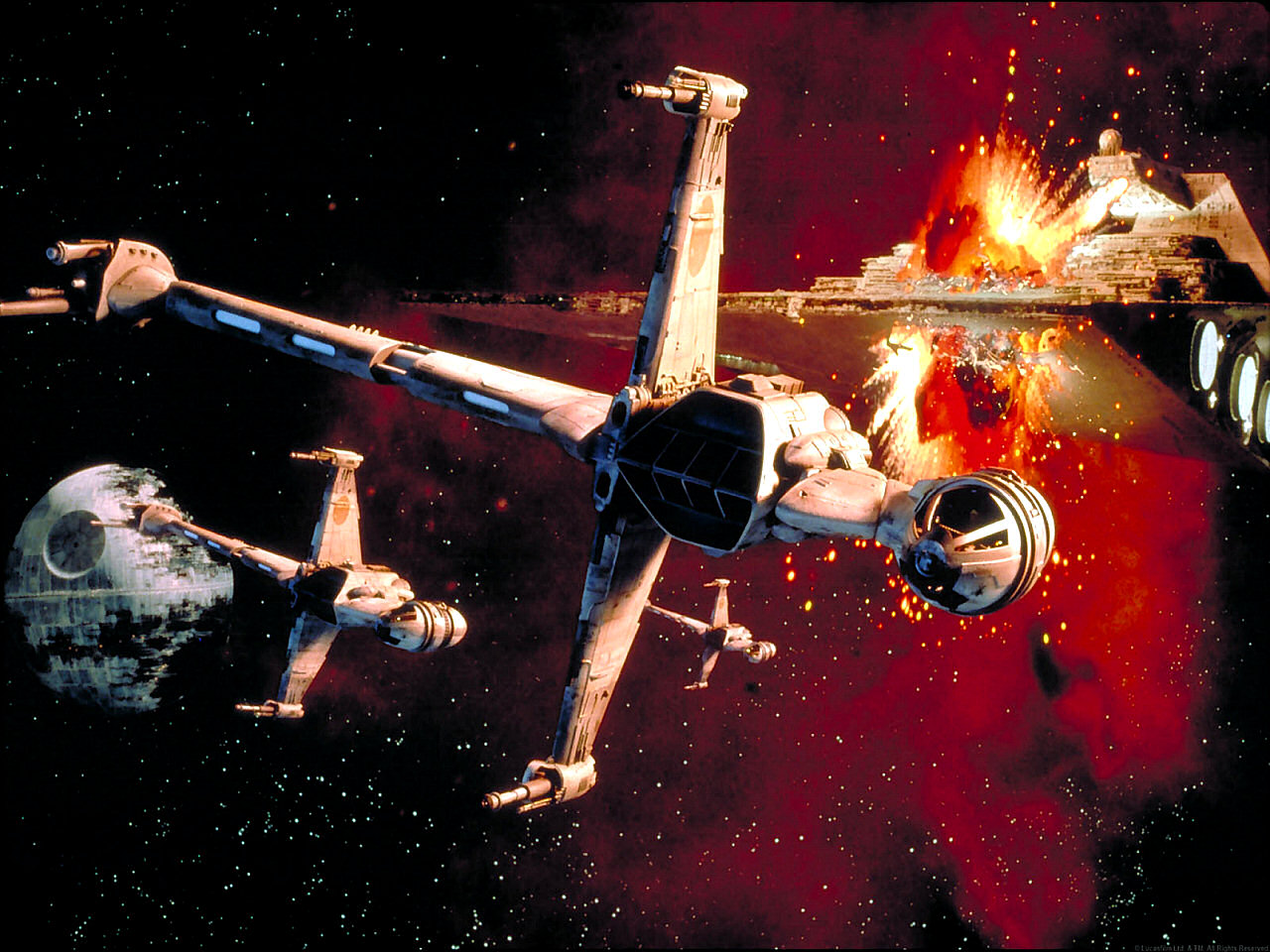
Hound Squadron was a B-wing formation active during the conflict against the Empire, with one of its members the aggressive Theelin rebel pilot Chass na Chadic. B-wings participated in the Battle of Endor as part of the Rebel Alliance fleet. Several B-wings followed General Lando Calrissian to attack the second Death Star, but broke off when they realized that the shield was still up. Blade Squadron also participated in the battle, destroying the Star Destroyer Devastator.
Hours after the battle, B-wing pilots Rynn Zenat and Preeti Delmin were ambushed in the Anoat sector by forces of Grand Moff Ubrik Adelhard. At least ten B-wings took part in the attack on the Hellion's Dare, where Hound Squadron was destroyed. After losing her squadron, Chadic would join the ranks of Alphabet Squadron, where she continued to fly a B-wing. Meanwhile, Blade Squadron participated in large-scale battles at Malastare, Kuat, and, ultimately, Jakku.
New Republic
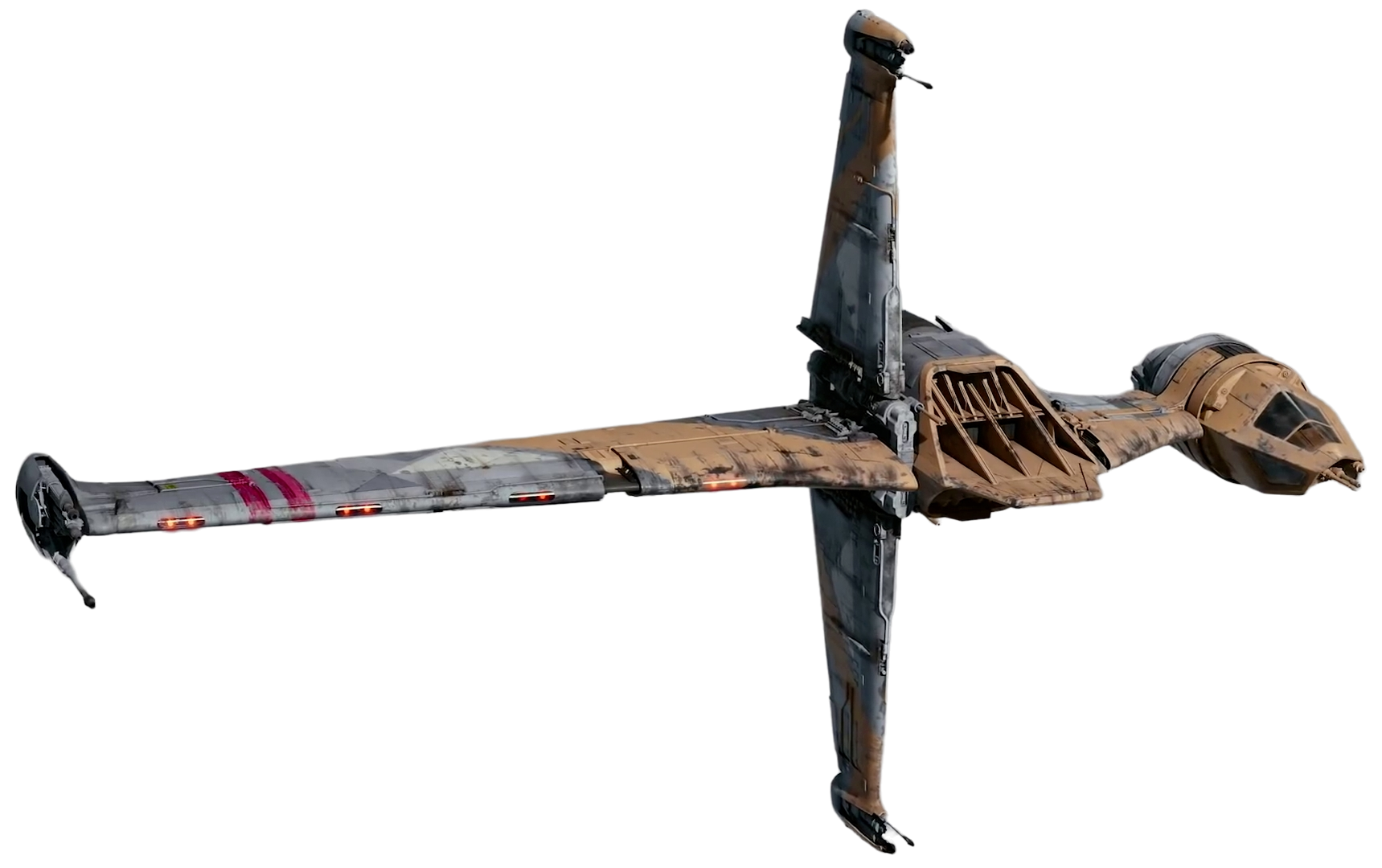
Following the conclusion of the Galactic Civil War, B-wings became available for civilian starship racing, with at least one participating in The Gauntlet. The New Republic deployed several starfighters, including two B-Wings that strafed and shot down Silvo's pirate frigate with Composite-beam laser, repelling Silvo's remaining pirates and liberating At Attin. They still remained in use with smaller, underequipped military forces, and the Amaxine warriors operated at least one B-wing in 28 ABY.
A similar vessel—referred to as the B-Wing Mark III or "Resistance B-wing"—would eventually be utilized by the Resistance, a paramilitary organization established by General Leia Organa following the Amaxine crisis to defend the Republic from the First Order, an Imperial successor state that had controlled the Amaxines. Three decades after the Battle of Endor in 34 ABY, open war erupted between the Resistance and First Order, with the small number of Resistance B-Wings seeing use by the second and final year of the war, 35 ABY.
Behind the scenes
Development
Joe Johnston and Bill George originally conceived the B-wing fighter for Return of the Jedi. Its designation stems from the fact that the crew labeled the two new Rebel Alliance starfighter models in Return of the Jedi as "A fighter" and "B fighter." Bill George's significant contributions to the starship's development led his colleagues to jokingly call it the "Bill-Wing Fighter." Years later in Star Wars Legends, the name "Blade wing" emerged as an in-universe nickname, which was canonized by the Star Wars Rebels production team.
The craft's unusually slender profile presented challenges for blue-screen photography, as the model tended to blend into the star field. Consequently, some planned sequences involving the B-wing were removed from the original release of Return of the Jedi, and the B-wing is not shown in action during the Battle of Endor in the film. In fact, after the ships fly away from the still-active Death Star II shield at the start of the battle, the B-wing is hardly seen at all. The rotating cockpit design of the B-wing was inspired by early concept art for the Millennium Falcon. Mike Quinn puppeteered a B-wing pilot in a deleted scene. With no dialogue provided in the script, Quinn relied on his improvisational skills, creating lines about not being able to receive his favorite radio station in space.
Further appearances
Within the Star Wars Legends continuity, the B-wing was said to have been designed and produced by the Rebel Alliance after the Battle of Yavin, partly as an in-universe explanation as to why the B-wing and A-wing fighters created for Return of the Jedi did not participate in the attack on the first Death Star. However, in the new Star Wars canon, both B-wings and A-wings are featured in material taking place well before the Battle of Yavin and have been given earlier origins. The production team for the Star Wars Rebels television series, which has featured both ships, explained that the intention is to depict different rebel cells using different fighters in different parts of the galaxy. The A-wings and B-wing appear as the primary star fighters of the Phoenix Squadron in Rebels, while the rebel cell led by Jan Dodonna and portrayed in Star Wars: Episode IV A New Hope used primarily X-wings and Y-wings. The Battle of Endor, intended to show the first time the entire Rebel Alliance comes together, therefore includes both sets of ships.
Star Wars author Alexander Freed characterizes the B-wing as a "ridiculous and aggressive" craft. Consequently, when considering the type of character who would pilot a B-wing for his Star Wars: Alphabet Squadron trilogy, he concluded that Chass na Chadic—an easily offended, aggressive, and often brutal rebel pilot who was practically born a rebel—was the ideal choice.