Imperial I-class Star Destroyer
The Imperial I-class Star Destroyer represented a specific model within the Imperial-class Star Destroyer line, serving the Imperial Navy. This wedge-shaped capital ship was heavily armed, carrying numerous weapon emplacements, assault troops, boarding craft, and TIE fighter series starfighters. During the era of the Galactic Empire, its command bridge was manned by the most skilled crew members in the navy.
Initially, Star Destroyers were deployed to sectors and systems experiencing unrest following the Clone Wars, where their mission was to suppress any signs of rebellion. As the Galactic Civil War progressed, the Destroyer's role shifted to hunting down valuable Rebel targets and bases. They participated in significant engagements such as the Battle of Hoth and the Battle of Endor. The Imperial II-class Star Destroyer evolved from the Imperial I-class design.
Characteristics
Dimensions

The Imperial I-class Star Destroyer was the original model in the Imperial-class family of Star Destroyers, conceived by Lira Wessex and utilized by the Galactic Empire's Imperial Navy. While Imperial doctrine classified the Star Destroyer as a capital ship, the Anaxes War College System designated it as a destroyer.
Measuring 1,600 meters in length and 985 meters in width, the wedge-shaped Imperial I-class Star Destroyer was significantly larger, by 445 meters, than its direct predecessor, the Venator-class Star Destroyer, which had been developed for the Galactic Republic during the Clone Wars. Reflecting the Empire's preference for subdued colors, the Imperial-class hull was painted whitish gray, a contrast to the Venator-class's red markings that signified the Republic's diplomatic status during the Clone Wars.
Crew requirements & quarters
Imperial I-class Star Destroyers required a crew of over 37,000 individuals, consisting of 9,235 officers and 27,850 enlisted personnel. The inclusion of 9,700 stormtroopers brought the total number of crew and passengers to 46,785, with a minimum of 2,000 personnel needed for safe operation. In line with other Star Destroyer classes, an Internal Affairs officer was stationed on board to monitor the crew for signs of disloyalty or rebellion, as well as to interrogate captured prisoners. As was the case on most Navy vessels, Rebaxan Columni MSE-6 series repair droids were used for messenger duties, repairs, and custodial tasks.
Officer accommodations were situated directly beneath the bridge, within the ship's command tower. The officer barracks, gunnery crew quarters, recreational spaces, meeting rooms, and cell blocks were located on the second level of the ship's multi-layered habitable superstructure, featuring four gradually ascending shorter 'levels' that led to the ship's 'neck,' connecting it to the upper command tower. In contrast, the barracks for the 27,000 enlisted personnel were positioned in the ship's midsection, outside the main superstructure. The ship also incorporated specialized training rooms capable of simulating various environmental conditions, including underwater combat, simulator pods for Imperial Starfighter Pilots, and several medical substations.
To support its substantial crew, each Imperial-class ship carried provisions for 2 years, with its liquid reserves and raw material storage located near the bow. Lateral umbilical restocking vestibules were situated on the ship's "side," in front of the hangars.
Armament and shielding
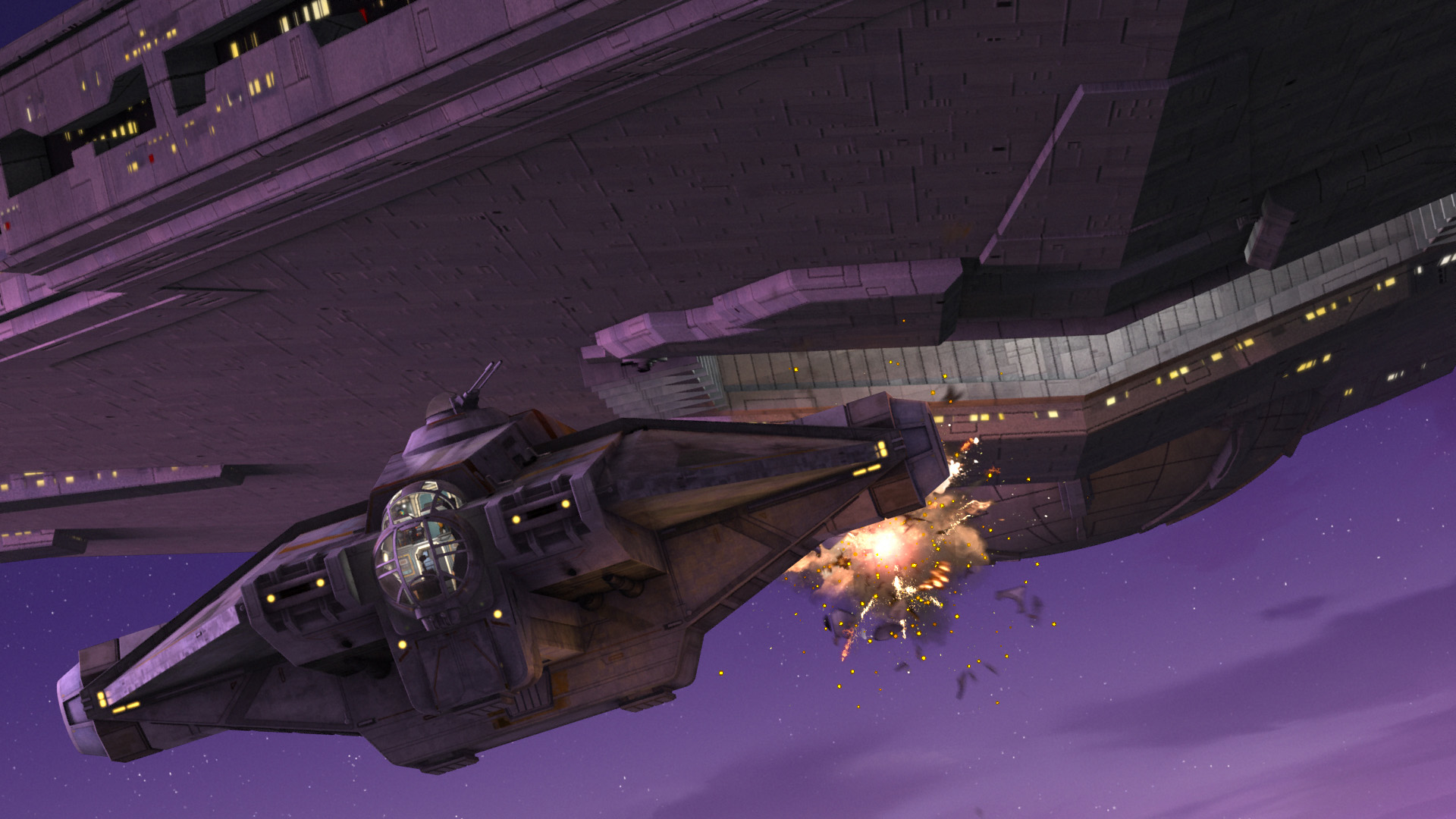
The Imperial-class Star Destroyer was heavily armed. Its whitish gray hull featured 60 Taim & Bak XX-9 heavy turbolaser batteries connected to large auxiliary power cell arrays, 60 Borstel NK-7 ion cannons, and ten Phylon Q7 tractor beam projectors. The forward pursuit tractor beam array was positioned at the ship's front, while four additional tractor beam projectors were located around the hangar bay opening. The ship also included six dual heavy turbolaser turrets, two quad heavy turbolasers, three triple medium turbolasers, and two medium turbolasers. Aft point-defense laser cannon emplacements were located at both "ends" of the Star Destroyer. The vessel was equipped with LeGrange targeting computers and a dedicated tractor beam targeting array at the top of the command tower.
The most formidable weapons on board were two dual heavy ion cannon turrets and six turbolaser turrets lining the dorsal superstructure flanking the command tower. Each turbolaser, measuring 50 meters in diameter, could penetrate heavy armor and overload shields. While hitting small, fast-moving targets was challenging, even a glancing blow could destroy them. Despite its impressive arsenal, the Imperial I-class had a significant blind spot in its aft quarter, beyond the reach of its weapons. Enemy starfighters often exploited this vulnerability, prompting experienced captains to maneuver the ship to mitigate the threat and deploy starfighter squadrons for defense.
The Imperial I-class boasted heavy shielding, capable of withstanding a collision with a GR-75 medium transport without hull damage. The navigational deflector generator was located on the underside of the ISD's very tip, accompanied by the ventral hull deflector shield generator at the ship's rear. Two additional ISD-72x shield generator domes were situated atop the command tower, adjacent to the tractor beam targeting array, providing protection for the tower and serving as geodesic sensor arrays. Additional deflector shield projector ports were distributed throughout the habitable superstructure.
Complement and hangars
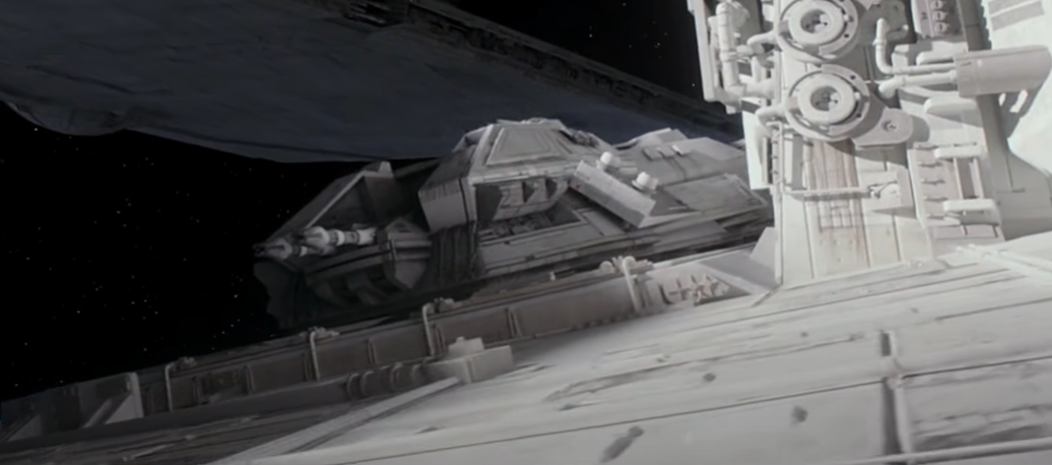
The Imperial I-class had two large hangar bays on its underside, with an opening large enough to accommodate a CR90 corvette. The roof of the opening featured an electromagnetic paralyzing pincer crane, used to seize and disable captured ships for boarding. One hangar, designated the primary attack hangar, served as a hub for transports and visiting shuttles, as well as for launching landing craft for planetary assaults. The other hangar housed the Star Destroyer's starfighter complement, consisting of seventy-two TIE fighter series starfighters. A smaller bay opposite the attack hangar was used to receive returning TIEs, which were then transported by receiver-carriers to a debarkation station where pilots exited their craft. The fighters were then moved to storage bays surrounding the hangar opening. TIE/sa tactical bombers were stored in specialized armored compartments to protect the ship in case of accidental detonation. Service and refueling bays surrounded the TIE stations, preparing the fighters for their next missions before they were moved back to the launch hangar via transfer tunnels. The Imperial I-class also had a backup hangar at the front of the ship, used for launching and receiving shuttle craft for high-ranking officials.
In addition to its TIE squadrons, the ship carried eight Lambda-class T-4a shuttles, twenty AT-AT walkers, thirty AT-ST or AT-DP walkers, and fifteen Imperial Troop Transports. It could also carry aerial landing platforms for use during planetary invasions.
Despite its fighter complement, Imperial I-class vessels were less effective against skilled rebel pilots compared to the Venator-class against droid starfighters. Nevertheless, they were crucial in the Imperial strategy of planetary containment and rapid infantry deployment, though the vessel was noted as one of the most resource-intensive ships in the Imperial Navy.
Imperial I-class Star Destroyers were equipped with escape pods featuring emergency beacons, allowing the crew to abandon ship in emergencies. They also had the capability to launch and retrieve hyperspace pods, with at least twelve docked in a bay above the hangar opening.
Power and propulsion systems

The Destroyer was powered by seven main engine units, including three Kuat Drive Yards Destroyer-I ion engines and four Cygnus Spaceworks Gemon-4 ion engines, enabling it to reach speeds of up to 975 kph. However, the ship was not well-suited for planetary atmospheres, requiring full power to remain airborne. Any power interruption in atmosphere could be catastrophic, despite vital equipment being shielded. The primary power source was a solar ionization reactor large enough to protrude ventrally, powering a massive cylindrical power generator surrounded by antiresonance plates in sector 19-A at the ship's rear.
Despite its armor, a direct hit from proton torpedoes in that area could breach the generator venting tunnel, causing the reactor to overload and explode within seven minutes. The entire reactor assembly could be jettisoned to prevent ship-wide catastrophe. To maintain functionality, the Imperial I-class also had a backup secondary reactor for the engines and a subsidiary reactor for auxiliary power. A third auxiliary reactor was located on the ship's prow.
Engine control was managed from a large room filled with walkways and "Tulip" style Imperial work stations. The Imperial-class used a Class 2 hyperdrive for light-speed jumps into hyperspace, with standard protocol dictating the dumping of garbage before entering hyperspace to reduce the ship's weight.
Bridge tower
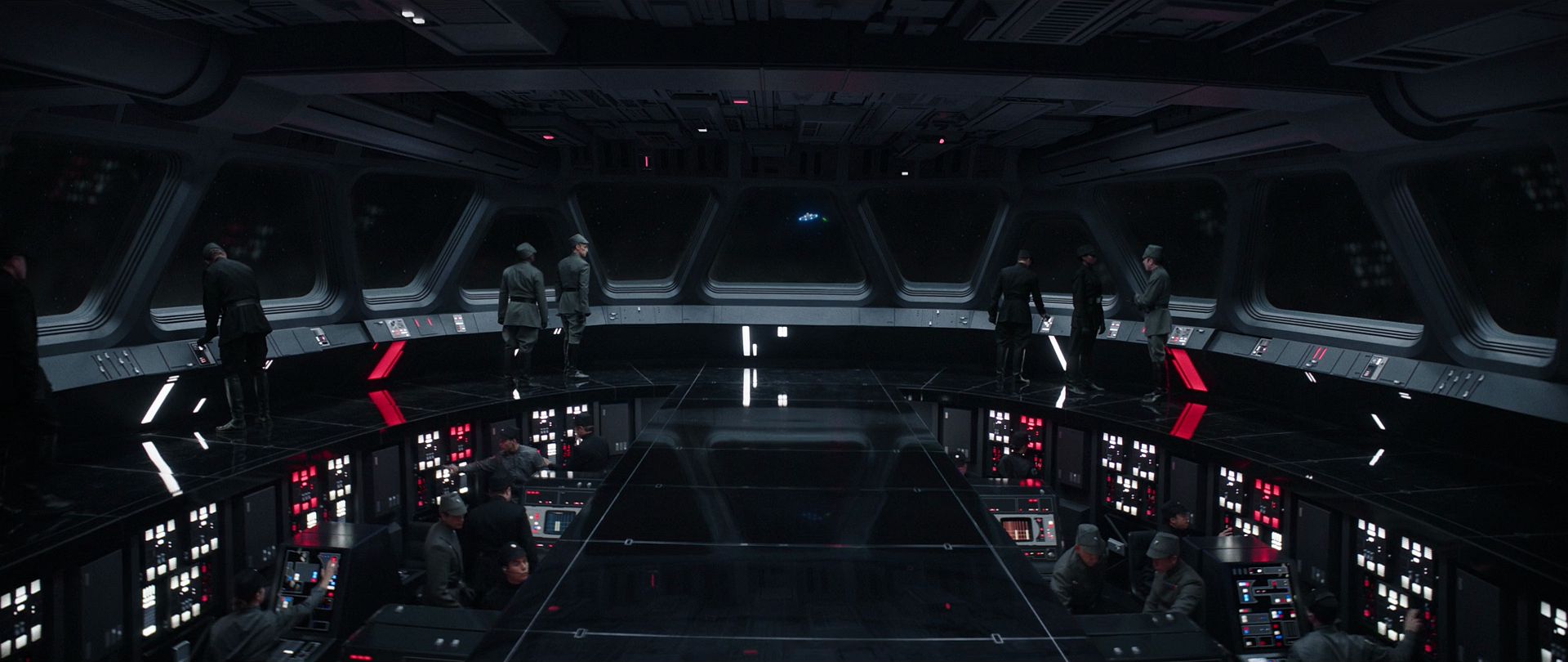
The bridge tower was a defining feature of the Imperial-class. The command bridge featured two elongated pits below floor level, with walls lined with monitors and control panels. Six additional duty station consoles were freely mounted in each pit, perpendicular to the walkway. High-ranking officers stood on a walkway surrounding the pits at deck height, an arrangement that emphasized rank hierarchy. The consoles beneath the viewports on this level included a holoprojector for officer communications and controls for the helmsman.
A small room behind the main bridge, separated by a blast door, provided access to advanced communications equipment and a holographic imaging table.
History
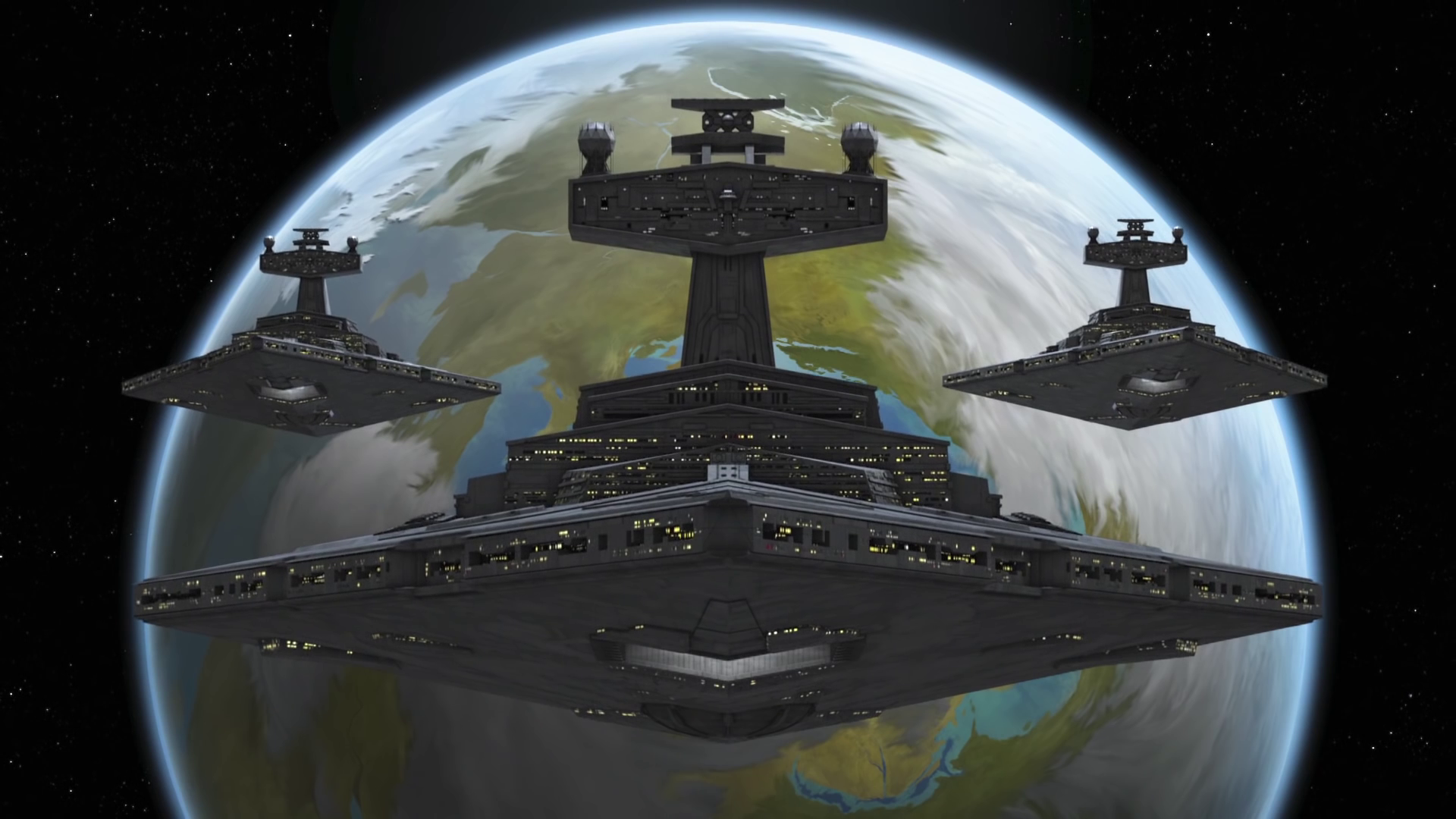
Imperial-class Star Destroyers were the technological successors to the Venator-class Jedi cruisers used by the naval forces of the Galactic Republic during the Clone Wars. After the Republic was turned into the Empire at the end of the Clone Wars, Sheev Palpatine, the self-proclaimed Galactic Emperor, initiated a massive military buildup. To meet interstellar defense needs, the galaxy's major shipyards, already active during the Clone Wars, remained operational throughout the Age of the Empire. Facilities at Kuat, Corellia, Ringo Vinda, Fondor, and other locations were converted from civilian docks to military starports capable of producing Imperial-class Star Destroyers. Building on the strengths of the Jedi cruisers, the larger Imperial-class vessels became iconic symbols of Imperial power, often bearing intimidating names like Lawbringer, Relentless, and Devastator.
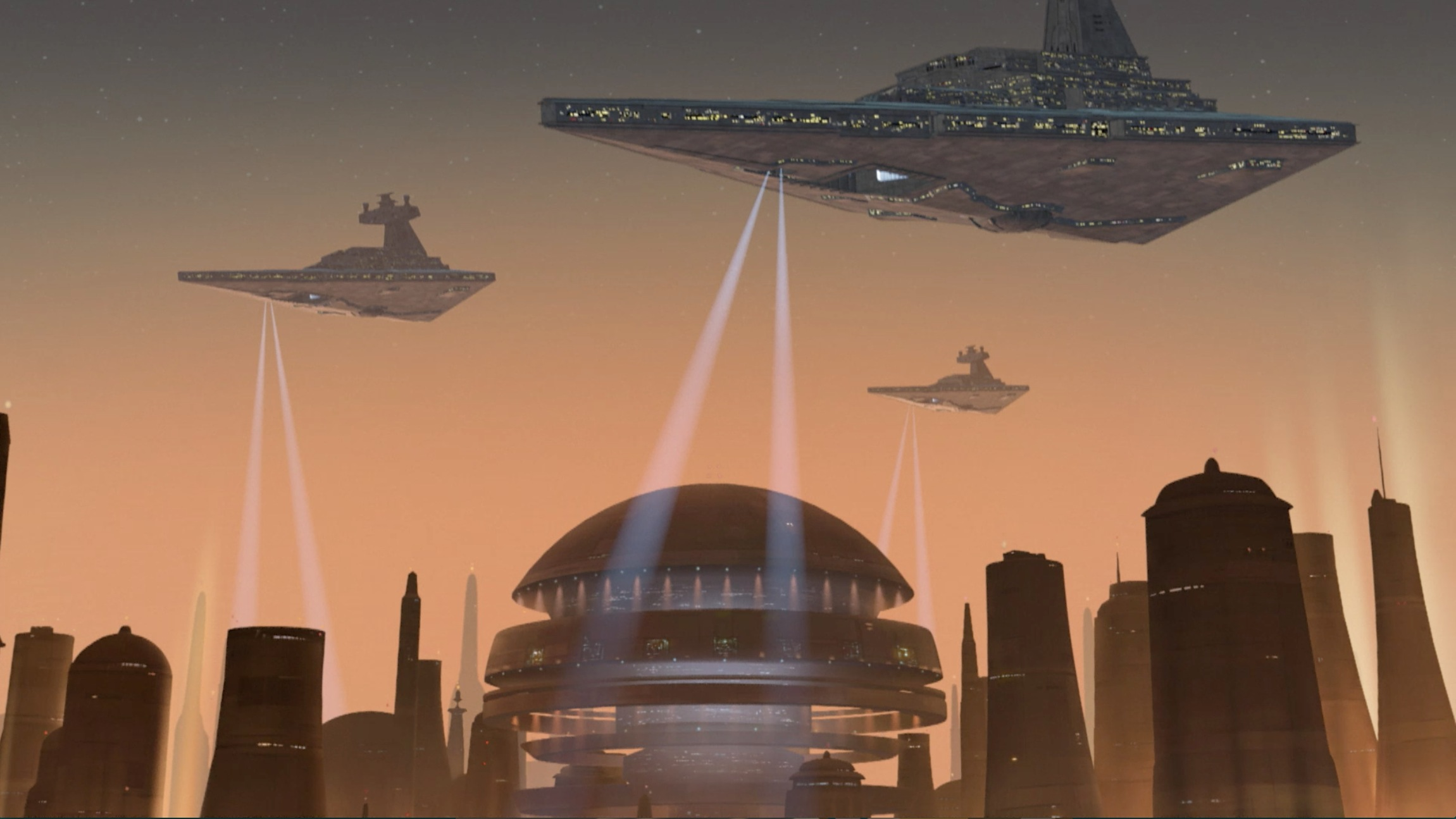
Initially, the new Star Destroyers were deployed to sectors and systems previously beyond Republic control, to subjugate them and suppress resistance. Imperial Star Destroyers became symbols of this new order. Citizens weary of chaos welcomed these giant warships, while pirates and enslavers feared them. However, some questioned whether the imposition of Imperial law justified the loss of freedoms.
Quickly becoming the most recognizable symbol of Imperial power, the Imperial-class demonstrated its tactical versatility by safeguarding galactic commerce and supporting Imperial-backed governments. Many admirals, Grand Moffs, ISB agents, and senior Imperial commanders used these ships as their personal command vessels, with the ship's officer often being as intimidating as the ship itself. At the height of the Empire, over 25,000 Imperial Star Destroyers existed, with 24 assigned to each of the 1,024 regional sectors to form independent Sector Groups. Kuat, with its industrial manufacturing center, was the Empire's primary source of Star Destroyers and Destroyer-equipped shipyards. Ultimately, these giant craft became the backbone of the Imperial Navy, hunting down Rebel forces, blockading rebellious worlds, and serving as launch platforms for planetary assaults.
The Imperial I-class Star Destroyer was eventually superseded by the Imperial II-class Star Destroyer. The Devastator was the last Imperial I-class Star Destroyer to leave Kuat Drive Yards before production shifted to the Imperial II-class, although it was later upgraded to match the newer warships.
The Imperial-class saw service in the First Order's Navy thirty years after the Battle of Endor, and was regarded as a highly respected ship. Many of its design flaws were addressed in the Resurgent-class Star Destroyer, a more powerful vessel based on the Old Empire's warships. 35 years after the Battle of Yavin, the Sith Eternal used Xyston-class Star Destroyers, which were based directly on the Imperial-I-class design but armed with a planet-killing weapon.
Behind the scenes
Inconsistencies exist regarding the armament of the Imperial I-class Star Destroyer. Starships and Speeders indicates that the Imperial I-class had both light and heavy turbolaser batteries, as well as two types of ion cannons. However, Star Wars: Rogue One: The Ultimate Visual Guide does not support different ion cannons or light and heavy turbolasers. Ultimate Star Wars, New Edition and Star Wars: Dawn of Rebellion: The Visual Guide state that it had 60 Taim & Bak XX-9 heavy turbolaser batteries and 60 Borstel NK-7 ion cannons. This article assumes Starships and Speeders is incorrect.