Star Wars: Episode I The Phantom Menace
Star Wars: Episode I The Phantom Menace, released in 1999, was both written and directed by George Lucas. Rick McCallum served as its producer, and it featured performances from Liam Neeson, Ewan McGregor, Natalie Portman, Jake Lloyd, and Ian McDiarmid. This film marks the beginning of the Star Wars prequel trilogy, stands as the fourth Star Wars movie to be shown in theaters, and is the first chronologically within the Star Wars saga.
Hitting theaters on May 19, 1999, The Phantom Menace became the first Star Wars installment since Star Wars: Episode VI Return of the Jedi, which had been released sixteen years prior. Its debut was marked by significant media attention and considerable anticipation from fans. Despite receiving mixed reactions from both critics and fans, the movie achieved a global gross of $924.3 million, positioning it as the second-highest-earning Star Wars film before adjusting for inflation. It was later made available on Blu-ray in September of 2011, and then re-released in cinemas in 3D on February 10, 2012.
Plot ‡
This film initiated a fifteen-year period of Star Wars narratives, primarily centered around the era of the prequel storyline. Its success paved the way for the subsequent two films in the prequel trilogy, along with the Star Wars: The Clone Wars film and its associated television series.
Opening crawl
Plot summary
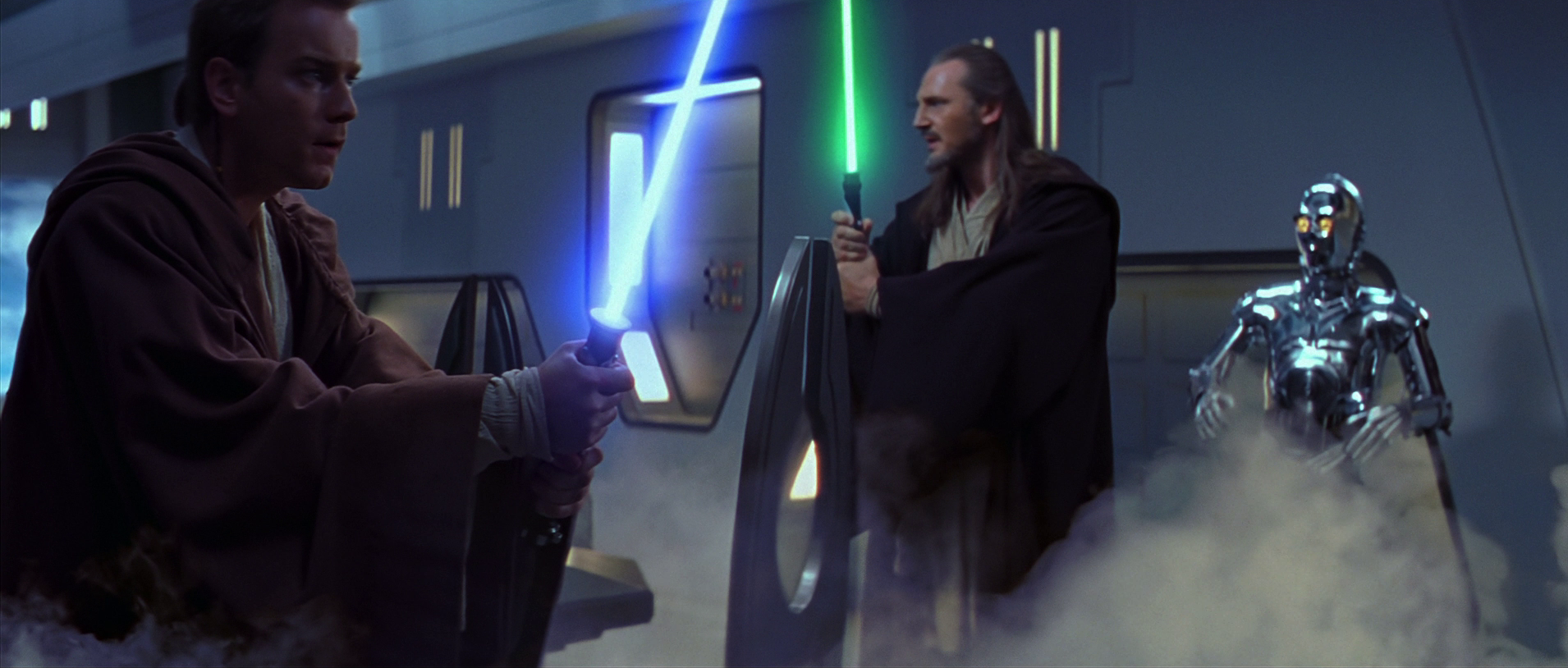
Thirty-two years prior to the events depicted in Star Wars: Episode IV A New Hope (and thirteen years before the establishment of the Galactic Empire), a commercial disagreement arises between the Trade Federation and the remote systems within the Galactic Republic. This dispute results in a blockade affecting the Mid-Rim planet known as Naboo. Supreme Chancellor Finis Valorum, the leader of the Galactic Senate, secretly sends two Jedi, Master Qui-Gon Jinn and his Padawan, Obi-Wan Kenobi, to act as "ambassadors" aboard the Federation's flagship. Their mission is to engage with Viceroy Nute Gunray and resolve the conflict. Unbeknownst to them, the Trade Federation is colluding with the enigmatic Darth Sidious, a Dark Lord of the Sith. Sidious covertly instructs Gunray to invade Naboo and eliminate the two Jedi upon their arrival. When Gunray questions the legality of this action, Sidious assures him that he will ensure its legitimacy.
The Viceroy confines the Jedi within the meeting chamber and attempts to assassinate them using poison gas, while simultaneously ordering the destruction of their vessel, the Radiant VII, within the hangar. However, the Jedi manage to escape. After fighting through groups of battle droids, Jinn and Kenobi advance to the command deck where Gunray is located, protecting himself behind blast doors. The Jedi are compelled to flee upon the arrival of two Destroyer Droids and secretly board two separate Federation landing craft heading for the surface of Naboo to initiate the invasion.
Back on the command deck, Queen Amidala communicates with Gunray to voice her disapproval of their blockade. Gunray explains that they wouldn't have taken such action without the Senate's approval. When she inquires about the ambassadors dispatched by the Chancellor, Gunray asserts that they have not received any such ambassadors, leaving Amidala surprised and suspicious. Gunray terminates communication with her and instructs his aide to disable all communications on the planet.
Concurrently, Amidala is in discussion with Senator Sheev Palpatine regarding the failed negotiation attempt and Gunray's claim that they did not receive any ambassadors. Palpatine expresses surprise, stating that he had received assurances from the Chancellor that his ambassadors did indeed arrive. However, Palpatine is unable to complete his statement as his hologram signal is interrupted. Naboo Governor Sio Bibble suspects that the communication disruption indicates an impending invasion by the Trade Federation.
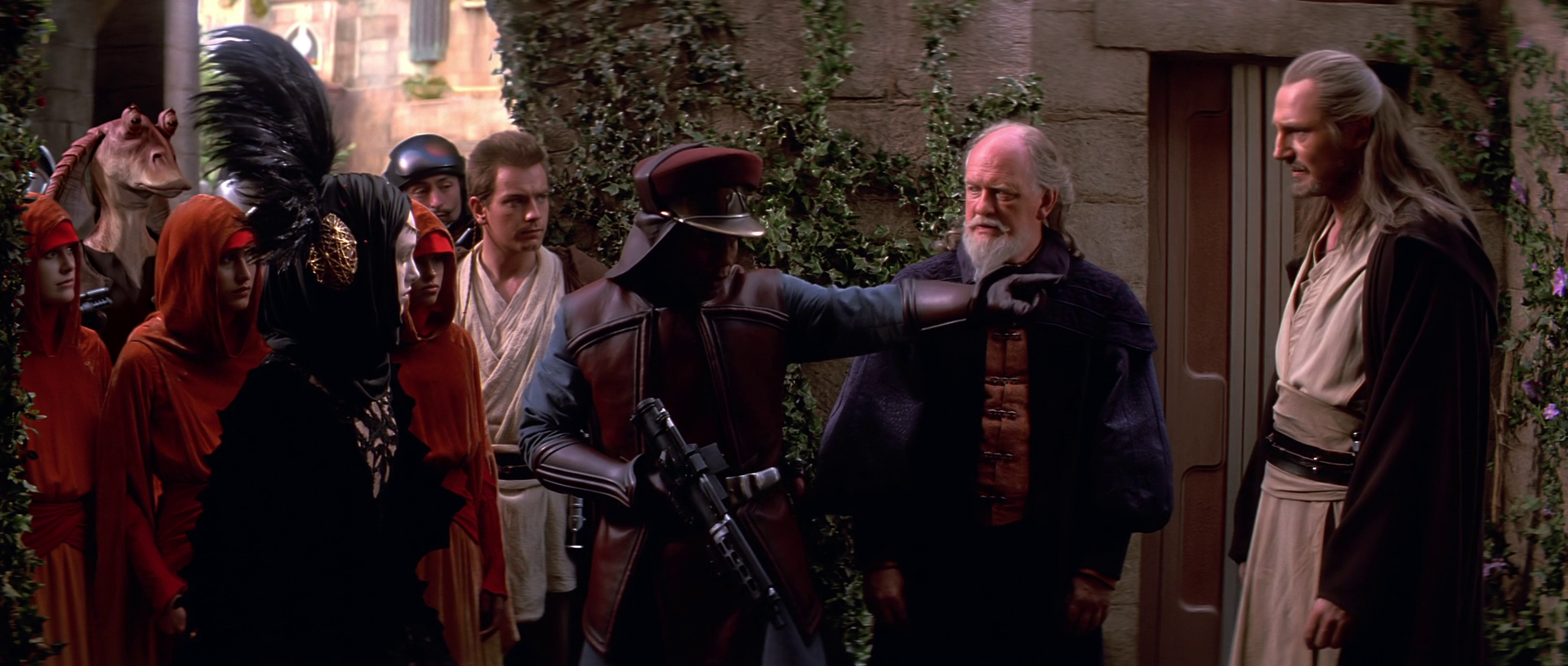
On the planet's surface, Qui-Gon rescues Jar Jar Binks, a native outcast, from being crushed by a Trade Federation MTT. Kenobi appears, pursued by STAPs, which Qui-Gon destroys. Jar Jar Binks guides the two Jedi to an underwater Gungan settlement known as Otoh Gunga. Meanwhile, the Trade Federation occupies Theed, Naboo's capital city, and captures Queen Amidala along with the rest of the government. In Otoh Gunga, the Jedi encounter the Gungan leader, Boss Nass, and request his assistance for the people of Naboo. However, Nass refuses due to his animosity towards the Naboo people and sends them away in a bongo submarine. They are attacked by an opee sea killer and a colo claw fish, but both creatures are consumed by a sando aqua monster. The Jedi, accompanied by Binks, arrive in Theed and liberate Queen Amidala, employing the Force and their lightsabers to eliminate squads of droids. They then depart for Coruscant, the Galactic Republic's capital planet, to seek assistance from the Senate. As they attempt to breach the blockade, the queen's starship sustains damage from Federation battleships, but an astromech droid named R2-D2 successfully repairs it, enabling their narrow escape.
Due to the damage inflicted on the ship's hyperdrive during the attack, the Jedi decide to land on the nearby planet Tatooine for repairs. While searching for a new hyperdrive generator, they befriend a young slave boy named Anakin Skywalker, whose master is Watto, a Toydarian junk dealer. Watto possesses the necessary parts in stock, but Qui-Gon is unable to purchase them because Republic credits are worthless on Tatooine, and he cannot use his powers to manipulate Watto, as Toydarians are resistant to mental influence.
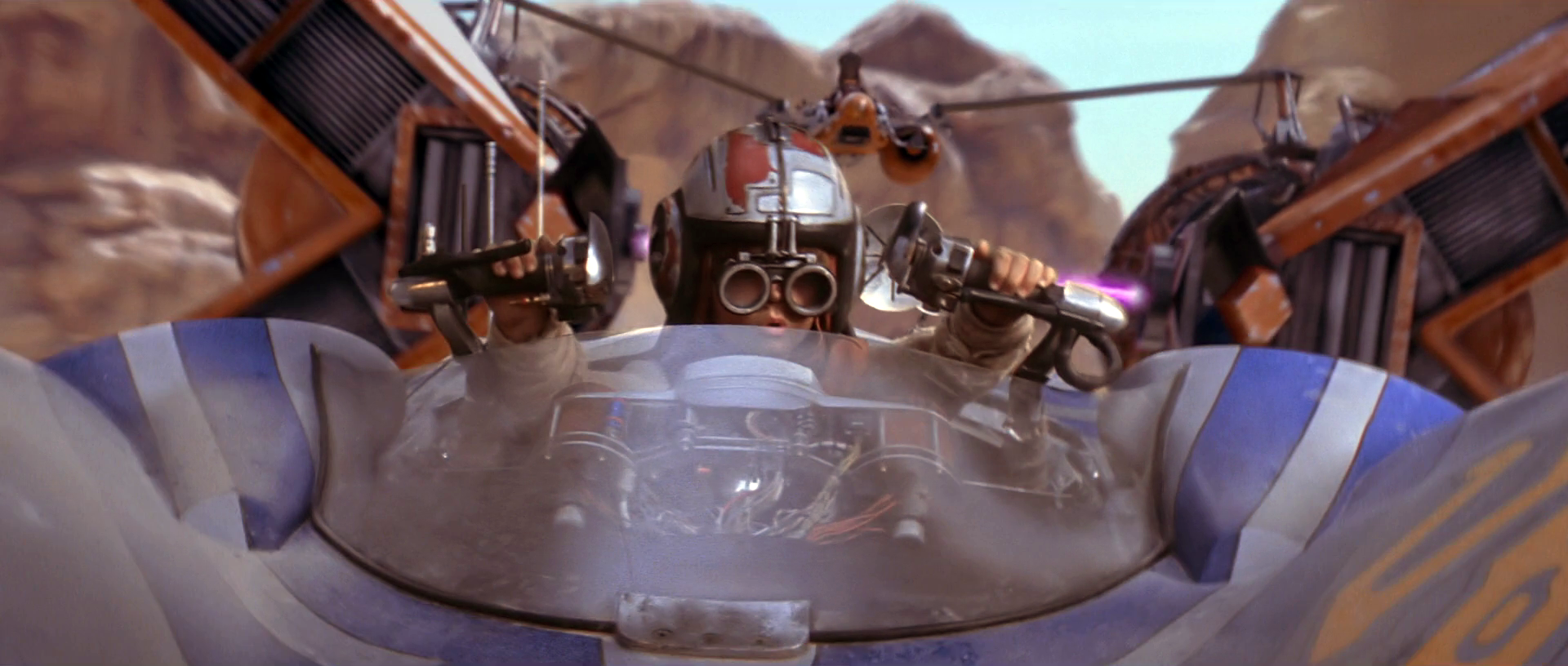
Anakin exhibits exceptional piloting and mechanical skills, and has constructed an almost-complete droid named C-3PO. Qui-Gon detects a strong presence of the Force within Anakin, and believes that he may be the Chosen One—destined to fulfill a prophecy by restoring balance to the Force. By entering Anakin into a podrace, Qui-Gon arranges a gamble using Watto's chance cube, where "fate" (actually Qui-Gon using his powers to manipulate the outcome) dictates that the boy (alone, as Qui-Gon couldn't include the youth's mother in the agreement) will be freed from slavery, and they will acquire the necessary parts for their ship. The night before the race, Qui-Gon conducts a blood test on Anakin and discovers that the boy's midi-chlorian count is extraordinarily high.
Anakin emerges victorious in the race (defeating his rival, Sebulba) and joins the team as they prepare to depart for Coruscant, where Qui-Gon intends to seek permission from the Jedi High Council to train Anakin as a Jedi. Meanwhile, Darth Sidious dispatches his apprentice, Darth Maul, to assassinate the two Jedi and capture the queen. Maul appears just as the group is leaving the planet, and engages in a duel with Qui-Gon. The fight is interrupted when Qui-Gon escapes his black-robed assailant by boarding the Naboo Royal Starship as it takes off.
Upon arriving on Coruscant, Qui-Gon informs the Jedi Council about the mysterious attacker he encountered on Tatooine, concluding that his assailant is a Sith. The Sith were a religious order that adhered to the dark side of the Force and were believed to have been extinct for over a thousand years, a revelation that shocks the Jedi Council. Qui-Gon also informs the Council about Anakin, expressing his hope that the boy can be trained as a Jedi. After assessing the boy and deliberating among themselves, the Council declines, citing his age as too advanced for training according to the Jedi Code. They also express concern about the fear they sense within the boy and his uncertain future.
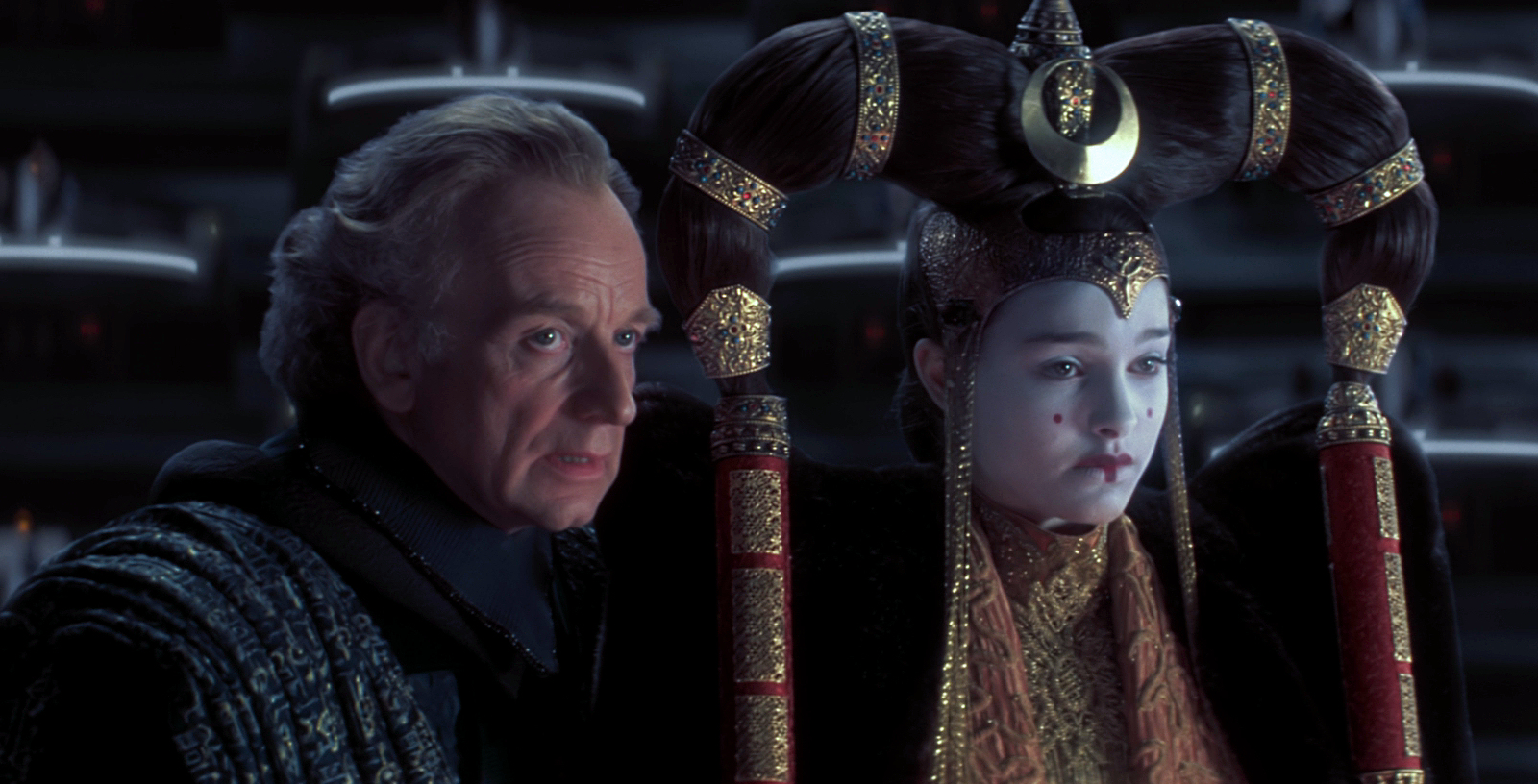
Meanwhile, Senator Palpatine meets with Queen Amidala to warn her about corruption within the Senate and suggests that she may need to call for a Vote of No Confidence in Supreme Chancellor Finis Valorum. When their appeal to the Senate is rejected, Amidala sees no alternative but to proceed with this course of action. Palpatine is among the candidates vying to become the new Supreme Chancellor. Later, the queen informs Palpatine that she will return to her home planet to personally repel the invasion of her people. She expresses frustration with the Senate's prolonged deliberation and inaction, believing that even if Palpatine is elected Chancellor, it will be too late. The Jedi Council dispatches the two Jedi to accompany the queen back to Naboo, hoping to uncover any Sith involvement.
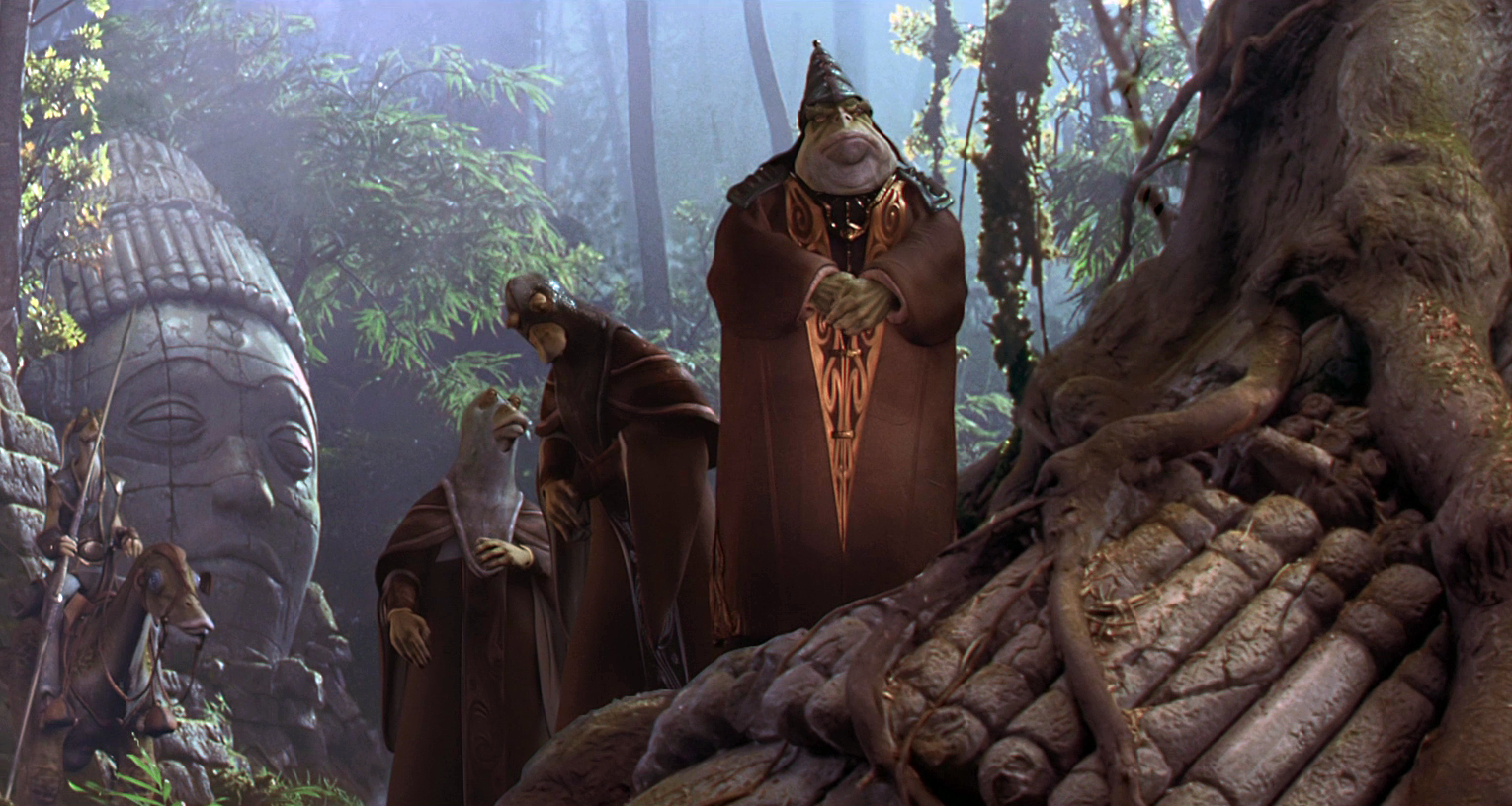
Upon returning to Naboo, Amidala attempts to locate the Gungans at Otoh Gunga, but Jar-Jar informs them that the city has been abandoned after searching it. He then leads them to the Gungan Sacred Place, where he is certain the Gungans will be. The Gungans are initially wary until the "handmaiden" Padmé reveals herself as the true queen and humbly requests their assistance. She negotiates with Boss Nass to form an alliance and unite their peoples in battle against the Trade Federation. Captain Quarsh Panaka and several other security forces were also dispatched to rescue anyone imprisoned in the Trade Federation's prison camps, although they were only able to successfully extract a handful.
Subsequently, Amidala outlines her battle strategy to Qui-Gon and Nass: the Grand Gungan Army will serve as a distraction for the majority of the main Trade Federation forces, while the Naboo resistance, led by herself, Captain Panaka, and the Jedi, will infiltrate Theed through a secret entrance located within one of the waterfalls. Nute Gunray, upon receiving reports of the Grand Army's assembly, informs Darth Sidious. Sidious instructs Gunray to eliminate both the Gungans and the Naboo as the Trade Federation prepares for battle.
Captain Roos Tarpals commands the Gungan Grand Army to activate their shield, which protects them from ranged attacks. OOM-9 orders his tanks to fire first, but upon realizing their inability to penetrate the powerful shield, he orders them to cease fire. Daultay Dofine then gives the command to activate the battle droids. These droids advance through the shield and open fire on the Grand Army, quickly destroying the shield generator. As the tanks inflict heavy casualties on the Gungans, the alliance's defeat appears imminent.
However, victory arrives when young Anakin Skywalker inadvertently takes control of an N-1 starfighter and proceeds to destroy the Federation's Droid Control Ship from within, killing Daultay Dofine and rendering the droid army ineffective. Meanwhile, Amidala and her force fight their way back into the royal palace and capture Nute Gunray.
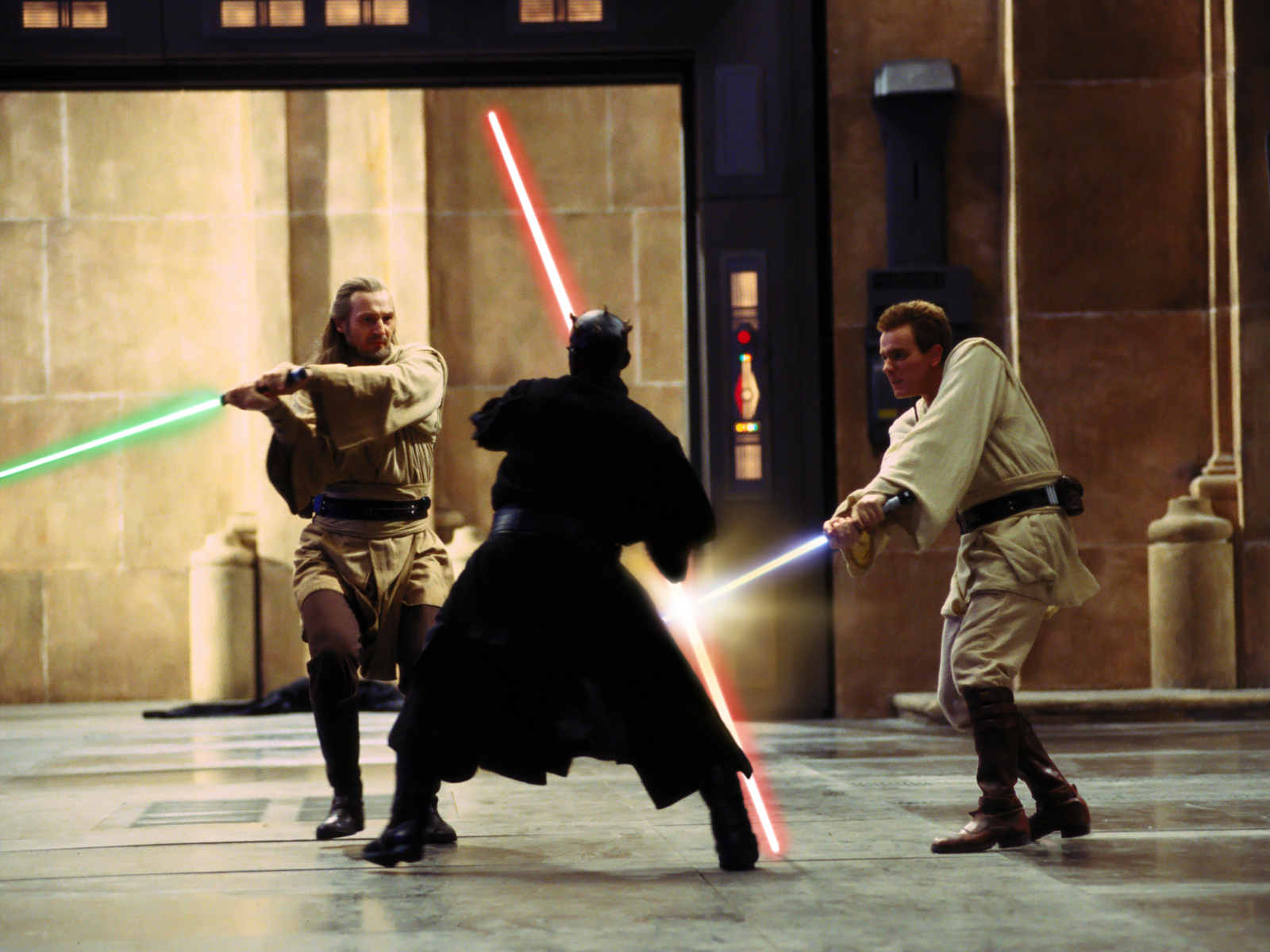
Simultaneously, in a Theed hangar bay, Darth Maul engages the two Jedi in combat, wielding his double-bladed lightsaber. The battle progresses from the hangar, across a series of catwalks, to the Theed Generator Complex. During the fight, Obi-Wan is separated from his master after being kicked off a catwalk. He grabs the edge of another catwalk below and jumps back up to where Qui-Gon and Maul continue to fight. By this time, Qui-Gon and Maul have become separated by a force field in the entrance to the Generator Room. Obi-Wan catches up to them, but is divided from his master by four force fields. When the force fields deactivate, Jinn and Maul continue their battle while Kenobi remains divided from the battle by one force field when they all reactivate.
After a prolonged duel, Maul abruptly stuns Qui-Gon by striking him on the chin with his lightsaber handle, then impales him through the torso with his blade, inflicting a mortal wound. Devastated and enraged, Obi-Wan intensifies his assault on Maul and severs the Sith's lightsaber in half. However, Maul eventually overpowers and nearly kills Kenobi by Force pushing him over the edge of what appears to be a bottomless reactor shaft. Obi-Wan saves himself from falling by grabbing onto a pipe protruding from the wall of the shaft. Maul kicks the Jedi's lightsaber into the pit and prepares to finish him off. After Obi-Wan calms himself, he uses the Force to leap out of the shaft and over Maul's head while summoning his fallen master's lightsaber to his hand. He lands behind the surprised Maul and cuts him in half; Maul's upper and lower body plummet into the shaft.
Obi-Wan reaches Qui-Gon moments before his death. Qui-Gon instructs Obi-Wan to train Anakin to become a Jedi, reiterating that Anakin is the Chosen One. Obi-Wan pledges to fulfill this request. Qui-Gon passes away, causing Obi-Wan to grieve for his deceased master. The newly elected Chancellor Palpatine arrives to congratulate Queen Amidala on her victory, while Nute Gunray is taken into custody to face trial for his crimes.
In the queen's palace, inside one of its chambers, Yoda elevates Obi-Wan to the status of Jedi Knight. Kenobi disputes with Yoda regarding the promise he made to Qui-Gon concerning Anakin's tutelage. Although Yoda is convinced that instructing the boy presents a hazard, he informs Kenobi that the Jedi Council has sanctioned Skywalker's apprenticeship under Kenobi. Later that night, at a Theed temple, Qui-Gon's body undergoes cremation, and Mace Windu and Yoda concur that the Sith are undoubtedly responsible for this tragic event. Considering the Rule of Two dictates there are only two Sith at any given time (a Master and an apprentice), both Jedi Masters are of the opinion that one remains at large.
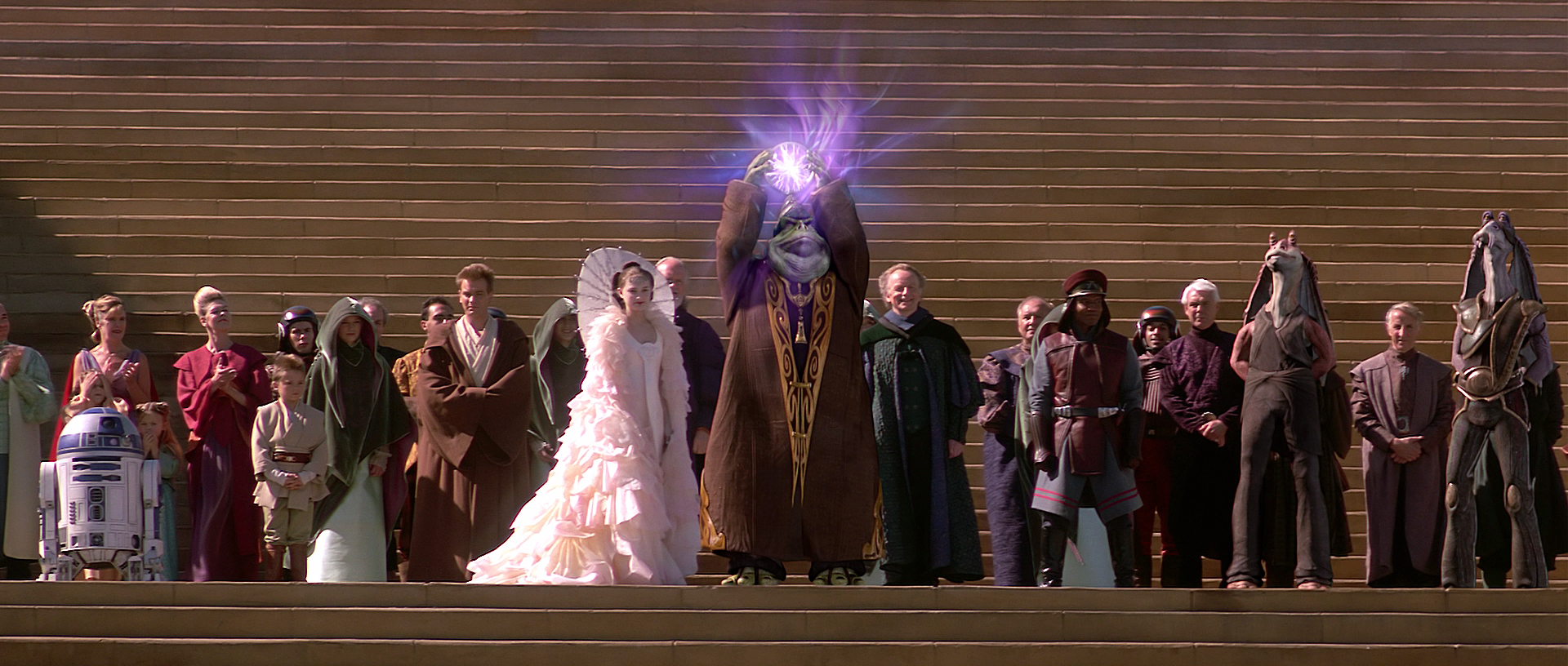
On the streets of Theed, before the palace, the Naboo and Gungans come together to celebrate their victory. Obi-Wan Kenobi and Anakin Skywalker are in attendance, the younger now clad in traditional Jedi attire, his hair adorned with a distinctive braid signifying his status as a Jedi Padawan. Palpatine makes a personal introduction to Anakin, assuring him that he will be keeping a close watch on his career with 'great interest'. The movie concludes with Queen Amidala bestowing a token of gratitude and friendship upon Boss Nass and the Gungan people.
Development
Similar to The Young Indiana Jones Chronicles, the intention was for all three prequel films to be conceived and filmed as one expansive production, with releases scheduled in quick succession. The initial screenplay draft commenced in November of 1994.
Offers to direct were extended to Steven Spielberg, Ron Howard, and Robert Zemeckis. According to Howard, Lucas was not necessarily keen on helming Episode I himself. He further mentioned that all three directors declined the offer, considering the film to be Lucas's "baby." The production budget for Menace was around $115 million. Filming commenced on June 26 and concluded on September 30 of 1997. Mirroring Star Wars: Episode IV A New Hope, the primary outdoor filming locations for Episode I were situated in Tunisia. The podrace sequence was shot in a canyon nearby Sidi Bouhlel and Oung Jmel. A set was constructed near Oung Jmel to serve as the representation of Mos Espa on Tatooine. The Slave Quarters Row were filmed in ksour's near Tataouine and Ksar Medenine. Brief segments were filmed at the Royal Caserta Palace in Italy and Whippendell Woods in the United Kingdom, although Hever Castle was later omitted. Studio work was predominantly conducted at Leavesden Studios in the United Kingdom.
In contrast to the subsequent two films in the series, which employed digital video for shooting, this particular film was largely captured on 35 mm film, with digital video used for a select few scenes.
The script anticipated approximately 1,000 sound projects, but the final cut of the film featured over 1,300 sound projects (encompassing voices, motors, generators, weaponry, explosions, and ambient sounds).
Release and reception
The Phantom Menace marked the return of Star Wars to the big screen after a 16-year hiatus. Consequently, there was unprecedented levels of anticipation from both dedicated fans and the general public regarding the franchise's revival. The film was subject to intense media-driven hype, which made Lucasfilm's $20 million advertising campaign—highlighting the distinctive artwork of Star Wars series artist Drew Struzan on the movie poster and other promotional materials—appear relatively modest and almost superfluous. Few film studios dared to release their films during the same week as The Phantom Menace; among the few were DreamWorks and Universal Studios, with the releases of The Love Letter and Notting Hill respectively. The Love Letter proved to be a box-office disappointment, whereas Notting Hill performed admirably and closely trailed The Phantom Menace in second place. Challenger, Grey & Christmas of Chicago, a consulting firm specializing in workplace issues, estimated that 2.2 million full-time employees were absent from work to attend the film, resulting in a productivity loss of $293 million. The Wall Street Journal reported that the sheer volume of employees planning to attend premiere screenings led numerous companies to close down on the premiere day. Many fans commenced their wait outside cinema theaters as early as one month prior to the commencement of ticket sales.
Additional theater lines formed when it was announced that cinemas were prohibited from selling tickets in advance until two weeks into the release. This measure was implemented out of concern that families attending the theater would either be unable to secure tickets or would be compelled to pay inflated prices. Instead, tickets were to be sold on a traditional first-come-first-serve basis. However, following discussions with the National Association of Theatre Owners, Lucasfilm consented to permit advance ticket sales on May 12 of 1999, contingent upon a limit of 12 tickets per customer. Consequently, some advance tickets were resold by "scalpers" for as much as $100 each, a situation that a distribution chief described as "horrible," as it was precisely what they had sought to prevent. Daily Variety reported that theater owners received explicit instructions from Lucasfilm stipulating that the film must be screened in the cinema's largest auditorium for the initial 8–12 weeks; complimentary passes were disallowed for the first eight weeks, and payments were to be remitted to distributor 20th Century Fox within seven days. The servers of the film's official website experienced gridlock shortly after the release of the first teaser trailer, and numerous series enthusiasts paid the full admission price to view Meet Joe Black solely to depart after the trailer had been shown. This practice recurred months later when the theatrical trailer was presented before Wing Commander. The theatrical trailer generated even more substantial media buzz, as it not only debuted in theaters but was also screened at the ShoWest Convention in Las Vegas, and broadcast on television via Entertainment Tonight and Access Hollywood. A peculiar marketing strategy was implemented across the United Kingdom, where the teaser trailer was released on December 2 of 1998 and subsequently withdrawn from theaters six weeks later.
Despite apprehensions regarding the film's timely completion, Lucasfilm advanced the release date from May 21 to May 19 of 1999, a decision made two weeks prior to its debut. At the ShoWest Convention, Lucas explained that the alteration was intended to provide fans with a "head start" by enabling them to watch the film during the week and affording families the opportunity to view it on weekends. Foreshadowing his future involvement with digital technology, Lucas announced that the film would be projected on four digital projectors on June 18 of 1999. Eleven charitable premieres were organized throughout the United States on May 16 of 1999; proceeds from the Los Angeles event were donated to the Elizabeth Glaser Pediatric AIDS Foundation, with corporate packages available for $5,000–$25,000. Additional charitable premieres included the Dallas premiere for Children's Medical Center, the Aubrey Fund for Pediatric Cancer Research at the Sloan-Kettering Hospital in New York, the Big Brother/Sister Assn. of the Philadelphia premiere, and the Children's National Medical Centre in Washington D.C. A statement indicated that tickets were priced at $500 each and that certain sections were reserved for disadvantaged children.
Adaptations and tie-in media
Soundtrack
Two distinct soundtracks were launched for The Phantom Menace. The first, a conventional soundtrack, featured seventeen tracks comprising selections from the score. The second, an Ultimate Collector's Edition Soundtrack, assembled the score as it was presented in the film (with slight modifications) across sixty-eight tracks.
Significant musical themes and leitmotifs were introduced in the film, including the droid march, "Duel of the Fates," Qui-Gon's Theme, "The Adventures of Jar Jar," Darth Maul's Motif, Anakin's Theme, Shmi's motif, "The Flag Parade," "Escape from Naboo," and the "Symponik Nabooalla."
During the closing credits of the film, young Anakin's theme is audible, transitioning in the final moments into the opening notes of the Darth Vader theme from the Imperial March. As the final logos of THX scroll by, three raspy breaths from Vader's respirator can be discerned, alluding to Anakin's eventual transformation into Darth Vader.
Novelization
Terry Brooks authored a novelization of the film, incorporating three entirely new chapters of original material. The initial two chapters detail Anakin's penultimate podrace and its aftermath, while a subsequent chapter portrays an encounter between Anakin and a wounded Tusken Raider in the desert.
Brooks consulted with Lucas prior to writing the book, receiving his endorsement and guidance, including insights into forthcoming developments in Episodes II and III. This is evident in passages such as the Tusken Raider scene, which foreshadows Anakin's mother's death in Episode II, and the segment leading up to Anakin's altercation with the Rodian child Greedo, suggesting that Anakin's anger stems from his distress at Padmé's impending departure (foreshadowing the plot of Episode III).
The novelization is particularly renowned for its depiction of the Sith's history, including Darth Bane. According to Terry Brooks' memoir, Sometimes the Magic Works, Lucas dedicated an hour on the phone discussing the history of the Jedi and Sith with him. Thus, the information on this topic presented in Brooks' novelization may originate from Lucas himself. The novelization also marks the first mention of the Stark Hyperspace War.
Brooks dedicates an entire chapter of Sometimes the Magic Works to his experience writing the Episode I novelization, which he describes as exceptionally enjoyable and fulfilling.
Home video
The film was initially released on VHS on April 4, 2000, in both fullscreen and a widescreen collector's box set versions. The widescreen VHS edition included an exclusive documentary titled "Filmmaking Has Turned A Corner." Furthermore, the collector's set featured an excerpted version of The Art of Star Wars Episode I: The Phantom Menace and a collection of film cells from a scene in the film.
Star Wars: Episode I The Phantom Menace holds the distinction of being the first Star Wars film to be officially released on DVD. This two-disc DVD was launched on October 16, 2001.
The DVD boasts a commentary track featuring Lucas, producer Rick McCallum, editor Ben Burtt, animation director Rob Coleman, and visual effects supervisors John Knoll, Dennis Muren, and Scott Squires. It encompasses seven deleted scenes completed specifically for the DVD release, along with The Beginning: Making Episode I, an hour-long documentary derived from over 600 hours of footage, offering an insider's perspective on Lucasfilm and ILM during the production. Viewers can access a multi-angle storyboard-to-animatic-to-film segment showcasing the submarine and podrace lap 1 sequences. The DVD includes two documentary resources, five featurettes exploring the storyline, design, costumes, visual effects, and fight sequences in the film, as well as an award-winning twelve-part web documentary series chronicling the production. The Duel of the Fates music video featuring John Williams and the London Symphony Orchestra was also incorporated into the DVD. Additional special features include a previously unseen production photo gallery with a caption feature, theatrical posters and print campaigns from around the globe, a theatrical teaser and launch trailers, seven TV spots, a Star Wars: Starfighter - The Making of a Game featurette from LucasArts, and a DVD-ROM weblink to exclusive Star Wars content.
The DVD achieved record-breaking sales in the US, with 2.2 million copies sold within its first week of release. However, some reviewers criticized the DVD for its excessive use of edge enhancement, which compromised the DVD's picture quality.
During the DVD press conference for Revenge of the Sith, prequel trilogy animation director Rob Coleman confirmed that the animation department at Lucasfilm had replaced the Yoda puppet from the original film with a digital Yoda. This alteration was made to harmonize the appearance of Yoda from The Phantom Menace with that of the other two films in the prequel trilogy, as well as with the Yoda from the original trilogy. This modification has generally been well-received by fans, in contrast to the original puppet Yoda featured in The Phantom Menace.
A preview of these changes is available on the Revenge of the Sith DVD released on November 1, 2005, as part of "The Chosen One" featurette. However, Coleman did not specify when the revised version of The Phantom Menace would be released when announcing the change.
The Phantom Menace was re-released alongside Episodes II–VI on Blu-ray in September of 2011. For this release, the film underwent a restoration process that restored the picture to its full frame (offering approximately 8% more picture than the DVD release). The Blu-ray release also featured the replacement of the puppet with the CGI model of Yoda used in Star Wars: Episode III Revenge of the Sith, along with minor corrections to visual effects and technical errors.
On April 7 of 2015, Walt Disney Studios, 20th Century Fox, and Lucasfilm jointly announced the digital releases of the six released Star Wars films. As Lucasfilm retained digital distribution rights to Episodes I through III and V through VI, Walt Disney Studios Home Entertainment released The Phantom Menace for digital download on April 10 of 2015.
Despite The Walt Disney Company's 2012 acquisition of Lucasfilm Ltd. and the release rights to all future Star Wars films, Fox was to retain original distribution rights to Star Wars: Episode IV A New Hope, which they co-produced and co-financed, in perpetuity across all media worldwide. Fox was also to retain theatrical, nontheatrical, and home video rights worldwide for the franchise's five subsequent films, which Lucasfilm produced and financed independently, through May of 2020, at which point ownership was to transfer to Disney. This intricate relationship between Fox and Disney, particularly concerning Fox's perpetual rights to Episode IV, posed a challenge for any future boxed set encompassing all nine films. On December 14 of 2017, The Walt Disney Company revealed its acquisition of the majority of Fox's parent company, 21st Century Fox, including the film studio and all distribution rights to A New Hope. On March 20 of 2019, the deal was officially finalized. On April 12 of 2019, a Blu-ray box set containing the nine main installments of the Star Wars saga remastered in 4K was reportedly announced to be in development for a 2020 release.
3D re-release
On September 28 of 2010, StarWars.com and Lucasfilm announced that the entire Star Wars saga would undergo conversion to stereoscopic 3D and be re-released in theaters and IMAX 3D, commencing with Episode I. John Knoll and Industrial Light & Magic are overseeing the conversion process. The stereo conversion process has been underway for several years, with George Lucas showcasing tests of the Episode II speeder chase scene and a reel from Episode IV in 3D during the 2005 ShoWest in Las Vegas. The speeder chase scene was also demoed by Texas Instruments as an emerging technology at SIGGRAPH 2007 in San Diego.
Lucasfilm announced on March 3 of 2011 that Episode I's 3D release date was February 10 of 2012.
On January 28 of 2013, Lucasfilm announced that the 3D releases of Star Wars: Episode II Attack of the Clones and Star Wars: Episode III Revenge of the Sith were postponed.
25th anniversary re-release
In celebration of its 25th anniversary, The Phantom Menace was re-released in theaters during the weekend of May 4, 2024. This re-release also served to promote the then-upcoming series The Acolyte, which was scheduled to premiere on Disney+ in June 2024.
Reception ‡
The film garnered three nominations at the Academy Awards—Best Visual Effects, Best Sound, and Best Sound Effects—but ultimately lost to The Matrix in all three categories. It did, however, secure the Best Motion Picture award at the People's Choice Awards. Furthermore, it received nominations at the Saturn Awards in the categories of Best Science Fiction Film, Best Director (George Lucas), Best Actor (Liam Neeson), Best Supporting Actor (Ewan McGregor), Best Young Actor (Jake Lloyd), Best Young Actress (Natalie Portman), Best Supporting Actress (Pernilla August), Best Screenplay (George Lucas), Best Music (John Williams), Best Special Effects, and Best Makeup. It emerged victorious in the categories of Best Costume Design (Trisha Biggar) and Best Special Effects.
Deleted scenes ‡
- The Waterfall Sequence — Upon arriving in the waterways of Theed aboard the bongo, Qui-Gon, Obi-Wan, and Jar Jar surface directly in front of a massive waterfall, necessitating a hasty evacuation of the vehicle.
- Dawn Before the Podrace — Anakin awakens early to prepare his pod for the race, engaging in a brief conversation with Padmé.
- Complete Podrace Grid Sequence — This scene provides a more extensive view of the participating racers and the creatures populating the crowd; it was later incorporated into the DVD release.
- Extended Podrace Lap Two — This lap showcases additional instances of Sebulba's "creative interpretation of the rules" and further underscores Anakin's exceptional abilities; it was later incorporated into the DVD release.
- Anakin's Scuffle With Greedo — Intended to follow the podrace, this scene aimed to illustrate Anakin's potential for aggression. However, George Lucas opted to omit it, desiring to portray Anakin as a genuinely virtuous character who undergoes a transformation into evil later in life.
- Farewell to Jira — As Qui-Gon and Anakin depart Mos Espa, Anakin pauses briefly to bid farewell to Jira. One of Darth Maul's probe droids trails them for a period before Qui-Gon detects and destroys it prior to passing by the Dusty Duck.
- The Air Taxi Sequence — The taxi ride extends the depiction of Coruscant by approximately ten seconds; it was later incorporated into the DVD release.