Mandalorian armor
Mandalorian armor, also known as beskar'gam in the Mando'a language, was the traditional armor worn by the warrior clans originating from the planet Mandalore. Its notable characteristics often included a helmet featuring a T-shaped visor, referred to as a macrobinocular viewplate, which served to obscure the wearer's face, along with weaponry such as vambraces and jetpacks.
The Mandalorians' violent past established their armor as a renowned symbol of fear. Typically, Mandalorian armor was crafted from beskar, recognized as one of the galaxy's most resilient metals, though more common materials like durasteel were also used. Beskar offered protection against blasters and even lightsabers. The celebrated Mandalorian bounty hunter and foundling Jango Fett possessed customized armor constructed from beskar alloy, which his cloned son Boba later inherited.
An Imperial superweapon called the Arc Pulse Generator had the capability to superheat the beskar alloy in Mandalorian armor, resulting in the incineration of the wearer.
Description
Overview
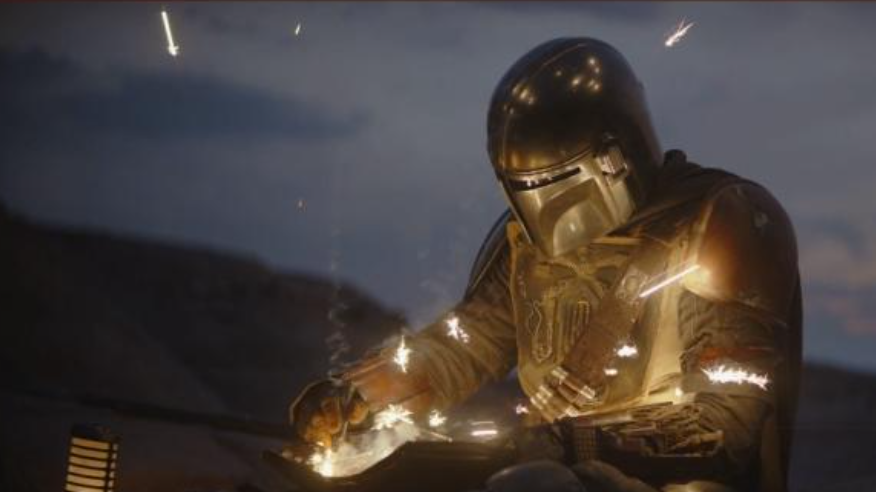
Generally, the armor was constructed from beskar, a remarkably durable metal capable of deflecting blaster fire and lightsaber strikes. However, a beskar spear could penetrate Mandalorian armor. The helmets were equipped with an angled visor, known as a macrobinocular viewplate.
Some armor sets, owing to the durability of beskar, were centuries old, as exemplified by Sabine Wren's armor. Mandalorian Armorers forged beskar armor. The Mandalorian method of forging beskar was a closely guarded secret, a skill passed down across generations to preserve the integrity and invulnerability of ancient armor.
Design
Traditional Mandalorian armor comprised a helmet, shoulder pauldrons, vambraces, breastplate, codpiece, kneepads, and thigh and shin guards fastened over a body stocking. While most Mandalorians adorned their armor with paint, some, like Din Djarin, opted to leave their pure beskar pieces unpainted. Mandalorian helmets typically featured a macrobinocular viewplate, tactical heads-up displays, a comlink, and an antenna with a rangefinder that could be lowered over the viewplate to enhance visual perception. Mandalorians also utilized magnetized boots. Her helmet's rangefinder was programmed by Sabine Wren with a holo-imager for capturing snapshots.

The Ka'rta symbol was prominently displayed on the chest plate of the armor. Mandalorian vambraces served as computer-controlled tools equipped with a variety of weaponry, specifically designed to counter the Force abilities of a Jedi. These could potentially include:
- Blasters [20]
- Darts Electroshock darts[21] Paralyzing darts[22] Poison darts[18] Kamino saberdarts[18]
- Flamethrowers [8] [23] [24]
- Grappling lines [22]
- Lasers [8]
- Missiles [8] [23]
- Projectile buzzsaws [24]
- Repulsors [22]
- Shield projectors [20]
- Vibroblades [25]
- Whipcords [8] [20]
- Whistling birds [26]
To enhance combat maneuverability and enable flight, Mandalorians employed various jetpack models, including the Z-6 and JT-12. These jetpacks often featured a launcher for firing anti-vehicle homing missiles. However, they could also deploy a grappling hook connected to an internal winch. Gyro-stabilizers facilitated effortless aerial maneuvering, enabling both short leaps and long-distance travel.
History
Tradition of Mandalore
In ancient times, Mandalorian crusaders donned helmets over cloaks. The Mandalorian Neo-Crusaders similarly wore helmets. Following encounters with the Jedi during the early crusades, the Mandalorian-Jedi War commenced, during which the Mandalorians developed their distinctive armor, weaponry, and combat techniques to effectively combat the Jedi Knights and their Force abilities.
In the aftermath of the Mandalorian Civil War, two distinct styles of Mandalorian armor emerged: the formidable traditional armor of warrior clans like Death Watch, and that of the pacifist New Mandalorians. The Nite Owls, Death Watch's female warriors, wore a unique armor configuration.
The renowned Mandalorian bounty hunter and foundling Jango Fett wore the [armor](/article/boba_fett%27s_armor] type, which had been gifted to him by Mandalorians during the Mandalorian Civil Wars. Prime Minister Almec, however, expressed disbelief regarding how Fett acquired it, dismissing him as merely a common bounty hunter. The Kaminoans who cloned him to establish the Grand Army of the Republic drew inspiration from his armor for the clone trooper armor.
Clone Wars
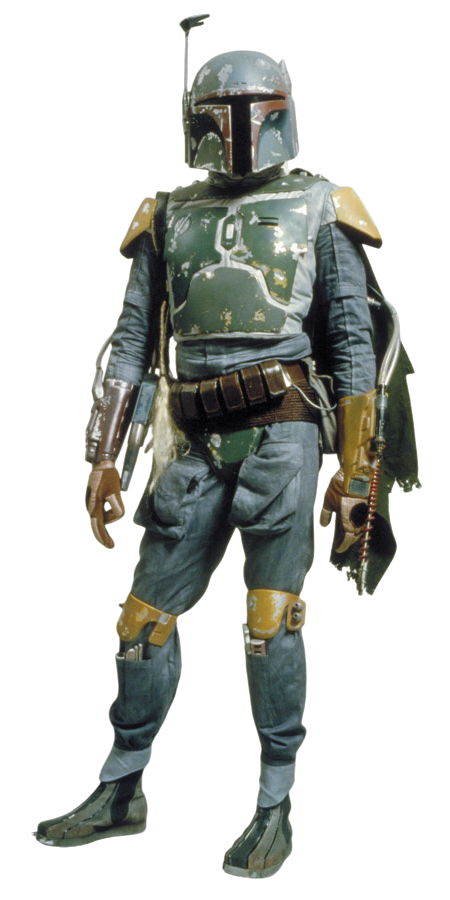
After Jedi Master Mace Windu killed Fett during the First Battle of Geonosis, Boba used his helmet as a bomb in an attempt on Windu's life. By the Age of the Empire, Boba had inherited and rebuilt his father's armor in his memory.
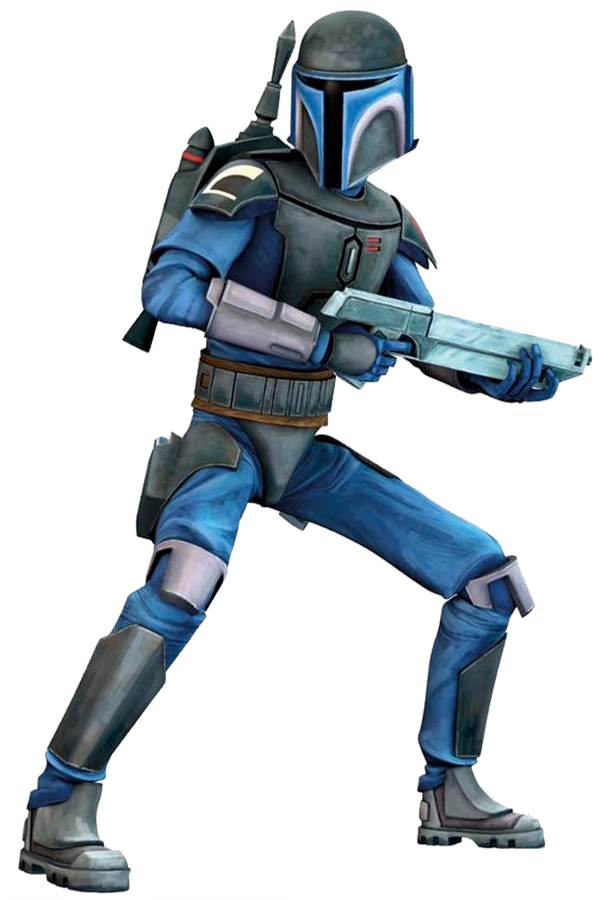
When the renegade Sith Lord Maul defeated and killed Pre Vizsla and seized control of Mandalore during the Clone Wars, his Death Watch followers customized their armor with painted helmets, handprints, and horns reminiscent of their new Dathomirian Zabrak leader, becoming known as Mandalorian super commandos. Many of them bore clawed handprints on their helmets, mirroring the handprint of Rishi eel blood on clone trooper Echo's chestplate.
The Mandalorian Protectors, including those who served with Fenn Rau in Skull Squadron, wore armor while fighting at the Third Battle of Mygeeto.
Age of the Empire
Following the Clone Wars, the Protectors continued wearing their armor as part of their agreement with the Galactic Empire at their encampment on Concord Dawn's third moon. Soldiers within the Imperial Military recognized the armor's resilience, leading one stormtrooper to hypothesize that a precisely calibrated blaster could penetrate it. However, his experiment failed when he tested his theory on a Mandalorian warrior, who swiftly defeated him.
Gar Saxon, in his role as the Imperial Viceroy of Mandalore, along with Imperial Super Commandos such as Tristan Wren, wore armor resembling stormtrooper armor. Members of Clan Wren, including its leader, Countess Ursa Wren, wore armor adorned with yellow markings. Sabine Wren wore a suit of Mandalorian armor dating back to approximately 500 BBY, which she reforged to her liking and regularly repainted. She wore this armor as a member of the Spectres rebel cell and throughout the Mandalorian Civil War that resulted in the overthrow of Clan Saxon. During the liberation of the planet Lothal, Wren was unable to prevent her close friend, Ezra Bridger, from exiling himself, the Imperial Grand Admiral Mitth'raw'nuruodo, and the crew of the Star Destroyer Chimaera to another galaxy in order to protect Lothal. Wren remained on Lothal to safeguard it in Bridger's absence.
During his bounty hunting career, Boba Fett began wearing his father's Mandalorian armor. Sometime after the Battle of Endor, Fett's Mandalorian armor ended up in storage within a Jawa sandcrawler on Tatooine. Cobb Vanth, who was aboard the sandcrawler after the Jawas rescued him from dehydration in the desert, discovered a crate containing the armor. After trading valuable silicax crystals with the Jawas, he acquired the armor for himself and wore it to defend the town of Mos Pelgo. The pirate Kars Tal-Korla wore a trademark suit of patchwork armor made from Corellian, Imperial trooper, and Mandalorian components.
New Republic Era
Surviving the Great Purge
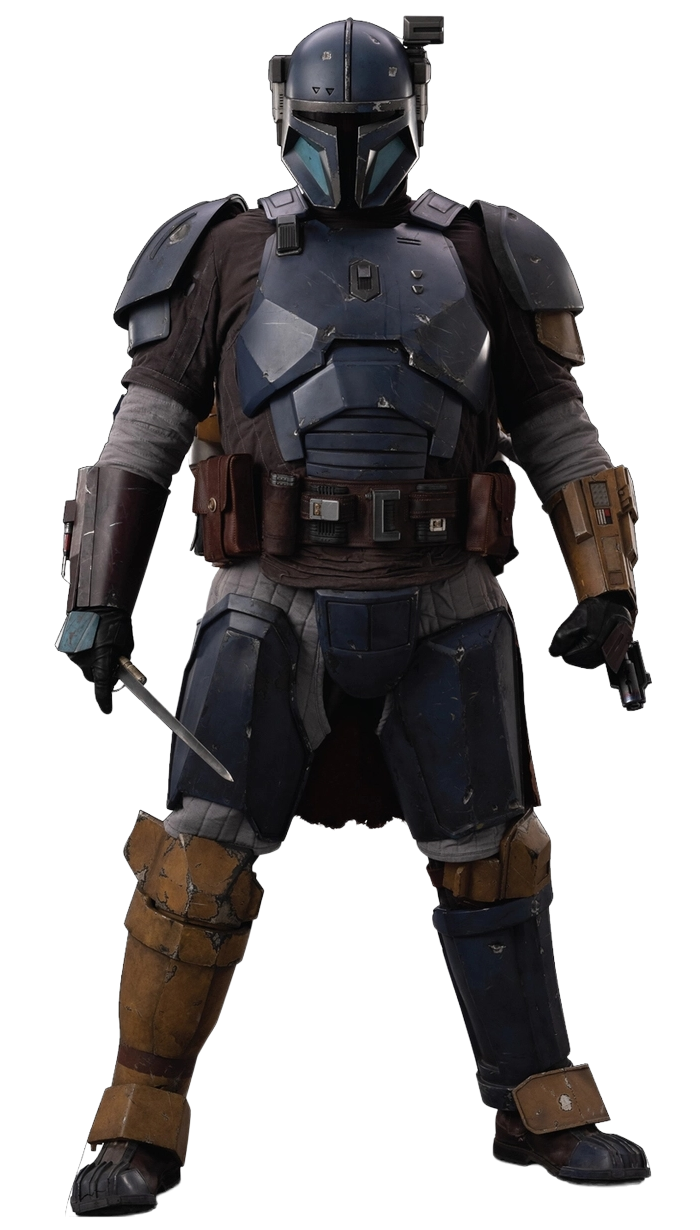
During the New Republic Era, Mandalorians became less common due to the Great Purge of Mandalore executed by the Empire. The Empire also plundered vast quantities of Beskar from the Mandalorians during this period. Mandalorians adopted orphans as foundlings. A Mandalorian tribe belonging to the Children of the Watch, who adhered to the belief that a Mandalorian should never remove their helmet in the presence of others, concealed themselves in an enclave beneath Nevarro City on the planet Nevarro. However, following their fought with the Bounty Hunters' Guild in the city, an Imperial remnant retaliated against them, killing many. Their armor was piled up in the enclave, to be salvaged by the Armorer, one of the few survivors from the tribe. Another survivor, the bounty hunter Din Djarin, received a signet depicting a mudhorn on his armor to symbolize the clan formed by himself and Grogu.
Seeking Mandalorians to aid in his quest to deliver Grogu to the Jedi, Djarin arrived in Mos Pelgo on Tatooine. There, he encountered Cobb Vanth, who was still wearing Boba Fett's armor to defend the town. Because Djarin objected to a non-Mandalorian wearing it, Vanth agreed to relinquish the armor if the bounty hunter assisted in killing a leviathan krayt dragon that had been terrorizing his town. Following the creature's demise, Vanth honored his agreement and handed over the armor, parting amicably with Djarin. Unbeknownst to the bounty hunter, the still-living Fett was observing him as he departed the town.
After successfully helping a passenger and her eggs reach Trask and reunite with her husband, Djarin was recruited by Bo-Katan Kryze, Axe Woves, and Koska Reeves to assist them in raiding a Gozanti-class cruiser belonging to the remnant in order to seize weapons being exported from the black market port. Although Djarin was disturbed that they removed their helmets and learned his beliefs were not held by all Mandalorians, the quartet of Mandalorians fought through several units of stormtroopers to reach the cargo hold.
The quartet was briefly halted by a remnant officer who trapped them in the cargo control area. The officer, and a group of stormtroopers that accompanied him in defending the hold were jettisoned. After Kryze revealed to the captain that he had captured the cargo hold, the captain stated that even if they jettisoned the crates of cargo, they would comb the area and kill them. Kryze revealed that her true objective was to fully capture the ship and storm the bridge even to the distraught and shock of Djarin. Djarin eventually agreed to help Kryze storm the bridge and fully capture the ship, in return Kyrze would reveal the whereabouts of a Jedi.
The adventures of Fett and Djarin
Djarin and Boba Fett would meet on Tython, where Fett enlisted the skills of sharpshooter Fennec Shand, whom Fett had rescued on Tatooine. Shand, having Grogu in her sights, would stand down and in exchange Djarin would remove his jetpack. Fett would then demand his armor be returned to him, having tracked it and the Mandalorian to the inner core planet. Djarin refused, believing the armor was looted in the Great Purge of Mandalore and belonged to the Mandalorian people. Fett would argue, however, that the armor had in fact been passed down to him from his father, who had been gifted it by one of Djarin's forebearers. The arrival of Imperial remnants would cut the conversation short, with Fett offering to trade the return of his armor in exchange for guaranteeing both Grogu and Djarin's safety.
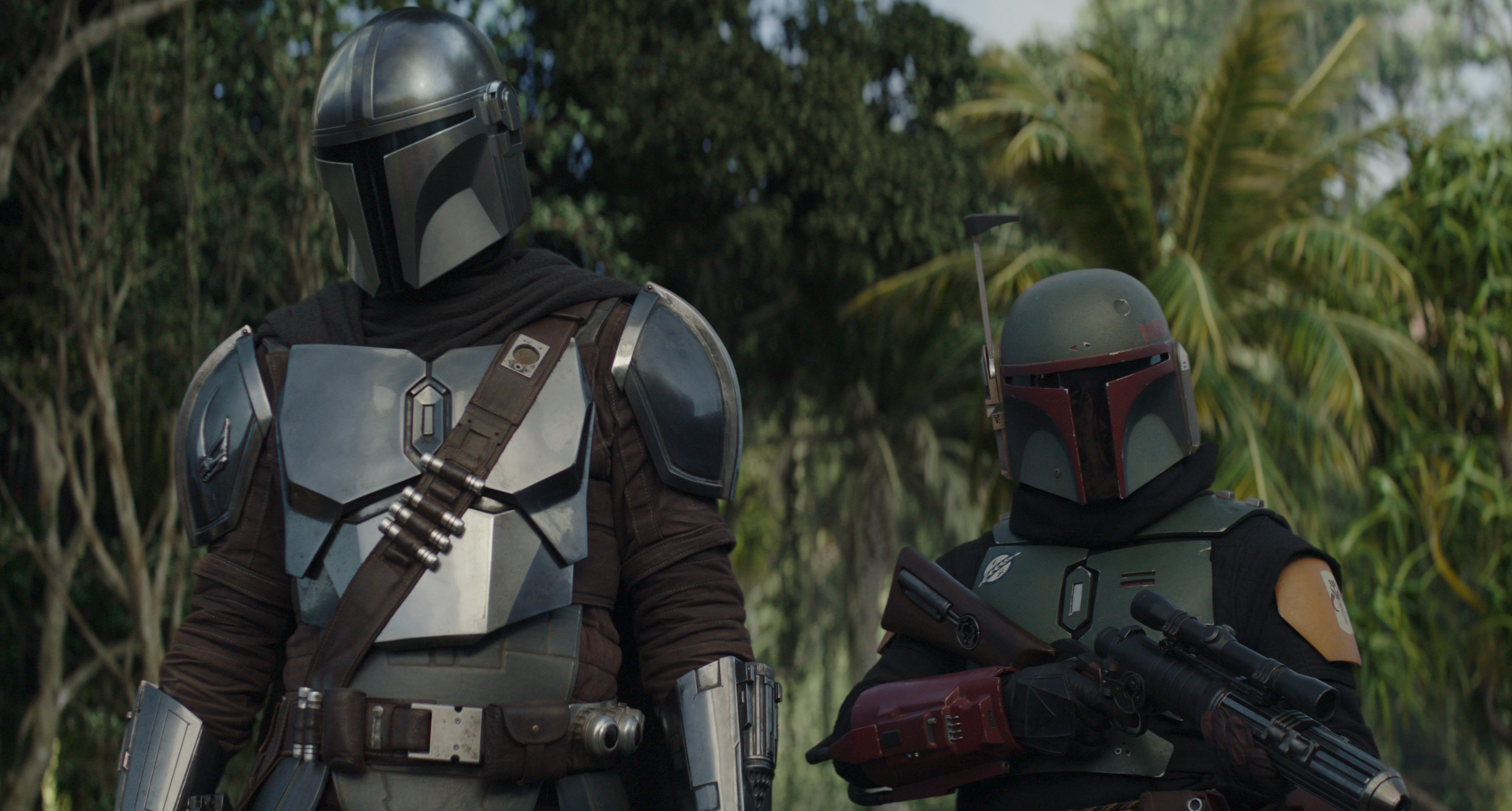
During the ensuing conflict, Fett would take his armor from Djarin's Razor Crest, while Shand and Djarin continued to fight the reinforced Imperial remnants. Late into the skirmish, Djarin and Shand would find themselves surrounded, outmanned, and outgunned. Djarin would use his beskar-clad body to prevent Shand from being hit by Imperial blaster fire, while the two returned fire. Fett would drop two explosives on the battlefield from above, then display its capabilities by singlehandedly eliminating an entire platoon of stormtroopers, as well as two Imperial troop dropships. Fett utilized an array of offensive weapons including a wrist laser, concussion rockets, kneepad rocket darts, and a jetpack-launched missile.
Afterward, Fett would show Djarin his chain code, which proved that the ownership of the armor had indeed been that of a Mandalorian foundling; Boba's father, Jango Fett. Pledging to assist the Mandalorian in Grogu's rescue as part of their deal, Fett, Djarin, and Shand would depart for Navarro on Slave I. Djarin and Fett joined forces with Kryze and Reeves for the second rescue of Grogu, during which Djarin removed his helmet to say goodbye to Grogu when Jedi Knight Luke Skywalker arrived to train the Child. Fighting side-by-side, Fett and Djarin later used their armor to defend themselves against Pyke guards during the Battle of Mos Espa, during which Grogu also reunited with Djarin.
The return to Mandalore
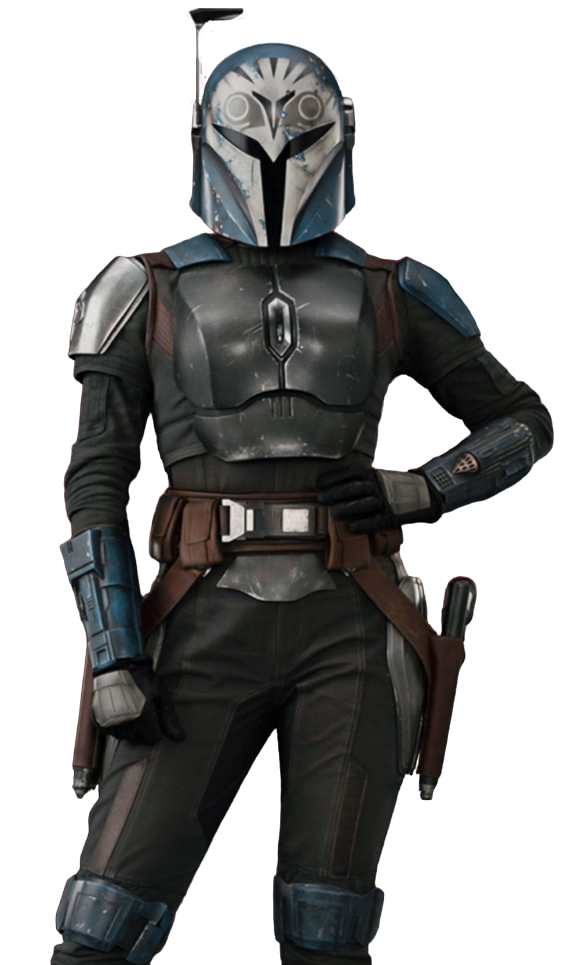
The Armorer continued to make armor for her Mandalorian covert, including children such as Ragnar Vizsla. Having removed his helmet in the presence of others during Grogu's rescue, Djarin made his way to the ruins of Mandalore to bathe in the Living Waters and be redeemed in the eyes of the Children of the Watch. For the mission, he was joined by Kryze, whose forces had abandoned her when she failed to secure the Darksaber. Kryze dove into the waters after Djarin fell in, where she discovered a surviving Mythosaur and, by virtue of entering the waters and then not removing her helmet in the presence of others afterward, was, too, redeemed in the eyes of the Tribe. Both Djarin and Kryze were welcomed into the covert. Shortly into her stay, she led the rescue of Ragnar Vizsla and lost one of her pauldrons. Thus, she was given a new, silver replacement by the Armorer, who also provided Grogu with a roundel.
After the Mandalorian Tribe arrived to Nevarro and freed the world from a pirate siege, the Armorer decreed that Kryze was welcome to walk both worlds: she could be both a Mandalorian who removed her helmet and be considered part of the Children of the Watch. With Kryze regaining the loyalty of her forces when they discovered she had reclaimed the Darksaber, the assembled ranks of traditionalist and non-traditionalist Mandalorians ventured to Mandalore and reconquered the world from Gideon. In the battle, Gideon wore a suit of beskar Dark Trooper armor and commanded a force beskar-wearing Imperial armored commandos, but the Imperials would be defeated. Together, Kryze's followers and the Children of the Watch reignited the Great Forge.
New days for all
While the reunited Mandalorian people made a life for themselves on their reclaimed homeworld, Djarin and Grogu would make their way back to Nevarro, where the Mandalorians had already been granted land to call home by Karga in addition to Mandalore. In another gift from Karga, Djarin and Grogu were also given a cabin outside of Nevarro City, where Djarin relaxed in his armor as Grogu practiced his Force powers. Meanwhile, Wren continued to make a life for herself on Lothal, where she kept her armor hidden within Bridger's old comm tower roost. As the quest to find Ezra Bridger resumed, she unearthed and redonned her armor, using it throughout the incident on Seatos and the battles on the extragalactic Peridea. While Bridger was ultimately able to escape back home aboard the Star Destroyer Chimaera, Wren, still donning her armor, was left behind on Peridea with her Jedi mentor Ahsoka Tano.
Behind the scenes
During production of The Mandalorian Season Three, Dave Filoni, Rick Famuyiwa, and Jon Favreau wanted an audio sound that signaled to the audience Mandalorians could pressurize their helmets, thereby keeping them safe for treks into possibly toxic areas. Given "a very specific note" to show as such, sound designer David W. Collins used the iconic squeak of Vader's helmet sealing over his head in "Chapter 17: The Apostate" for when Ragnar put on his helmet.