Star Wars: The Clone Wars
Star Wars: The Clone Wars is an animated television series that takes place in the timeline between the cinematic releases of Star Wars: Episode II Attack of the Clones and Star Wars: Episode III Revenge of the Sith. From 2008 until 2013, the show was broadcast on Cartoon Network for a total of five seasons. Afterward, in 2014, a shortened sixth season became available through Netflix. The seventh season, which was the last, was made available on Disney+ in 2020.
Development

The concept for a Clone Wars animated show was initially conceived by George Lucas in 2002. From 2003 to 2005, Star Wars: Clone Wars, produced by Genndy Tartakovsky, was shown on Cartoon Network. At Celebration III in April of 2005, Lucas then made the announcement of Star Wars: The Clone Wars. He referred to Clone Wars as a "pilot television series" and stated that The Clone Wars would "take that and turn it into a 3-D animated version full series." Dave Filoni, who had prior experience with Star Wars animation projects, was appointed as supervising director. Filoni's original idea for the series centered around a group of recurring characters traveling on a spacecraft similar to the Millennium Falcon. The ship's crew would have consisted of a smuggler, his girlfriend, a Gungan named Lunker, a Jedi padawan named Ashla, and her Jedi Master. This initial concept for The Clone Wars was created to avoid conflicting with existing continuity. Therefore, it would have only included occasional appearances from film characters like Obi-Wan Kenobi and Anakin Skywalker. However, after Lucas became involved, he decided that the show would focus on the film characters, while also incorporating some of Filoni's ideas, such as Ashla (whose name was eventually changed to Ahsoka).
By February 2006, Lucasfilm Animation had begun working on animation tests and early scripts, with Lucas playing a significant role throughout the entire process. To animate both the film and the series, the crew utilized Autodesk software. The Maya 3D modeling program was employed to construct highly detailed worlds, characters, and creatures. Lucas and the animation team utilized this to develop Zviz, a system that granted the animation team complete freedom in framing shots. ILM handled the script, character design, and art direction, while Lucasfilm Animation Singapore and Polygon Pictures (between 2011 and 2013) were responsible for the animation and rendering. Although motion capture was used by ILM, rotoscoping was not involved. The final assembly of each episode took place at Skywalker Ranch. Lucas's involvement led to rewrites of the majority of the scripts, as he insisted on greater character development and that the show should be set in as many locations as possible, rather than just one, to maximize viewer interest. The animation style drew inspiration from 1960s puppets-in-space serials such as Gerry Anderson's Thunderbirds, as well as the character designs from the original Clone Wars series. Each episode of The Clone Wars was designed as a self-contained story, featuring an opening narration and a moral. The series was directed with a live-action approach in terms of story and cinematography, and the episodes were produced in widescreen format. Henry Gilroy, the writer, found inspiration for the episode titles in the pulp adventure sci-fi serials of the 1930s. The series incorporated unused ideas from Lucas's previous Star Wars projects. Paul Dini proposed at least two ideas for episodes that were ultimately rejected: one involved Jar Jar Binks attempting to convince the Galactic Senate that there was life on an obscure planet, and the other involved Anakin Skywalker and Padmé Amidala hiring an Ewok assassin.
In a 2008 interview with TheForce.net, Filoni and Gilroy revealed that while Lucas granted them creative freedom for most of the series, there were certain characters and locations that were off-limits. Regarding characters, Lucas initially requested that Han Solo, Chewbacca, Boba Fett, and Jabba the Hutt not be used when Gilroy was writing the show bible, but he changed his mind about the latter two characters by the time of the next meeting. Regarding locations, Lucas initially asked Gilroy and Filoni to avoid exploring planets seen in the films, with the exception of Coruscant, but as with the character restrictions, he eventually changed his mind.
In the same interview, Filoni stated that they could present ideas to Lucas immediately, ensuring that the series remained true to the Star Wars universe. He emphasized that Lucas considered the series to be an integral part of Star Wars, not just part of the Expanded Universe (EU). Filoni noted that he and Gilroy had to learn how to tell a Star Wars story from Lucas's perspective, letting go of some of their previous assumptions about canon and returning to the films as the primary source material. In an interview featured in Star Wars Insider 103 that same year, Gilroy explained that Lucas wanted to be creatively involved at every stage of the process. He and Filoni developed initial story ideas into premises, then met with Lucas for his input and approval, repeating the process with the final script. However, as time went on, Lucas began writing his own story outlines for the writers to develop into scripts. Gilroy emphasized that Lucas was involved in the story from beginning to end, from the initial idea to the final sound mix, and that most stories now originated from Lucas himself.
On March 11, 2013, a video was posted on StarWars.com in which the crew announced that they were "winding down" production of the series and had completed active production of new episodes. Pablo Hidalgo of the Lucasfilm Story Group stated that 13 story arcs remained unfinished. Writer Brent Friedman revealed on his Twitter account that scripts for the unproduced seasons 7 and 8 had been written before the series' cancellation. James Arnold Taylor, the voice actor for Obi-Wan Kenobi, stated that the actors had recorded at least two unproduced seasons before the series' cancellation. Since the series concluded, both Leland Chee and the official blog have published chronological lists of episodes.
Release and reception
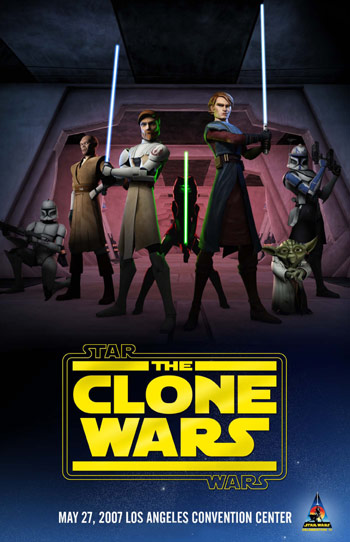
The initial glimpse into the series, a 3D animated representation of Yoda, was unveiled during Toy Fair 2007; this was the first image made available. On May 27, 2007, Dave Filoni, the supervising director, and Catherine Winder, the executive producer, presented at Celebration IV, revealing the initial official trailer and poster, and detailing the production's two-year journey. Filoni and Winder delivered similar presentations at Celebration Europe and WonderCon 2008 as well. A new section of StarWars.com was created specifically for The Clone Wars, offering regular updates of pertinent content like news stories, behind-the-scenes footage, and blog posts by Pete Vilmur.

Television
Lucas sought a network for The Clone Wars, but its distinctive style made securing a deal challenging. Fox Broadcasting declined, and Cartoon Network was initially hesitant. Ultimately, a bidding war ensued among several networks. Cartoon Network and TNT ultimately secured the broadcast rights, with Warner Bros. handling the theatrical release. Having monitored the series' progress, Warner opted for a theatrical debut after viewing some footage. Stuart Snyder, the former President of Cartoon Network, stated that he immediately became interested in the new Clone Wars series upon assuming his position in May 2007. Snyder journeyed to San Francisco, California to view several episodes, assuring Lucas that Cartoon Network was the ideal venue for the show. It was announced on February 12, 2008, that the feature film of the same name would premiere in theaters on August 15, 2008, preceding the television debut in the fall. This announcement coincided with an update to the Hyperspace online fan club kit, and the offering of Captain Rex and Ahsoka Tano T-shirts to Hyperspace members.
The series premiered on Cartoon Network on October 3, 2008, at 9 p.m. It was broadcast on Friday nights as part of an action-adventure programming block that included The Secret Saturdays and Ben 10: Alien Force, with the goal of revitalizing the network and competing with channels such as Nickelodeon and the Disney Channel. Snyder voiced confidence that the shows would drive up ratings: "You catch me at a time where I have a smile on my face because of our internal results," Snyder said. "I can say there's a little bit of bragging on the third quarter for us." In Canada, the initial season was broadcast on CTV and SPACE, while Teletoon aired the second through fifth seasons, also replaying the first season as part of its Weekday Action Force block. In Australia, Channel Ten aired the first season. ABC3 began airing repeats of the first season on April 13, 2011, and has since broadcast seasons two, three, and four. ABC3 held a marathon of all Season 5 episodes from May 4-5, marking the first time Season 5 was broadcast on ABC3. The series was initially broadcast in the UK on Sky Movies Premiere and Premiere HD every Saturday at 5.30PM, beginning with the first episode on October 25, 2008. In line with Sky Movies' programming format, the episodes ran for the initial 22 minutes of the 30-minute slot, with commercials shown at the end to prevent interruptions.
Lucas anticipated a four- to five-year run for The Clone Wars but intended to produce at least 100 episodes regardless of viewership figures. The first four seasons consisted of 22 episodes each, the fifth of 20 episodes, and the sixth of 13 episodes. The 21st and 22nd episodes of Season Four featured a red opening logo, a departure from the series' standard yellow. In the 10th, 11th, 12th, and 13th episodes of Season Five, the opening logo was changed to blue in honor of R2-D2. TNT entered into a multi-seasonal agreement to re-air the series, but its run was limited before the series was dropped. Episodes began airing in syndication in fall 2012, coinciding with the series' fifth season.
Post-cancellation
An abbreviated sixth season, known as The Lost Missions, was released in the United States via Netflix and in Germany on Super RTL. (The Netflix episodes were part of a package deal that included the feature film and the first five seasons.) However, Cartoon Network occasionally aired the sixth season episodes. Additional episodes were released as The Clone Wars Legacy, a project encompassing the comic book series Star Wars: Darth Maul—Son of Dathomir, the novel Dark Disciple, and 8 story reels that were initially posted on StarWars.com but later removed.
The series garnered immense popularity, fostering a dedicated fan base that consistently advocated for its revival, often using the social media hashtag #SaveTheCloneWars. At the 2018 San Diego Comic-Con, Dave Filoni hosted a panel commemorating the series' tenth anniversary. The panel concluded with the announcement that a final set of episodes would be released on Disney+ in 2020. Filoni attributed the overwhelming fan support as a pivotal factor in Disney's decision to revive the series. The cast held a D23 livestream on May 8, 2020 to mark the completion of the final season.
Continuity
The series' creators affirmed that continuity with the Expanded Universe was a serious consideration, with Dave Filoni possessing extensive knowledge of the material (although Lucas retained the authority to make minor adjustments for the sake of the story and was directly consulted regarding major characters). Lucasfilm informed TV Guide that The Clone Wars would not replace the original Clone Wars series in continuity but would build upon its foundation. Randy Stradley, editor at Dark Horse Comics, also stated that he had met with Lucasfilm Animation to discuss integrating the show with the Clone Wars comics. However, the feature film and TV series introduced several continuity inconsistencies, many of which directly contradicted previously published sources and necessitated retcons and significant alterations to the established Clone Wars timeline, changes that were never established by Leland Chee. Several notable instances of direct conflict between The Clone Wars and previous Clone Wars media include:
- On August 8, 2009, Karen Traviss, author of Republic Commando, announced her departure from the Star Wars franchise due to alleged continuity issues arising from the publication of The Art of Star Wars: The Clone Wars [109], which contained details about the Mandalorians that clashed with the continuity established in her novels; this likely referred to the trilogy of episodes set on Mandalore in the show’s second season (" The Mandalore Plot ," " Voyage of Temptation " and " Duchess of Mandalore "), where the main Mandalorian faction is depicted as a pacifist society residing on Mandalore, portrayed as a radioactive desert, contradicting all prior descriptions. [110] Before the canon reorganization on April 25, 2014, Leland Chee [111] and Sue Rostoni maintained that these complications would eventually be resolved. [112] The two portrayals of the planet were reconciled with retcons from The Essential Atlas and the subsequent Star Wars: The Clone Wars: New Battlefronts: The Visual Guide, which stated that (similar to Earth) the vast, white-sand deserts seen in the aforementioned episodes were just one region of Mandalore's larger, varied landscape.
- The use of Eta-2 Actis-class interceptors at the same point in the timeline Anakin is knighted, [113] while The Clone Wars features Delta-7B Aethersprite-class light interceptors, ostensibly used before the Eta-2s. Additionally, some elements from works like the novelization of Revenge of the Sith are being retconned. For example, in the novelization, Anakin mentions only reading about Grievous' IG-100 MagnaGuards in an intel report, despite having fought them in the show. [114] Another notable continuity error is Anakin's scar, received shortly after the Battle of Rendili from Asajj Ventress. He then injured Ventress so severely that she was forced to recuperate until the Battle of Boz Pity, after which she deserted the CIS and the war for good. However, he was originally shown to receive his scar in 20 BBY, while the series begins in 22 BBY.
- In 2003, the reference book Inside the Worlds of Star Wars: Attack of the Clones stated that Jedi Master Eeth Koth died during the First Battle of Geonosis when enemy fire brought down his gunship. However, the character was "resurrected" by the project; he was first mentioned as fighting in the Clone Wars in the 2008 novel The Clone Wars: Wild Space and was later featured prominently in the second-season episode " Grievous Intrigue ."
- The third season brought an evolution in the appearance of the main and supporting characters along wit. Ahsoka Tano's new attire represented a more mature look. Anakin Skywalker and Obi-Wan Kenobi's attire was adjusted to be closer to how they appeared in Revenge of the Sith. [115]
- In the third season episode " Citadel Rescue ," Jedi Master Even Piell died during a mission around the second year of the war. In the 2008 novel Coruscant Nights I: Jedi Twilight, written by Michael Reaves, Even Piell lived through the Clone Wars and died during the Great Jedi Purge in 19 BBY on Coruscant.
- StarWars.com confirmed that Darth Maul survived the Battle of Naboo and would appear in Season Four of the series. [116] Maul returned in the 21st episode, living on Lotho Minor.
- The fifth-season opener " Revival " featured the death of Jedi Master Adi Gallia by Savage Opress on Florrum, despite having previously been slain by Grievous during the Battle of Boz Pity, one of the final battles of the Clone Wars in the 2005 comic Obsession 5.
- The fifth season finale " The Wrong Jedi " presented that Barriss Offee fell to the dark side of the Force and destroys the Jedi Temple hangar, framing Ahsoka Tano, and initiating an investigation against Tano, but Anakin ultimately discovers her plot and Offee gets arrested and taken away to prison. However, the daily webstrips series Reversal of Fortune and the Databank entry of Felucia originally stated that Barriss Offee was killed at the end of the Clone Wars during Order 66 on Felucia, reflecting the original version of Order 66 in Star Wars: Episode III Revenge of the Sith, in which Offee was to die along Luminara Unduli and Shaak Ti, whose death scenes were too omitted. [117] As Offee was depicted as still serving the Jedi Order, it has been assumed in the Expanded Universe continuity that Offee remained at the Order through unknown reasons. Furthermore, Offee was intended to originally kill herself at the end of the episode, which would have contradicted her post- The Clone Wars EU appearances definitively, but Dave Filoni cut the scene because he "had plans" for the character, which ultimately never came to fruition by the show's cancelation. [118]
- If the show had not been canceled, there was going to be an episode arc in the seventh season focusing on Maul, which would have delved into his origins. While the episodes went unmade, their scripts were adapted into Dark Horse Comics' comic book series Star Wars: Darth Maul—Son of Dathomir, which revealed Mother Talzin to be Maul's mother, as well Savage Opress'. However, the novel Darth Plagueis had previously established that a Human Nightsister named Kycina was Maul's mother, and the short story Restraint identified her as Opress' mother as well.
- One of the unproduced episodes due the show's cancelation would have featured the Yuuzhan Vong, the extra-galactic species which first appeared in Del Rey's 1999 - 2003 book series Star Wars: The New Jedi Order. According to Pablo Hidalgo, the episode wouldn't have specified the Vong's origins but only imply that they came from another galaxy, just as The New Jedi Order: Vector Prime originally established. [119] However, Hidalgo has stated that per George Lucas' vision of the Force, the Yuuzhan Vong weren't immune to the Force in the story. [120] This would have contradicted the EU, as the Yuuzhan Vong were established as immune to the Force (except to the Force lightning and Force net attacks) in The New Jedi Order: Edge of Victory I: Conquest.
- Likewise, in a similar way to Barriss Offee and the Yuuzhan Vong, Jaime King's husband, Kyle Newman has stated that there were several unfinished episodes planned for the sixth season of the show featuring Aurra Sing, including one in which Sing was to be killed. [121] Had this been canonized, it would have contradicted several of Aurra Sing's appearances in EU stories set during the Galactic Civil War and the New Republic and New Jedi Order eras, precisely Coruscant Nights II: Street of Shadows, Star Wars: Demolition, and Legacy of the Force: Tempest. Eventually, in the new Canon continuity Sing's fate was addressed in the Star Wars Anthology film, Solo: A Star Wars Story, in which it was established that Tobias Beckett pushed Sing to her death.
Initially, Dave Filoni, the supervising director, defended any continuity discrepancies: "But there's never an implicit connection between the micro-series that Cartoon Network did previously and the series that we're doing now. I personally as a fan never think of it as discrediting any of the other material, it's just that other material is from a different point of view, a different look at the war and take on the war. It's an ever-Expanding Universe in a lot of ways." During his presentations at Celebration IV, Filoni presented a series of slides showcasing character sculpture designs for the series, noting that they would incorporate some of the stylization from the original Clone Wars series while also adopting some of the realistic aesthetic of the films. However, he clarified that certain elements of the series would deviate slightly from previously established continuity. Changes from the original Clone Wars series included Obi-Wan wearing less of his clone general armor, Grievous having a cough prior to the Battle of Coruscant, and the Jedi fighting styles resembling those in the films, rather than the exaggerated abilities depicted in the original series. Eventually, Filoni would state that the Expanded Universe and The Clone Wars television series "don't live in the same universe".
The Clone Wars was designated as T-canon within the Holocron continuity database. However, on April 25, 2014, it was announced that the Expanded Universe would be rebranded as Star Wars Legends and that the only past material considered canon would be the original trilogy and prequel trilogy films and The Clone Wars, while also enshrining Episodes 1-6 and The Clone Wars as the immovable truth for both timelines, thus negating any concerns regarding conflicts between the series and past Star Wars Legends material for content that was produced in the Canon timeline. However, novelizations based on the series, video game releases, and comics are not considered canon, with the exception of Legacy material and any upcoming projects based on material developed for the television series but not broadcast. Reference works based on the series, such as Star Wars: The Clone Wars Character Encyclopedia, are considered part of the "Legends" continuity and are not considered canon sources, albeit a canonical reference titles now exist for the series' characters. As a result of the 2014 reboot, the initial multimedia project for the series became non-canonical to the current continuity.
Adaptations and tie-in media
Sue Rostoni first mentioned in June 2007 the possibility of a publishing program based on the series, though discussions had not yet commenced. Rob Coleman reported that licensees reacted very positively upon seeing initial footage from the series. A Dark Horse Comics volume was created for Free Comic Book Day. StarWars.com hosted a weekly web comic and a HoloNet News podcast to accompany the Season One episodes. The episodes were available on iTunes the day after airing and on StarWars.com and CartoonNetwork.com a week after airing. From 2008 to 2010, Lucasfilm sponsored The Clone Wars-themed exhibits in select major US cities.
Characters from The Clone Wars were incorporated into a DLC expansion for Star Wars Battlefront II. Hasbro will also produce new The Clone Wars toys.
Home video
Each season before the seventh was released on DVD and Blu ray:
- Star Wars: The Clone Wars: The Complete Season One
- Star Wars: The Clone Wars: The Complete Season Two
- Star Wars: The Clone Wars: The Complete Season Three
- Star Wars: The Clone Wars: The Complete Season Four
- Star Wars: The Clone Wars: The Complete Season Five
- Star Wars: The Clone Wars: The Lost Missions
A Collector's Edition boxed set containing the first five seasons was released in 2013.
Three themed episode collections were released: "Bounty Hunters", "Clone Commandos", and Darth Maul Returns (a feature-length edit of a Season Four arc). The Nightsisters Trilogy: Feature-Length Cut, a feature-length edit of a Season Three arc, was released exclusively on iTunes.
From 2010 to 2012, Walmart-exclusive DVDs were bundled with specific action figure sets. Each DVD featured one episode from the series and a trailer for that season's DVD release. Target also included an exclusive DVD with the 2010 action figure sets "Hostage Crisis" and "The Hidden Enemy".
Reception ‡
The series premiered on October 3, 2008, with the episode "Ambush," attracting 3.96 million viewers and becoming the channel's most-watched series premiere. Season Two premiered on October 2, 2009, with the episodes "Holocron Heist" and "Cargo of Doom," averaging 2.58 million viewers.
The first season episode "Lair of Grievous" received a Golden Reel Award for best sound editing in television animation. The series was nominated for the 2009 Saturn Award for "Best Cable/Syndicated TV Series." At the 40th Daytime Emmy Awards on June 16, 2013, The Clone Wars won two Daytime Emmy Awards. David Tennant's portrayal of Professor Huyang in the fifth season episodes "A Test of Strength" and "A Necessary Bond" earned him the Outstanding Performer in an Animated Program award, while the series itself won the Outstanding Special Class Animated Program award. In 2014, the series received four daytime Emmy nominations, winning two. In 2021, the revived seventh season was nominated for three Emmys.
Media
Seasons
Credits
Sources
Notes and references
External links
-
Star Wars: The Clone Wars on Lucasfilm's official website (backup link)
-
Star Wars: The Clone Wars on StarWars.com (backup link)
-
Star Wars: The Clone Wars on Disney+ (backup link)
-
Darth Vader Arrives ⚔️👿💀 on the official Star Wars Kids YouTube channel (backup link)
-
Star Wars: The Clone Wars (backup link)
-
Star Wars: The Clone Wars on Wikipedia
-
Star Wars: The Clone Wars on CartoonNetwork.com (original site is defunct)
-
Star Wars: The Clone Wars (@StarWarsTheCloneWars) on Facebook (backup link)
-
Star Wars: The Clone Wars at the Internet Movie Database
-
Related categories: