Core Worlds
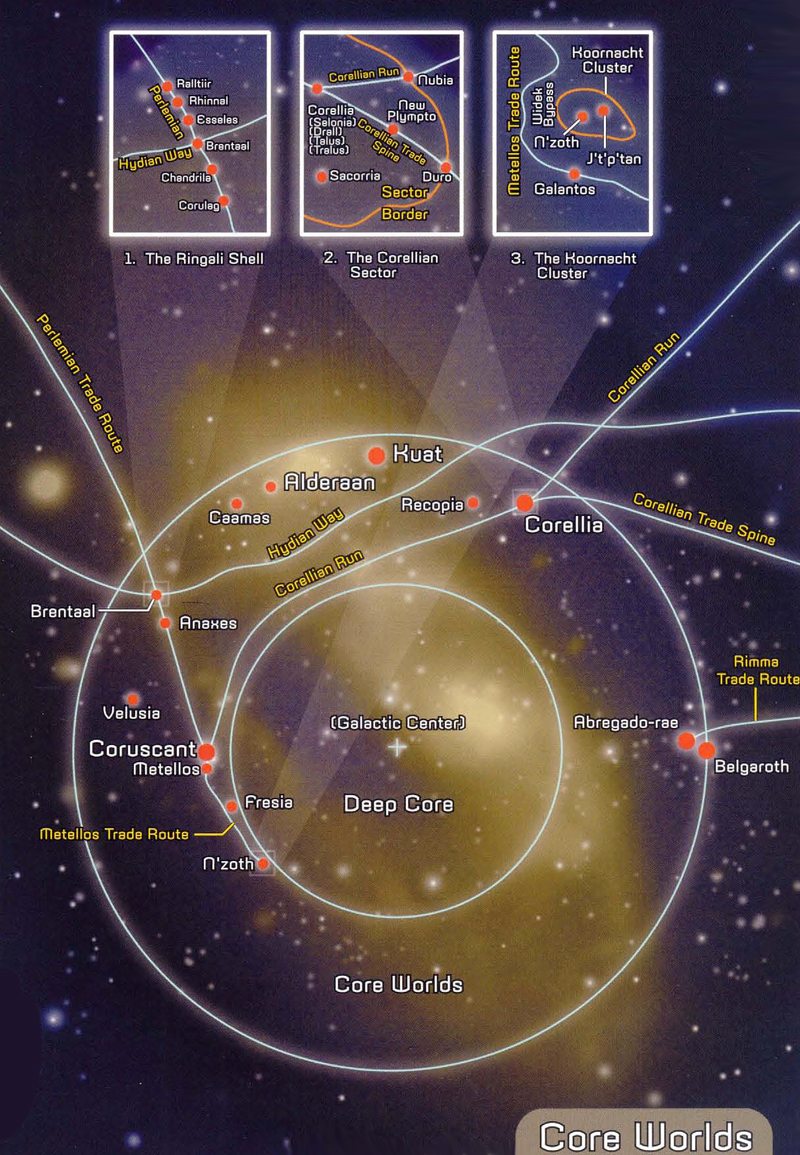
The Core Worlds, also called the Galactic Core, and during the Imperial Era known as the Imperial Core, encompassed some of the most esteemed, advanced, famous, and densely inhabited planets in the galaxy, with minimal political constraints. This region stood as the epicenter of galactic culture, encompassing finance, technology, education, and the fine arts. Powerful noble families exerted considerable influence, and nearly every interstellar corporation maintained offices or headquarters within the Core Worlds. While the term "Core" broadly aligned with the galaxy's central area in astrophysical terms, its precise application often involved greater complexity.
The major Rimward hyperlanes extended outward across slightly more than half of the galactic disk. The Core Worlds formed a C-shaped region around the Deep Core, the astrophysical core's heart (typically considered a separate, outlying area), stretching outward toward the Unknown Regions.
History
Pre-Republic era
Before the Galactic Republic's establishment in 25,053 BBY, the history and cultures of the Core Worlds remained largely obscure for much of galactic history. Many prominent galactic circles believed that Humans originated from one of the Core Worlds. Although lacking substantial archaeological support, Coruscant was widely speculated to be humanity's birthplace. Around 1,000,000 BBY, the Celestials engineered the Corellian system by utilizing the massive Centerpoint Station to pull the five planets—Corellia, Selonia, Drall, Talus, and Tralus—through hyperspace to orbit the star Corell. Subsequently, Selonians, Dralls, and humans from Coruscant settled these planets, resulting in the system's diverse population. The Celestials employed similar techniques to construct the Vultar system.
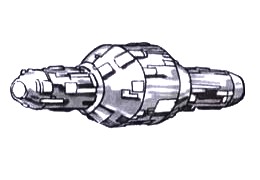
In the distant past, war erupted on Coruscant between the near-Human Taungs and the 13 Human nations of the Battalions of Zhell. The Zhell were devastated by a volcanic eruption that darkened the skies for two years, leading the Taungs to adopt the name Dha Werda Verda (Warriors of Shadow). The Human Zhell eventually rebounded and drove the Taungs offworld. Circa 100,000 BBY, the Columi surveyed Coruscant and the Duros homeworld of Duro, dismissing the native civilizations as primitive failures. During this era, Coruscant's surface gradually transformed into the planet-spanning ecumenopolis of Galactic City, with new structures built atop the old, leaving virtually no exposed land. The city's forgotten underlevels were plagued by darkness, pollution, and crime, while the elite occupied government offices and penthouses above.
In 35,000 BBY, the insectoid Killiks of Alderaan constructed the Castle Lands of Oroboro. The Killiks colonized nearby Alsakan at some point. After depleting Alderaan's natural resources, the Celestials removed them from Alderaan in 30,000 BBY. The galaxy long believed them extinct until they were rediscovered in the Unknown Regions in 35 ABY.
From 35,000 BBY to 25,200 BBY, the Infinite Empire of the Rakata subjugated and enslaved numerous worlds within the Core region, including Duro and the Corellian systems. Slaves from these worlds constructed the Star Forge in 30,000 BBY. Under Rakatan rule, Coruscant's Humans were limited to colonization attempts via sleeper ships, which ultimately reached Alderaan, the Tion Cluster, Seoul 5, Kuat, Alsakan, Axum, Anaxes, Atrisia, Metellos, Corulag, Csilla, and numerous other worlds. A devastating plague eventually decimated the Rakata, leading to slave revolts on their subject worlds in the Core.
Over the next couple of centuries, hyperspace cannons, operated by the Herglic Trade Empire, linked Coruscant to other Core Worlds, including Corellia, Alderaan, New Plympto, and Duro. During this period, the Coruscant government peacefully annexed the nearby Azure Imperium. The languages of Coruscant and its neighbors merged to form Old Galactic Standard in these pre-Republic years. Before the invention of the hyperdrive, galactic civilization was confined to the Core Worlds. The Core Worlds, densely populated and heavily industrialized, gradually evolved into a socio-economic powerhouse vital for galactic dominance over the millennia.
Rise of the Republic
The Galactic Republic was established in 25,053 BBY with the signing of the Galactic Constitution following the Unification Wars. Key Core Worlds, collectively known as the Core Founders, including Coruscant, Alderaan, Duro, Kuat, and Humbarine, founded it. Duro entered a golden age under Queen Rana Mas Trehalt's leadership as an early Republic founder. Later, the monarchy was replaced by a collection of ruling corporations managed by the Duros High House, led by a Chief Representative Officer. During that time, Human and Duros scientists reverse-engineered the Rakatan hyperdrive, inventing the modern hyperdrive. This spurred extensive colonization in a small Core region known as the Tetrahedron.
The Tetrahedron was based on a Duros hyperspatial physicist's theories that Coruscant, Alderaan, Corellia, and the Ginn Jump were the four corners of a specific space region. Coruscant's strategic location and extensive infrastructure led to its designation as the Republic's capital, bearing the coordinates 0-0-0 on hyperspace maps. The discovery of the Perlemian Trade Route connected Coruscant to the Outer Rim world of Ossus, which became the Jedi Order's domain and a fortress world blocking Tionese and Hutt expansion into the Core. Over the subsequent millennia, the Corellian Run was mapped, linking Coruscant to Corellia and beyond. The wedge defined by these trade routes became known as "the Slice." The Arrowhead referred to the Core Worlds' portion of the Slice, and the Republic soon expanded into the Colonies. Several Core Worlds, including Anaxes, Basilisk, and Ixtlar, thrived due to this territorial expansion.
In 24,000 BBY, war erupted between the Republic and the Union, spreading across both sides of the Perlemian. The Republic secured victory by turning the Hutts against the Tionese, ending the Union's existence as an independent state and paving the way for the Core-based Republic's galactic dominance. By 23,900 BBY, all former Honorable Union worlds had joined the Republic, except for Desevro, which remained proudly isolationist. Despite promoting hyperspace exploration, the government on Coruscant initially favored slow expansion. However, against the government's wishes, the Republic's membership surged during its first millennium, primarily due to worlds seeking protection from Hutt Space.
During the Great Manifest Period (20,000 BBY–17,000 BBY), the Republic expanded eastward across the galaxy into the Inner Rim and Expansion Region. The Slice, however, remained the heart of navigable space. Eventually, the Republic expanded beyond the Slice's galactic-northern and -southern borders, though most of the galaxy remained unexplored, save for outposts like Ord Mantell (12,000 BBY) and Malastare (8000 BBY). The space west of Coruscant remained unexplored due to the lack of analogues to the Perlemian Trade Route and the Corellian Run in that direction. Furthermore, progress was hampered by hazardous one- or two-light-year jumps into a region of hyperspatial anomalies. Consequently, the Republic government expanded eastward instead.
During this era, several key Core Worlds, including Coruscant and Alsakan, established holdings in the Expansion Region. However, this region suffered greatly due to Alsakan's attempts to seize control of the Republic from Coruscant, resulting in seventeen Alsakan Conflicts spanning from 17,000 BBY to 3017 BBY. Most of the fighting, however, occurred between their holdings in the Expansion Region rather than in the Core itself. Coruscant emerged victorious in every conflict. In 15,500 BBY, following a disastrous first contact, Star Dragons assaulted Coruscant in the Duinuogwuin Contention. Supreme Chancellor Fillorean and the Star Dragon philosopher Borz'Mat'oh peacefully resolved the conflict, jointly founding the University of Coruscant.
In 12,000 BBY, the humanocentric theocratic Pius Dea sect, which installed one of their own, Contispex I, as the Supreme Chancellor of the Republic, gained influence over the Core Worlds. Over the following centuries, his descendants sanctioned several crusades against rival alien sects in the Outer Rim, leading to a perpetual state of alternating hot and cold wars. During this period, military outposts known as Ordnance/Regional Depots were established, ostensibly to protect Human settlers from hostile alien threats. The anti-alien nature of the crusades deepened interspecies tensions, forcing an exodus into Hutt Space and transforming the Rimward Slice into a militarized zone dominated by war profiteers. Although Pius Dea rule ended in 11,000 BBY, the repercussions of these crusades soured relations between the Core and the Outer Rim for millennia.
The Sith Wars
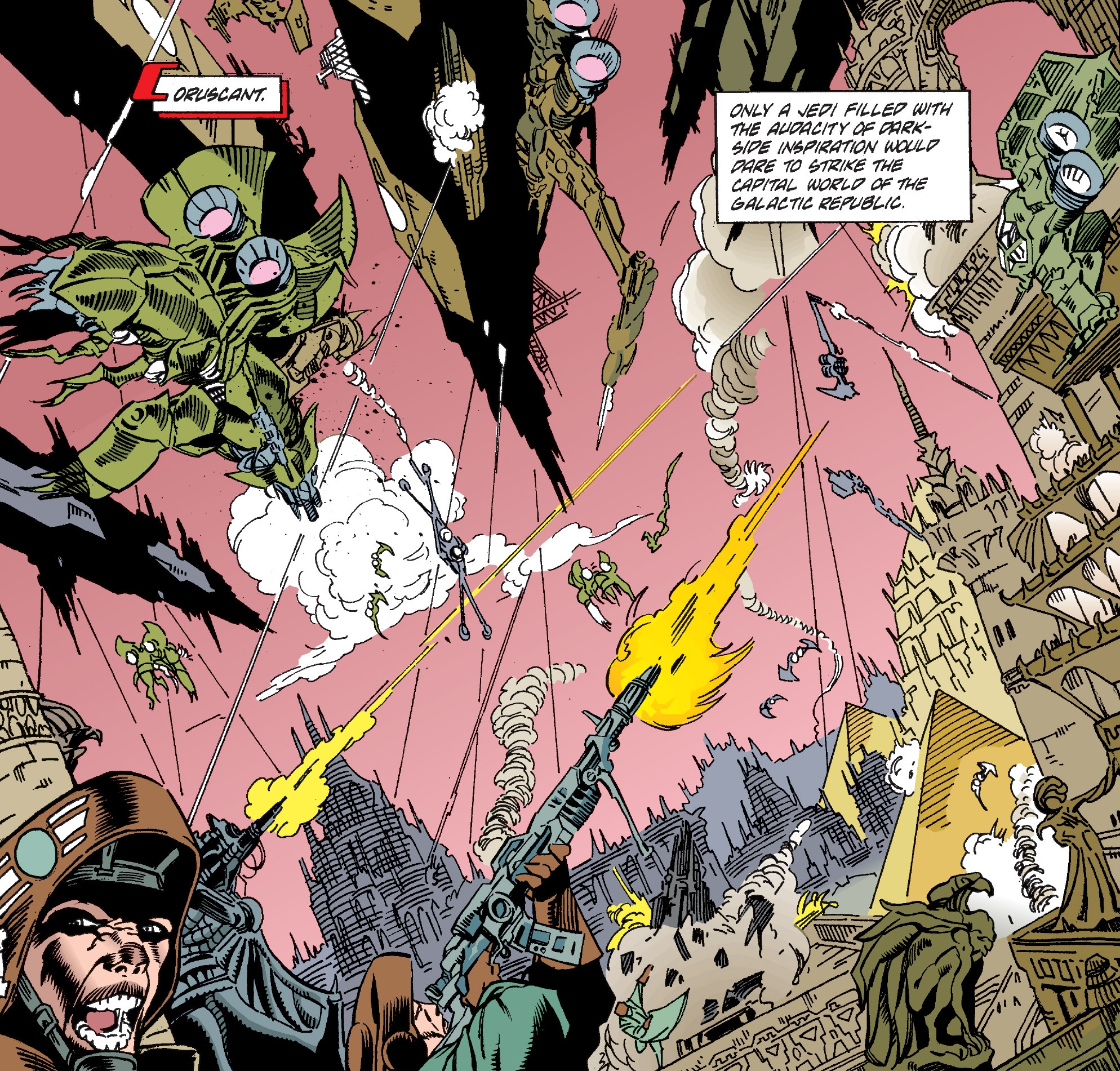
During the Great Hyperspace War in 5000 BBY, the Sith Empire invaded Coruscant, quickly overwhelming the Senate District. The destruction of Sith Lord Naga Sadow's Sith Meditation Sphere above Primus Goluud led to Republic reinforcements from Anaxes driving back the Sith forces. Republic forces then invaded and devastated Sith Space, ending the Sith Empire. In 4250 BBY, the Third Great Schism occurred on Coruscant, with the surviving Dark Jedi fleeing to the Vultar system. The Dark Jedi discovered the system's artificial construction by the Celestials and attempted to use the ancient machinery, including the Cosmic Turbine, but ultimately destroyed themselves and the system during the Vultar Cataclysm.
By 4225 BBY, Kaikielius had become impoverished and a crime hub dominated by the Neimoidians and Hutts. A joint Jedi and Republic task force ousted the Hutts and other criminal elements, and the planet was rebuilt with Republic aid. In 4015 BBY, the Great Droid Revolution on Coruscant was defeated but sparked increased anti-droid sentiment among the galactic populace. During the Great Sith War, the Krath and their Mandalorian allies attacked several Core Worlds, including Basilisk, Foerost, Kaikielius, and Coruscant. Following the devastation of Ossus in 3996 BBY, the Jedi Council established its residence in the Jedi Temple on Coruscant, where many Jedi relics from Ossus were taken. The Temple underwent significant expansion and reconstruction over the preceding millennia.
The Mandalorian Wars, the Jedi Civil War, and the Sith Civil War largely spared the Core Worlds from devastation, as most of the fighting occurred in the outer galaxy. In 3962 BBY, the Mandalorians devastated much of Duro. During the Great Galactic War, the resurgent Sith Empire and their Mandalorian allies blockaded the Hydian Way, depriving the Core Worlds of essential supplies and raw materials from the Colonies and Outer Rim. This triggered riots on Coruscant, and some senators considered complete surrender to the Sith. However, the intervention of the Mirialan smuggler Hylo Visz, who successfully broke the Mandalorian blockade, alleviated the Republic's situation. The Sith then proposed peace negotiations with the Republic on Alderaan in 3653 BBY. Catching the Republic and Jedi off guard, a Sith fleet invaded and rampaged the galactic capital, causing extensive damage to the Galactic Senate and Jedi Temple. The Republic was compelled to sign the unfavorable Treaty of Coruscant, ceding territories to the Sith, setting the stage for the Cold War, characterized by border skirmishes and proxy wars.
In 3017 BBY, Coruscant won the Seventeenth Alsakan Conflict, ending a long series of conflicts with its rival, Alsakan. This solidified Coruscant's dominance as the galaxy's political and economic center, granting it a monopoly on sponsoring colonization and settlement of outlying systems. In 3000 BBY, Corellian Engineering Corporation acquired Corellia StarDrive following the death of its design team.
By 1100 BBY, the Republic had entered a "Dark Age" following centuries of protracted warfare with various Sith factions, including the New Sith Empire. Excessive corruption, corporate bankruptcies, rampant lawlessness, and the depletion of mineral reserves characterized this period. The Republic could no longer afford to maintain the HoloNet beyond the Core Worlds, necessitating the use of couriers for communications between worlds outside the Core. A galaxywide epidemic of Candorian plague further exacerbated the situation, killing up to two-thirds of the population on some worlds. The Jedi gained greater influence in the Republic government, assuming control of the office of Supreme Chancellor. Although infighting seemed to have fractured Sith unity, the situation weakened the Republic Navy and Army, which also fell under increasing Jedi control. During the Light and Darkness War (1010 BBY–1000 BBY), Lord Kaan's reorganized Brotherhood of Darkness penetrated deep into the Core, capturing Corulag, Chandrila, and Brentaal IV, but failed to seize the galactic capital, Coruscant.
Fall of the Republic
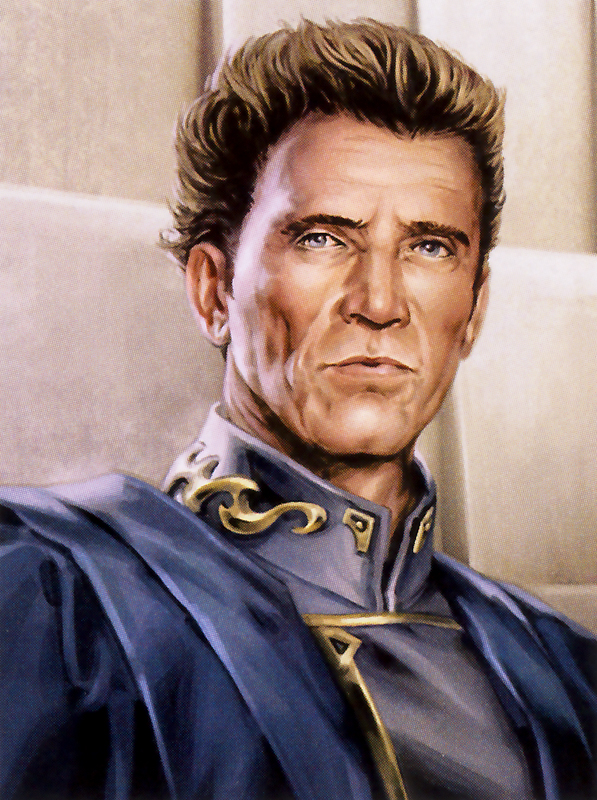
Following the Seventh Battle of Ruusan, Tarsus Valorum—the first non-Jedi Supreme Chancellor in centuries—implemented the Ruusan Reformation, which reduced the Chancellor's power, increased the Galactic Senate's authority, and abolished the Republic's military. The Ruusan Reformation also sought to curb corruption and decentralize power from a few influential Coreward sectors that dominated representation by reorganizing the existing millions of sectors into only 1,024 sectors. Each new sector received its own Senator, although politically powerful core worlds retained their individual representation through exemptions. Other slots were granted for species types and cultural entities. However, increasing the Senate's power led to gridlock and reduced representation for many worlds and systems.
The subsequent era saw a lack of large-scale conflict in the region, which largely recovered and prospered. Nevertheless, small, short-lived conflicts and threats persisted. Around 500 BBY, Corellia, allied with Selonia and Drall, unsuccessfully attempted to conquer the Federation of the Double Worlds. In 470 BBY, Corellia tried to secede from the Republic, progressing far enough to close its sector's borders and withdraw from the Senate using Contemplanys Hermi, but the plan ultimately failed, and the system remained a reluctant Republic member-state. In 380 BBY, the Corellian Jedi Keiran Halcyon defeated the Afarathu pirates, a Selonian terrorist sect that sought to kill all Humans on Corellia. The Afarathu would return to plague Corellia during the Galactic Civil War. In 312 BBY, the Corellian King Berethron e Solo established a parliamentary constitutional monarchy, replacing his own absolute monarchy. In 150 BBY, Corellia's powerful conglomerates, including Gowix Computers, the Corellia Mining Corporation, and the Corellian Engineering Cooperation, overthrew the Royal House of Solo and installed a pro-business government known as the Diktat.
At some point in time, certain individuals among the Human population of the Core Worlds reached a conclusion: the sprawling cities of their region, the pressures of urban life, and the difficulties of peaceful coexistence were not suitable for them. Consequently, they made the decision to establish a settlement on Leritor, an insignificant planet situated in the Mid Rim near the Corellian Run. In the year 33 BBY, a terrorist group known as The Flail, alleging corruption within the Galactic Senate, disrupted essential public services on Coruscant. These disruptions included commerce, communications, traffic management, and weather control, resulting in property damage and loss of life. Agents working for Supreme Chancellor Finis Valorum, a descendant of Tarsus Valorum, successfully put an end to their activities.
Following the events of the Naboo crisis in 32 BBY, the secret Sith Lord and Senator of Naboo, Palpatine, ascended to the position of Supreme Chancellor. In 27 BBY, Ashaar Khorda nearly brought about the destruction of Coruscant through the use of the Infant of Shaa. Jango Fett, Zam Wesell, and Yarael Poof intervened to save Coruscant, with Poof ultimately sacrificing his own life. However, the news of this averted catastrophe did not become widespread knowledge. By 23 BBY, the stability of the Core Worlds was jeopardized by the successes of Count Dooku's Confederacy of Independent Systems, and the Senate experienced division between those who supported and opposed the Military Creation Act. While the majority of the Core Worlds maintained unwavering loyalty to the Republic, the Separatists garnered support from various remote worlds and sectors within the Expansion Region, the Mid Rim, and the Outer Rim. The secession of Republic worlds, such as Ando and Sy Myrth, led to a significant exodus of Aqualish and Sy Myrthians from Coruscant. In response to escalating tensions, the Corellian sector, under the leadership of Senator Garm Bel Iblis, declared its neutrality and temporarily withdrew from the Republic, once again invoking Contemplanys Hermi.
Throughout the duration of the Clone Wars, Coruscant and other Core Worlds were frequently targeted by Separatist terrorist actions, assassinations, and military operations. During the Dark Reaper crisis in 22 BBY, Separatist forces commanded by Sev'rance Tann destroyed the geothermal generators on the planet Sarapin, thereby disrupting the power supply for the entire region. Separatist uprisings on Brentaal IV and Esseles were swiftly put down by Republic and Jedi forces. Coruscant itself was subjected to a raid, and several prominent Republic officials, including former Chancellor Finis Valorum and Senator Viento, were assassinated by Separatist agents. In that same year, the Fourth Constitutional Amendment granted Republic worlds located in the Core, Colonies, and Inner Rim greater voting power compared to worlds situated in the Expansion Region and beyond.
During the Foerost campaign in 20 BBY, the Bulwark Fleet under the command of Separatist commander Dua Ningo breached the Republic blockade at Foerost and inflicted severe damage on several critical Republic outposts throughout the strategically significant Sector Zero. In response, the Republic launched the Victory Fleet, led by Captains Jan Dodonna and Terrinald Screed, which consisted of the newly developed Victory I-class Star Destroyers. These two fleets engaged in battles at Ixtlar, Alsakan, and Basilisk, culminating in the defeat of Ningo's forces at Anaxes. As a result of his accomplishments, Screed was placed in command of the Coruscant Home Fleet. However, the forces of General Grievous successfully captured the Core Worlds of Kaikielius and Duro during Operation Durge's Lance. Grievous' forces also carried out an orbital bombardment and depopulation of Humbarine and unleashed the Loedorvian Brain Plague, which led to the extermination of all humans within the Weemell sector.
In 19 BBY, Republic forces under the command of Jedi Masters Saesee Tiin and Plo Koon recaptured the strategically important world of Rendili, enabling Coruscant to seize control of the Rendili Home Defense Fleet. This, along with a series of victories at Duro, Commenor, and Balmorra in the Colonies, shifted the momentum of the war in favor of the Republic, compelling the Separatist fleet to retreat to the Mid and Outer Rim Territories. The Republic's capital became increasingly fortified, and the humanocentric COMPOR managed to pressure the Coruscant government into deporting all members of species whose homeworlds had joined the Confederacy.
Despite the numerous precautions taken, the Confederacy managed to launch a surprise raid on Coruscant. By circumventing the heavily fortified Corellian sector through the use of secret hyperspace routes in the Deep Core provided by Darth Sidious, a Separatist fleet under the command of General Grievous launched an attack on Coruscant. While the Republic and Jedi defenders were preoccupied, Grievous and his elite IG-100 MagnaGuards captured Palpatine. However, Anakin Skywalker and Obi-Wan Kenobi successfully rescued the Supreme Chancellor from the notorious Separatist flagship, the Invisible Hand. Eventually, the battle turned in the Republic's favor, and the Separatist armada was forced to retreat completely.
Imperial Period
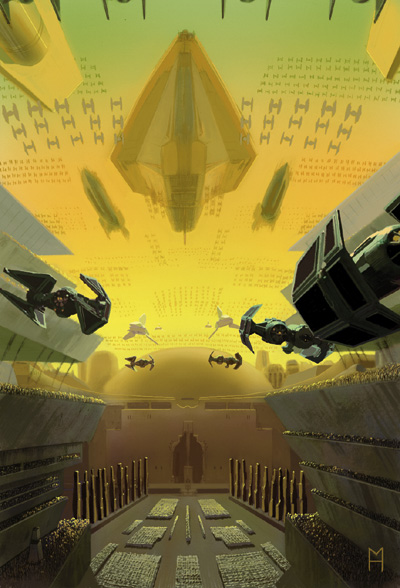
At the conclusion of the Clone Wars in 19 BBY, the Republic underwent a transformation into the Galactic Empire. Due to its advantageous location and robust economic foundation, the Core became a vital stronghold for the Empire. Following Emperor Palpatine's Declaration of a New Order, Coruscant was renamed the Imperial Center. The majority of key Human-dominated Core Worlds, including Coruscant, Kuat, and Anaxes, which had steadfastly supported the Republic's war efforts during the Clone Wars, transferred their allegiance to the Empire. During the Imperial era, the Republic's informal policy of humanocentrism was formalized into law through the Empire's promotion of Human High Culture. Non-human species residing on Coruscant were compelled to live in segregated ethnic neighborhoods, while various alien homeworlds within the Core, such as New Plympto, Orooturoo, and Caamas, were subjected to Imperial atrocities. Following a prolonged resistance on pro-Separatist New Plympto led by Purge survivor Dass Jennir, the Nosaurians were brutally suppressed and enslaved, treated as mere animals. In retaliation for Caamasi opposition to Imperial policies, Palpatine ordered the bombardment of Caamas in 19 BBY. Bothan agents sabotaged the planetary shields, while the Imperial fleet leveled the planet's surface, causing widespread destruction of the natural environment and forcing the species to evacuate the planet.
Several prominent Imperial figures, including Supreme Commander Gilad Pellaeon, Imperial Intelligence Director Ysanne Isard, Governor Wilek Nereus, and Commander Nahdonnis Praji, originated from various Core Worlds. However, the region also served as a base for several notable opponents of the Galactic Empire. The founders of the Alliance to Restore the Republic, Senators Mon Mothma and Bail Organa, were from Chandrila and Alderaan, respectively, as was the former Corellian senator Garm Bel Iblis. Other prominent Alliance figures from the Core Worlds included future New Republic Chief of State Leia Organa, the Corellians Han Solo, Crix Madine, Wedge Antilles, and former Republic Navy Captain Jan Dodonna.
During the Galactic Civil War, pro-Imperial factions initiated the infiltration of Ralltiir's financial system, manipulating its markets to favor the Empire. This included the erasure of fiscal records belonging to alien investors. Shortly before the Battle of Yavin, Rebel sympathizers within the Ralltiiri High Council attempted to halt this activity and restore equilibrium to the markets. In response, an Imperial force under the command of Lord Tion invaded the planet. Subsequently, Imperial forces disbanded the High Council, placed the planet under military occupation, and interned its population in camps. Tion also sealed off the entire Ralltiir system (prohibiting even relief organizations from traversing his blockade), which severely disrupted commerce along the Perlemian.
In 0 BBY, Leia Organa embarked on a humanitarian mission to deliver medical supplies and equipment to the Raltiiri High Council. She received permission to land from Tion himself. While there, Leia rescued a wounded Rebel soldier who later revealed the existence of the first Death Star. Shortly thereafter, the Death Star, under the command of Darth Vader and Grand Moff Tarkin, obliterated the prominent Core world of Alderaan, resulting in billions of deaths and prompting widespread outrage that drove many sentients to support the Rebel Alliance. Shortly after this event, the Death Star was destroyed at the Battle of Yavin. In 1 ABY, Coronet City, the capital of Corellia, became the site of a heated skirmish between Imperial forces and elements of the Alliance, including the elite Rogue Squadron, who successfully rescued the former Storm Commando Madine from Imperial custody.
In 3 ABY, a Rebel team led by Leia infiltrated Coruscant in an attempt to enlist the assistance of the Falleen Black Sun leader, Prince Xizor, in uncovering the assassins targeting Alliance leader Luke Skywalker. However, this turned out to be a trap, and Skywalker devised a plan to rescue the Alliance delegates. During the ensuing conflict, Xizor's palace was destroyed, and the Prince himself met his end at the hands of Vader, whose flagship, the Executor, obliterated Xizor's skyhook. Capitalizing on the chaos, the treacherous Grand Admiral Demetrius Zaarin attempted a coup against the two Sith Lords but was eliminated by loyalist Imperial forces.
New Republic era
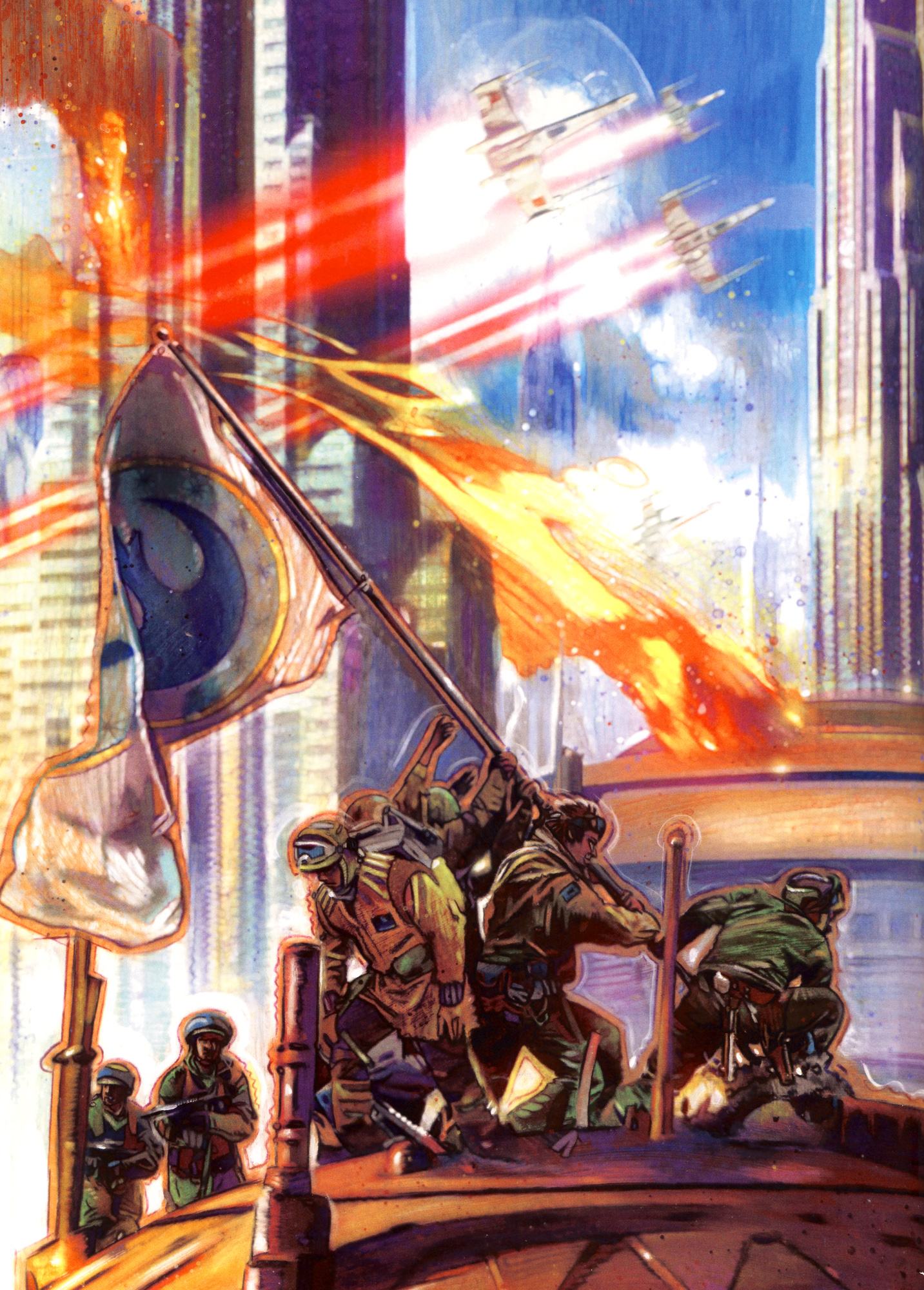
During the concluding phases of the Galactic Civil War, control of the Core Worlds shifted multiple times between the New Republic and the Empire. Following the deaths of the Emperor and Darth Vader during the Battle of Endor in 4 ABY, the region was divided among various Imperial warlords. Coruscant was the location of a short-lived anti-Imperial uprising, which was suppressed by Imperial forces under the command of Grand Vizier Sate Pestage and Isard. While Pestage assumed control of the galactic capital, his authority was challenged by the Imperial Ruling Council, which was secretly manipulated by Isard. In 5 ABY, the Alliance's successor state, the New Republic, captured Ralltiir, Esseles, and Brentaal IV, the latter being an influential Core World near Chandrila. Isard manipulated Pestage into losing the strategically important Brentaal to the New Republic as a means of undermining Pestage's position of power.
When Pestage's clandestine negotiations with the New Republic to cede Coruscant in exchange for an independent fiefdom in the Outer Rim became public knowledge, the Ruling Council seized the opportunity to take control of Coruscant. Pestage was incarcerated by local Imperial authorities on Ciutric IV, prompting the New Republic to launch a rescue operation to encourage further defections. This attempt was unsuccessful, and Pestage was murdered by the warlord Admiral Delak Krennel, who subsequently assumed control of Pestage's fiefdom. Meanwhile, Isard liquidated the entire Ruling Council and took control of Coruscant, transforming the capital into a fortress world against the advancing New Republic by reinforcing it with Imperial troops.
In 6 ABY, Coruscant fell to Republic forces without intense fighting after Alliance agents sabotaged the planet's shield generators. However, Isard had vanished, having infected the capital's alien populations with the deadly Krytos virus as a means of exacerbating tensions between humans and aliens. While the Republic managed to treat the virus with shipments of bacta from Thyferra following the Bacta War, interspecies tensions remained prevalent. Later, Isard escaped Coruscant on the Executor-class Star Dreadnought Lusankya, which also served as a private prison buried beneath layers of urban sprawl. This event triggered earthquakes that resulted in millions of fatalities.
In 9 ABY, Grand Admiral Thrawn's forces seeded the space surrounding Coruscant with cloaked asteroids, effectively blockading the New Republic capital by disrupting space traffic and preventing the planetary defense forces from lowering the world's shield generators. With Thrawn's death, the blockade was lifted. Following the defeat of the Imperial warlord Krennel's forces, the New Republic deployed the majority of its Core-based naval units into the Outer Rim, leaving the strategically important region undefended.
In 10 ABY, after Grand Admiral Thrawn was assassinated during the Battle of Bilbringi, the Imperial Ruling Council under Ars Dangor's leadership gathered Imperial warlords to organize a brutal blitzkrieg that recaptured several key systems in the Core Worlds within days. Ralltiir, Chandrila, Duro, Kaikielius, Esseles, and Metellos were swiftly seized by Imperial forces. Admiral Sander Delvardus initiated an orbital bombardment during the Battle of Metellos, resulting in the deaths of five billion inhabitants of the planet. A substantial Imperial armada bombarded Coruscant, compelling Chief of State Mon Mothma to evacuate the capital's population and relocate the New Republic to the Outer Rim. The Empire invaded the galactic capital, and the Ruling Council summoned the political leaders and military commanders of the Empire to reinstate Imperial government. However, the Empire descended into a civil war that devastated Coruscant and caused widespread destruction throughout the Empire. After months of infighting between rival Imperial fleets and armies, Emperor Palpatine returned to conquer the galaxy. Following his initial death during the Battle of Endor, Palpatine was resurrected in a clone body at his secret throneworld of Byss in the remote Deep Core. Having regained control of the Core Worlds, Palpatine was able to launch Operation Shadow Hand, which targeted various "rebellious worlds" such as Dac, Balmorra, and Da Soocha V.
With his final death in 11 ABY, the New Republic reclaimed the majority of the Core, while the Empire was pushed back to the Deep Core and regions in the Outer Rim, which collectively became known as the Imperial Remnant. The term "Imperial Core," or sometimes simply "the Core," was used by supporters on both sides to refer to areas of remaining Imperial control around the Galactic Center. This usage persisted even after Coruscant and most of the historical Core Worlds had joined the New Republic, and the Imperial holdouts in the area were primarily confined to the Deep Core and the fringes of the Unknown Regions.
Until 25 ABY, the Core Worlds remained largely stable and prosperous, with the exception of brief minor disturbances such as the Corellian Crisis and the Second Imperium Crisis. During the Black Fleet Crisis (16–17 ABY), the New Republic Fifth Battle Group was deployed against the xenophobic Yevethan Duskhan League, which perpetrated genocide in the Koornacht Cluster. In 17 ABY, the Senate Hall on Coruscant was bombed during the Almanian Uprising, resulting in numerous senators being killed or wounded. Core-based Republic forces were also deployed against the Deep Core warlords.
During the Corellian Crisis in 18 ABY, the Sacorrian Triad attempted to secede the Corellian sector by supporting various separatist factions in the Corellian system and then kidnapping a Republic delegation led by Chief of State Leia. However, one of these groups—the extremist Human League led by Thrackan Sal-Solo—turned on their Triad bosses by using Centerpoint Station to generate an interdiction field that blocked all travel to and from the system. The Sacorrian Triad used Centerpoint to destroy three planetary systems in the Core, including Bovo Yagen.
Tensions between the Human League and its Sacorrian backers reached a boiling point when Thrackan attempted to secede the sector with himself as leader. Deactivating the interdiction field, the Sacorrians deployed a war fleet, which was defeated by Bakuran and New Republic forces during the Battle of Centerpoint Station. Following this defeat, the New Republic reasserted control over the Corellian sector and apprehended the rebels. To ease tensions between the region and the Coruscant government, the Drall Marcha was appointed the sector's new Governor-General. Nevertheless, many Corellians continued to desire independence and resented the New Republic's intervention. Despite the normalization of foreign relations and trade with the Imperial Remnant in 19 ABY, the Republic still faced resistance from splinter factions such as the Second Imperium, which raided Coruscant for supplies and recruits in 23 ABY.
Yuuzhan Vong War
During the Yuuzhan Vong War, spanning from 25 to 29 ABY, the Yuuzhan Vong invaders from beyond the galaxy considered the Core Worlds a key objective in their campaign for galactic control. Initially, the Core Worlds displayed a lack of concern and were hesitant to allocate resources to assist the Outer Rim planets, as the Yuuzhan Vong's initial attacks were primarily directed towards those outer regions. However, the situation shifted in 26 ABY when the Yuuzhan Vong extended their incursions into areas such as the Mid Rim, Expansion Region, Hutt Space, the Inner Rim, and even launched a failed assault on Fondor located in the nearby Colonies. Billions of displaced individuals were then relocated to Duro, under the supervision of the Senate Select Committee for Refugees, with the belief that Duro was safe from further enemy attacks. However, Tsavong Lah, the newly appointed Warmaster, altered the battle strategy, leading to a massive Yuuzhan Vong fleet attacking Duro, resulting in the destruction of its orbital cities and the deaths of countless refugees. Seeking to incite anti-Jedi sentiment, the Yuuzhan Vong proposed a cessation of hostilities in exchange for the surrender of all Jedi to them. Several influential politicians from the Core Worlds, including Senator Viqi Shesh and Corellian Governor-General Thrackan Sal-Solo, secretly collaborated with the invaders. Following their victory at Duro, Yuuzhan Vong forces captured New Plympto and Talfaglio within the Corellian sector in 27 ABY, followed by the seizure of Ralltiir, Kuat, and Kaikielius.
On New Plympto, a resistance army led by the Twi'lek Jedi sisters Alema and Numa Rar stood in opposition. In response, the Yuuzhan Vong occupiers unleashed a virus that decimated the planet's population. Reacting to the New Republic's resistance, the Yuuzhan Vong attempted to execute refugees on Talfaglio, but their plans were foiled by a Jedi raid. Subsequently, the invaders launched a large-scale attack on the galactic capital, Coruscant, utilizing a massive fleet. During the subsequent battle, both sides suffered extensive losses, and the Chief of State, Borsk Fey'lya, was killed.
The Yuuzhan Vong then initiated the terraforming of Coruscant, transforming it to resemble their original homeworld, Yuuzhan'tar. They introduced unique species from their home galaxy, significantly altered the planet's landmarks, and even modified its climate by employing dovin basals to shift it closer to Coruscant Prime. Much of the former urban landscape was overtaken by vegetation, and one of its moons was destroyed to create a vast asteroid field known as the Rainbow Bridge. Consequently, Coruscant became the central hub of the new Yuuzhan Vong empire. Similar projects were undertaken on Duro, transforming it into a thriving forested world, reversing the effects of centuries of pollution and neglect.
In 29 ABY, the New Republic's successor, the Galactic Federation of Free Alliances, reclaimed Coruscant after a major battle that resulted in the death of the Yuuzhan Vong Supreme Overlord Shimrra Jamaane and a rebellion among the oppressed Worker caste and Shamed Ones, inspired by the emerging Jeedai heresy. The Yuuzhan Vong were then relocated to Zonama Sekot, a sentient world that was a seed of the original Yuuzhan'tar. With Coruscant's recapture and the reversal of the terraforming processes, it regained its position as the galactic capital in 30 ABY.
Legacy era
Following reconstruction, Coruscant was once again the galactic capital, while the Core Worlds gradually regained their economic and cultural strength. On Duro, the Yuuzhan Vong's terraforming efforts successfully created a lush and habitable environment. During the Second Galactic Civil War, progress toward peace and recovery was hindered by conflict between the Alliance and the secessionist Confederation, led by the Corellian system and the Bothans. In 40 ABY, Chief of State Cal Omas was overthrown by Jacen Solo, a former Jedi who became a Sith Lord, and Cha Niathal, further dividing the Alliance into factions loyal to Jacen and the opposing Jedi Coalition. With the end of fighting in 41 ABY, former Imperial admiral Natasi Daala became the new Chief of State, although the Core Worlds remained split between the Alliance and the Confederation.
Before the Sith–Imperial War, the Galactic Alliance and the Fel Empire signed a treaty on Anaxes, committing to mutual defense against aggressive powers. After the sabotage of the Ossus Project, the Fel Empire exploited widespread anti-Vong sentiment to declare war on the Galactic Alliance. Within three years, much of the Core, including Coruscant, fell under the control of the Fel Empire led by Roan Fel, who was later overthrown by Darth Krayt's Sith Empire in 130 ABY. Duro, now a thriving world, became an Imperial stronghold and the location of the Imperial Naval Academy, where talented Duros trained Imperial pilots and capital ship crew members.
As of 137 ABY, resistance to the Sith-led Empire in the Core Worlds persisted through the Alliance's Core Forces under Admiral Gar Stazi during the Second Imperial Civil War. While much of the conflict took place in the Outer Rim Territories, the Temple of the Sith on Coruscant was raided by Cade Skywalker, a former Jedi. Subsequently, a combined Galactic Alliance and Fel Empire fleet attacked Ralltiir and decimated the Coruscant Third Fleet, forcing the Sith Empire to allocate more resources to defend the strategically vital Core world.
Astrography
Sectors
The Core Worlds were divided into several sectors, including: