The galaxy
The galaxy, one of billions in the universe, consisted of roughly four hundred billion stars within a disk spanning 120,000 light-years. Seven smaller satellite galaxies orbited it, with five directly accessible during the Galactic Empire's reign. Between five and twenty million sentient species called the galaxy home, with over one hundred quadrillion sentient beings inhabiting one billion star systems. These beings interacted through various means, including travel, diplomacy, trade, politics, and war. Historically, the Galactic Republic, the Galactic Empire, the New Republic, the Galactic Federation of Free Alliances, the Fel Empire, Darth Krayt's Galactic Empire, and the Force-using orders of the Jedi and the Sith had all played a role in shaping this galaxy's history.
Astrography
Structure
Spanning between 100,000 and 120,000 light-years in diameter, equivalent to 37,000 parsecs (with one parsec equaling 3.258 light-years), the galaxy was approximately 13 billion years in age. The galaxy's bright disk contained about four hundred billion stars, with only a quarter having been properly studied by the galactic community by the time of the Galactic Empire. The luminous disk rotated around the Galactic Center, a supermassive black hole with a mass equivalent to four million suns. Even as late as the Declaration of a New Order, only probe droids had ventured near the black hole at the Galactic Center. The explored portion of the galaxy encompassed nearly a billion inhabited star systems, ranging from hidden smugglers' settlements to planet-wide ecumenopoleis where virtually every square meter was developed. During the Galactic Empire's rule, almost seventy million of these systems possessed sufficient population to warrant some form of representation.
A bright sphere, known as the Deep Core, bulged around the Galactic Center. This region, approximately seven thousand light-years in diameter, contained around thirty billion densely packed stars. Closer to the center, the stars in the Deep Core were separated by only a hundredth of a light-year, leading to frequent collisions and the stripping of stellar cores. Most of the luminous galaxy's stars were located in a disk of spiral arms that revolved around the Deep Core. Galactic civilization had identified four spiral arms: the Bakchou Arm, the Ettarue Arm, the South Arm, and the Tingel Arm. The spiral arms contained the highest concentration of bright supergiant stars, as well as glowing clouds of gas and dust, which created the illusion of gaps between the arms despite the presence of numerous stars in those areas.
The majority of stars resided within a thousand light-years above or below the luminous disk's plane, forming a two thousand-light-year region known as the "thin disk". Extending three thousand five hundred light-years on either side was the "thick disk," which contained fewer stars than the thin disk, and even fewer with planetary systems.
Stellar halo

Beyond the thick disk lay the stellar halo, a vast sphere encompassing the entire galaxy, containing a few billion stars in highly elliptical orbits. Nearly two hundred globular clusters orbited within this region. These globular clusters, typically devoid of life, packed hundreds of thousands of extremely old, inhospitable stars into a space of only a hundred light-years. Nevertheless, many of these globular clusters, such as Cosm's Well, were considered remarkably beautiful sights.
Seven dwarf satellite galaxies orbited the main galaxy, some containing as many as twenty billion stars. They were ranked by their distance. Companion Aurek, also known as the Rishi Maze, was the closest, representing a complex arrangement of stars high above the galactic plane. Companion Besh, also known as Firefist, was approximately 150,000 light-years away and had only been explored by probe droids. The remaining satellite galaxies, from Companions Cresh through Grek, were located much farther out. Most of the Companions were characterized by ancient, metal-poor remnants of stars and limited signs of life.
A circumferential hyperspace barrier significantly complicated hyperspace travel beyond the galactic disk, generally discouraging extra-galactic exploration. This barrier consisted of rapidly spinning whorls and eddies that were impossible to traverse at faster-than-light speeds. Some astrophysicists believed it was created by an ancient, enigmatic race known as the Celestials. Separating the galaxy from others beyond its edge was the Intergalactic Void, a vast expanse of space devoid of stars.
Stars
While a hyperspace disturbance existed outside the galaxy, hyperspace travel within the galaxy enabled a vast and diverse civilization. Of the galaxy's 400 billion stars, approximately 180 billion were orbited by a system of planets. The majority, 90%, of the galaxy's stars were Main Sequence stars. The remaining 10% were protostars or stellar remnants like white dwarfs, neutron stars, and black holes. The larger blue and white stars of the sequence, O-, B-, and A-type stars, such as Garnib, Kessa, and Colu, had short lifespans of only a few million years, rarely allowing sufficient time for intelligent life to evolve in their systems. The most suitable stars for habitable planets were G- and K-type yellow and orange dwarfs, such as Corell and Yavin, which had lifespans of tens of billions of years, providing ample time for life to develop. G- and K-type stars made up 19% of the galaxy's stars, with 75% of those being habitable. However, the most common stars in the galaxy were M-type red dwarfs, comprising 70% of all stars, but only 1% of them, such as Barab, were habitable. Few red dwarfs were settled; most were surveyed by probe droids during the early years of the Galactic Republic and generally abandoned unless they contained valuable resources.
Considering the necessary heat and light output for advanced civilizations to form, there were approximately 7.1 billion truly habitable stars within the galaxy, resulting in about 3.2 billion habitable star systems. It was estimated that roughly one billion of these systems were currently populated or had been settled by sentient beings.
Regions
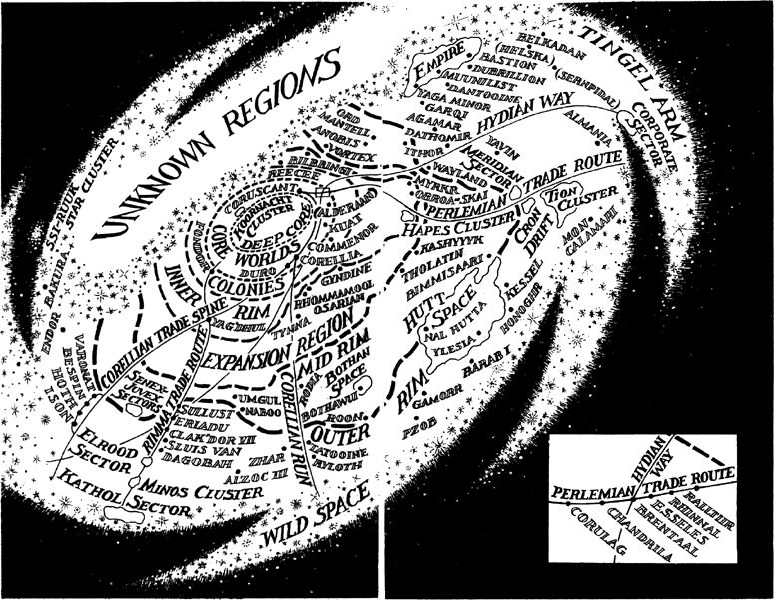
The galaxy was divided into numerous regions, primarily cultural rather than political, generally reflecting stages of exploration and settlement. The nine most well-known regions were the Deep Core, the Core Worlds, the Colonies, the Inner Rim, the Expansion Region, the Mid Rim, the Outer Rim Territories, and beyond the galactic frontier, Wild Space, the Unknown Regions and the Galactic Rim. Common parlance usually categorized the galaxy into "the Core" and "the Rim," with the latter encompassing the Expansion Region and areas beyond.
Deep Core
The Deep Core (also known as the Core Systems) was at the galaxy's center, a region spanning seven thousand light-years and containing approximately 30 billion stars. The immense gravitational forces from the numerous stars, along with a massive black hole at the center, significantly warped local space-time, making hyperspace travel extremely challenging. For millennia, only the Deep Core's fringes nearest the Core Worlds, within a mathematically defined boundary called the Horizon, were settled. These worlds included Khomm, Thoadeye, Vulpter, and Empress Teta, the Deep Core's dominant planet. The region's heart was believed to be almost inaccessible until Emperor Palpatine discovered several safe hyperlanes into the area. The Deep Core remained fiercely loyal to the New Order and served as an Imperial stronghold until almost twenty years after the Battle of Endor.
Core Worlds
Bordering the Deep Core's outer limits, the Core Worlds constituted an ancient region containing some of the galaxy's most prestigious, developed, well-known, and densely populated planets. The Galactic Republic, and subsequently all galaxy-wide governments, originated in the Core Worlds and expanded outwards. During both the Republic and Empire eras, Coruscant, a prominent Core World, served as the Galactic Capital. The Tetrahedron region within the Core Worlds was the birthplace of the early Republic. Simultaneously, scouts discovered the Perlemian Trade Route and the Corellian Run emanating from Coruscant, creating a region known as the Arrowhead encompassing the ancient worlds of Alsakan, Anaxes, Basilisk and Ixtlar. Colonization created a semi-circular ring extending south to Abregado-rae, often considered the pinnacle of the Core Worlds, while subsequent centuries saw the creation of a second ring to the galactic west. These worlds, known disparagingly as "the Negs" due to their negative-digit galactic coordinates, were viewed unfavorably by the rest of the Core. The Core's natural wealth was augmented by the farming worlds of the Agricultural Circuit, the semi-independent colonies of the Illodia sector, the Bormea/Darpa Corridor, the manufacturing planets of the Humbarine sector, and the military shipyards of the Kuat sector.
Colonies
The Colonies, named for being among the first areas colonized outside the Core, contained many of the galaxy's wealthiest worlds and took pride in being the galaxy's economic powerhouse. Worlds in this region were typically heavily populated, industrialized, and cultured, serving as the intersection of Core wealth and Rim raw materials. Forming the tip of the Slice, the Colonies came to include many of the galaxy's oldest manufacturing worlds, including Balmorra, Commenor, and Neimoidia. Subsequent colonization led to the shipyards of Loronar, the urbanized worlds of the Pencael system, and the young worlds of Yabol Opa with its renowned university, the fortress world of Raithal, and the farm worlds of the Delle system.

Inner Rim
The Inner Rim was located between the Colonies and the Expansion Region. Initially called "The Rim," it was expected to be the known galaxy's farthest extent for centuries. However, the Expanded Rim (later renamed the Expansion Region) was opened within a hundred years of the Inner Rim's settlement during the Great Manifest Period. Inner Rimmers generally considered themselves part of the Core and looked down upon the "outer galaxy," while also resenting and envying the Core Worlds' greater wealth and history. The region had minimal cultural influence and few truly notable planets beyond the ecumenopolis of Denon and the medical worlds of Manaan and Thyferra. Serving as a bridge between the Core and the Rim, the Inner Rim possessed significant strategic value, and during both the Clone Wars and the Galactic Civil War, fierce battles were fought for control of the region.
Expansion Region
The Expansion Region originated as an experiment involving corporate-controlled worlds, initially known as the Exploitation Region, where powerful corporations heavily exploited planets for their raw materials, metals, and ores, generating substantial profits. Inhabitants were oppressed as corporations stripped entire stellar systems along the Corellian Run of their resources. The resulting damage was so severe that colonization shifted spinward to the Perlemian Trade Route, creating the distinctive northern "bulge" in the modern Inner Rim's border. Colonization resumed during the Great Manifest Period, but the Alsakan Conflicts devastated many of the Expansion Region's worlds in the Slice, shifting colonization west of the Corellian Run. This created a stretch of space known as the 77 Sectors, which was dominated by Corellians for millennia. This part of the Expansion Region prospered, with the Rimma, Hydia, and Corellian Trade Spine Routes opening up the region and connecting worlds like Tynna, the Gran homeworld of Kinyen, and the trading planets of the Harrin Trade Corridor. Citizens in this area often considered themselves separate from the rest of the less fortunate Expansion Region, which continued to struggle during the Republic's final millennium. A second, disastrous experiment in corporate control, known as the Outer Expansion Zone, ravaged the region, and the resulting scandal forced the Senate to disband the Expansionist Oligarchy. However, the Republic's final centuries saw the Slice sectors of the Region fall into economic ruin. The region's trade routes reflected this decline; while the Core, Colonies, and Inner Rim had dense networks of tangled hyperlanes, the Expansion Region was poorly served, giving the impression that it had never been settled. Expansion Region worlds continued to produce raw materials and ores. However, most natural resources were exhausted by the Imperial Period, with Gyndine, Bacrana, and Cyrillia among the few remaining viable ports.
Mid Rim
Lacking the abundant natural resources (and therefore a smaller population) found in many neighboring regions, the Mid Rim was a territory where residents worked diligently for everything they possessed. Colonization began concurrently with the Expansion Region's settlement. While corporations continued to favor exploiting the Expansion Region, homesteading incentives and development grants from Coruscant were instead utilized by religious communes or local political confederations. The Slice in the Mid Rim was colonized gradually over several millennia, following a crosshatching pattern dictated by Coruscant, resulting in an organized region where residents had ample space to spread out. Corporate exploitation remained concentrated in the Expansion Region, while lawlessness gravitated towards the less-governed Outer Rim Territories, which were opened for colonization simultaneously. Consequently, the Mid Rim developed a successful economy based on low-cost manufacturing and agriculture. Following the blazing of the Hydian Way in 3693 BBY, the northern and southern arcs of the Mid Rim took shape. Historic Republic outposts like Malastare or lost colonies like Naboo found themselves at the center of new, orderly, government-zoned settlement districts, some of which retained their alphanumeric identifications for centuries. Few Mid Rim worlds achieved widespread fame, but notable exceptions included the Wookiee homeworld of Kashyyyk, the Zabrak homeworld of Iridonia, the ocean planet of Glee Anselm, the Order of the Sacred Circle's retreat of Monastery, and Ansion, the nexus of several hyperlanes linked by the Keitumite Mutual Military Treaty.
Outer Rim Territories
The Outer Rim Territories represented the galaxy's largest region and the last extensively settled area before Wild Space and the Unknown Regions. It was characterized by scattered, obscure worlds and rugged, primitive frontier planets. Due to its distance from the Core, government control was historically weakest in the Outer Rim Territories, making it a traditional haven for dissidents, pilgrims, and freedom-seekers, but also a region plagued by lawlessness, oppression, and violence. Consequently, the worlds of the Outer Rim were immensely diverse: Eriadu was a prosperous, industrialized megalopolis, and Entralla was a vibrant, Human-dominated spaceport world, while Terminus and Aduba-3 were criminal-run shadowports, and Tatooine was a Hutt-controlled trade depot. The Outer Rim also featured sparsely inhabited worlds like Dagobah, Hoth, Tund, and Muskree. Worlds closest to the major super-hyperroutes tended to be more civilized, while those farther from these trade links were often dominated by the Hutts. Large-scale settlement of the Outer Rim began after 5500 BBY, when colonists took advantage of the new trade routes of the Hydian, the Rimma, and the Corellian Trade Spine. Settlement in the southern quadrant proceeded rapidly, but expansion in the northern quadrant was hindered by the Great Galactic War and the horrors of the Kanz Disorders. Reversing the galaxy's typical pattern, colonization was slowest in the Slice, which was largely controlled by Hutt Space. Republic authority in the region essentially collapsed during the New Sith Wars and arguably never recovered, with the Hutts filling the power vacuum and piracy, slavery, and anarchy prevailing. In 124 BBY, the Senate declared the entire region a Free Trade Zone to stimulate economic development, but this was exploited by the Trade Federation. The Senate's re-imposition of taxation in 33 BBY triggered the Invasion of Naboo and the Separatist Crisis. The Galactic Empire oppressed much of the Outer Rim, fostering greater sympathy for the Alliance to Restore the Republic in the region. However, the New Republic and the Galactic Alliance both failed to establish central control in the area, leaving the Outer Rim largely unchanged for centuries.
Unknown Regions
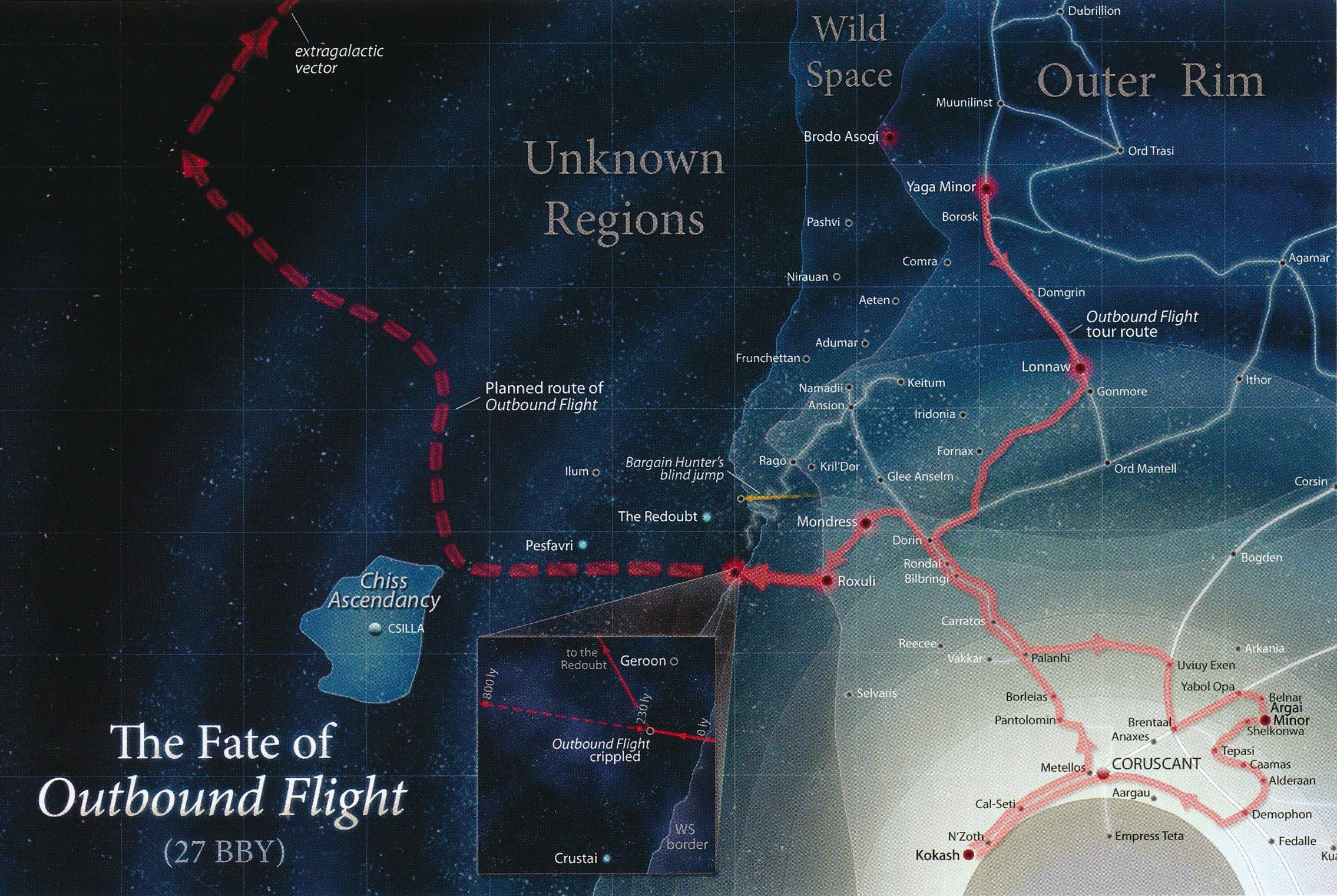
The areas that hadn't undergone direct surveying by either Republic or Imperial scouting parties were known as the "Unknown Regions." This term was most frequently used to describe the lesser-known portions of the galaxy's western disk, specifically a quadrant situated approximately between Bakura and the Imperial Remnant. However, it also encompassed the gaseous halo, dust clouds, and stellar formations surrounding the main galaxy, along with satellite galaxies. When all of this territory was considered together, the Unknown Regions were almost three times larger than the areas with established settlements, although some estimates placed the total stellar mass within the Unknown Regions at only 15% of the entire galactic disk. The inaccessibility of the Unknown Regions within the galaxy was due to the absence of western equivalents to the Perlemian Trade Route and the Corellian Run, as the Republic's initial scouting missions prioritized the more easily accessible territories of the Slice. It was later discovered that a complex web of hyperspace disruptions, which effectively divided the galaxy in half and formed the central part of the galactic barrier that encircled the galaxy, blocked the path to the west. Despite this barrier, passage to the Unknown Regions was possible, as evidenced by spacer stories of unusual ships visiting remote Outer Rim ports like Terminus, hyperdrive malfunctions that sent ships through the divide, and ancient alien pathways that provided access to the region.
One of the earliest formal attempts to venture into the Unknown Regions was the doomed Outbound Flight Project, while Grand Admiral Thrawn of the Galactic Empire dedicated several years to charting sections of the area. The Chiss were the dominant species residing in the Unknown Regions. However, unlike known space, where most amoral or expansionist species were subdued or eliminated by the early Republic, the Unknown Regions remained a lawless and untamed area. Other influential species within the region included the Vagaari' slaver empire, the illusion-weaving mollusks known as Crokes, the religiously zealous Ssi-ruuk, and the blind berserkers of the Leech Legion. Beyond the galactic disk, in the satellite galaxy of Companion Besh, lived the Nagai and their oppressors, the Tofs. The Nagai launched an invasion into known space in 4 ABY, pursued by the Tofs. They ultimately joined forces with the Alliance of Free Planets to defeat their oppressors and then returned to Firefist to liberate it.
Following the Yuuzhan Vong War, the normalization of relations with the Chiss Ascendancy led to the establishment of reliable hyperroutes into the Unknown Regions through the Utegetu Nebula, such as the Rago Run. By 44 ABY, the term "Unknown Regions" was largely inaccurate, at least when referring to the galactic disk. Nevertheless, the galactic halo and the satellite galaxies remained largely unexplored and shrouded in mystery.
Wild Space
The term Wild Space was not a formal designation but rather a colloquial term for the edge of galactic society, encompassing the unsettled fringes of the galaxy and other regions with minimal colonization or development. During the Imperial Period, Wild Space typically denoted the sparsely populated edge of the galaxy's eastern disk, as well as the narrow, winding zone that separated the civilized galaxy from the Unknown Regions. One of Emperor Palpatine's final actions was to facilitate greater exploration of much of this region. Wild Space differed from the Unknown Regions in that it had undergone some degree of exploration, with findings documented in official records, whereas the Unknown Regions remained largely enigmatic. The worlds of Wild Space generally disregarded the central government, were often peaceful, and served as havens for criminals.
Galactic Rim
The Galactic Rim, situated at the galaxy's edge, was distant from most civilization, and much about it remained unknown. The Galactic Rim exhibited a slight decrease in luminosity as the stars thinned out. Notably, the Galactic Republic was aware that the Yuuzhan Vong had established a foothold at the galaxy's edge. The Galactic Empire maintained a substantial shipyard there, which was later utilized by the Dark Empire.
Other terms
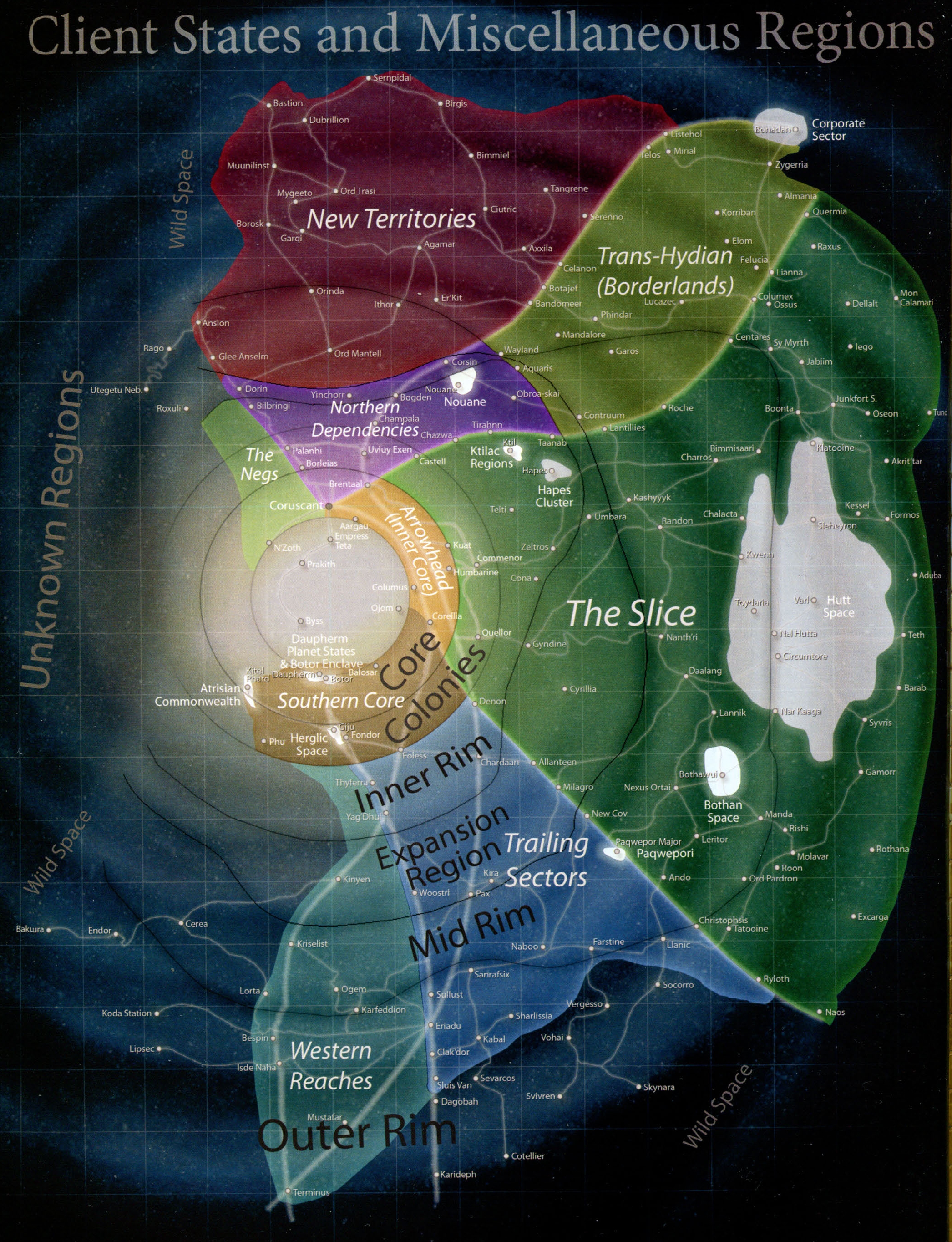
The galaxy's ten primary regions did not fully represent its political and cultural complexities. Within the territorial bands between the Core and the Outer Rim existed various groupings and prefectures, some with their own regional governments and others sharing only cultural stereotypes. The largest of these was the Slice, a vast expanse of space between the Perlemian Trade Route and the Corellian Run, generally regarded as the center of galactic civilization and commerce. At its apex was the Arrowhead, encompassing the Core Worlds portion of the Slice, with Coruscant at its tip. The Arrowhead's other two vertices traditionally fell on Vento on the Perlemian and on Corellia itself, on the Run. The Arrowhead contained the elite of the Core Worlds, and grew out of the ancient pre-Republic Tetrahedron that was the cradle of galactic civilization. Sometimes called the Inner Core, the Arrowhead included Ixtlar, Alsakan, Grizmallt and Anaxes, which became ever-more prestigious the closer they were to Coruscant.
Colonists emanating from the Arrowhead established settlements in the Slice, venturing into what became known as the Colonies and then further beyond. The worlds along the Perlemian and the Corellian Run were settled for millennia, and colonization gradually expanded from both to unite the Slice. The Core, Colonies, and Inner Rim portions of the Slice were densely populated and crisscrossed by thousands of hyperlanes and praediums; the Expansion Region was heavily colonized near the Corellian Run (and dominated by Corellian interests) but more sparsely settled south of the Perlemian, the result of the millennia-long Alsakan Conflicts. The Slice's prestige had begun to wane by the time colonists pushed beyond the Expansion Region in the central Slice; the Mid Rim reaches were well-surveyed but thinly-settled, and the Hutts dominated the Outer Rim precincts even beyond Hutt Space. Although new industries and businesses had largely migrated beyond the Slice by the time of the Clone Wars, the region was still considered the heart of galactic civilization, a distinction its citizens remained proud of.
The Southern Core was settled from the Arrowhead and expanded through interaction with several advanced ancient civilizations, including the Devaronians, the Herglics, and the Atrisian Commonwealth. This resulted in a diverse region that defied easy categorization. The western quadrant of the Core Worlds long resisted exploration, lacking any super-hyperroutes and restricting progress along hyperlanes like the Metellos Trade Route to short, one- or two-light-year jumps. Worlds settled along this western frontier received a negative first digit in their galactic coordinates due to their position west of Coruscant, earning them the name "the Negs," condemning areas such as the Farlax sector to perpetual second-class status within the Core.
The Northern Dependencies, a long-settled region north of Coruscant, generally looked outward, whether to Nouane, the worlds of the Hydian Way, or the New Territories beyond. Some of the galaxy's greatest traders, explorers, and entrepreneurs originated from the Northern Dependencies, and the region included some of the galaxy's oldest worlds, rarely concerning itself with Core World politics. To its northeast, the region north of the Perlemian Trade Route, was the Trans-Hydian, an area dotted with worlds with ancient histories, such as Mandalore or the planets of the Sith Worlds and the Tion Cluster, but largely sidelined economically until late in galactic history. Economic development shifted from the Slice to the Trailing Sectors further south and then followed the Hydian Way into the New Territories. For millennia, the threat of the Mandalorians, rumors of the ancient Sith, and geographic anomalies such as the vast Radama Void encouraged more profitable enterprises elsewhere. The Trans-Hydian owed its name to traders from Ord Mantell and Celanon, who braved the threat of Mandalorian raiders to pioneer new trade routes like the Listehol Run, the Shaltin Tunnels and the Gordian Reach to connect the Hydian and the Perlemian. After the Battle of Endor, the region's loyalties were split between the Empire and the New Republic, earning it the name of the Borderland Regions.
The Trailing Sectors were settled during the Alsakan Conflicts, which resulted in the ruin, enslavement, or depopulation of many colonies in the Slice, driving colonization west of the Corellian Run. Here, intrepid traders had long conducted business with the Herglics, Givin and Tynnans, and the Expansion Region's Trailing Sectors soon surpassed the Slice sectors, catalyzing expansion into the Mid Rim. The rise of the Rimma Trade Route in 5500 BBY and the Hydian Way two thousand years later further propelled this long period of growth, uniting the region for traders from across the galaxy. Inhabitants of the Trailing Sectors tended to view their region as having built upon the successes and traditions of the Slice while avoiding its mistakes, valuing entrepreneurship and hard work.
The Western Reaches developed around the Corellian Trade Spine and the Hydian Way, with settlement originating from the Southern Core and the Trailing Sectors, inheriting those regions' diversity and sense of independence. Explorers and settlers continued to expand the region as late as the period of the New Republic, venturing further west into the Unknown Regions. The Reaches' independence and distance from Coruscant historically made them a hotbed of rebellion, serving as a refuge for the last holdouts of the Confederacy of Independent Systems after the Clone Wars. The Galactic Empire launched a massive campaign to pacify the Western Reaches, but the area remained a sanctuary for the Alliance to Restore the Republic throughout the Galactic Civil War and was the site of numerous Imperial atrocities.
The New Territories lay beyond the Northern Dependencies in a region that had developed slowly compared to much of the galaxy. Worlds such as Ithor, Ord Mantell, and Iridonia were well-known but remained isolated outposts. Large-scale efforts to promote settlement in the northern quadrant repeatedly failed, leading to disasters like the Kanz Disorders and the Outer Expansion Zone. The region was finally properly settled in the final years of the Republic, with the D'Asta merchant family of Serenno establishing markets along the Braxant Run while the Nalroni Merchant Council expanded along the Celanon Spur. These economic successes encouraged Coruscant to invest heavily in the region, soon dubbed the New Territories. Due to Republic spending on programs like the Planetary Pioneers and the influence of the D'Asta family, the region was strongly Loyalist during the Clone Wars and the Galactic Civil War. The New Territories formed the core of many Imperial successor states after the Battle of Endor and became the contested frontier between the New Republic and the Imperial Remnant. The New Territories were devastated during the Yuuzhan Vong War and struggled to recover afterward.
History
Formation
Approximately thirteen billion years prior to the Battle of Yavin, an enormous cloud composed of gas and dust underwent gravitational collapse, leading to the formation of a rotating disk that ultimately became the galaxy. Over the subsequent billions of years, stars and planets began to materialize. By 5,000,000,000 BBY, life had begun its evolutionary journey within the galaxy, with some of the earliest instances of non-sentient life emerging on Goroth Prime.
Around 2,000,000 BBY, the evolutionary paths of many of the galaxy's most recognized species were taking shape: the Wookiees originated on Kashyyyk as arboreal creatures. The Oracle of Pelgrin, potentially the oldest artifact in the galaxy, is believed to date back to this era. By 200,000 BBY, the Zhell, the ancestors of Humans, had attained intelligence and were engaged in war with the Taungs for dominion over their shared homeworld of Notron, later known as Coruscant.
The earliest civilizations
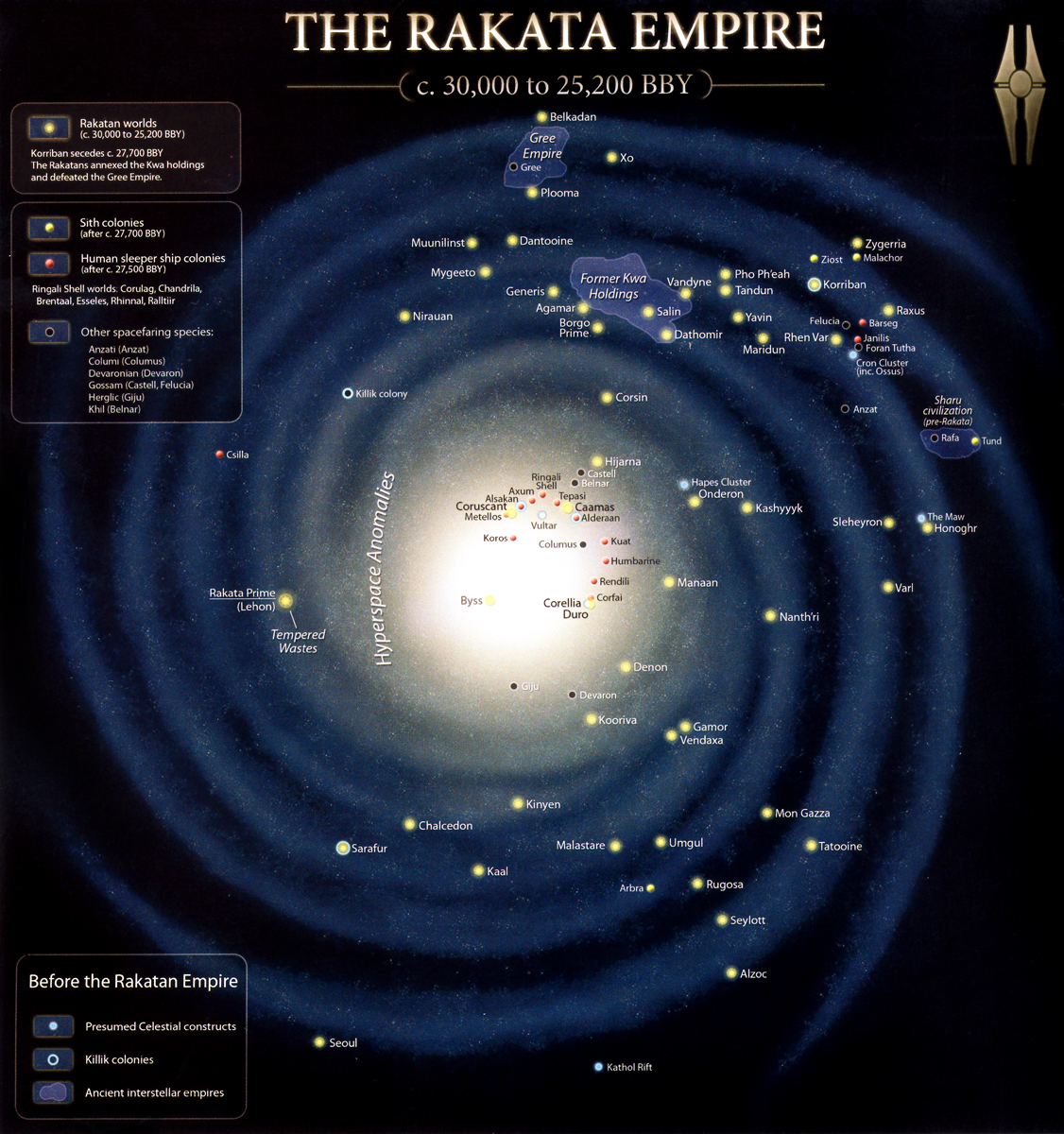
By 100,000 BBY, the galaxy was dominated by a mysterious race called the Celestials. Also referred to as the Architects, this extraordinarily powerful race was thought to possess the ability to manipulate and reposition stars. Surviving Celestial technology, such as Centerpoint Station and the Cosmic Turbine, could manipulate gravity on a massive scale using repulsor pulses, tractor beams, and hyperspace wormholes. Utilizing this technology, the Celestials were believed to have constructed the Corellian system, the Vultar system, and 15 other star systems, as well as the Hapes Cluster, the Kathol Rift, and the Maw black hole cluster. Pre-Republic scholars also attributed the creation of the circumferential hyperspace barrier to the Celestials, possibly as a defense against external threats. They were also believed to be responsible for the chain of hyperspace anomalies west of the Core that bisected the galaxy and prevented travel into the Unknown Regions. It is speculated that the Celestials crafted the hyperspace anomalies that divided the galaxy in order to contain the Rakata.
Around this time, several other spacefaring races became clients of the Celestials. The insectoid Killiks of Alderaan were exploited as laborers and dispersed across the galaxy until approximately 30,000 BBY, when they disappeared into the western regions of the galaxy and the Unknown Regions, presumably relocated by the Celestials. The Kwa and the Gree utilized structures known as the Infinity Gates and hypergates, respectively, to traverse between planets, leading to territorial disputes. Other species fled to escape the Celestials: the Sharu of the Rafa system in the far eastern reaches of the galaxy experienced a brief period of expansion, spreading their signature plastic pyramid cities as far into the Core as Aargau, but this may have attracted the attention of the Celestials, prompting the Sharu to bury their cities and seek refuge in primitivism to evade them. Similarly, the Columi of Columus surveyed both the Humans and the Duros in the Core and were unimpressed by their findings, but also retreated to their homeworld, possibly to avoid retribution from the Celestials.
A cosmic war transpired at some point in the galaxy's distant past. Around 35,000 BBY, the Rakata slave race revolted and usurped the Celestials' dominion. They stole technology from the Kwa, waged war against the other servant races, breached the barrier surrounding the Unknown Regions, entered the main galaxy, and launched a war of extermination against the Celestials. The ultimate fate of the Celestials remained unclear. They may have been trapped within the galaxy by their barrier and destroyed by the Rakatan revolt, or they may have escaped through the barrier. By 30,000 BBY, the Celestials had vanished, and the Rakatan Infinite Empire had risen to prominence.
The Rakata expanded from their homeworld of Lehon in the Tempered Wastes of the Unknown Regions, utilizing hyperdrives that harnessed the power of the Force to guide them to worlds with strong Force signatures. The Infinite Empire occupied scattered systems throughout the galaxy, but vast stretches of territory between these holdings remained untouched, allowing smaller interstellar confederations to thrive. The Devaronians and the Gossam experimented with the tumble hyperdrive, and while worlds like Coruscant, Corellia, and Duro were occupied by the Rakata, Humans, Duros, Selonians, and Drall were able to study the principles of the Rakatan hyperdrive. The Rakata proved to be cruel overlords, subjecting entire populations to slavery. After nearly five thousand years of dominance, the Rakatan Empire collapsed following a devastating plague that robbed the Rakata of their ability to wield the Force. A colonial slave revolt completed the empire's downfall by 25,200 BBY.
Galactic governance
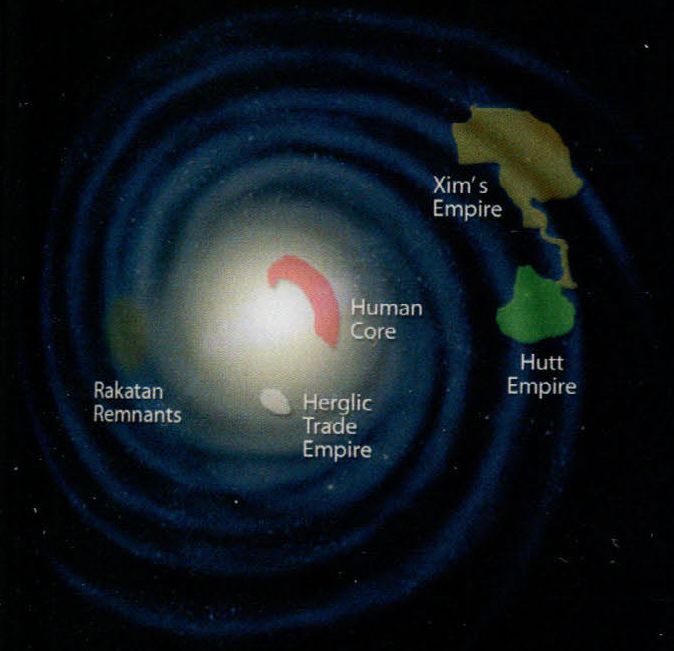
The decline of the Infinite Empire coincided with the reverse-engineering and refinement of Rakatan hyperdrive technology by other species in the galaxy. By developing technological substitutes for its Force-based components, various species ventured out from their homeworlds, initially with slower-than-light sleeper ship colonies, followed by the invention of the hyperspace cannon. Through this repurposing of Rakatan technology, several civilizations rose to prominence: the Humans and Duros dominated the Core, while the cetacean Herglics established their own trade empire to the south. On the Rim, Human sleeper ship colonies formed the Tionese civilization, which was unified into an empire by Xim the Despot, before engaging in conflict with the empire of the Hutts.
This era marked the inception of the Jedi Order on Tython, with its exploration of the Force, as well as the religious rivalry between understandings of the light and dark sides of the Force. Conflict between the Jedi and the Dark Jedi would reassert itself multiple times throughout galactic history, a cycle that persisted beyond the Yuuzhan Vong War.
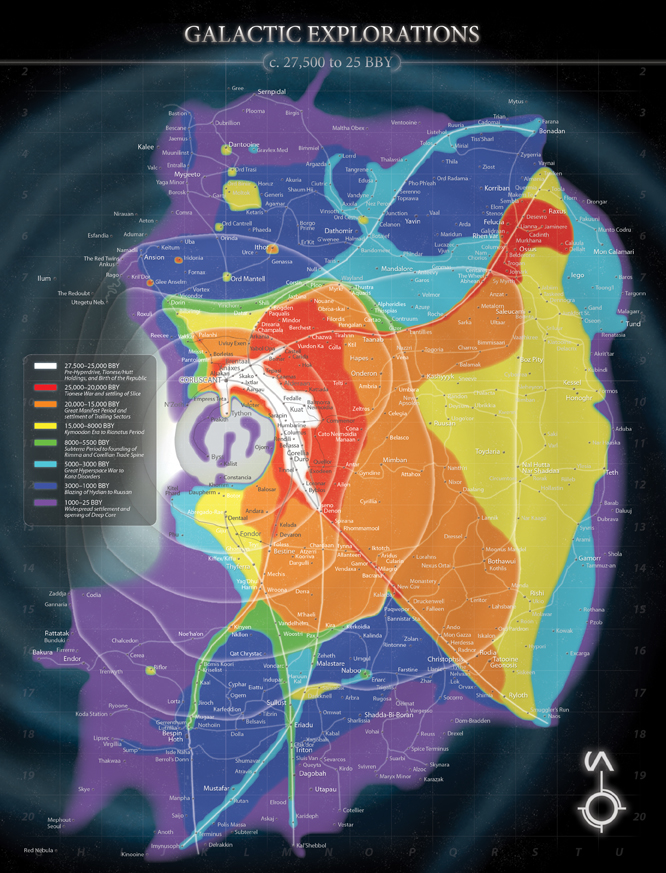
In the era of 25,000 BBY, subsequent to the Unification Wars, the diverse entities of the Core region convened on Coruscant. There, they formalized the Galactic Constitution, thereby inaugurating a society governed by shared legal principles, a unified language, and a common monetary system, and proclaiming the establishment of the Galactic Republic. This Republic consolidated the predominantly Human Core Worlds, with the Core Founders encompassing influential political bodies such as Coruscant, Alsakan, Corellia, Duro, Kuat, and Alderaan; potent military powers like the Azure Imperium centered on Axum and Anaxes; burgeoning commercial centers including Esseles and Rendili, alongside emerging trade hubs like Tepasi, Brentaal IV, and Humbarine; and finally, planets of significance to medical science, diplomacy, and philosophical thought, such as Chandrila, Caamas, Rhinnal, and Shawken.
The Expansionist Era unfolded concurrently with the Republic's inception, marking the initial phases of systematically mapping and colonizing significant portions of the galactic spiral. Exploratory missions venturing eastward from Coruscant navigated along two prominent trade routes, specifically the Perlemian Trade Route and the Corellian Run. These routes defined the borders of an expansive spatial sector known as "the Slice." Situated at the terminus of the Corellian Run was Kalarba, a pivotal trading post overseen by merchants hailing from Paqwepori. Conversely, the Perlemian route facilitated access to the commercial worlds of Tirahnn, Nouane, and Roche. The absence of analogous pathways to the galactic west resulted in the prolonged obscurity and limited exploration of that particular galactic quadrant, which subsequently became recognized as the Unknown Regions. This period of expansion brought the Republic into conflict with the Human societies inhabiting the Tion Cluster. Following its triumph in 24,000 BBY, the Republic experienced a substantial increase in its territorial holdings, surpassing its initial administrative capabilities as numerous systems sought protection against the predatory activities of the Hutts.
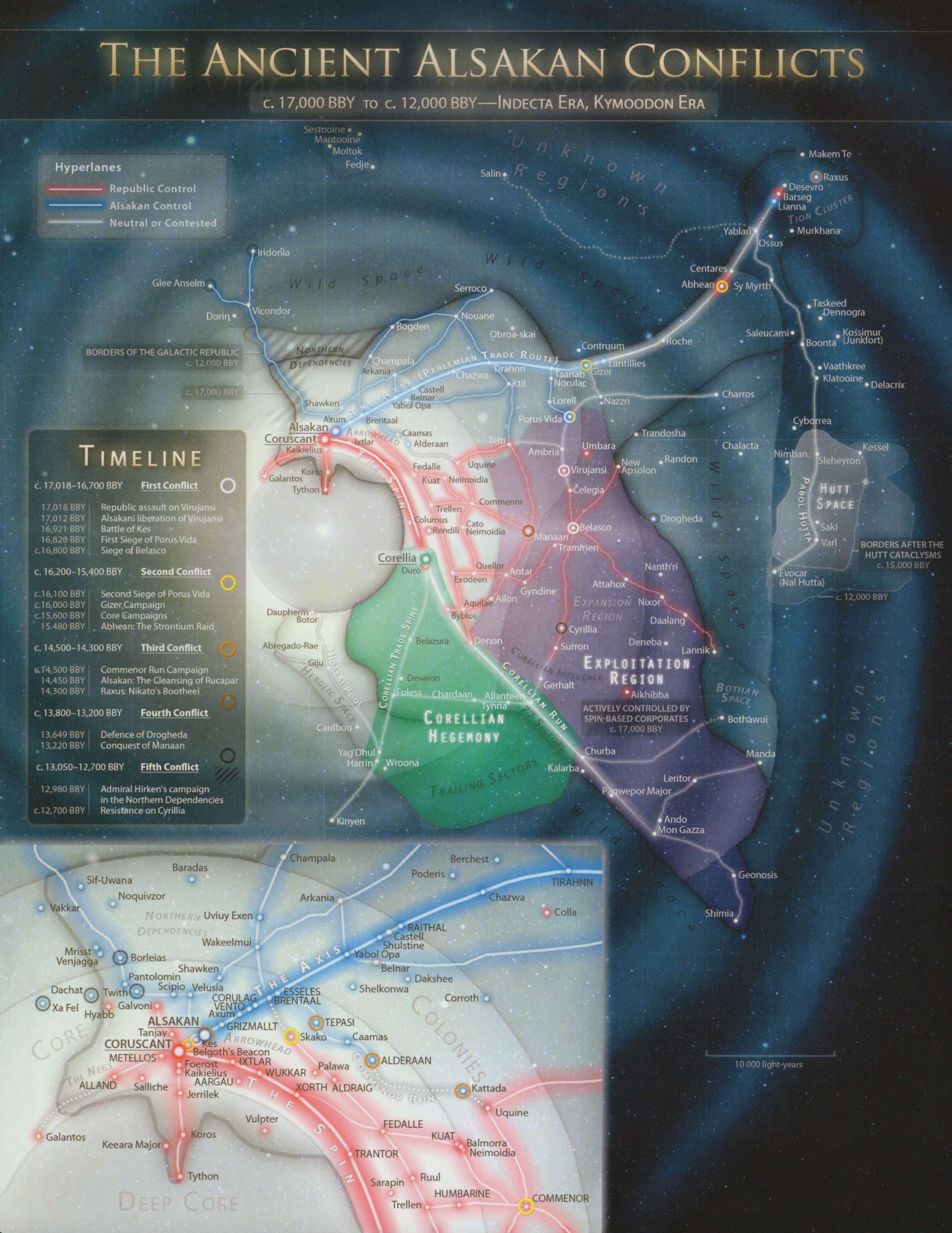
The Great Manifest Period commenced in 20,000 BBY, characterized by the widespread colonization of the Slice, with the intricate network of systems at its apex becoming known as the Arrowhead. Coruscant exerted significant influence over this region, while Corellia dominated the settlement activities along the Corellian Run. Disagreements between Coruscant and Alsakan concerning policies related to the Perlemian Trade Route precipitated the First Alsakan Conflict in 17,000 BBY, marking the onset of the Indecta Era. Although a truce was eventually negotiated, the Alsakan Conflicts persisted in a reduced form for approximately 14,000 years. The initial five Alsakan Conflicts also impeded colonization efforts along the Perlemian Trade Route, redirecting colonists toward the Corellian Hegemony situated in the Trailing Sectors along the Corellian Run, as well as the developing Corellian Trade Spine.
The Kymoodon Era, which began in 15,000 BBY, initiated another surge in colonization that rivaled the Great Manifest Period. Advancements in hyperdrive technology facilitated the establishment of scattered pockets of colonization in the previously unexplored northern and southern quadrants. Furthermore, the Herglics joined the Republic, spurring a wave of development around the Hidakai Pool, which would later evolve into the Rimma Trade Route. However, this era also sowed the seeds for future discord, as the Republic's territorial boundaries increasingly bordered those of Hutt Space, leaving isolated colonies vulnerable to raids conducted by Hutt slavers. Widespread animosity toward the Hutts in the Rim was exploited by Contispex I and the Humanocentric Pius Dea religious order, leading to a series of Crusades against the Hutts beginning in 12,000 BBY. The subsequent millennia-spanning Pius Dea Era witnessed the subjugation, persecution, or extermination of numerous non-Human species until the Contispex dynasty was overthrown by the Jedi Order. This era also fostered profound resentment among the species residing in the Rim. The ensuing Ductavis Era and Rianitus Period, spanning from 11,000 to 8000 BBY, represented periods of consolidation and reconstruction following the Crusades.
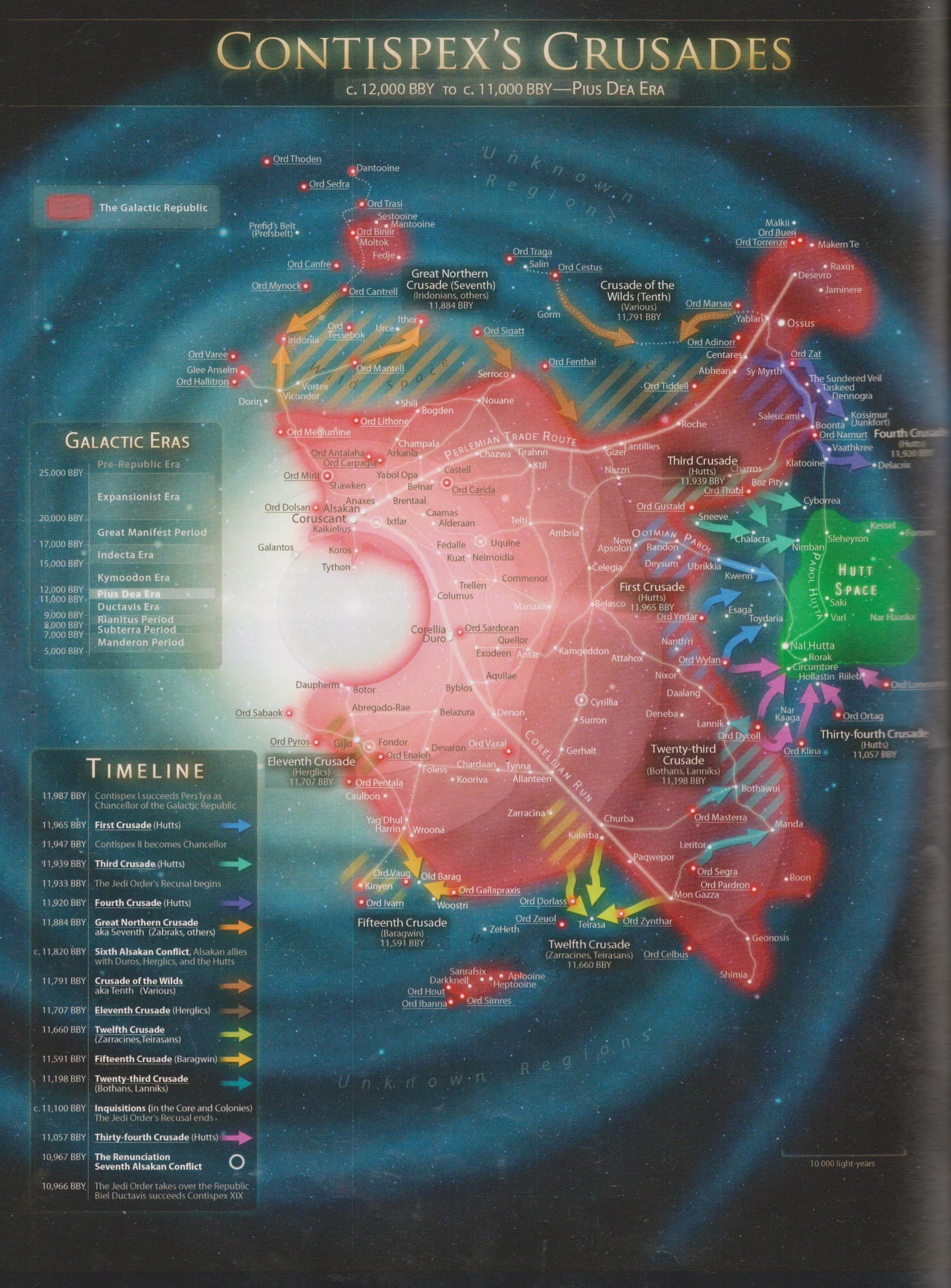
During the Subterra Period, spanning from 8000 to 7000 BBY, the galactic southern quadrant underwent renewed mapping efforts, with colonies such as Malastare serving as focal points for the intricate networks of praediums that interconnected the region. Around this time, scouts also ventured into the Rishi Maze. However, the absence of a super-hyperroute into the southern quadrant, coupled with the general inaccessibility of the newly established colonies, fostered lawlessness in the Rim and curtailed Coruscant's authority. This situation is believed to have contributed to the Second Great Schism within the Jedi Order in 7003 BBY, which triggered a galaxy-wide rebellion of Dark Jedi known as the Hundred-Year Darkness. In the aftermath of the conflict, the defeated Dark Jedi were banished beyond the Rim into the uncharted territories north of the Perlemian Trade Route. There, the Exiles established settlements on the planets of Korriban and Ziost within the Stygian Caldera, where they asserted dominance over the indigenous Sith species and established an empire.
During the Manderon Period, the Corellian Trade Spine and the Rimma Trade Route were formally established in 5500 BBY through the collaborative efforts of the Herglics, Givin, and Corellians, who interconnected hundreds of pre-existing praediums, thereby enhancing accessibility to the southern quadrant. In 5000 BBY, the Republic rediscovered the Sith Empire, precipitating the Great Hyperspace War when the Sith Lord Naga Sadow attempted to conquer the Republic. Although the Sith were ultimately defeated and driven into exile once more, this marked the beginning of a persistent threat that would plague the Republic throughout its existence. A millennium later, in 4000 BBY, Sith teachings unearthed on Korriban and Onderon seduced the Jedi Exar Kun and Ulic Qel-Droma to embrace the dark side, initiating the Great Sith War. The Sith's alliance with the Mandalorians, a nomadic warrior culture descended from the Taungs, during that conflict would later give rise to another challenge to the Republic in the form of the Mandalorian Wars. The Republic endured nearly five decades of continuous warfare, collectively known as the Old Sith Wars, as a consequence of Exar Kun's actions, until the Sith Empire was vanquished in 3950 BBY by the redeemed Sith Lord Revan.
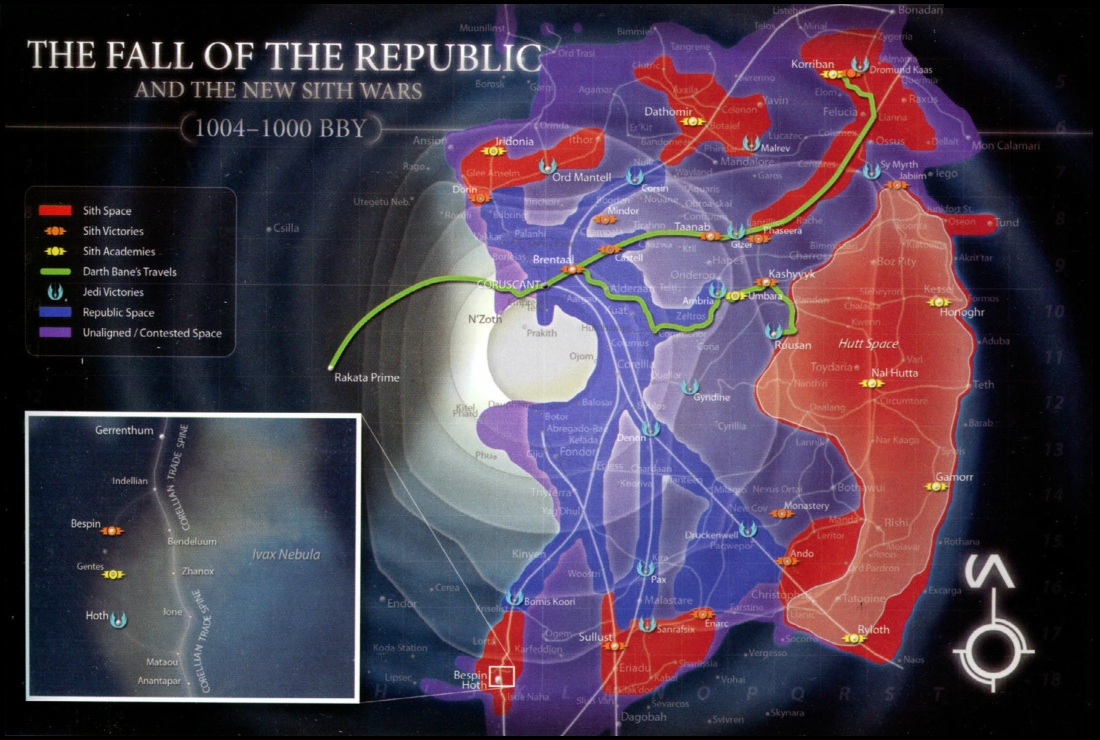
By approximately 3700 BBY, the galaxy had undergone extensive mapping and settlement, extending as far as Farana in the northern regions and Malastare in the southern regions. However, significant portions of the northern and southern quadrants beyond the established trade routes remained largely uninhabited. Around this period, Freia Kallea, an explorer hailing from Brentaal, expanded the ancient Brentaal–Denon Route and linked several pre-existing praediums. By 3693 BBY, she had extended the trade routes south of Denon as far as Imynusoph, effectively mapping the entire length of the Hydian Way, which represents the sole super-hyperroute spanning the galaxy's entirety. The enhanced accessibility to the northern and southern quadrants facilitated by this route significantly expanded the Republic's influence into the New Territories and the Western Reaches, while also unlocking numerous new sources of minerals, crystals, and gases. From 3681 to 3642 BBY, the Republic endured decades of war and tension with a resurgent Sith Empire composed of exiles from the Great Hyperspace War, and led by the Sith Emperor Vitiate. A second Galactic War erupted between the two factions in 3642 BBY, and chaos prevailed until the Sith Emperor's stronghold, the Eternal Empire, was defeated.
Following these conflicts, the galaxy experienced several centuries of relative prosperity, which came to an end in 2000 BBY with the advent of the Draggulch Period and the commencement of the New Sith Wars when the Jedi Master Phanius proclaimed himself Darth Ruin. During the ensuing millennium of conflict between the Republic and the New Sith, the Republic teetered on the brink of collapse, culminating in the Republic Dark Age during the final century. During this time, the Republic's authority effectively dissolved beyond the major trade routes, and the HoloNet communications network ceased to function. The New Sith Wars ultimately concluded when the Army of Light, led by the Jedi Lord Hoth, defeated Skere Kaan's Brotherhood of Darkness at the Seventh Battle of Ruusan. A solitary Sith Lord, Darth Bane, managed to escape and establish a new Sith order, while Supreme Chancellor Tarsus Valorum enacted the Ruusan Reformations, which fundamentally restructured the Republic.
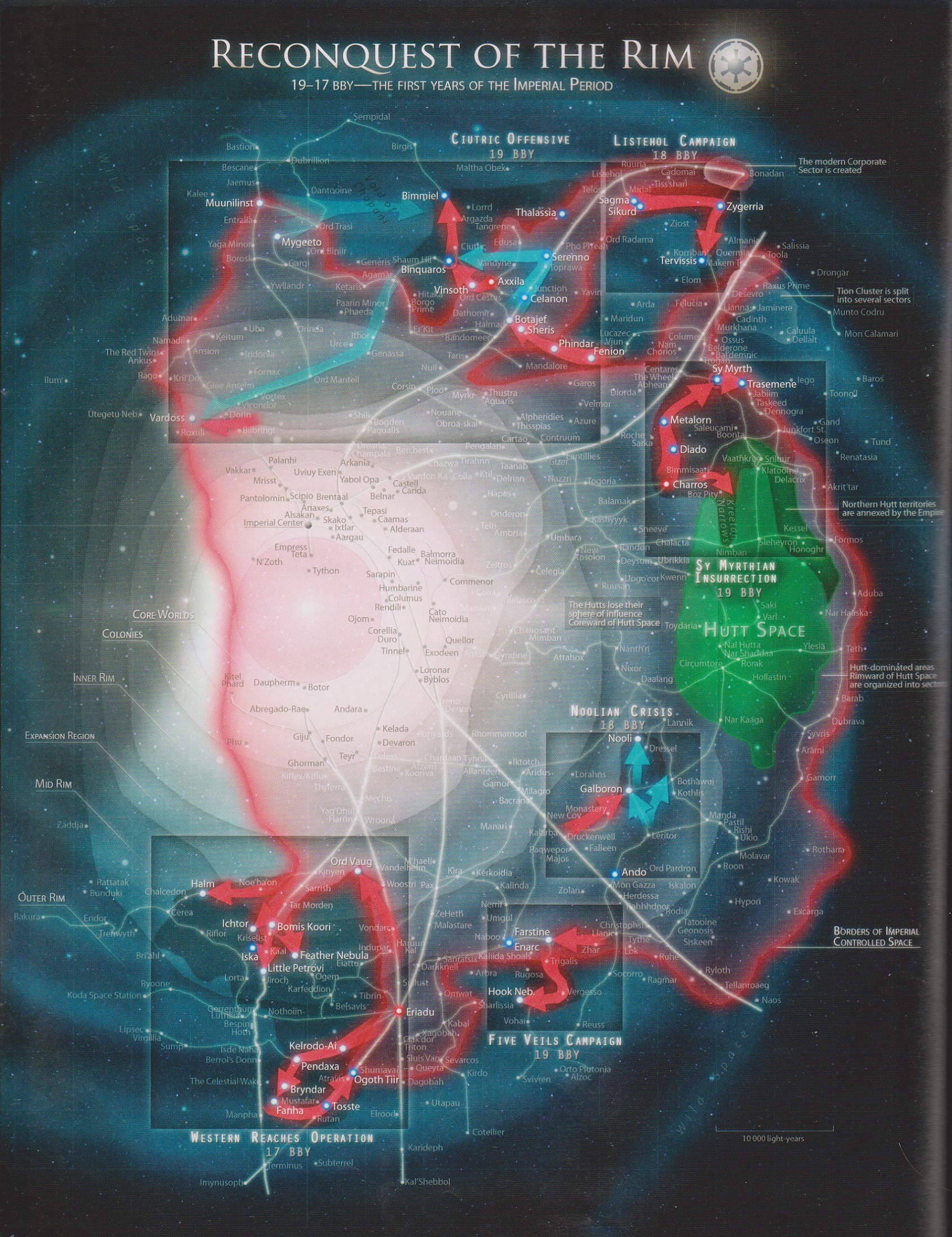
The Republic's concluding millennium was characterized by relative peace. However, the provisions outlined in the Ruusan Reformations led to a surge in lawlessness within the Outer Rim Territories, which eventually fell under the control of powerful megacorporations and criminal syndicates. This discontent was manipulated into a Separatist movement by the Sith, who had remained hidden for a millennium. By orchestrating the Clone Wars, the Order of the Sith Lords successfully destroyed the Jedi Order and re-established their Empire under the leadership of Darth Sidious. Sidious dissolved the Republic and replaced it with the ephemeral Galactic Empire, eventually abolishing all vestiges of the Republic. One lasting consequence of Imperial rule was the opening and extensive colonization of the Deep Core, as well as the mapping and exploration of significant portions of the Unknown Regions. The Empire endured for two decades marked by tyranny, but following the Galactic Civil War and the death of Darth Sidious at the hands of Anakin and Luke Skywalker, a New Republic was established by an alliance of free worlds. Nevertheless, the remnants of the Empire continued to resist the new government for over a decade before finally signing a peace treaty.
The Yuuzhan Vong War represented a pivotal moment in galactic history, marking the first instance of an invasion by an extra-galactic force. The brutality of this conflict would shape galactic politics for more than a century thereafter. Shortly after the conclusion of the Galactic Civil War, an extra-galactic species known as the Yuuzhan Vong launched an invasion of the galaxy. The Yuuzhan Vong War wrought devastation across much of the galaxy, including Coruscant, and resulted in the deaths of approximately 365 trillion beings. However, they were ultimately defeated by a newly formed Galactic Alliance comprising the Imperial Remnant, the remnants of the New Republic, and various minor powers within the galaxy. Another consequence of the war was the normalization of relations between the galaxy proper and the Chiss Ascendancy, the dominant power in the Unknown Regions. Within a few decades, stable hyperroutes and colonies had been established in the region, dispelling much of its mystery.
While some Yuuzhan Vong were integrated into the galactic community, the post-Yuuzhan Vong War galaxy proved exceptionally challenging to govern, leading to a Second Galactic Civil War between the Galactic Alliance and a Confederation led by Corellia. Within a century, the Galactic Empire had been restored under the Fel dynasty, although this time without the support of the Sith. Ultimately, however, the Fel Empire was manipulated by the One Sith, led by Darth Krayt, to declare war on the Galactic Alliance. The Sith exploited lingering animosity toward the Yuuzhan Vong, making it appear as though they were planning to reconquer the galaxy. The One Sith subsequently usurped the Imperial throne, establishing a new Sith empire. However, the resulting war between the Sith and the Galactic Alliance Remnant, as well as the Fel-loyalist Empire-in-exile, culminated in the Sith's defeat. Consequently, the Galactic Alliance once again became the dominant governing body in the galaxy once again.
Hyperspace
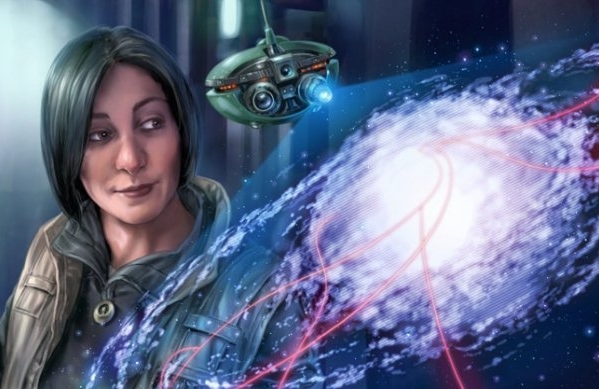
The bedrock of galactic civilization was formed by well-defined and dependable routes across hyperspace, referred to as hyperlanes or hyperroutes. For starships, hyperlanes served as secure pathways, circumventing the perilous gravitational "mass shadows" that realspace objects projected into hyperspace. Spacers who were hyperspace explorers, such as Aitro Koornacht, Jori, and Gav Daragon, charted and established these routes. What follows is a discussion of notable routes that influenced galactic history.
The super-hyperroutes
The largest, longest, and fastest hyperlanes in the galaxy were the super-hyperroutes. Many of these routes stretched from the Core Worlds to the Outer Rim's edge. The Perlemian Trade Route and the Corellian Run, the two oldest, were established after the hyperdrive was developed in 25,000 BBY. The Slice's northern border was the Perlemian, which connected the galactic capital, Coruscant, to the Jedi training world of Ossus and the Tion Hegemony's civilizations. Colonies and species along the Perlemian's length requested Republic protection from the Tionese or the Hutts early in the Republic's history, which fueled the Republic's rapid expansion. "The Axis," as the Perlemian was poetically known, was initially dominated by Alsakan, which started the socio-economic divide that caused the Alsakan Conflicts. Beyond Quermia, the Perlemian emptied into Wild Space at the galaxy's edge.
The Corellian Run secured Corellia's economic supremacy within the burgeoning Republic and served as the Slice's southern border. The portion of the Run Coreward of Corellia, "the Spin," was initially dominated by Coruscant, which created the divide with the Spin and Alsakan. However, Rimward of Corellia, Corellians and humans of Corellian descent held substantial economic power in the sectors surrounding the Run for millennia. The establishment of the two oldest hyperroutes made exploration in and around the Slice much easier, resulting in a population boom that shaped the galaxy's settlement patterns.
In 5500 BBY, the Corellian Trade Spine was established, although the first led existed as far back as 25,000 BBY, connecting Corellia and Duro. The Trade Spine crossed the Rimma Trade Route at Yag'Dhul before extending Rimward to the Greater Javin and past Terminus. While the Corellian Trade Spine offered fast transit into the galactic southern quadrant, it never provided the same economic benefits as the Rimma Trade Route. The Rimma, which was established around the same time, was mapped by Givin hyperspatial cartographers and blazed by Sullustan scouts from Herglic Space. The Rimma aided in the widespread colonization of the southern quadrant and enriched the worlds of the Tapani sector in the Colonies. The rich industrialized world of Eriadu at the junction with the Hydian Way, the Bith homeworld of Clak'dor VII, and the shipyards of Sluis Van were significant planets on the Rimma.
The Hydian Way, the last super-hyperroute to be established, was unique in that it spanned the galaxy's entire length. Freia Kallea, a Brentaal-based scout, was primarily responsible for its creation. Around 3700 BBY, she extended the ancient Brentaal–Denon Route eastward, connecting several obscure routes into a single passage that reached the northern quadrant's galactic edge. She then blazed new routes south of Denon to the galaxy's Rim in the southern quadrant, opening up vast areas for new colonization.
Additional routes of interest
The Metellos Trade Route was located west of Coruscant in the Negs as an unsuccessful attempt to find a western counterpart to the Perlemian Trade Route. Its growth stalled due to the hyperspace eddies near the Unknown Regions, and explorers could only extend its length by a few light-years per century until it ended in the Farlax sector. The Koros Trunk Line, an ancient pre-Republic route connecting Coruscant to the carbonite mines of the Koros system, was a more successful Core Worlds hyperroute. The route became known as the Carbonite Pipeline because it transported so much ore after the hyperdrive was developed, as carbonite was essential for keeping sleeper ships' passengers in suspended animation.
The Salin Corridor, one of the Outer Rim's oldest hyperlanes, was originally forged by Xim the Despot's empire as the Warrior's Trace to support his wars with the Hutts. It was maintained by a "lighthouse network" of jump beacons. The stability of parts of the Salin Corridor was unusual and had intrigued hyperspace theorists for millennia, even though many of the Xim-era beacons had vanished. One of the longest routes in the Outer Rim, it began in the Hutt-controlled Rim worlds near Aduba, meandered Coreward around the tip of Hutt Space, and then turned north into the edges of the Tion Cluster. It skirted the Radama Void, crossed the Hydian Way at Botajef, and ended in the northern quadrant.
The most important route in the northern quadrant was the Braxant Run, which began at Bandomeer on the Hydian and twisted across the New Territories via Muunilinst to Bastion. The Triellus Trade Route, the third most important route in the Outer Rim, stretched over 75,000 light-years from Centares to Enarc, forming one side of the "Spice Triangle." However, due to smugglers, slavers, and pirates operating from Hutt Space, travel along the "Hutt Highway" was frequently slow and dangerous.
The Ootmian Pabol connected the Expansion Region's financial centers with the heart of Hutt Space. It was derived from the Huttese term Ootmian Pankapolla and was created around 12,000 BBY by Republic scouts from Gyndine to Nal Hutta. Thriving trade transformed Nal Hutta's moon, Nar Shaddaa, into a boomworld. However, the supernova of the Kyyr system's star in 4000 BBY rendered the route impassable. The Ootmian was eventually restored, but the rise of the Corellian Run ended Nar Shaddaa's status as a respectable tradeworld, with legitimate business relocating and the moon becoming one of the galaxy's most infamous shadowports. It was speculated that the Kyyr supernova was responsible for the Hutt kajidics' shift toward criminal activities.
Some routes were used for illicit purposes, particularly smuggling. The Kessel Run, an 18.5 parsec three-stop route between Kessel and an area south of the Si'Klaata Cluster, was one of the most well-known examples of illegal routes. During the Galactic Empire's reign, smugglers used it to transport Glitterstim spice without being apprehended by Imperial ships. It also connected to the Kessel Trade Corridor, the Triellus Trade Route, and the Pabol Sleheyron routes. Han Solo, a notorious smuggler, claimed to have completed the Kessel Run in under 12 parsecs in his ship, the Millennium Falcon, by skirting close to the black holes that made up part of the Kessel Run.
The Ison Corridor was a short route within the Corellian Trade Spine with five system stops before reconnecting with the Spine, connecting the coreward and rimward regions.
The Sisar Run was a hyperspace trade route that began in the Tharin sector, passed through the heart of the Periphery, crossed Hutt Space and Srillur, bypassed the Si'Klatta Cluster, and split at Sispe. It connects to the Salin Corridor, the Pabol Hutta, the Pabol Sleheyron, and the Ac'fren Spur routes.
Myto's Arrow, named after its discoverer, the Galactic Republic scout Keos Myto, was an Outer Rim route used to travel between the Raioballo sector via Dantooine and the Obtrexta sector. It was connected to the Veragi Trade Route and the Braxant Run.
The Daragon Trail, famous for being the longest successful blind jump in galactic history, connected Korriban in the Outer Rim to Empress Teta (formerly known as Koros Major) in the Deep Core. It was named after Gav and Jori Daragon, the couple who discovered it in 5000 BBY. Parts of it were incorporated into the smuggling route Carbonite Run.
Government and politics
Senatorial representation
The people of the galaxy were represented in the legislative body known as the Galactic Senate under the Galactic Republic. Initially, any star system with a sufficient population would elect a [senator](/article/senator-legends], but this was quickly rejected as a recipe for gridlock as the Republic grew and thousands of delegates attended Senate meetings. Sectorial representation replaced the Planetary Senate: the Republic was divided into sectors with no more than fifty inhabited systems, each represented by a single sectorial senator, because it was feared that larger sectors would become the foundation for breakaway empires. However, the amendment's passage required additional legislation that allowed many of the Republic's Core Founders to keep their planetary seats, giving the most powerful Core and Colonies sectors extra votes.
Strict Galactic Constitutionalists considered this the Republic's "founding tyranny," a cynical plan to maintain the Core systems' power. The awarding of single-system votes sparked such outrage that a compromise was reached: anyone recognized as a representative of a single system had the right to petition the full Senate, a right still occasionally invoked under the New Republic Senate.
Sectors grew to include thousands of star systems, but even with the "rule of fifty" widely ignored, the Republic expanded to include millions of sectors by 17,000 BBY, rendering the galaxy ungovernable once more. The Challat Compromise was adopted after the First Alsakan Conflict, dividing the legislature into a seated Senate, whose members had full rights of address, and an unseated Senate, whose members had to petition for such rights. Predictably, the seated senators became power brokers, and corruption flourished, with unseated senators trading the vast majority of their votes for the chance to be heard in the Senate.
The Ruusan Reformations of 1000 BBY resulted in a remarkable dismantling of central authority and reorganized the Republic into 1,024 regional sectors, each represented by a single senator, although a series of exceptions once again favored planets in the Core and Colonies. Furthermore, the right of representation was extended to functional constituencies representing distinct cultural and species enclaves. While the galaxy was once again governable, the Reformations inevitably concentrated power in the hands of a select few, particularly when the definition of functional constituencies was expanded in 124 BBY to include the galaxy's most powerful guilds and corporations, most notably the Trade Federation. The Trade Federation purchased large blocks of votes from poor sectors and gained control of key appointments in the bureaucracy. By the time of the Separatist Crisis, it was the Senate's greatest power and paralyzed the Senate in the face of the Confederacy of Independent Systems.
Palpatine stripped the Senate of most of its power during the Clone Wars and dissolved the Imperial Senate entirely in 0 BBY. The New Republic reinstated the body, but it inevitably became mired in gridlock, archaic tradition, and corruption once more. The very name of the Galactic Federation of Free Alliances, into which the New Republic was reorganized during the Yuuzhan Vong War, appeared to acknowledge the need for decentralization of power. However, efforts to rehabilitate the galaxy after the Yuuzhan Vong War relied heavily on centralized power, resulting in the rebellion of independent-minded systems in a Confederation led by Corellia, and thus the ancient problem of galactic democracy began a Second Galactic Civil War.
Sectors
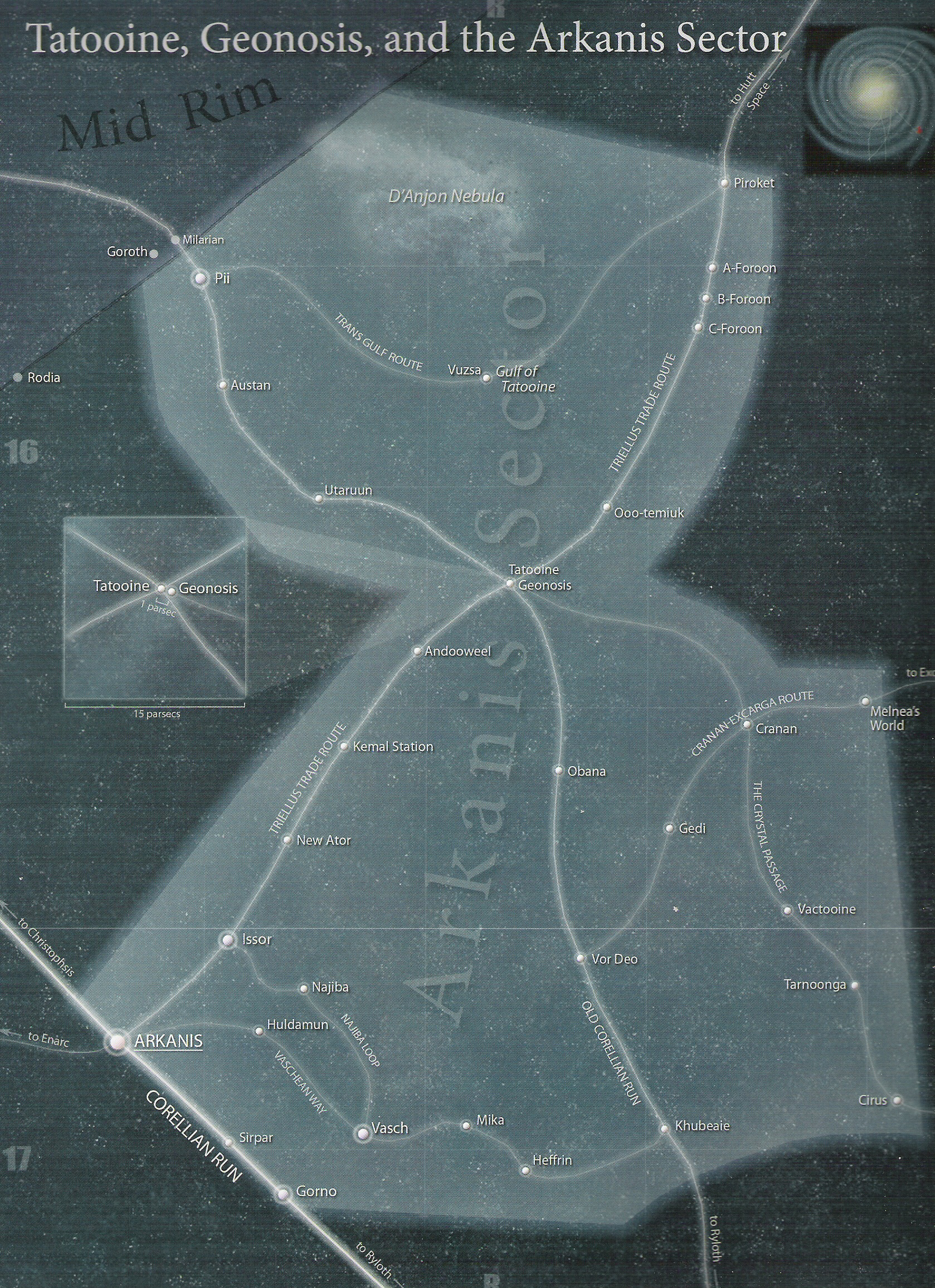
The sector, which was largely an artificial division of space organized for political, military, and economic reasons, served as the basic political unit for much of galactic history. The star systems of the Republic were organized into sectors limited to fifty systems with substantial populations after the Galactic Republic's early years. The Galactic Senate became gridlocked due to the large number of sectors as the Republic expanded, and some sectors grew to include thousands of inhabited worlds, even as galactic civilization continued to expand wildly, resulting in millions of sectors.
The Ruusan Reformations of 1000 BBY, which reorganized the galaxy into 1,024 regional sectors divided into constituent subsectors, did not resolve this. The Chommell sector of the Mid Rim, for example, contained approximately forty thousand inhabited worlds, despite being sparsely populated. By 0 BBY, sectors included cultural groupings such as the Tapani sector and the Senex-Juvex, as well as business-controlled economic areas such as the Corporate Sector. However, they were generally arbitrary groupings of planets and colonies with vastly different fates and cultures, such as the Gordian Reach, the Arkanis sector, and the Anoat sector.
The Ruusan Reformations created a number of sectorial representation problems that would persist until the Republic's demise. A moratorium was placed on the creation of new sectors, but settlers continued to push beyond the Republic's frontier, reclaiming systems lost during the New Sith Wars and settling new worlds. Some of these systems were annexed by existing sectors, causing some outlying sectors to grow to enormous proportions. Others became de facto corporate possessions or were directly administered by the Republic bureaucracy and denied Senate representation, despite claims that they were "virtually represented" by other senators. The old Core sectors saw the rimward megasectors as a threat to their ancient power and prestige, while the directly-administered systems complained that their "virtual representation" was a sham. The reforms of 124 BBY sought to address these issues, with many settled areas outside the Republic's borders being incorporated as freestanding subsectors, with their representatives reporting to the senator of an associated sector.
Sectors were governed by their senators until the Galactic Republic's final years, while the Supreme Chancellor had the authority to appoint a Governor-General to coordinate military action within the sector during a state of emergency. Palpatine frequently used this law during the Clone Wars, culminating in the Sector Governance Decree, which appointed a permanent new class of military governors to the regional sectors – the Galactic Empire's Moffs. The Galactic Empire also created or carved out a number of new sectors, overturning the Ruusan Reformations' moratorium, including the Indrexu sector in the Greater Tion, and combined several freestanding subsectors to create the Baxel and Zuma sectors.
Any planet with a large enough population was granted a seat in the Galactic Senate during the Galactic Republic's early years. However, even before the Galactic Republic had expanded beyond the Core Worlds, this governmental system was unworkable: the Senate's immense size made debate unending and consensus nearly impossible to reach. As a result, the Planetary Senate was reorganized, with sectors made up of groups of up to fifty star systems serving as the new constituencies, while recognized representatives of a single planet or species retained the right to petition the full Senate. Jar Jar Binks, representing the Gungan people of Naboo, was a prominent example of this near the end of the Republic.
Planetary Governors served as the central government's representatives on a single planet. Their jurisdiction typically encompassed the entire star system, with exceptions for systems containing multiple planets with large populations or vastly different cultures, such as the Corellian system. Systems and even individual planets were centers of political power in the Core Worlds' oldest regions, a remnant of the Galactic Republic's origins. Systems were subordinate to subsectors, sectors, and regions in representation elsewhere.
Client states and Allied Regions
The Allied Regions were independent states that voluntarily joined the Galactic Republic as it grew early in its history, and their rulers were given the honorary title of Moff. Most Allied Regions had been divided into sectors by the time of the Clone Wars, but a few remained as regions with a distinct cultural identity, such as the Trailing Sectors or the New Territories; or a sector dominated by a single species, such as Trianii Space. Several of these governments survived as client states under the Galactic Empire and maintained some independence. The New Republic recognized them afterward.
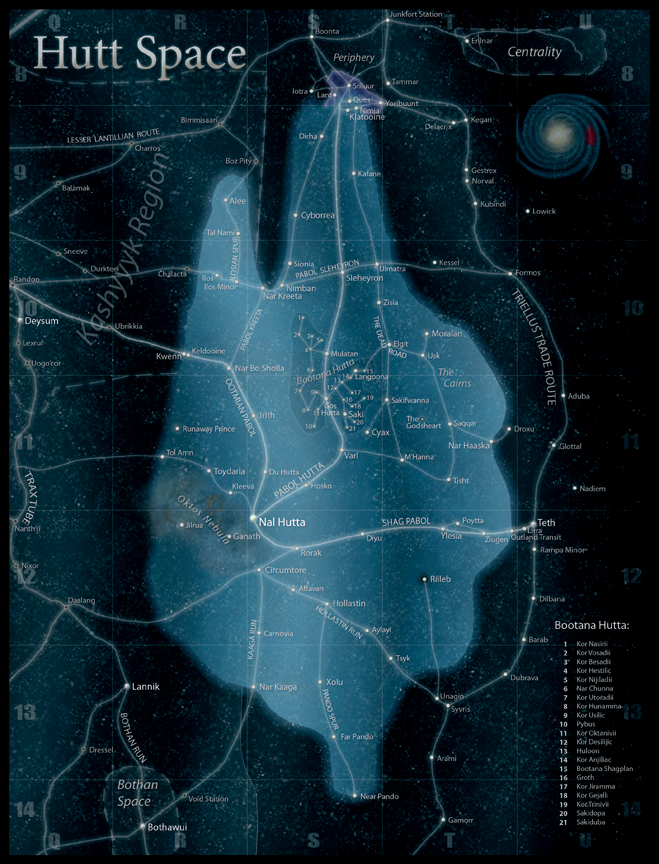
Hutt Space referred to the Rimward Slice's large stretch controlled by the Hutt Ruling Council, the Hutt species' governing body. The Hutt Empire, originally powerful warriors, overthrew Xim the Despot's empire, but a devastating civil war around 15,000 BBY known as the Hutt Cataclysms prompted a cultural reformation, ushering in a new philosophy known as kajidic, which emphasized economic dominance over outright conquest. Hutt Space's borders fluctuated over the millennia, but the Hutts' influence in both the economic and criminal spheres remained, extending as far Coreward as Gyndine as the Galactic Republic deteriorated during the Separatist Crisis. Hutt Space was technically part of the Galactic Empire, but the New Order largely tolerated the Hutts' criminal activities because the Hutt Ruling Council was a known entity compared to the possibility of hundreds of feuding Hutt crime lords. Hutt Space was devastated during the Yuuzhan Vong War, but it recovered surprisingly quickly, ushering in a new era of Hutt militarism that manifested itself when the region declared its support for the Confederation during the Second Galactic Civil War.
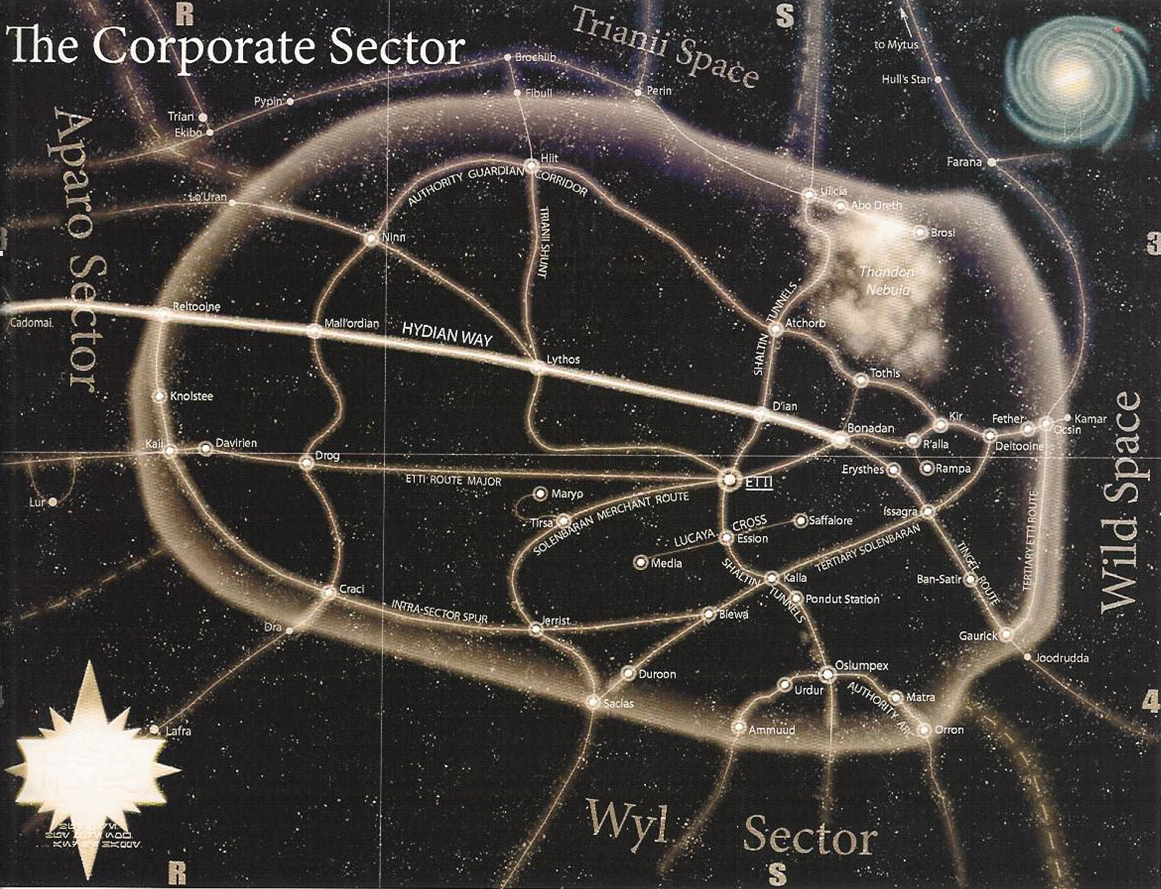
The Corporate Sector Authority, or CSA, functioned as the government for the Corporate Sector. This region, comprised of nearly 30,000 star systems bordering the Tingel Arm, was governed from Etti IV. It was essentially a consortium of businesses and corporations holding exclusive rights to all resources within the sector. This experiment in corporate governance, designed to safeguard worker rights, was implemented following the lessons derived from the Outer Expansion Zone scandal. Baron Orman Tagge's suggestion led to the Corporate Sector's significant expansion under the Galactic Empire, transforming it into a formally recognized haven for Loyalist corporations seeking protection from nationalization. The CSA thus became the region's sole governing body, employer, proprietor, and military force, with corporations investing in the Authority receiving profit shares proportional to their investment.
Established in 3350 BBY, the Centrality was an independent state founded on libertarian principles, existing as an extended territory located north of Hutt Space. Predominantly inhabited by Humans, its capital, Erilnar, was often under the sway of Hutt kajidics, who frequently benefited from the profits generated by the Centrality's primary export: the life-crystals sourced from Rafa V. Although officially an Imperial territory, the Imperial Center generally left the Centrality to its own devices. Emperor Palpatine's only significant action concerning the region occurred a few years before the Battle of Yavin, when he granted de facto control of the Centrality to Rokur Gepta, the Sorcerer of Tund. Gepta was later killed by Lando Calrissian at the Battle of ThonBoka while defending the region's native Oswaft.
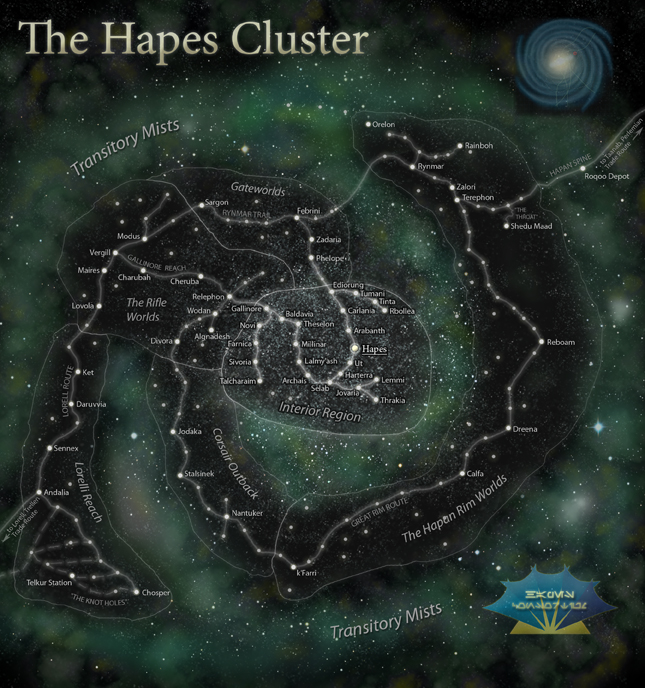
Located in the Inner Rim, the Hapes Consortium represented the monarchical government ruling the Hapes Cluster. Known for their isolationist policies and matriarchal society, the enigmatic Hapans were renowned for their purported wealth, beauty, pride, and internecine aristocratic conflicts. Many were surprised by Emperor Palpatine's acceptance of the region's autonomy, with some suggesting that the Emperor maintained Hapes as a cautionary example to the galaxy, illustrating the dangers of isolation and moral decay. Following the Declaration of a New Republic, the Hapes Consortium chose to open its borders.
Situated in the Core Worlds, close to the Unknown Regions, the Atrisian Commonwealth encompassed a region of two hundred planets. The political, military, and diplomatic writings originating from Atrisia, notably the Sayings of Uueg Tching, had been the subject of study for millennia. After Emperor Palpatine's death on Endor, the isolated territory declared its independence, eventually accepting Allied Region status within the New Republic. Similarly, Nouane, initially a flourishing Inner Rim empire beyond the Slice, was celebrated for its philosophers and intellectuals, particularly the controversial Four Sages of Dwartii. Nouanese ministers were frequently found in the fledgling Republic, and the territory sought Allied Region status after being devastated by the Mandalorian Crusaders in 3963 BBY. This region, consisting of 212 planets, had been a steadfast supporter of the Empire and proclaimed its independence under the New Republic.
Bothan Space encompassed around 150 settled systems in the Mid Rim, predominantly inhabited by Bothan colonists and governed by the Bothan Council. The Bothans, one of the few species near Hutt Space to retain their independence, were credited with the diplomatic and espionage efforts that maintained stability across much of the Mid Rim. In 4 ABY, Bothan Space was among the first regions to announce its support for the New Republic.
The Botor Enclave and the Daupherm Planet States were neighboring territories situated on the Core's periphery. The ursine Botori held dominion over two dozen star systems located within a nebula, while the Human Dawferim controlled slightly over thirty systems. Despite accepting Allied Region status under the Galactic Republic, the two states had engaged in no fewer than forty wars, and both declared their independence following the Declaration of a New Republic.
Herglic Space denoted the diminished remnant of the once-great Herglic Trade Empire. It included approximately forty star systems along the Rimma Trade Route, but substantial Herglic populations existed on hundreds of worlds outside Herglic Space along the Rimma. While brutally oppressed under the Empire, Herglic Space regained Allied Region status under the New Republic and the Galactic Federation of Free Alliances.
The Ktilac Regions, a confederacy located off the Perlemian Trade Route within the Inner Rim, were governed by three species: the Ktilacs, the Murachaun, and the Tocoyans. Driven by religious fundamentalism, the region had fostered a shared culture in which each species was viewed as complementary to the other two, while the rest of the galaxy was deemed unholy. Each species governed sixty-three star systems, with an additional three open to outsiders under strict conditions. The Regions maintained Allied Region status within the Galactic Alliance.
Paqwepori was a small grouping of ninety affluent star systems situated just off the Corellian Run in the Mid Rim. The bazaars of Paqwepor Major were popular destinations for Republic traders extending the Corellian Run for countless years. The Paqwepori were recognized for their passion for commerce and ambition, while simultaneously despising any law that might restrict individual expression or initiative.
Economy
The expansion of technology and civilization across the galaxy resulted in the emergence of the galactic economy, which is the system involving the production, distribution, exchange, and consumption of goods. Few planets could achieve total self-sufficiency. Some, like the factory worlds of Telti and Mechis III, focused their economies exclusively on producing high-tech goods, relying on agriworlds for sustenance. Conversely, these agriworlds depended on manufacturing planets to provide the heavy machinery necessary for harvesting and processing foodstuffs, as well as chemical industries for the production of fertilizers and pesticides.
Due to the galactic economy's significance, several megacorporations were able to amass substantial economic and political influence. In the years leading up to the Clone Wars, the Trade Federation, a consortium of shipping and merchant cartels, exerted control over the votes of hundreds of star systems within the Galactic Senate by making their commerce reliant on its Merchant Fleet and enforcing agreements through the Trade Defense Force. Corporations such as the SoroSuub Corporation, which directly governed the planet Sullust under the Empire, produced goods for a wide range of industries. TaggeCo controlled numerous star systems and a multitude of subsidiaries, establishing itself as one of the galaxy's most powerful entities. Even smaller enterprises, like the Figg conglomerate in the Greater Javin, wielded considerable influence within their homeworlds and sectors.
The primary currency of the Galactic Republic was the Galactic Credit Standard, which was divided into ten decicreds.
Demographics
Population
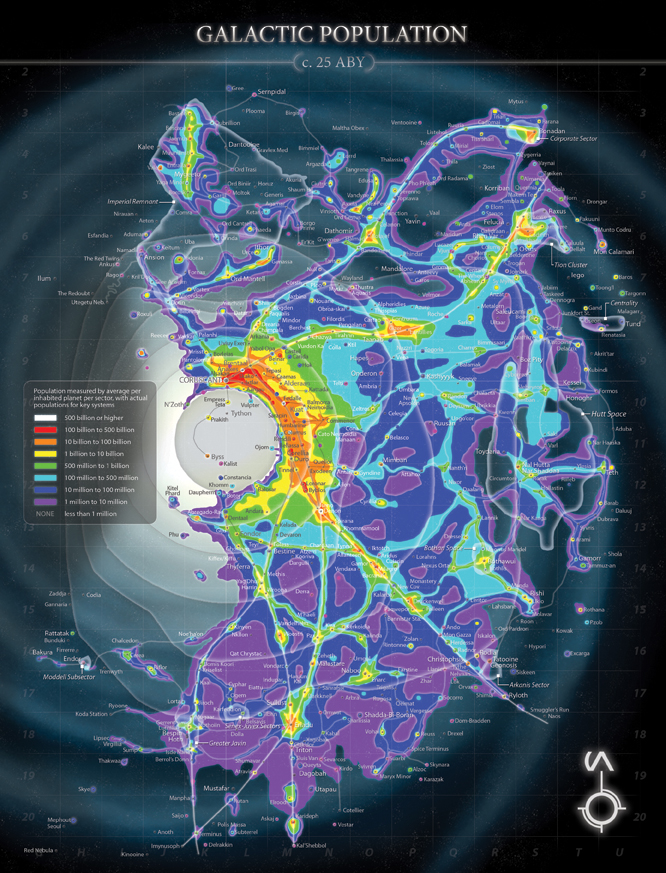
Of the galaxy's one billion settled systems, most were sparsely populated colonies of little importance, often absent from sector maps. The Chommell sector, for example, included thirty-six worlds with sufficient population to warrant representation in the Galactic Republic, alongside 40,000 settled dependencies and 300,000,000 barren, uninhabited stars.
During the era of the Galactic Empire, over 69 million systems met the criteria for Imperial representation, with 1.75 million planets recognized as full member worlds. The population of these nearly 70 million systems under Imperial jurisdiction exceeded 100 quadrillion individuals.
Races and species
Given that only about a quarter of the galaxy's four hundred billion stars had been thoroughly explored, scientists remained uncertain about the actual number of sentient species. The Galactic Empire recognized five million sentient species, although it was generally accepted that galactic civilization had yet to discover many more, potentially raising the total to as high as twenty million.
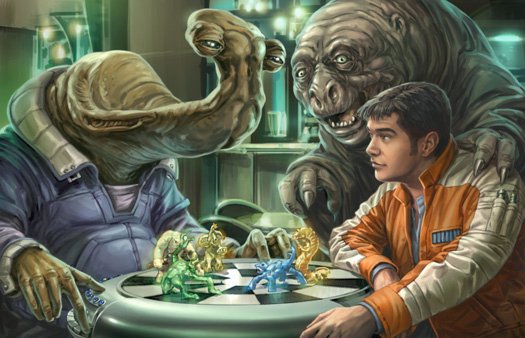
In the established history, Humans were the predominant species. Originating from the Core Worlds, Humans were the most numerous species in the galaxy, and therefore often formed the basis of major governments. Sentient beings who were not Human were sometimes called "aliens," although the term "non-Human" was considered less offensive. Nevertheless, the Humanocentric definition of races was considered unacceptable by some, and simply another expression of unwarranted Human dominance. Other notable spacefaring species included the Baragwin, who had long forgotten their homeworld and roamed the galaxy as merchants; the Duros, a founding species of the Republic and creators of the modern hyperdrive; the Herglics of Giju, the founders of the Rimma Trade Route; the Gran of Kinyen, who had settled countless colonies, including Malastare; and the Ithorians, who had long maintained great networks of Herdships for galactic trade, and transferred their civilization there after Ithor was devastated during the Yuuzhan Vong War.
Although not considered a race for obvious reasons, droids played a significant role in society, assisting and living alongside the population. On Naboo, more advanced droids were regarded as equals, recognized as fellow sentient beings.
Extragalactic interaction

Due to a circumferential hyperspace barrier that restricted hyperspace routes far beyond the galactic disk, and the desolate expanse of the Intergalactic Void, travel between galaxies was challenging. However, by the time of the Clone Wars, contact had been made with two small galaxies orbiting the main galaxy: the Rishi Maze, also known as Companion Aurek, and Firefist, also known as Companion Besh. The InterGalactic Banking Clan held influence in these distant locations.
The Extragalactic Society was an organization dedicated to discovering life beyond the galaxy. Around the period of the Clone Wars, two major expeditions were launched to explore beyond the galaxy: the Outbound Flight Project aimed to establish a settlement in another galaxy but was destroyed by the Chiss after accidentally entering their territory in the Unknown Regions. In 19 BBY, during the Republic's final days, Senator Grebleips, the leader of the Brodo Asogi, sent an expedition to another galaxy, but the outcome of this mission remains unknown.
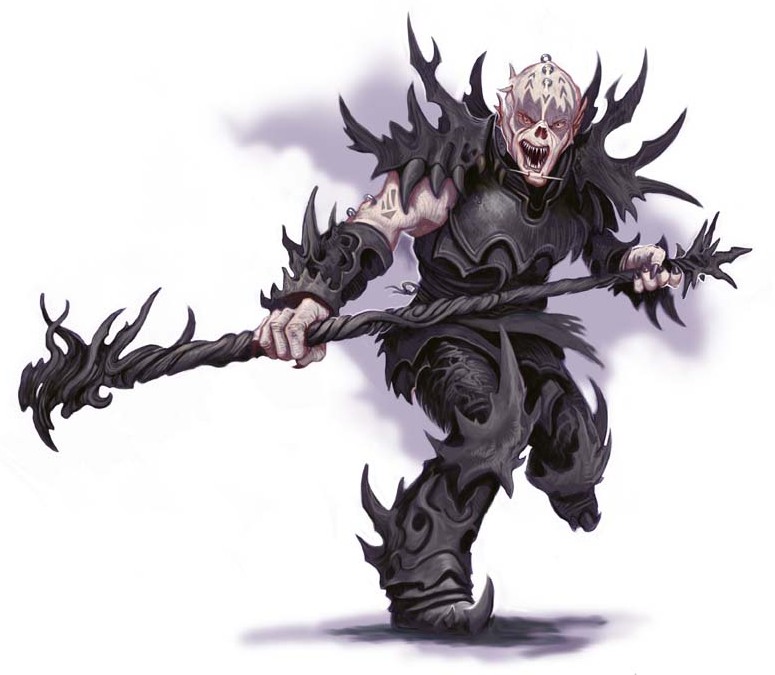
Shortly after the Battle of Endor, the Nagai and the Tofs, species originating from the companion galaxy of Firefist, invaded the galaxy. The Nagai sought to escape the Tofs, who had oppressed them for centuries. With the help of the Alliance of Free Planets and the Mandalorians, the Nagai defeated the Tofs and returned to liberate their home galaxy, bringing the Nagai–Tof War to an end.
Among the most notorious extra-galactic aliens were those who had fled from the Yuuzhan Vong galaxy: the droid races of the Abominor and the Silentium, as well as the Yuuzhan Vong themselves and their slave soldiers, the Chazrach. The Abominor and the Silentium had engaged in a devastating war before the Yuuzhan Vong rose up against both and drove them from their galaxy. Of the surviving Silentium and Abominor, two individuals, the Great Heep and Vuffi Raa, established themselves in the galaxy around the time of the Galactic Civil War. The former was destroyed on Biitu, while the latter was recovered by the Silentium after the Battle of ThonBoka.
After expelling the Silentium and the Abominor from their galaxy, the Yuuzhan Vong turned inward and fought their own civil war, the Cremlevian War, which decimated much of their galaxy's life. Seeking a new home, the Yuuzhan Vong and the Chazrach traversed the Intergalactic Void for millennia until they arrived in the galaxy, initiating a religious war that nearly destroyed galactic civilization as it was recovering from the Galactic Civil War.
Speech
The galaxy's common language was Galactic Basic Standard, which originated as a Human language from Coruscant known as Old Galactic Standard. As the Galactic Republic grew, Old Galactic Standard incorporated elements from Durese, Bothese, and Olys Corellisi, evolving into Mid-Galactic Standard by 15,000 BBY. The influence of the Dromnyr language after the Vultans joined the Galactic Republic around 14,000 BBY led to the development of Mid-Galactic Standard into modern Basic. As Humans were the dominant species in the galaxy, Basic was also adopted by many non-Human species.
The second most prevalent language was Huttese, which spread through the Hutts' criminal and financial activities, leading to its adoption throughout the Outer Rim Territories by species closely associated with them, such as the Rodians and the Toydarians.
The primary writing system in the galaxy was Aurebesh, derived from the script of the Rakatan Infinite Empire by its former subject species after the Empire's fall, although the symbols themselves may have been much older. Aurebesh spread across the galaxy during the Tionese War between the young Galactic Republic and the Honorable Union of Desevro & Tion, when the new Republic Military standardized its communications and adopted Coruscant's writing system. The second most common writing system was the High Galactic alphabet, promoted by Alsakan after 17,000 BBY during the Alsakan Conflicts as part of its efforts to be recognized as the galactic capital. Derived from Tionese characters, the High Galactic alphabet was popular among the upper class, and as late as 22 BBY, one-third of Republic citizens who spoke Basic used the High Galactic alphabet. Consequently, notices were often written in both Aurebesh and High Galactic.
Behind the scenes
Name
There hasn't been a serious effort to provide the galaxy with an official astronomical designation. The descriptive phrase "the Star Wars galaxy" is commonly used outside of the fiction. According to The Essential Atlas, the Nagai of Firefist call the main galaxy Skyriver, which is the closest any official source has come to giving the galaxy an in-universe name. However, it is unknown whether or how members of the galactic community refer to their own home galaxy, as we call ours the "Milky Way".
"The Galaxy Far, Far Away," frequently shortened to GFFA, is the informal name many fans use for the galaxy that serves as the setting for the Star Wars films and related works. Within the films, this galaxy is simply referred to as "the galaxy." This name originates from the introductory text at the start of each film, many video games, and some fan films and novels:
The acronym GFFA became so widespread that Del Rey named the post-New Jedi Order government, the Galactic Federation of Free Alliances, in its honor.
Relation to Earth
The opening lines of each Star Wars film place the galaxy within the same reality as our own, indicating that it is a finite distance—"far, far away"—from us, but no further details about its location have been revealed. Humans exist in both galaxies, and Galactic Basic is essentially the same as modern English, including its British, American, New Zealander, Caribbean, and Indian variations. Moreover, numerous cultural practices (from the handshake to marriage) are similar or identical in both galaxies, though these similarities lack explanation.
Similarly, the time frame of the galaxy and the events within it, compared to Earth's timeline, is not explicitly stated beyond the opening declaration that they occurred "A long time ago." The teaser trailer for A New Hope began with the line "Somewhere in space, this may all be happening right now..." Originally, George Lucas intended the galaxy to be within our own, specifically in the thirty-third century, as noted in his initial treatment for the first film. Walter Murch, a colleague of Lucas since his time at American Zoetrope, suggested that the decision to set the story in a galaxy "far, far away" was partly to allow Lucas to both create the film and subtly convey anti-Vietnam War messages, akin to a transubstantiated remake of Apocalypse Now, as he couldn't directly address the Vietnam War while it was still ongoing. George Lucas provided a similar explanation for the change in The Making of Star Wars.
The Empire Strikes Back debate
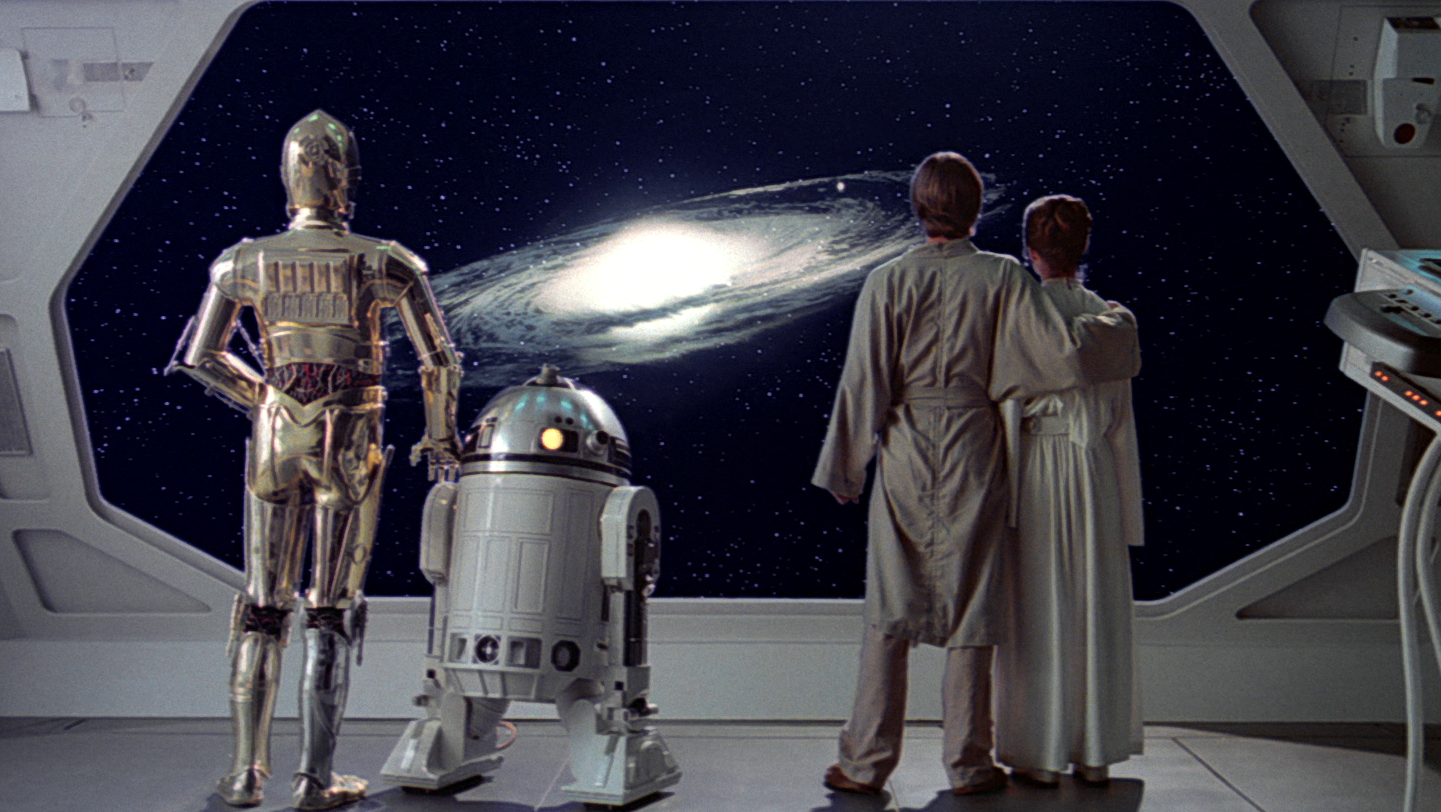
At the conclusion of Star Wars: Episode V – The Empire Strikes Back, the characters observing from the Rebel fleet witness a distant cosmic entity. Certain enthusiasts have posited that its rotational velocity is excessively high for a galaxy, and its luminosity at that distance would be less intense than depicted in the movie.
Certain accounts suggest the fleet concealed itself beyond the galactic disk, potentially alluding to this specific scene. However, as stated in the Tales of the Bounty Hunters story Of Possible Futures: The Tale of Zuckuss and 4-LOM from 1996, the object seen is indeed the galaxy itself, with the Rebel fleet having journeyed to a location in space significantly elevated above the galactic plane. This point, while not technically outside the plane, was situated at a considerable height above it.
Following the publication of Tales of the Bounty Hunters, the identification of the object has varied. The Complete Star Wars Trilogy Scrapbook, initially published in 1997, describes it as a rotating star formation. The Episode II DVD-ROM Exclusive Content in 2002 proposed that the luminous object might be the cluster known as the Rishi Maze. In 2003, Leland Chee verified on the StarWars.com Message Boards that the object was, in fact, the Star Wars galaxy. This was further supported by the release of The Essential Atlas in 2009, which confirmed the Rebel fleet's regrouping at a point above the galactic plane.
A History of Published Cartography
Numerous publications have presented "maps" of the galaxy. However, these are, at best, two-dimensional projections of what is actually a three-dimensional galaxy. The initial maps of the Star Wars galaxy appeared in roleplaying game sourcebooks created by West End Games, which featured detailed maps of specific regions and sectors. The Elrood sector was mapped in Planets of the Galaxy, Volume Three, the Brak sector in Flashpoint! Brak Sector, the Kathol sector in The DarkStryder Campaign, and the Tapani sector along with the Rimma Trade Route in Lords of the Expanse.
Despite these localized maps, a fully realized, official galactic map did not emerge until 1998 with the release of the CD-ROM digital encyclopedia Star Wars: Behind the Magic. This map pinpointed the locations of key planets from both the films and the Expanded Universe. The map offered a bird's-eye view of the Star Wars galaxy, employing concentric rings to denote the various regions, ranging from the Deep Core to the Outer Rim Territories, and also marked the location of Naboo, which was set to appear in the then-upcoming Star Wars: Episode I – The Phantom Menace.
The year 1999 brought the debut of The New Jedi Order series, with each novel incorporating a comprehensive galactic map illustrating the progression of the Yuuzhan Vong invasion. These maps presented an isometric view of the galaxy, showcasing the spiral arms and the largely uncharted galactic west, known as the Unknown Regions. Each novel featured the same foundational map, which charted planets from established lore alongside newly introduced worlds from the New Jedi Order narratives. The Essential Chronology from 2000 reused this map as its endpapers.
Inside the Worlds of Star Wars: Episode I, also released in 2000, reverted to a map format using concentric circles, similar to the Behind the Magic map, but maintained largely consistent planet placements with The New Jedi Order map. However, other maps, beginning with Star Wars Gamer 5, expanded upon the concept of The New Jedi Order map, and increasingly detailed color maps were featured in certain issues of The Official Star Wars Fact File (1, 56, 139). A sizable poster map was included in Star Wars Insider 65 in 2003, and The New Essential Chronology from 2005 also dedicated a spread to an updated galaxy map and its most prominent systems, and was the first to identify the locations of the planets from Star Wars: Episode III – Revenge of the Sith.
The year 2009 saw the publication of The Essential Atlas, which abandoned isometric projections in favor of a top-down chart, while preserving regional boundaries and planet placements to a great extent. In addition to a large-scale galaxy map, The Essential Atlas also contained a multitude of historical, regional, and sectoral maps, and introduced a coordinate system and galactic compass. Furthermore, The Essential Atlas included an index of 4,387 star systems, assigning each a coordinate, sector, and region. Since then, The Essential Atlas has been augmented by an Online Companion, which features an updated index listing 5,085 star systems, believed to encompass every system mentioned in Star Wars Legends, as well as maps of the Outer Rim, Mid Rim, and Expansion Region sectors.
Video Game Cartography
The chapter selection screen of Star Wars: TIE Fighter (1995) marked the initial appearance of what could be deemed a galaxy map. It consisted of a basic galactic shape with the supposed location of the current mission highlighted. However, these highlights do not align with the canonical coordinates of those locations (for example, selecting the Greater Javin campaign incorrectly highlights the Galactic Core). The 1998 video game Star Wars: Rebellion presented a galaxy map interface divided into 20 sectors and 200 systems. Nevertheless, these positions are solely for game mechanics and have been contradicted by subsequent official sources.