Imperial Palace
The Imperial Palace, also called the Emperor's palace and previously known as the Jedi Grand Temple, the Coruscant temple, or simply the Jedi Temple, served as the official residence for Darth Sidious, the Galactic Emperor and Dark Lord of the Sith. It was situated in the Palace Court within the Federal District of Imperial City on Coruscant, which was the capital planet of the Galactic Empire during the Imperial Era. Although its Jedi origins were erased, the Palace maintained its ziggurat shape, along with its signature feature: a crown composed of four Council Towers and the central Palace spire, which housed the Emperor's throne room.
Millennia before Sidious' ascent to power, the Four Masters constructed it as a Jedi temple atop the Shrine in the Depths's foundations, functioning as the Jedi Order's home throughout the Republic Era. It underwent several reconstructions and expansions over the centuries. Besides being the central hub for all Jedi activities across the galaxy, the Temple served as a monastery for Jedi Knights and Jedi Masters and a training academy for Padawans and initiates. Key areas within the Temple included the Holocron Vault, safeguarding the Order's most confidential secrets; the Jedi Archives, the most extensive information repository; and the Jedi Council Chamber, where the Jedi High Council convened to deliberate on galactic events and discern the will of the Force.
During the Clone Wars, the Jedi, as leaders of the Grand Army of the Republic, coordinated the war effort against the Confederacy of Independent Systems from the Temple on Coruscant. Despite its security, Cad Bane, a bounty hunter, infiltrated the Temple and stole a holocron at the direction of Darth Sidious, a Sith Lord. In 19 BBY, a bombing attack orchestrated by Padawan Barriss Offee damaged the Temple. Following this terrorist act, the Jedi attempted to remove Palpatine from his position as Supreme Chancellor after discovering his identity as Darth Sidious. Consequently, the 501st Legion, under the command of Darth Vader, Sidious' Sith apprentice, marched on the Temple. The Jedi, branded as traitors under Order 66, were attacked by clone troopers both within the Temple and throughout the galaxy, marking the beginning of the Great Jedi Purge. With the Sith regaining power, the Jedi Temple was transformed into the Imperial Palace.
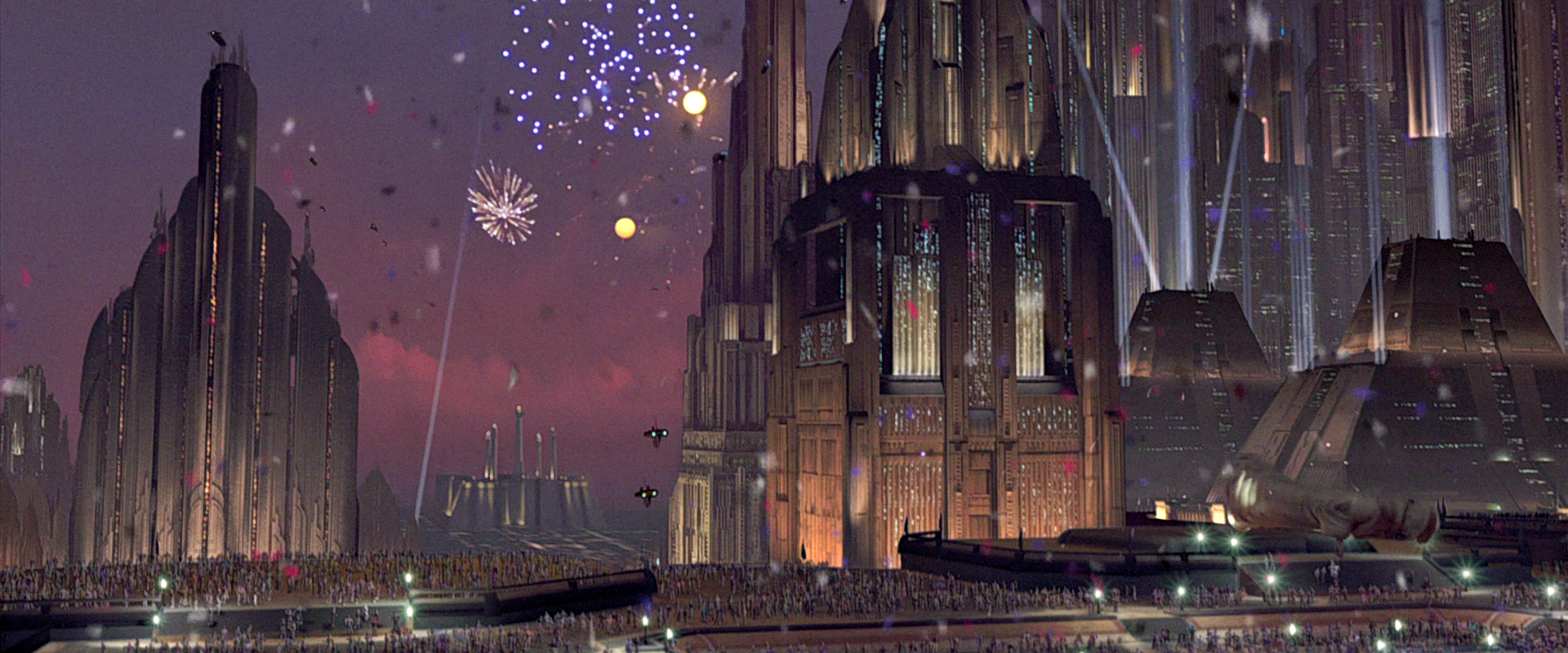
The death of the Emperor at the Battle of Endor in 4 ABY triggered celebrations among the citizens of Coruscant in the streets of Monument Plaza, while Mas Amedda, the Grand Vizier, and his supporters barricaded themselves inside the Palace. Around the same time, Luke Skywalker, a Jedi Knight, recovered fragments of the Great Tree that once stood at the heart of the Jedi Temple. In the final days of the Galactic Civil War, soldiers loyal to Gallius Rax, the self-proclaimed Counselor to the Empire and Fleet Admiral, placed Amedda under virtual house arrest within the Palace. By the time of the Battle of Jakku in 5 ABY, he had escaped from the Palace with the help of a gaggle of children.
Description
Jedi Grand Temple
Among all Jedi temples in the galaxy, the Jedi Grand Temple held the most renown. Situated apart from the rest of the Federal District on Coruscant, the Temple occupied its own low-rise area known as the Temple Precinct. This Precinct, adorned with statues and small parks, was divided by the Processional Way, a lengthy road that culminated in a ceremonial staircase leading to the Temple's entrance hall. The main entrance, crowned by four statues—two Warrior Masters and two Sage Masters—featured twelve massive pylons decorated with depictions of the Four Masters who founded the Temple.
Constructed around and incorporating a natural mountain spire, the Jedi Temple was an amalgamation of numerous shrines, temples, academies, and sacred sites that had existed on the location for millennia. As a sacred place for various Force traditions, the Temple preserved some of these ancient structures, repurposing them as museums or art galleries due to their architectural and historical significance. The mountain spire's peak at the facility's core was surrounded by ancient meditation balconies and access points to the mountain's interior, which was riddled with cave chapels and buried shrines. One of the earliest Jedi libraries on the site was eventually transformed into a formal banquet hall. As the Jedi solidified their control over the facility, they began to incorporate their architectural style, constructing a massive ziggurat around the mountain spire that completely enveloped it.
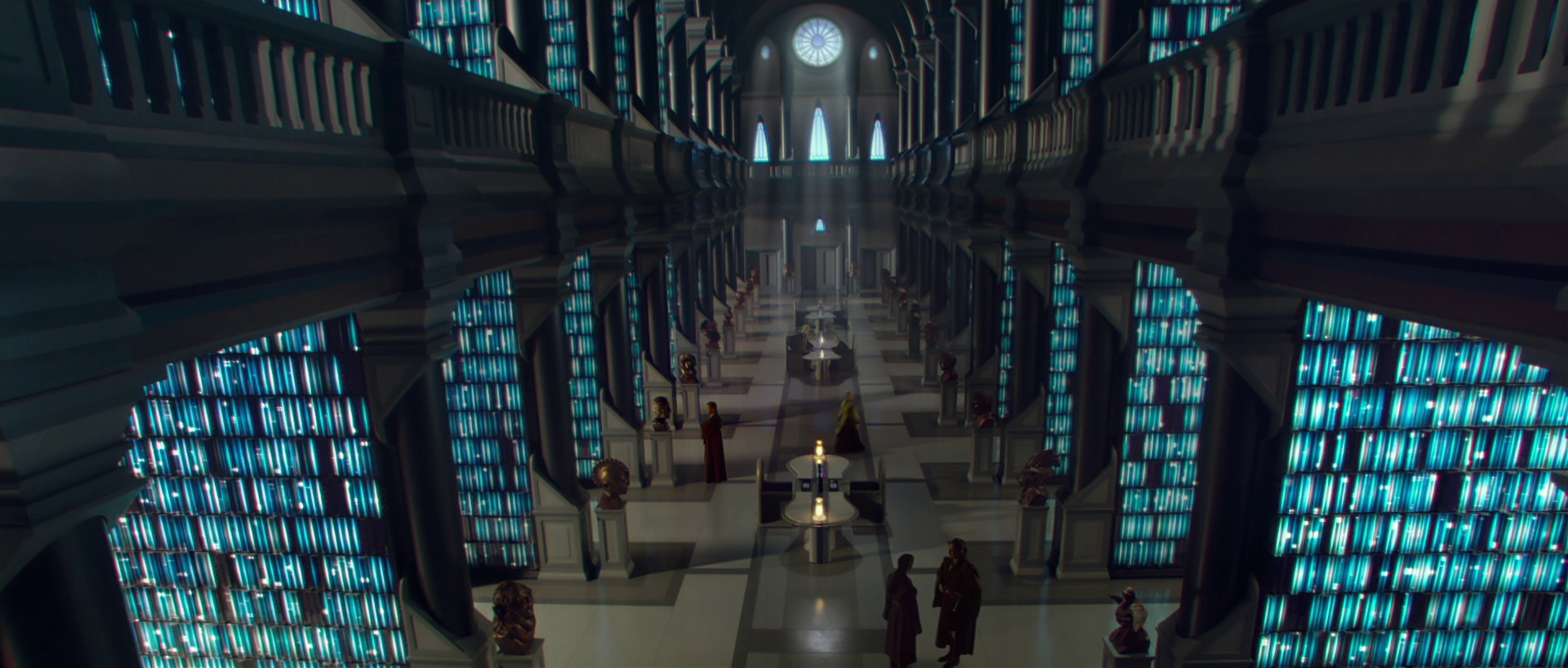
The ziggurat's base consisted of a series of pillared halls supporting the weight of the structure above. Additional rooms, such as the Room of a Thousand Fountains and a rotunda chapel converted into a meditation hall, comprised the base of the ziggurat. Higher up in the main body of the Temple complex was a medical center staffed by the Medical Corps, a transformation chamber for disguising Jedi, containment cells for hostile Force-users, and various workshops and maintenance facilities. The Temple also housed the Jedi Archives, a vast repository of knowledge said to contain the collective wisdom of the galaxy's scholars and historians. In addition to its collections of holobooks and artifacts, the Archives contained the secured Holocron Vault, where the Jedi stored their valuable holocrons, accessible only to Jedi Masters.
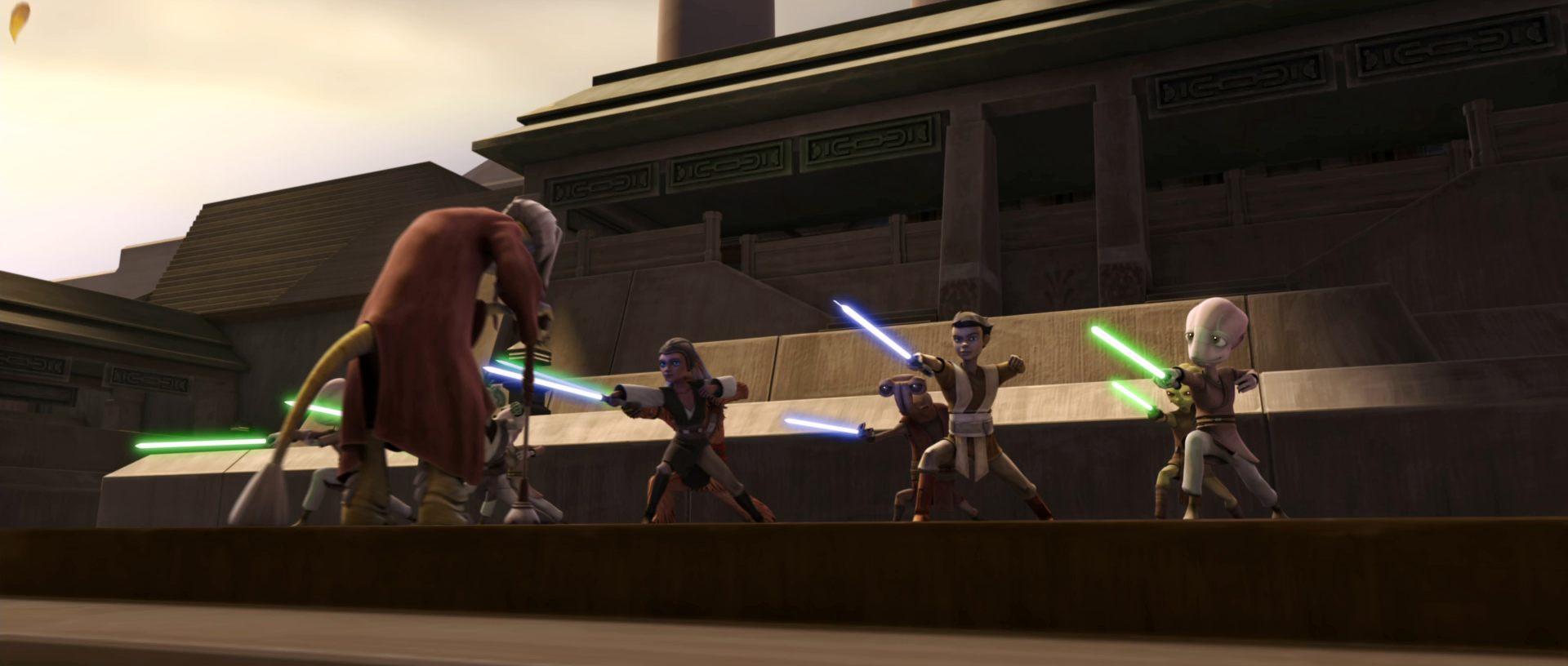
One level within the Temple was allocated for storage purposes. One of these storage areas was dedicated to linen products, while another was for training equipment. The Temple's interior was filled with dormitories and classrooms to house and educate the youngest initiates and Padawans. Holographic training suites employed advanced technology to simulate realistic combat scenarios for Jedi-in-training to enhance their skill with a lightsaber. A lightsaber crafting facility allowed Jedi to construct or upgrade their weapons between missions. More advanced classes were conducted in facilities built after the Temple's initial construction, found throughout the Temple Precinct. The surface level of the ziggurat base featured ancient temples and shrines from the Temple's earliest days.
The Chamber of Conclave was located among the shrines, serving as a gathering place for Jedi from across the galaxy to hear an annual report from the Jedi High Council. Among the ancient temples were salvaged remnants of the earlier Temple, believed to be about two thousand years old, and an ancient exterior wall of the Temple Precinct. Modern facilities were also erected here, such as the Temple's main vehicle garage and other facilities to house surface and ground vehicles. Throughout the Temple, visitors could find statues and tapestries detailing the history of the Jedi Order. One of the Temple's mosaic floors was salvaged from the ancient Jedi Temple on Ossus.
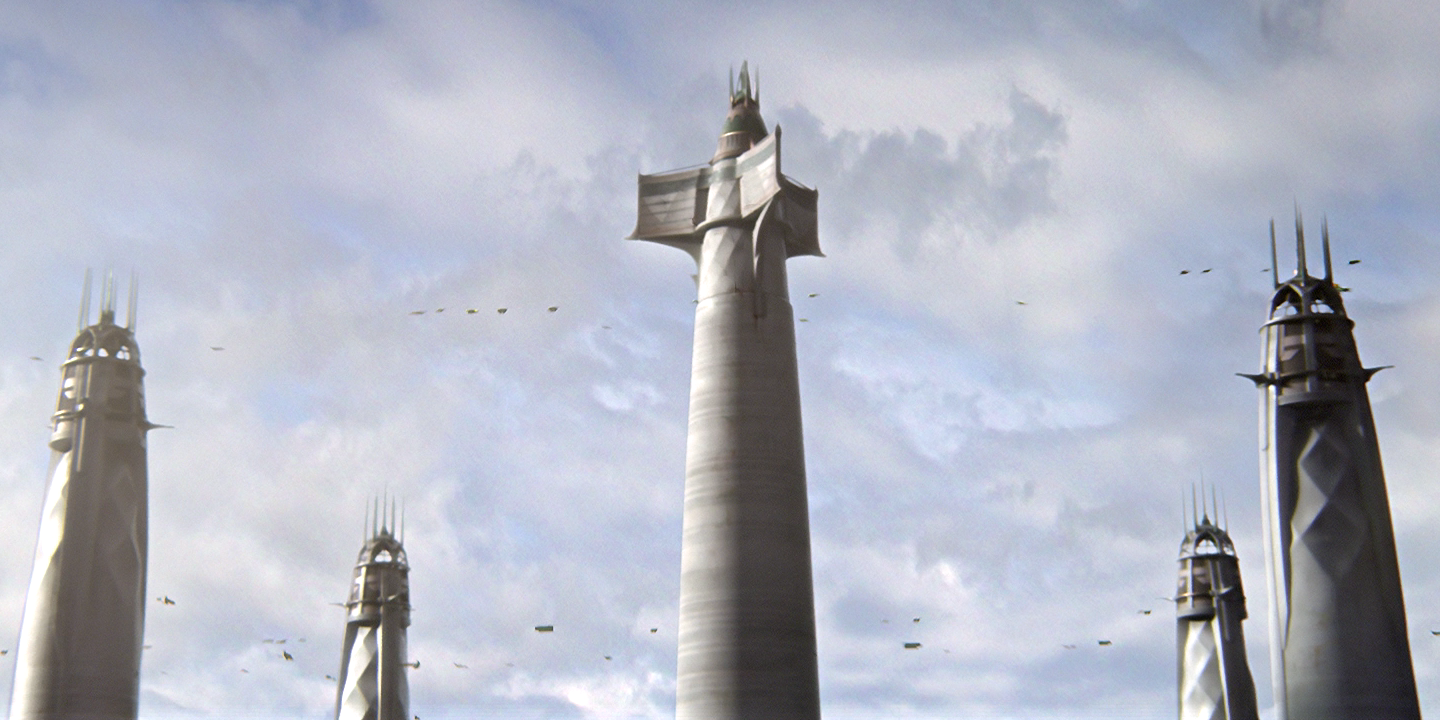
Stained-glass arcades and ancient tablets depicting battles and the Jedi Code preserved the Order's greatest heroes and most time-honored stories. The central spire of the Temple perhaps contained the most art and history. Rising from the center of the ziggurat's flat roof, the central spire towered above the four peripheral towers that crowned the facility. Within its hollowed interior, the central spire housed massive memorial statues suspended on repulsorlift pads. At its peak, the central spire was adorned with three decorative fins, inside which was housed the Hall of Knighthood, where the status of Jedi Knight or Jedi Master was conferred upon members of the Order. The Pinnacle Room of the central tower held the oldest known texts possessed by the Order. Members of the Jedi High Council would occasionally convene within this chamber to discuss the Order's future.
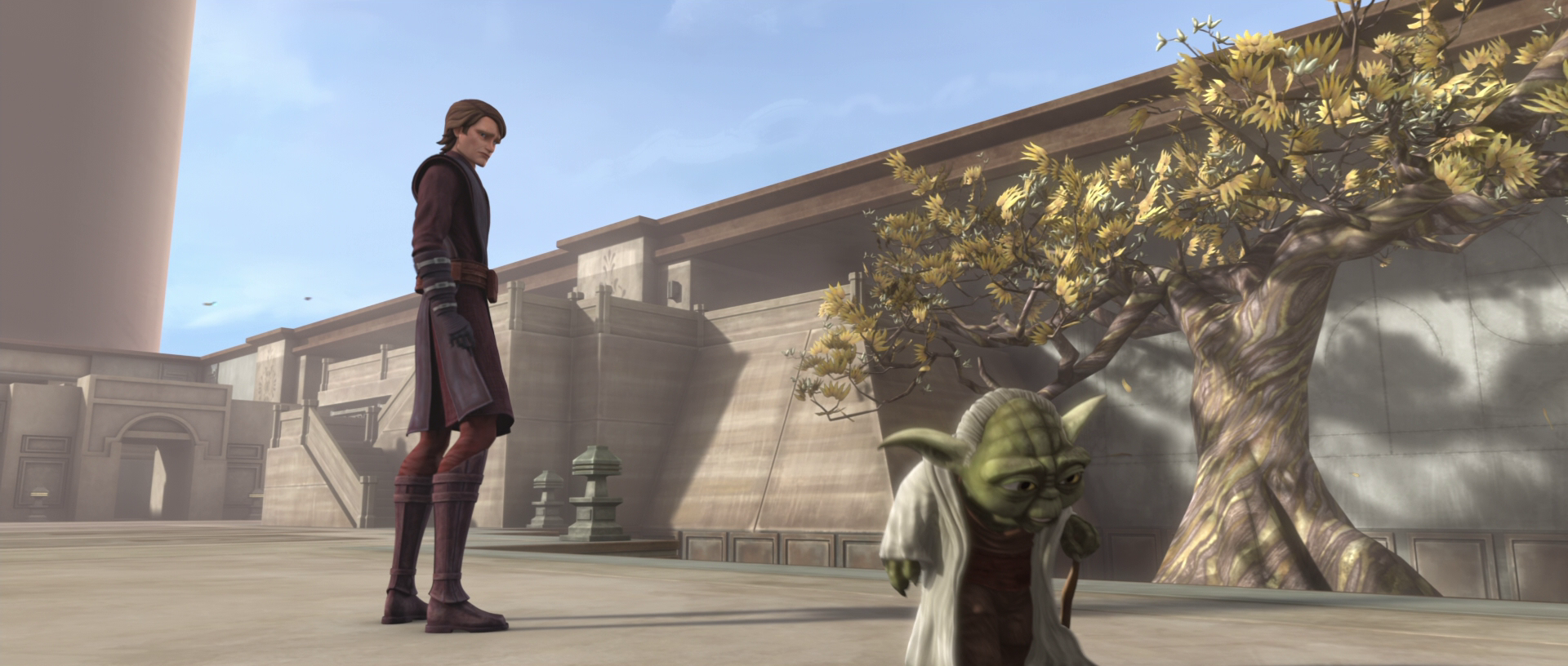
The roof of the Temple's ziggurat was accessible to Jedi and frequently used for outdoor sparring sessions by younglings and Padawans. A gnarled, ancient tree stood in the shadow of the Temple's five crowning spires, providing solace for many Jedi. Each of the four lesser towers of the Temple was topped with an array of powerful reception and transmission antennas that tapped into hyperspace itself, allowing the Temple to receive information in real-time. A pyramid system of holomaps operated within the towers, beginning with twelve teams at the base monitoring disturbances in the Force, and escalating potential threats to the large galaxy holomap situated below the pinnacle Council Chamber of each tower. Contemplation stations surrounded the holomap level of each tower, allowing Jedi awaiting an audience with the Council to find peace before appearing before the Order's leaders.
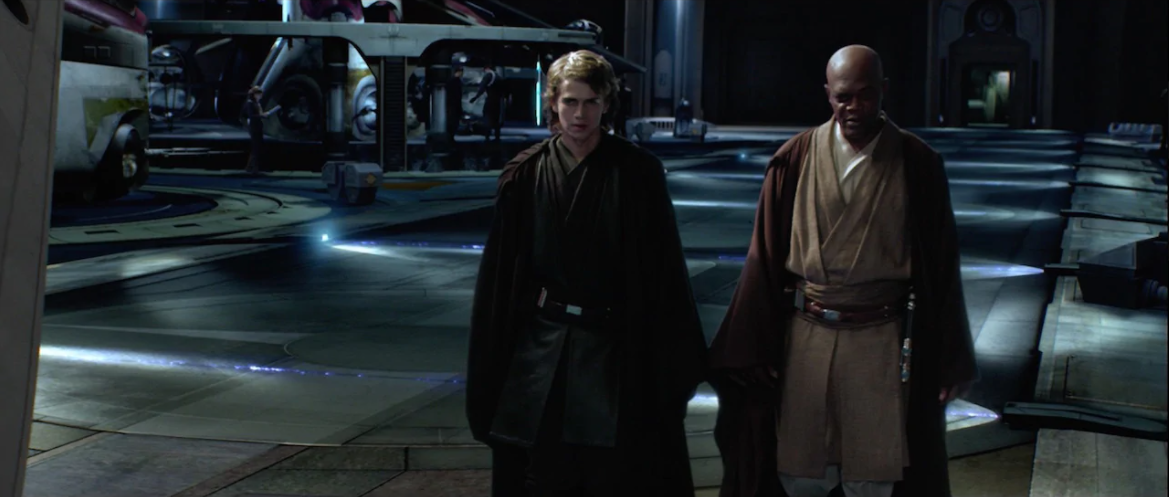
Within the Tower of Reassignment, the Chamber of Judgment was located, where Jedi could be judged if accused of violating the Order's strictures or galactic law. Each tower was equipped with a hangar and extendable landing platform for Jedi and visiting dignitaries to land and store their ships. During the Clone Wars, these tower hangars, equipped with a carbon-freezing facility for freezing cargo for transport, housed Delta-7 Aethersprite-class light interceptors, Low Altitude Assault Transport/infantry, and Eta-2 Actis-class light interceptors. Near the base of the High Council tower was the beacon through which the High Council could contact all Jedi throughout the galaxy. The temple contained numerous mediation rooms, including one featuring the Kyber Arch constructed from Kyber crystals retrieved from fallen Jedi.
Imperial Palace
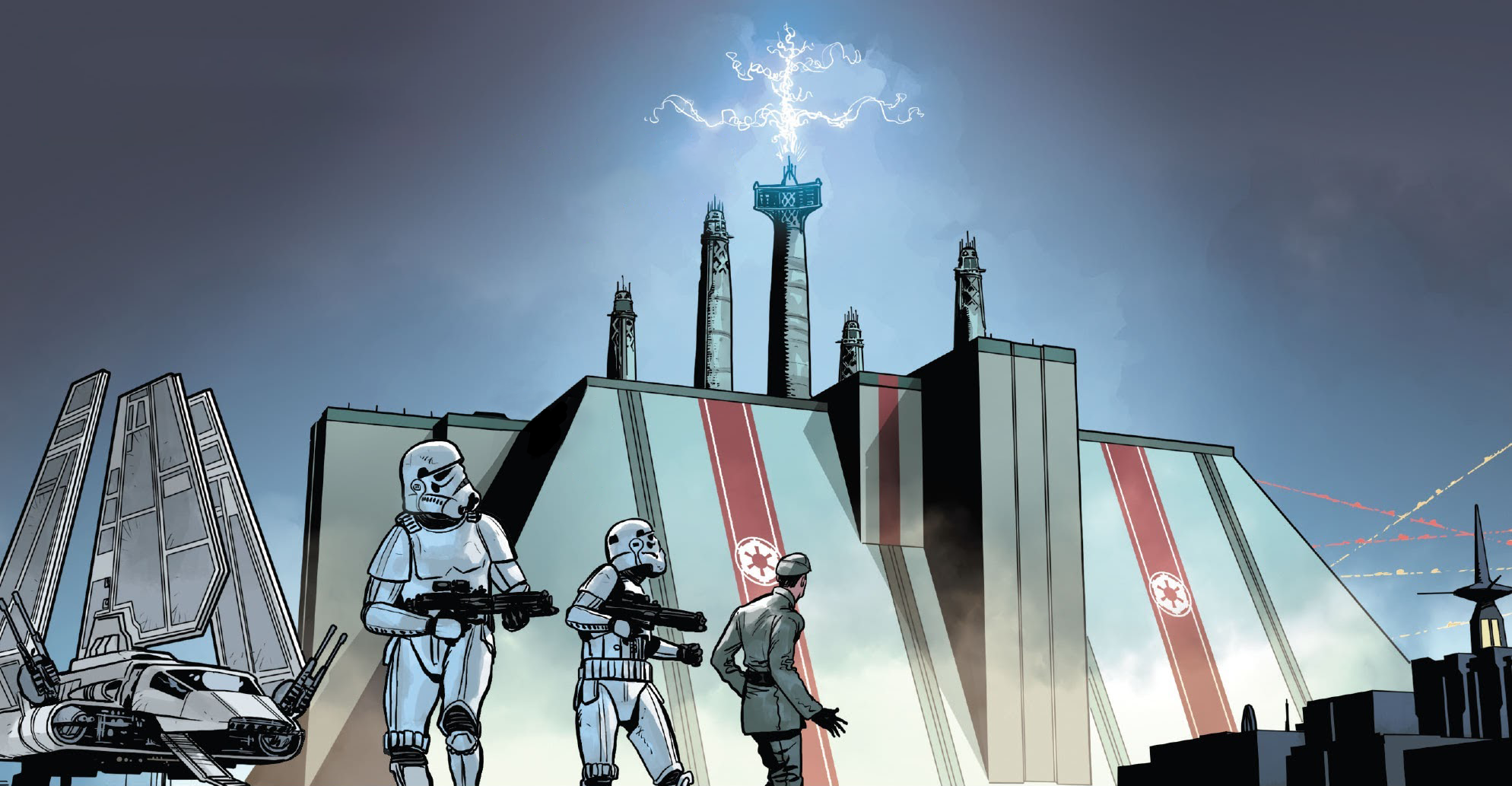
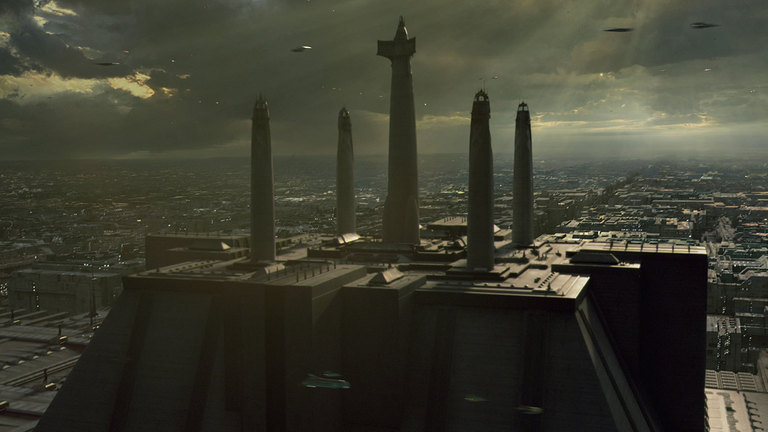
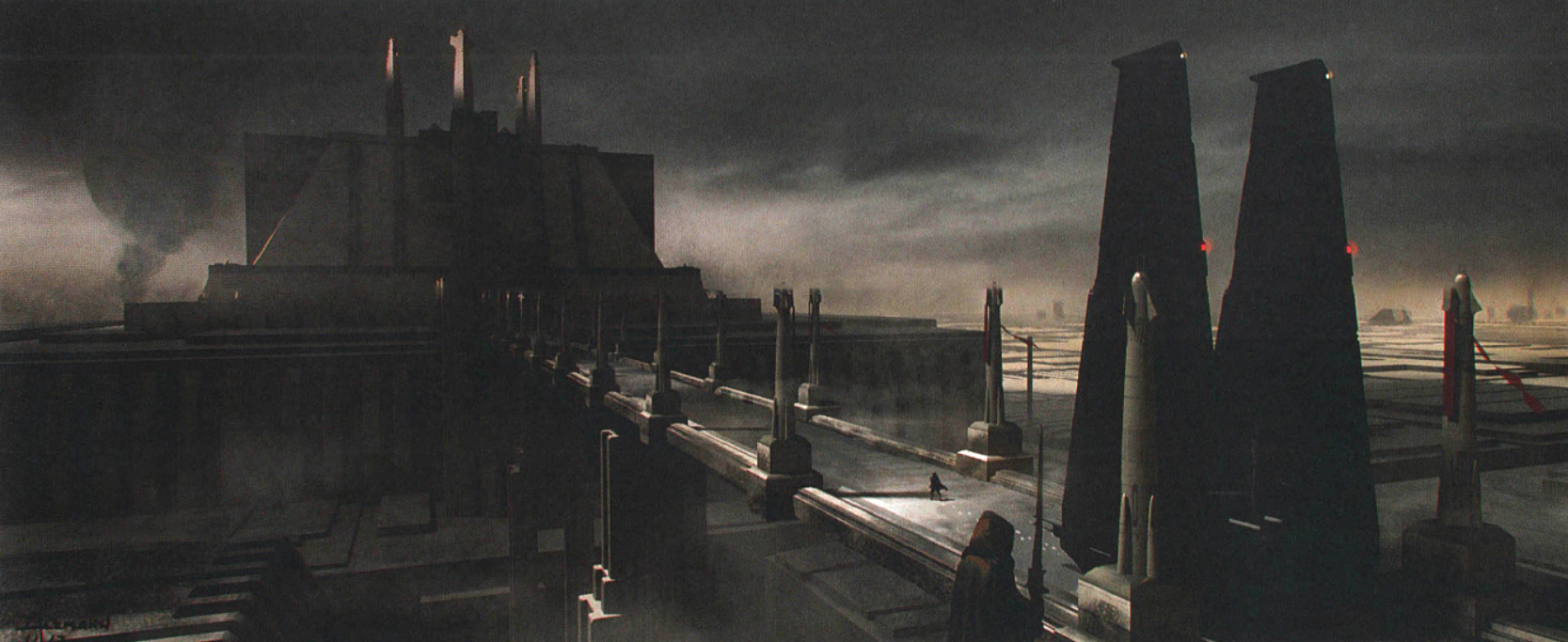
One year after the war's conclusion and the Jedi Order's downfall, the Galactic Empire transformed the ruined Jedi Temple into the Imperial Palace. This Palace served as the official residence for Darth Sidious, the Dark Lord of the Sith publicly known as Galactic Emperor Sheev Palpatine. The only remnants of the original temple were its five skyscraping spires, which crowned an assortment of blockish structures with sloping facades. The Temple Precinct, now the Palace Court, featured a courtyard landing field large enough to accommodate Star Destroyers of the Victory and Venator classes. This courtyard provided access to the Palace's interior through elaborate doors. Along with the Naval Intelligence headquarters and the COMPNOR arcology, the Imperial Palace formed the supreme triangle of Imperial City's Federal District, considered one of the grandest and most elegant structures on the entire planet.
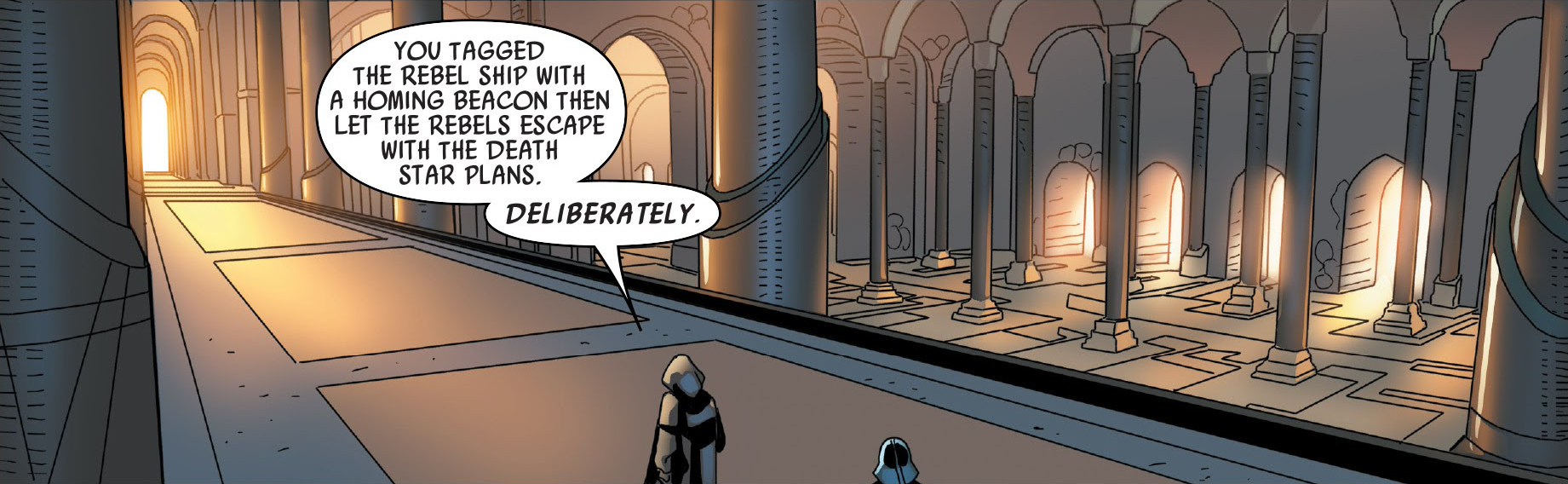
Inside the Palace, all remnants of the Order were removed, including ancient mosaics, tapestries, and paintings. The walls and plinths of the expansive corridors were devoid of statues and other art pieces, although some banquet chambers were draped with Imperial flags and banners. One of the Temple's vast pillared halls was converted into a ballroom, with ornately tiled and mirrored walls. Crystalline sculptures stood on pedestals, shifting shape from abstract forms into Imperial symbols during a ceremony honoring Imperial cadets.
The exterior of the Emperor's Residence also underwent significant changes from its time as the Jedi Temple. The five spires that made the Jedi Temple so iconic were the only recognizable features; the rest of the structure had expanded rapidly, sprawling across the area and filling it with blockish buildings.
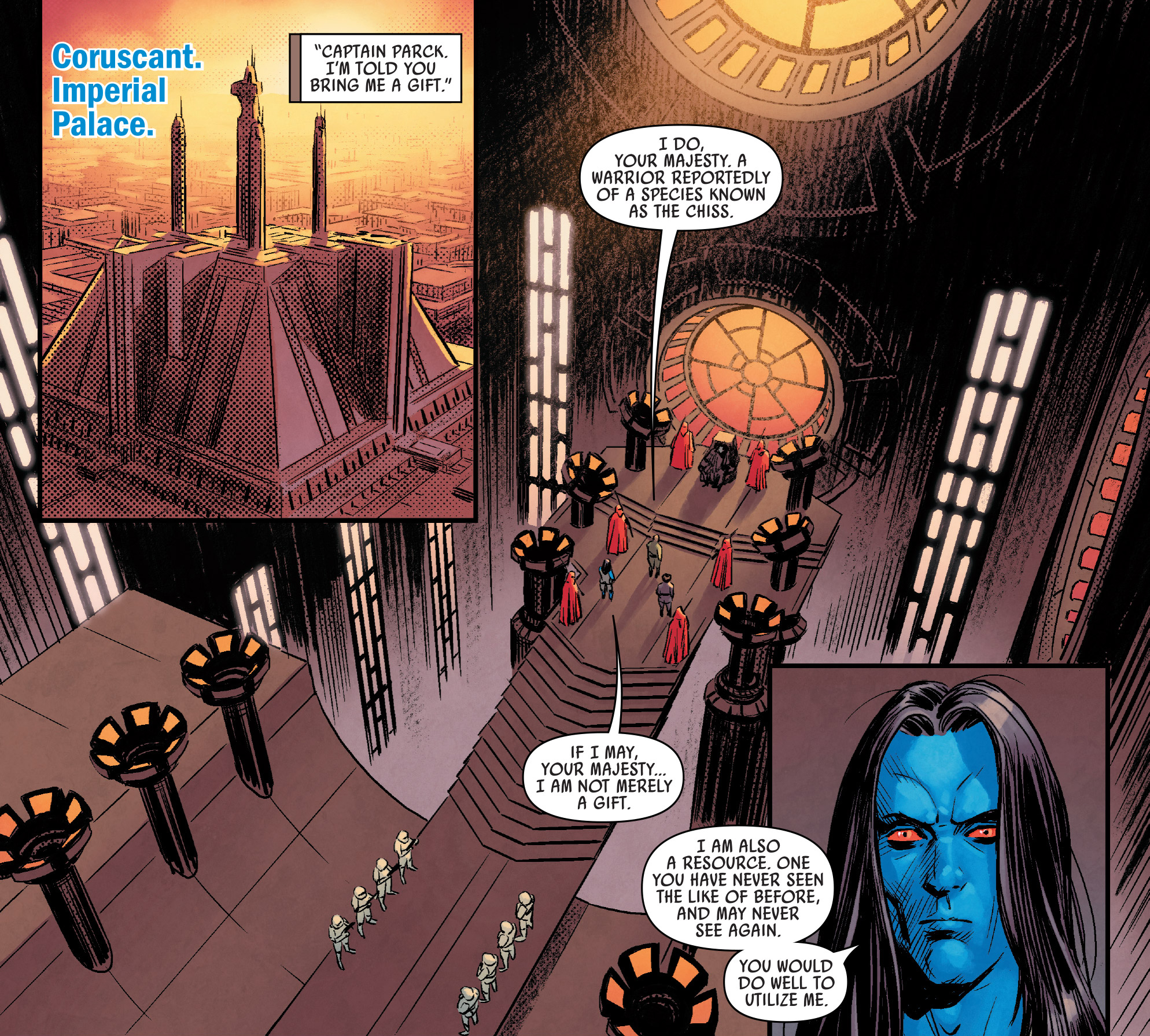
The Imperial Palace housed the Emperor's throne room. The Emperor's receiving room was a dimly lit chamber with large windows overlooking the Coruscant skyline. From within the Pinnacle Room of the central spire, the Emperor conducted his daily affairs, descending to the penultimate level, formerly the Hall of Knighthood, to his audience chamber. Although most of the Temple had been transformed to serve the Empire, the enormous holographic galactic maps within the four peripheral towers were maintained, allowing the Emperor to monitor problems within the Empire.
The vast halls of the Imperial Palace were filled with civilian workers and ambassadors from various species. Quarters within the Palace were reserved for Grand Vizier Mas Amedda. Amedda's chamber included access to a balcony and a laundry vacu-tube, with windows providing a view of Imperial City. Despite the Imperial Palace being designed as impregnable, the laundry tube was large enough for younglings to climb through.
Security
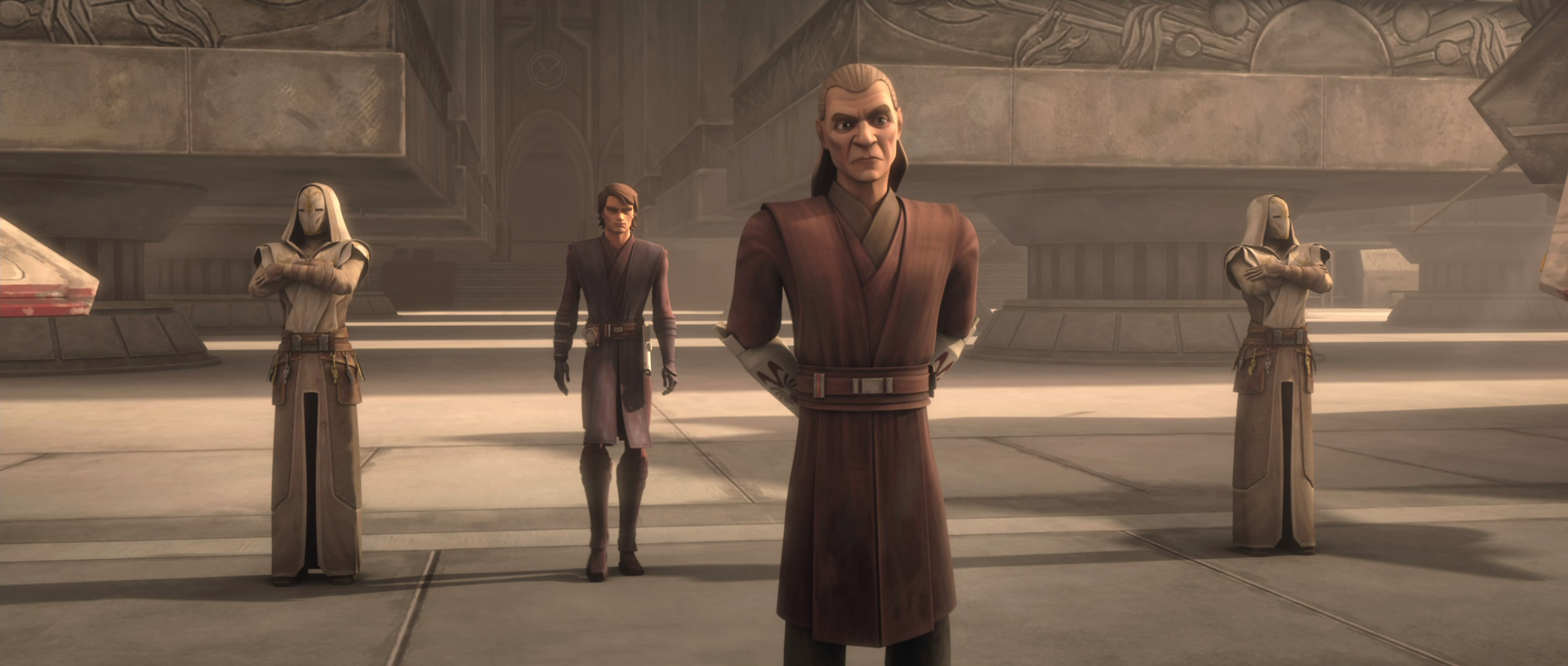
The Jedi Temple Guard protected the Jedi Grand Temple. Jedi Knights selected for the Temple Guard became anonymous sentinels, demonstrating their commitment to the Jedi Order. The role of the Temple Guard was considered a higher calling, requiring them to wear formal Jedi robes and face-concealing masks as the ultimate expression of emotional detachment. They were armed with distinctive lightsaber pikes featuring rare yellow plasma blades.
The Temple Guard had a command structure staffed by officers such as Captain Kolloma Ree, with the Chief of Security overseeing the overall organization. The Temple Guard was supplemented by clone troopers stationed in the Temple's hangars. The Coruscant Guard deployed clone shock troopers to assist the Temple Guard, providing additional security for the Temple during an anti-war protest.
After the Temple's fall, the Coruscant Guard and the Coruscant Security Force secured the surrounding area. The Emperor's Royal Guard assumed the duty of providing security in the Temple after it was repurposed as the Emperor's residence. In addition to the Royal Guards, stormtrooper units were stationed in the Imperial Palace.
History
The distant past
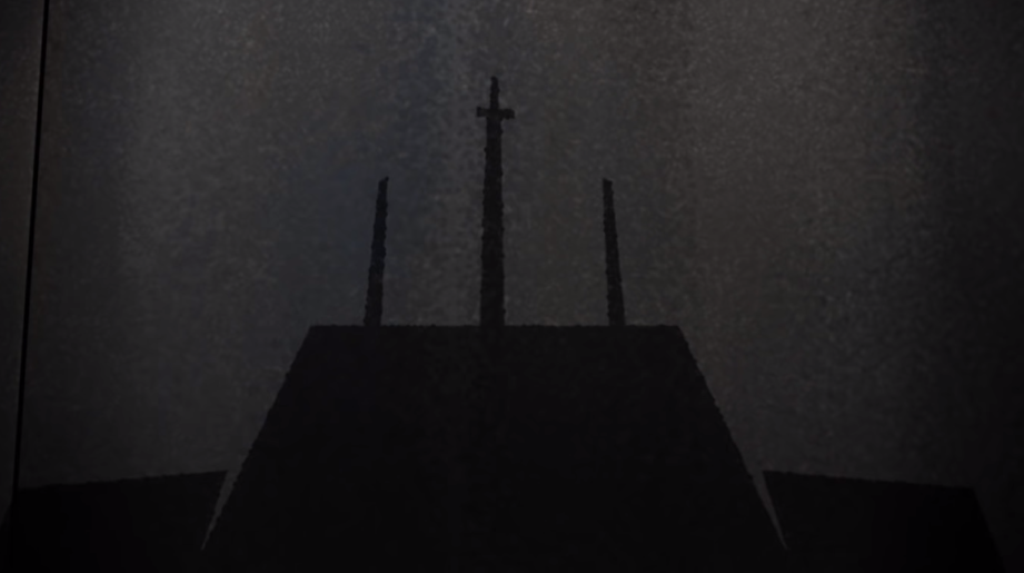
The location of the Jedi Grand Temple, and later the Imperial Palace, was considered sacred on planet Coruscant for many millennia by numerous Force-wielding traditions. These temples and shrines, constructed around and within a natural mountain spire, were rich in the Force, which permeated the site and imbued it with radiant energy. After the ancient Sith, the Jedi Order's enemies, gained control, they erected a shrine on the mountain from which they dominated Coruscant. When the Jedi reclaimed the mountain during a great war, they reduced the Sith facility to its foundations, removing all remnants of their fallen foe. Unbeknownst to the Jedi, a hidden portion of the shrine remained in the mountain's foundations, forgotten but still active. The Jedi built their own shrine over the Sith shrine's foundations. Over the following centuries, the Jedi Temple slowly took shape. The ruined foundations of the Sith shrine were steadily buried beneath layers of plasteel and ferrocrete as a massive, flat-topped ziggurat was constructed around them. The mountain's interior was hollowed out and filled with hundreds of chambers and grand halls connected by countless kilometers of broad corridors. Important Jedi artifacts were brought to the temple from across the galaxy, and records from the lost Great Jedi Library on Ossus were installed in the newly built Jedi Archives. In the center, directly above the site of the shrine, was built the Temple Spire, an incredibly tall and graceful tower. As the Order erected the Jedi Temple over the mountain, the shrine's malevolent energies continued to permeate the site, slowly clouding the Jedi's collective use of the Force with the power of the dark side.
Sometime after 1050 BBY, the Temple housed a Jedi artifact known as the Darksaber—a black-colored lightsaber constructed by Tarre Vizsla, the first Mandalorian inducted into the Jedi ranks. The Darksaber remained in the Order's possession until the fall of the Old Republic, when members of House Vizsla stole the weapon while sacking the Temple.
The Temple was rebuilt approximately two thousand years before the rise of the Empire; the salvaged remnants of the earlier Temple formed part of the ziggurat base. During the Jedi-Sith War, the Sith attacked Coruscant and took possession of both the planet and the Temple. Later in the war, the Jedi repelled the invaders during the liberation of Coruscant. The Temple still bore the scars of Sith occupation around a thousand years later, and its heroes were later honored in the stained-glass arcades and statues.
Time of the Republic
A false appearance of hope
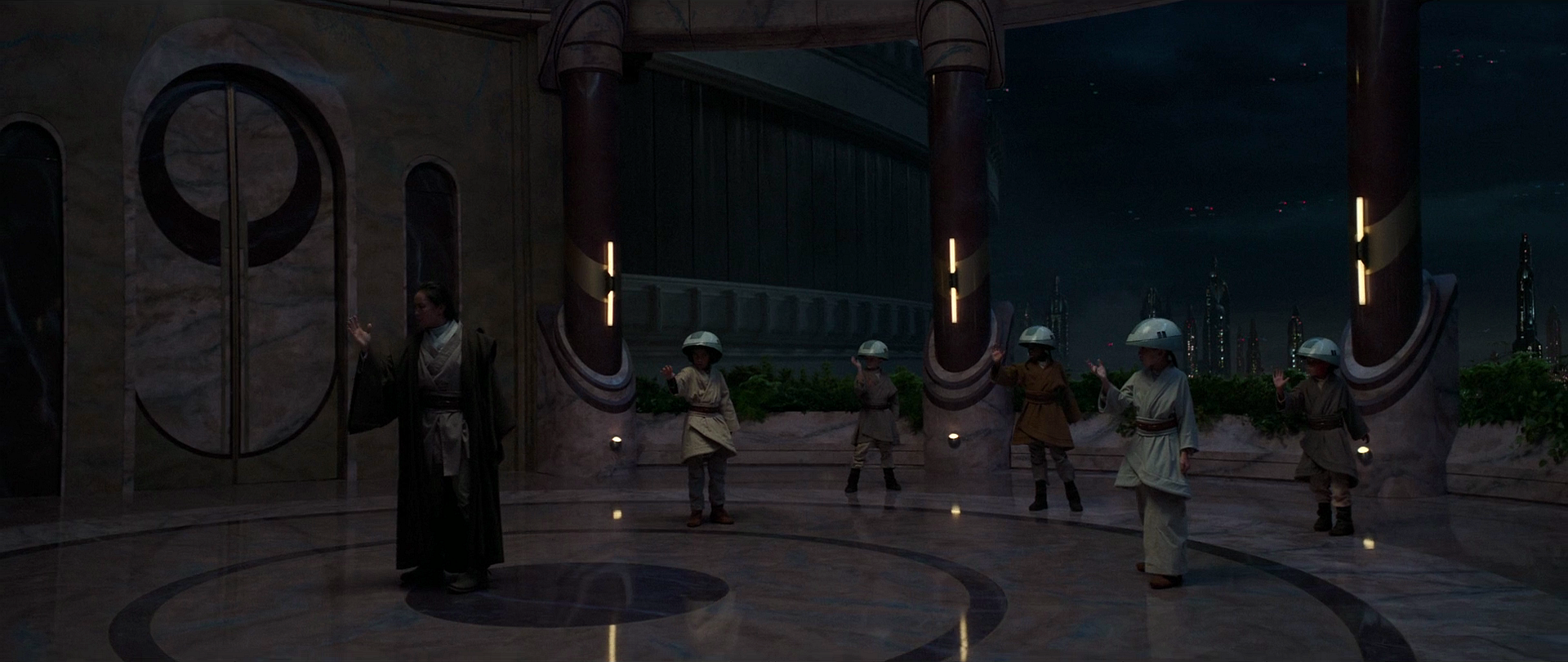
Spanning the thousand-year era of the modern Galactic Republic, the Jedi Temple underwent numerous reconstructions and expansions, ultimately evolving from a collection of interconnected ancient temples and shrines. Functioning as the central hub for the Jedi Order for centuries, the Temple was where the youngest initiates received their training in the Force and progressed to the rank of Jedi Knight. The Jedi flourished within its walls, mastering the Force, martial arts, diplomacy, and meditation, even as the Republic became increasingly corrupt. The Jedi High Council, the Order's governing body, convened in the High Council Tower, one of the four towers encircling the Temple Spire, alongside the Council of First Knowledge, the Council of Reconciliation, and the Council of Reassignment.
During the High Republic Era, the Jedi maintained a network of outposts across the Outer Rim as the Republic expanded its reach. In that period, while the Coruscant Temple remained the primary center for the Jedi, the Order established a presence on distant worlds through these numerous outposts, integrating themselves into local communities. Over time, however, a growing number of these outposts were deemed unnecessary and closed, reflecting the increasing centralization of the Jedi Order. With the Jedi becoming more closely aligned with the Republic and confined to Coruscant, the Temple came to represent the Order's true state: outwardly healthy, but increasingly detached from the galaxy's inhabitants.
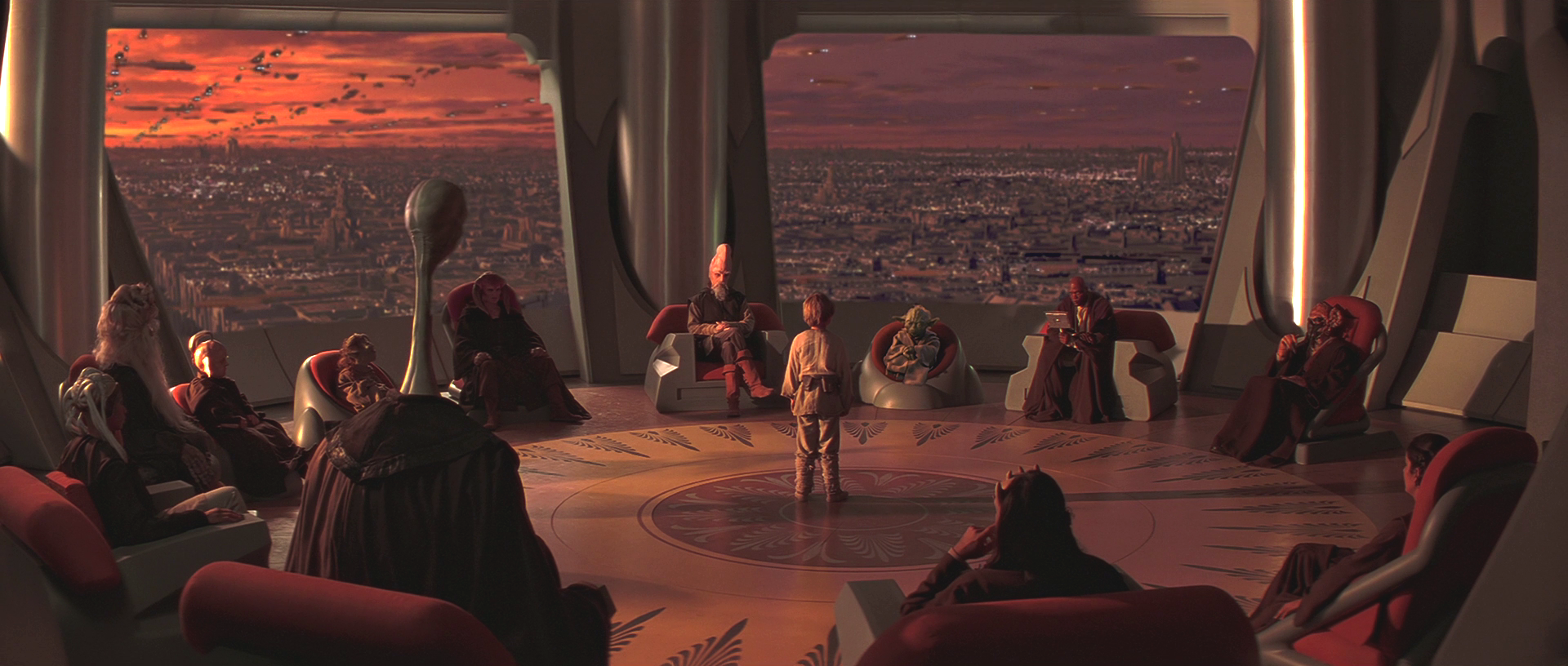
Jedi Master Qui-Gon Jinn questioned whether the Jedi's location on the Republic's capital had transformed them into instruments of the Republic. He recognized that this was how the Jedi appeared to the galaxy, and even worried that they themselves had adopted this view. However, Grand Master Yoda cautioned him that the Council would not share his concerns. In 33 BBY, Jinn challenged the Council on Coruscant regarding the Order's growing isolation, prompting Master Mace Windu to suggest a Council-wide journey to the planet Kwenn as a gesture of goodwill. During the Invasion of Naboo, Jinn brought Anakin Skywalker to the Jedi Temple, convinced that the former slave from Tatooine was the Chosen One foretold in Jedi prophecy. Jinn's intention was to have Skywalker trained in the Jedi arts, but despite Skywalker's exceptional midi-chlorian count, which indicated a natural affinity for the Force, the High Council initially refused to authorize his training. Following Jinn's death in the Battle of Naboo, the High Council reversed its decision, granting the newly appointed Jedi Knight Obi-Wan Kenobi's request to take Skywalker as his Padawan.
Fall of the Republic period
After a millennium of unbroken peace and prosperity, the Jedi Order was once again embroiled in conflict with the Sith during the Clone Wars. The Jedi assumed the role of generals within the Grand Army of the Republic. The Temple served as the central coordination point for the Jedi's involvement in the war, with classrooms being repurposed as military briefing rooms.
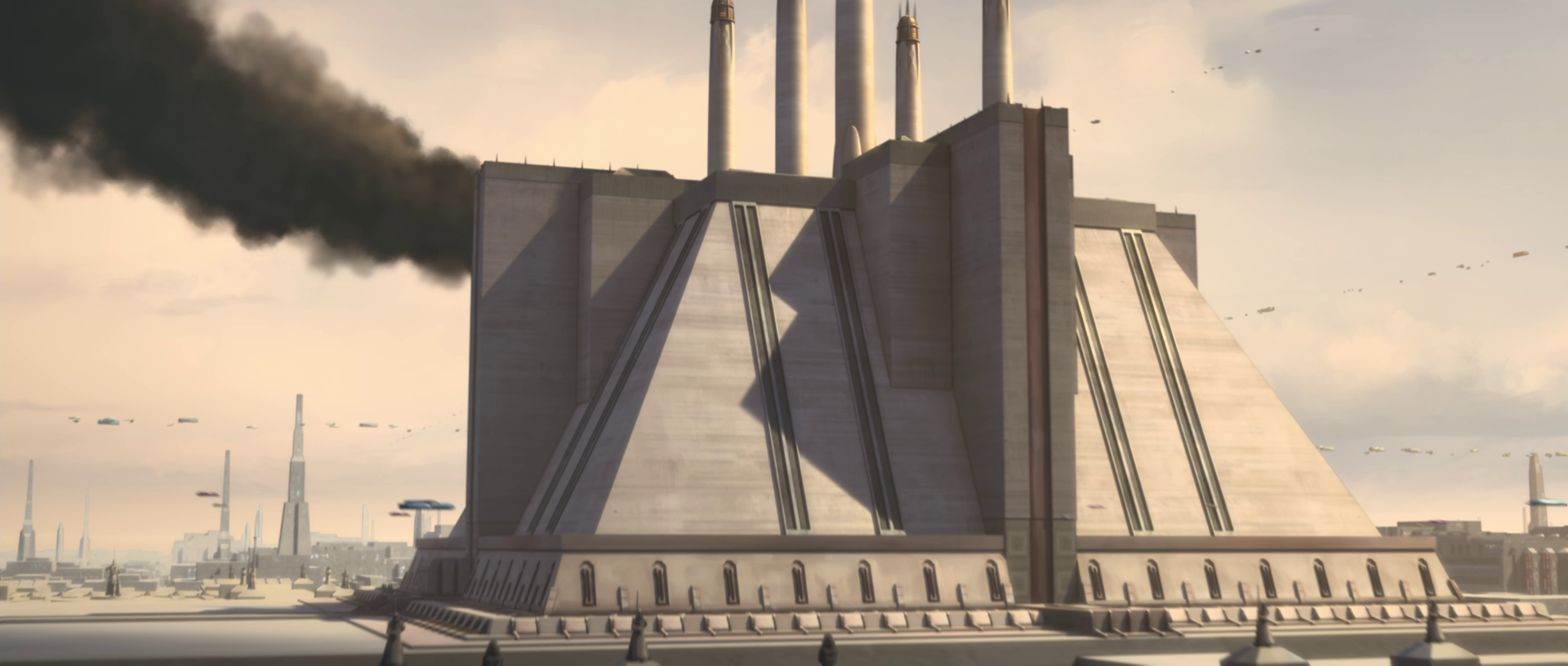
As public opinion turned against the war, protests erupted on the Temple's front steps, and one of its hangars was targeted in a bombing by Padawan Barriss Offee, who believed the Jedi had become obsessed with violence. Her actions led to the deaths of civilians, clone troopers, and several Jedi who were caught in the blast. Although the attack occurred on Jedi grounds, and the Jedi initially considered it an internal matter, the Republic government asserted its jurisdiction due to the deaths of clones and Republic citizens.
The bombing of the Temple intensified anti-war sentiment among the Republic's citizens. A crowd of civilians gathered along the Processional Way, protesting against the Jedi, the Republic Military, and the Clone Wars. The presence of these demonstrators prompted the Order to enhance its security measures, stationing Temple Guards at the Temple's entrance. The Coruscant Guard dispatched a unit of clone shock troopers, equipped as clone riot troopers, to support the Temple Guard.
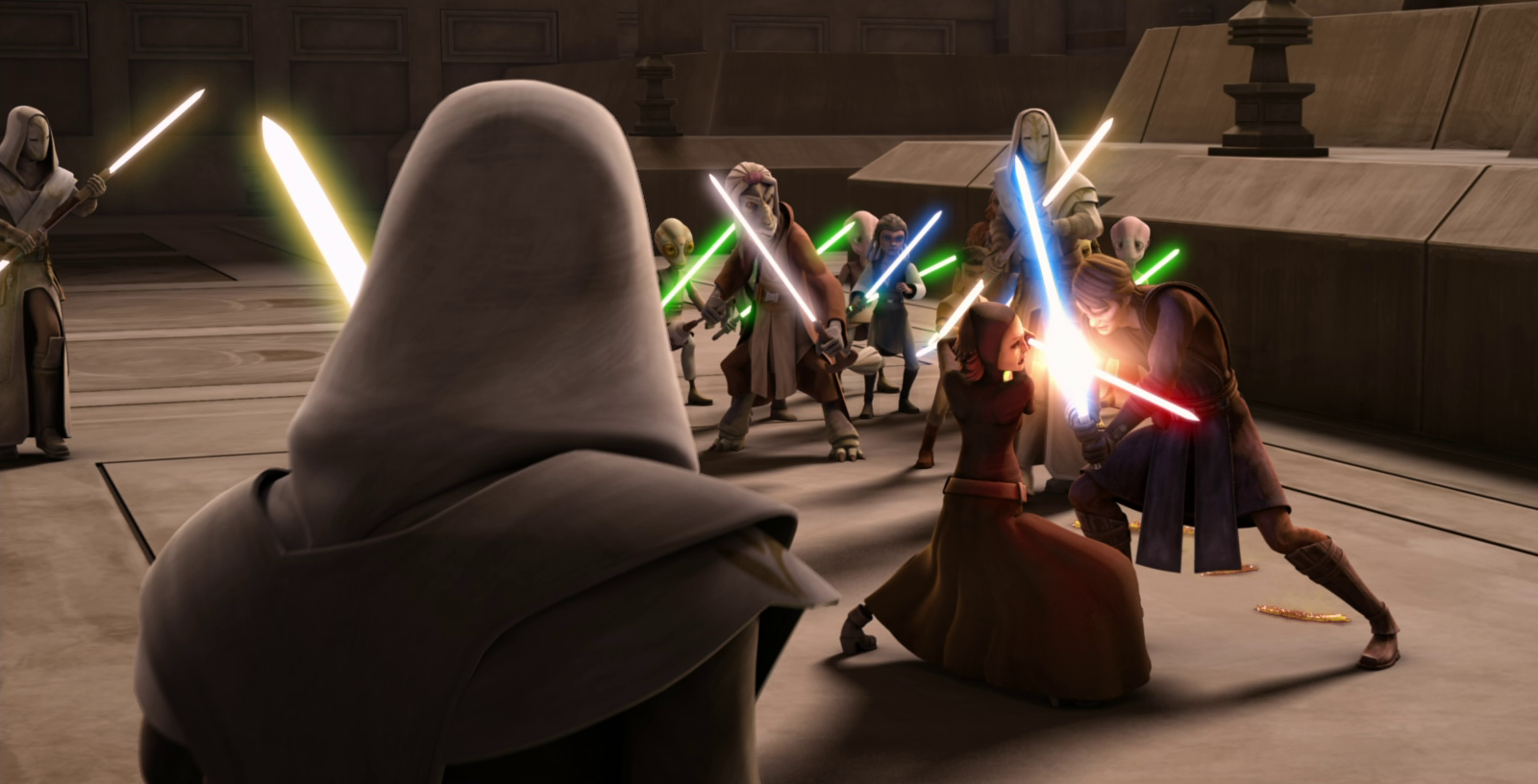
Jedi Knight Anakin Skywalker uncovered Offee's involvement in the bombing, leading to a confrontation with the fallen Padawan within the Temple. Temple Guards converged on their location, demanding that the two Jedi cease their hostilities within the sacred halls of the Temple. Despite this, their duel spilled over into the Temple's training grounds, where Jedi Master Tera Sinube was instructing a class of younglings. The Temple Guards surrounded the area to protect the students and prevent Offee from escaping. Skywalker ultimately subdued Offee, and with the assistance of the Temple Guards, she was arrested as a traitor to both the Jedi Order and the Galactic Republic.
Late in the Clone Wars, Grand Master Yoda experienced a Force vision of the Jedi Temple while exploring the Wellspring of Life. In this vision, he saw the Temple as it was before the galactic conflict. An apparition of the youngling Katooni commented on the Temple's beauty. Haunted by an earlier vision of a massacre within the Temple, Yoda briefly allowed himself to be captivated by the Temple's serenity and splendor before the vision ended.
Age of the Empire
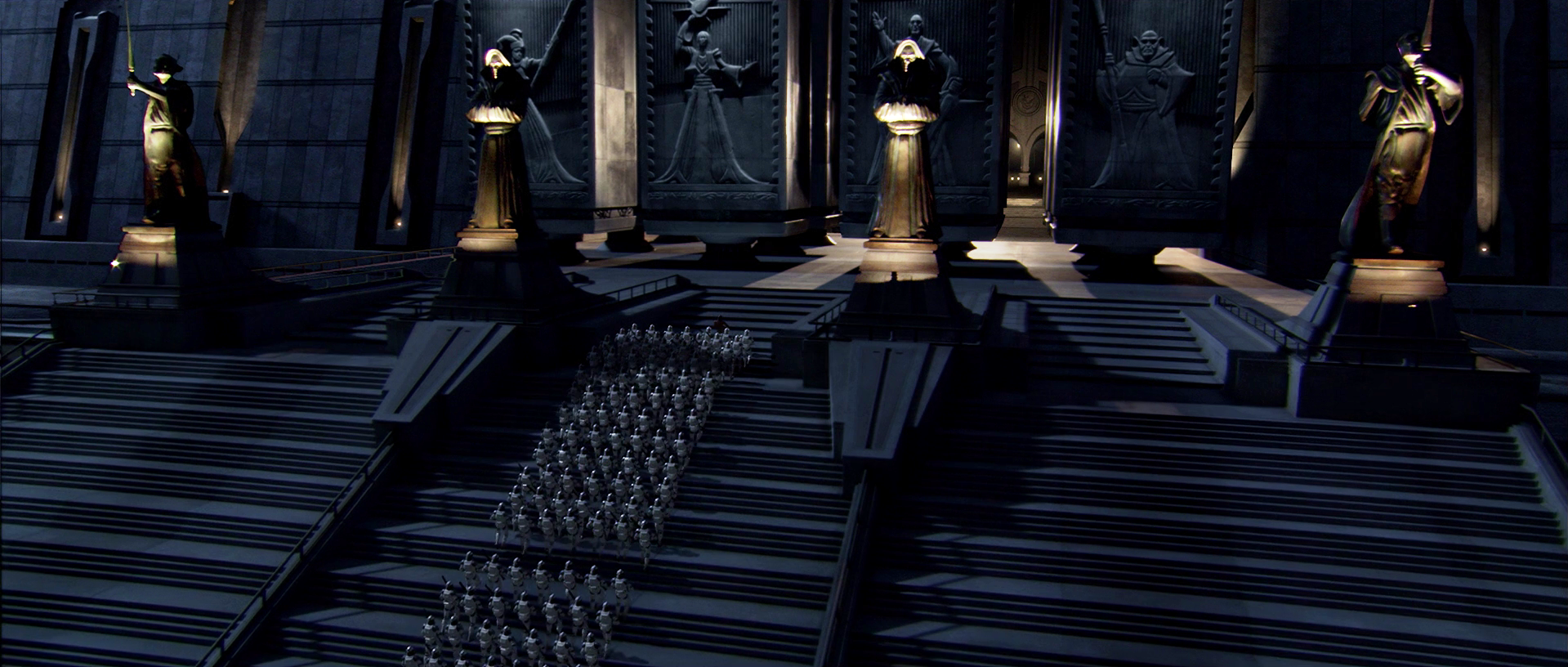
As the Clone Wars drew to a close, the Grand Army of the Republic initiated Order 66 under the command of Supreme Chancellor Sheev Palpatine—the public face of the Sith Lord Darth Sidious—who accused the Jedi Order of betraying the Galactic Republic. A group of Jedi Masters, led by Mace Windu, had attempted to arrest Palpatine after discovering his Sith identity, but their efforts were thwarted by Anakin Skywalker, who allowed Sidious to kill Windu. With the Chosen One now his Sith apprentice, Sidious dispatched the newly christened Darth Vader to the Jedi Temple with orders to eliminate all within, while the remaining Jedi across the galaxy were betrayed and executed by their own soldiers.
Operation: Knightfall began with the elite 501st Legion marching on the Temple under Vader's command. The attack caught the Jedi completely off guard. Younglings, including Reva Sevander, were in the midst of a training session when the 501st stormed their classroom, opening fire on the students. Jedi Master Minas Velti defended Sevander and the other younglings, killing several clones before being fatally shot. Her students attempted to flee, but were intercepted by a column of troopers led by Vader, whom they recognized as Anakin Skywalker. Instead of helping the younglings, as they expected, the former Jedi Knight used his lightsaber to cut them down, killing all but Sevander, who was wounded but survived.
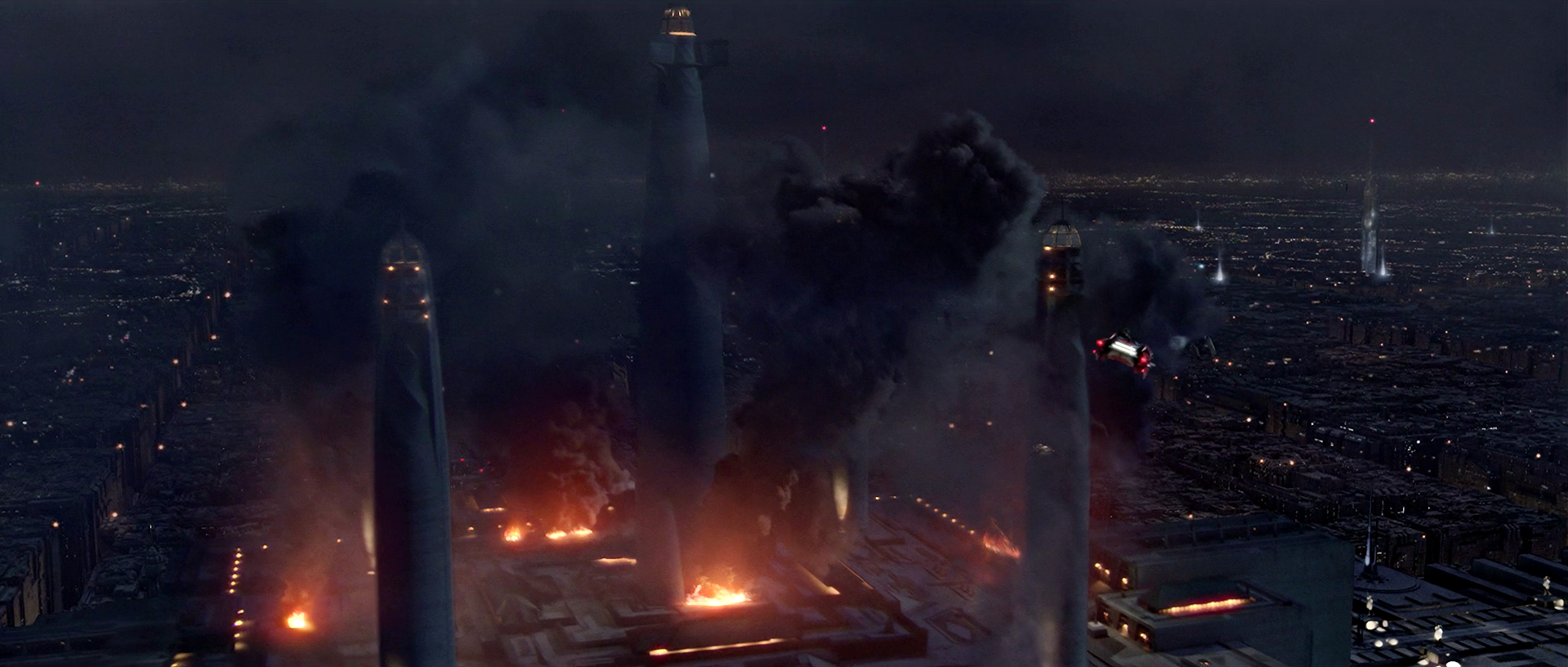
The Temple was set ablaze as the battle raged within its walls. Exploiting their numerical advantage, the clones surrounded and overwhelmed individual Jedi, gunning them down. Others, such as the Battlemaster Cin Drallig and the Padawans Bene and Whie Malreaux, were personally slain by Vader. A group of younglings sought refuge in the Jedi Council Chamber, where Vader discovered them hiding behind the High Council's seats. Like Sevander's group, the younglings were unaware of Skywalker's allegiance to the Sith. One of the younglings approached Vader, calling him by his former name and looking to him for guidance. Having succumbed to the dark side, the former Jedi ignited his lightsaber and murdered the children who had looked to him for help.
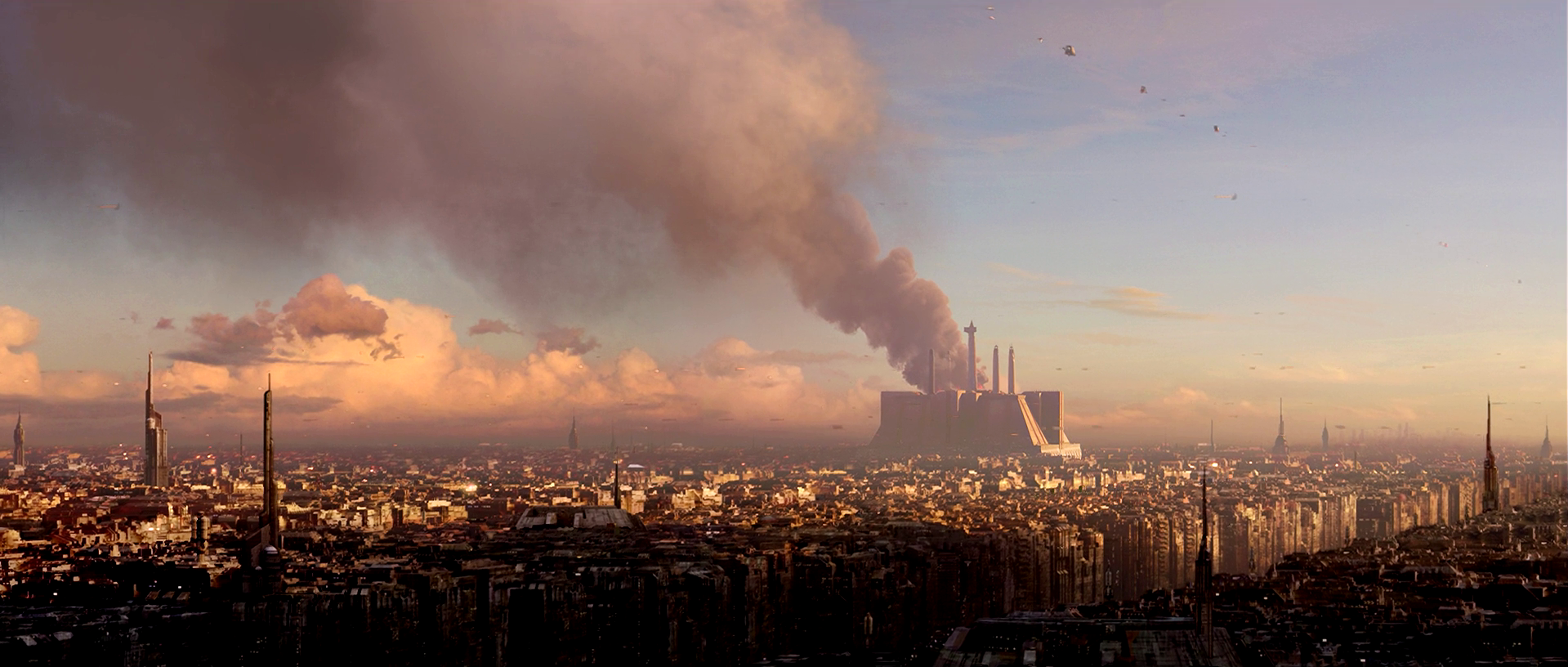
With the Jedi Temple in ruins and the Jedi Order nearly annihilated, Palpatine was declared Emperor of the newly formed Galactic Empire. While the Galactic Senate was in session, Jedi Masters Yoda and Obi-Wan Kenobi returned to Coruscant. After eliminating a contingent of the 501st Legion guarding the Temple's entrance, they discovered the massacre of their fellow Jedi. As Kenobi mourned the deaths of the younglings, Yoda observed that not all of the Jedi had been killed by clones, noting that one of the Padawans had been slain by a lightsaber. After recalibrating the signal beacon to warn any surviving Jedi against returning to the Temple, Kenobi accessed the facility's surveillance system and learned that his former apprentice had not only murdered younglings but had also pledged his loyalty to the Sith as Darth Vader.
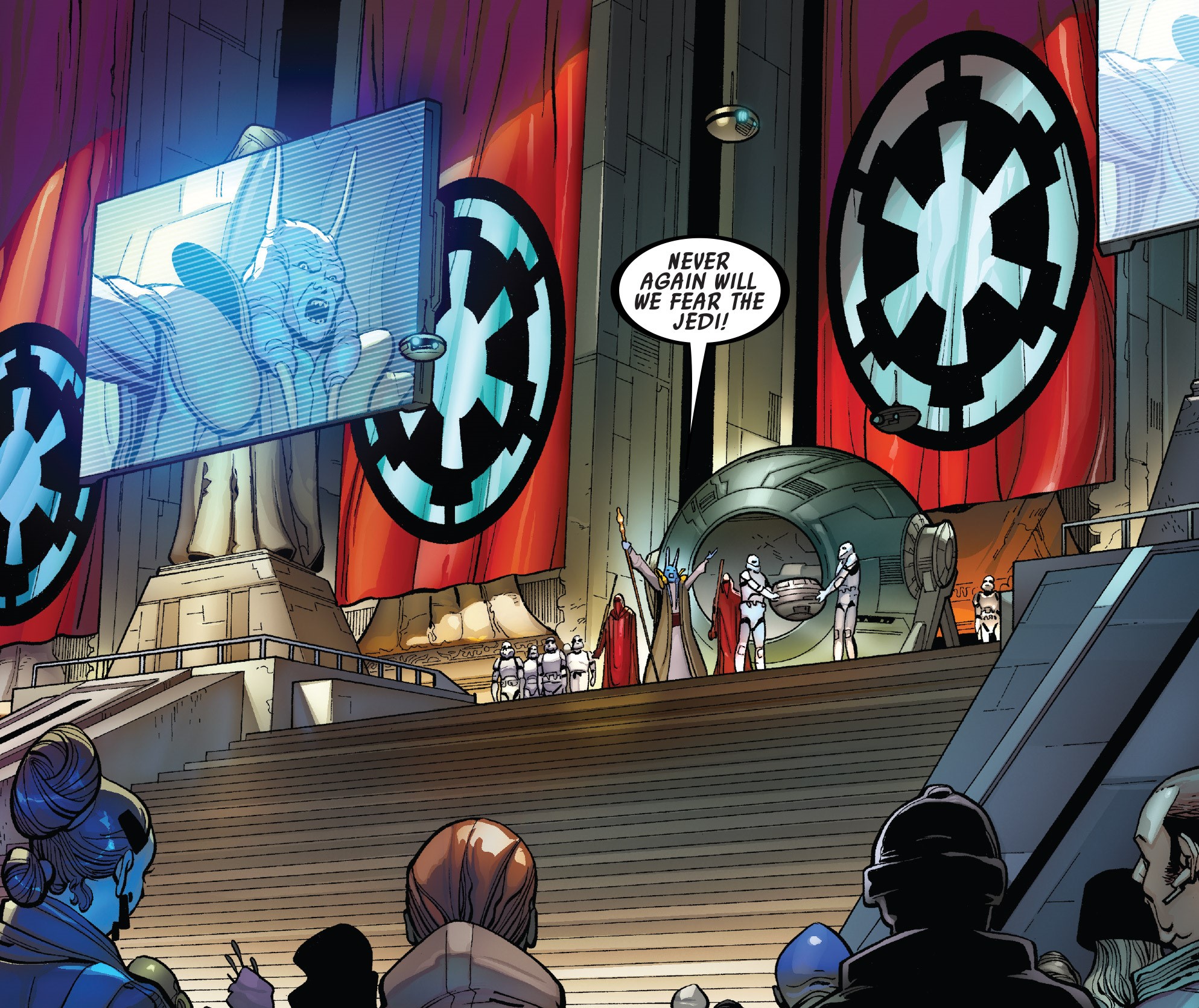
In the wake of the Temple's desecration, the lightsabers of deceased Jedi were burned on its steps during a grand celebration hosted by Grand Vizier Mas Amedda. The Grand Inquisitor entered the former Jedi Temple, granted access to the Jedi Archives by Sidious, a privilege he had been denied as a Temple Guard. However, he was confronted by Darth Vader, who had recently returned from his mission on Al'doleem. Vader damaged the Inquisitor's lightsaber and prepared to strike him down, but Sidious intervened, revealing the existence of the Inquisitorius to Vader. Vader later tasked the Grand Inquisitor with searching the Archives for clues to the location of surviving Jedi.
Jocasta Nu, the Jedi Archives' Chief Librarian, returned to Coruscant in hopes of retrieving a holocron containing a list of Force-sensitive younglings. She infiltrated the Temple through a secret entrance and succeeded in obtaining the holocron, but felt compelled to confront the Grand Inquisitor when she witnessed him desecrating the Jedi Archives. Darth Vader personally led the hunt for Jocasta Nu, ordering Clone Commander CC-1010 to lock down the Temple with the Coruscant Guard and the Coruscant Security Force. Although the Inquisitor defeated Nu, Vader prevented him from killing her, as his master wished to capture her for her knowledge. Nu deleted the Archives' contents and fended off Vader with a lightsaber rifle. The Dark Lord attempted to pursue Nu as she fled the Temple, but was fired upon by Imperial shock troopers who mistook him for a Jedi. Vader killed CC-1010 for this error and ordered his troops to cease firing on Nu on the Temple battlements, taking her into custody before executing her.
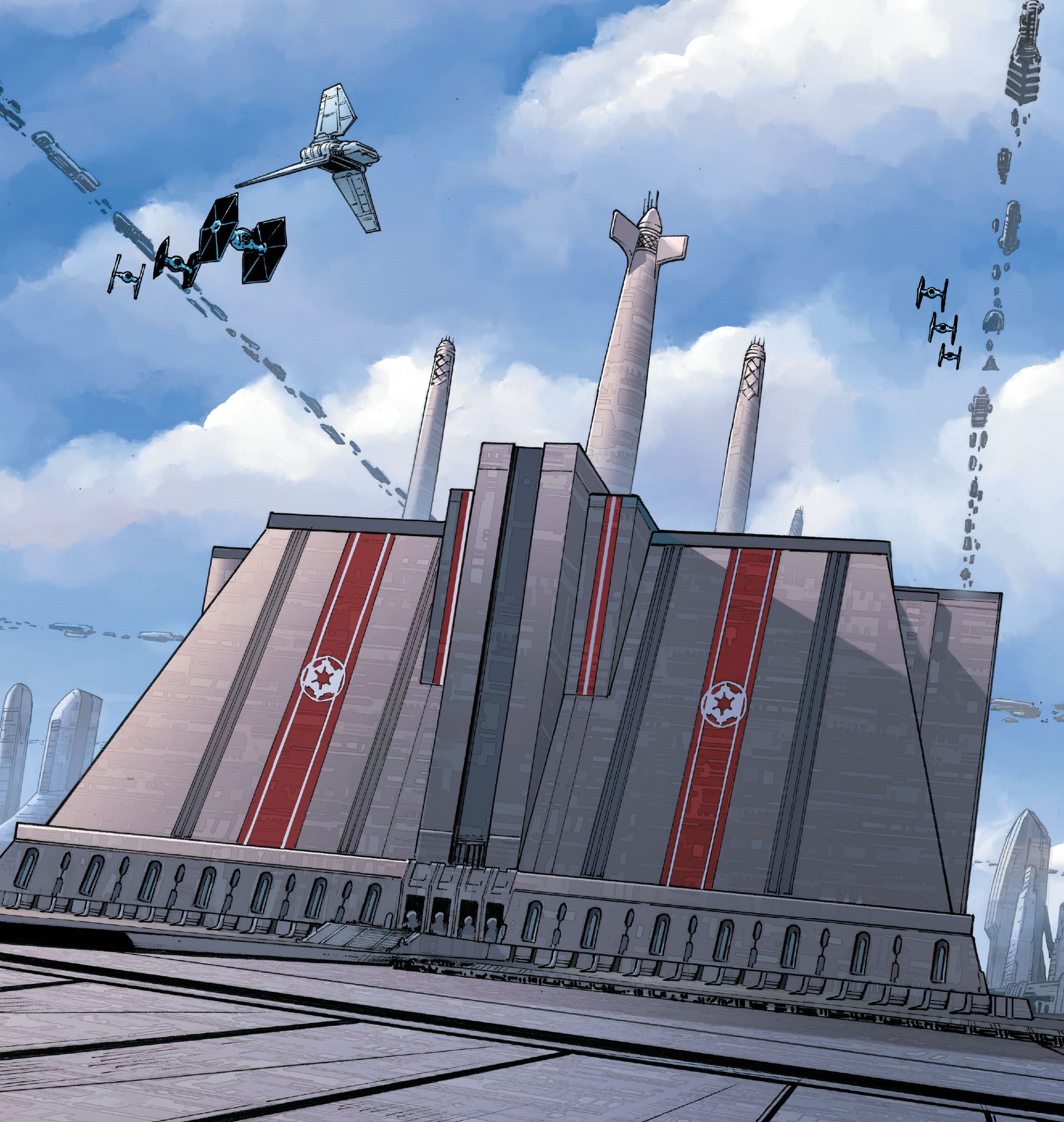
Following the destruction of the Jedi Order, the Jedi Temple was transformed into the Imperial Palace under the direction of Colonel [Alva Brenne]. Imperial agents scoured the Temple, removing all traces of its former occupants. The numerous statues, paintings, and tapestries that chronicled the Jedi's history were destroyed and replaced with statues of the Emperor and art celebrating the glory of the new Empire. The Emperor relocated his collection of dark side artifacts from the Grand Republic Medical Facility to their new home in the Imperial Palace, making it his primary residence. He delegated the day-to-day governance of the Empire to his advisers, while he occupied the old Tranquility Spire, which towered above the palace, and held court in the Pinnacle Room.
While the former Jedi Kanan Jarrus mused that nothing of the Temple remained, the Imperial Palace stood until after Darth Sidious' death during the Battle of Endor.
New Republic Era
Grand Vizier Mas Amedda was confined to his quarters within the Imperial Palace on the orders of Counselor to the Empire Gallius Rax. Although Rax publicly recognized Amedda as the Empire's rightful leader, he had effectively seized control of the Empire. The Imperial Security Bureau on Coruscant secured the Imperial Palace, but they reported to Rax rather than Amedda. Isolated by the ISB, the Grand Vizier was placed under house arrest in his own quarters. He initially attempted to escape, disregarding the Counselor's warning that his soldiers would resort to violence. As a result, one of the guards broke Amedda's leg.
Confined and unable to leave his quarters, Amedda spent months in isolation, save for the ISB agents who routinely forced him, at blaster point, to broadcast speeches praising the Empire and Rax's leadership. As time wore on, he became increasingly disillusioned with the Empire, now viewing it as a failed state. Although the doors to his balcony were sealed to prevent a suicide attempt, Amedda could see through his windows that Coruscant was in a state of chaos and began to suspect that the Empire had lost control of its own capital.
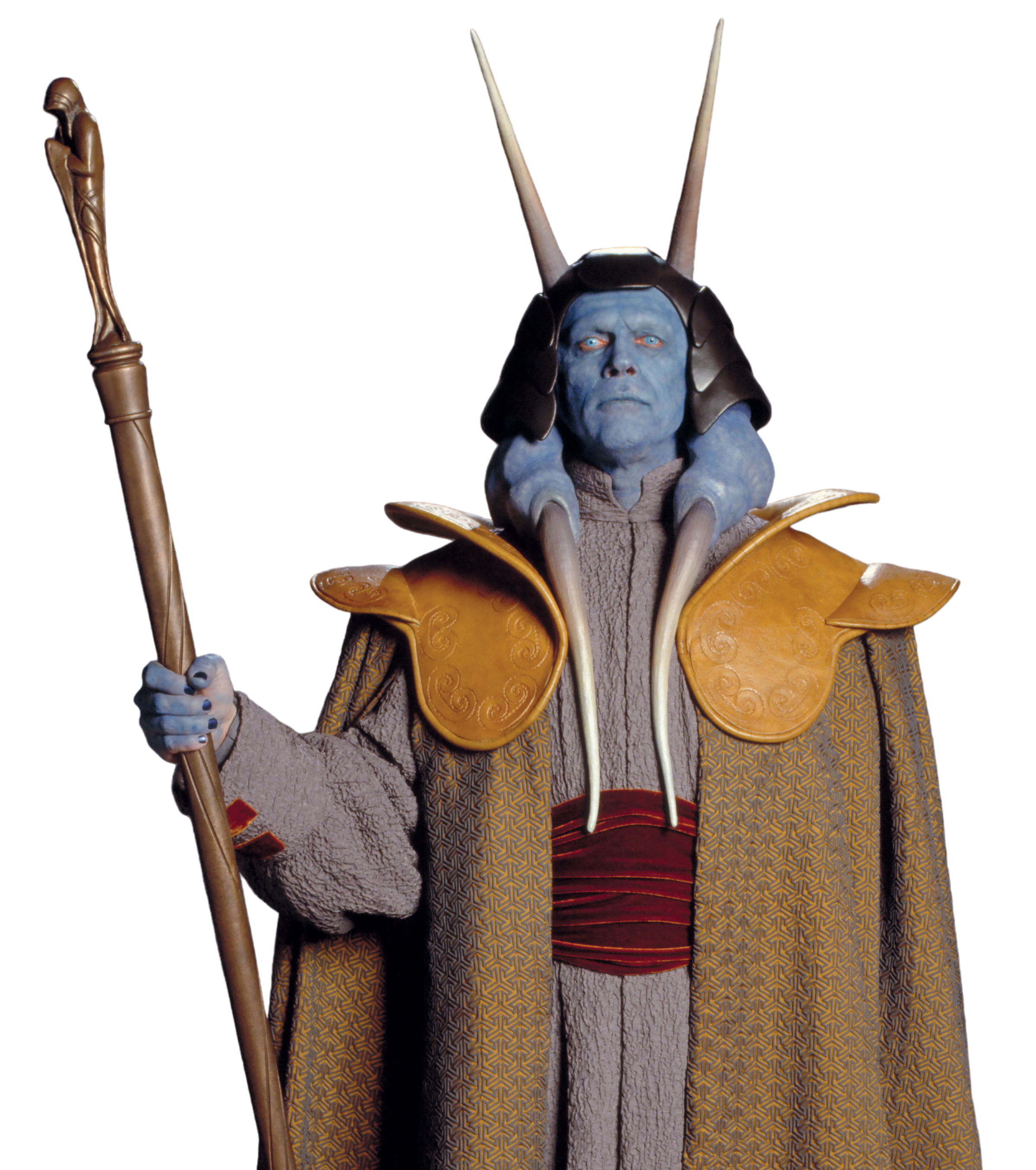
By the end of his confinement, Amedda's quarters were filthy, and the laundry tube had stopped working. Unbeknownst to Amedda, a group of rebellious adolescents—the Anklebiter Brigade—damaged the vacu-tube to gain access to Amedda's room. Their initial plan was to assassinate the Grand Vizier, but his disheveled appearance, misery, and desperation gave them pause. Amedda pleaded with the adolescents to help him escape, offering to use his executive codes to a turbolift if they overpowered the few sentries guarding his quarters. He also assured them that, with their assistance, he would use his authority to surrender the Empire and end the war with the New Republic.
The Anklebiter youths agreed to his request and smuggled Amedda out of the Imperial Palace. He reappeared after Rax was killed in the Battle of Jakku, which allowed him to sign the Imperial Instruments of Surrender and the Galactic Concordance, bringing an end to the civil war. After the war, Amedda publicly acknowledged the Coruscanti adolescents who had freed him from the Palace.
Behind the scenes
The Imperial Palace, along with Coruscant, made appearances in the Rough Draft and Revised Rough Draft of the script for Return of the Jedi. In these early drafts, The Emperor's throne room was located in a subterranean chamber within the Palace, and Coruscant was referred to as Had Abbadon. However, in the second draft of the script for Return of the Jedi, Had Abbadon was removed, and the throne room was relocated to the 2nd Death Star.
The Jedi Temple was first seen in the 1999 movie Star Wars: Episode I The Phantom Menace. In 2004, the Jedi Temple was incorporated into the conclusion of Star Wars: Episode VI Return of the Jedi during the final montage of planets celebrating the Emperor's demise. Subsequently, the Temple was featured in several episodes of Star Wars: The Clone Wars, which aired from 2008 to 2013.
The concept of transforming Coruscant's Jedi Temple into Darth Sidious' Imperial Palace originated in Chris Warner's 2002 Star Wars Infinities story, Star Wars Infinities: A New Hope, which presented an alternate version of the original Star Wars film, Star Wars: Episode IV A New Hope. The novel Tarkin by James Luceno, published in 2014, officially established this idea as canon, revealing that the Jedi Temple had been converted into the Imperial Palace.
Early concept art for the 2019 film Star Wars: Episode IX The Rise of Skywalker, based on an initial draft by J.J. Abrams and Chris Terrio, depicted Coruscant's Jedi Temple. These images showed Kylo Ren confronting ferocious space wolves on the Temple's steps, now long abandoned along with Coruscant itself.
Continuity issues
The book The Rebellion Begins by Michael Kogge portrays Kanan Jarrus recalling the destruction of the Jedi Temple. According to Jarrus, nothing remained of the Jedi Temple when Coruscant became Imperial City. However, Tarkin states that the Jedi Temple was converted into the Imperial Palace. The Special Edition of Return of the Jedi shows the Imperial Palace intact.
When questioned about whether Jarrus was referring to the Temple's transformation into the Imperial Palace or if it was a continuity error, Lucasfilm Story Group's Matt Martin stated that Jarrus was referring to Anakin Skywalker's attack on the Temple during Revenge of the Sith. Martin later conceded that he believed it was a continuity error, as he had not yet joined the Story Group when the book was published and was therefore unaware of the text's intended meaning.
The Freemaker Adventures

The Imperial Palace serves as a plot element in Bill Motz and Bob Roth's non-Canon 2016–2017 animated television series LEGO Star Wars: The Freemaker Adventures. As in the Canon continuity, the Imperial Palace is portrayed as the former Jedi Temple and functions as the headquarters of Emperor Palpatine and Darth Vader. During the first season, the Imperial Palace sustains damage during an attack by the renegade Sith Naare. During the second season, the Emperor and Lord Vader interrogate Rowan Freemaker about the location of the kyber crystal planet shortly before the Battle of Endor. The palace's top pinnacle is later damaged during a skirmish between the Freemakers and the Imperial hunter droid M-OC, causing debris to fall onto the palace's battlements.